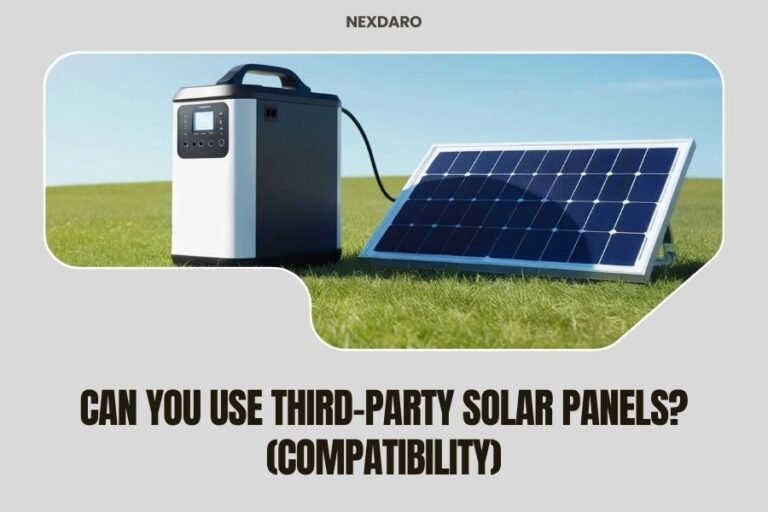
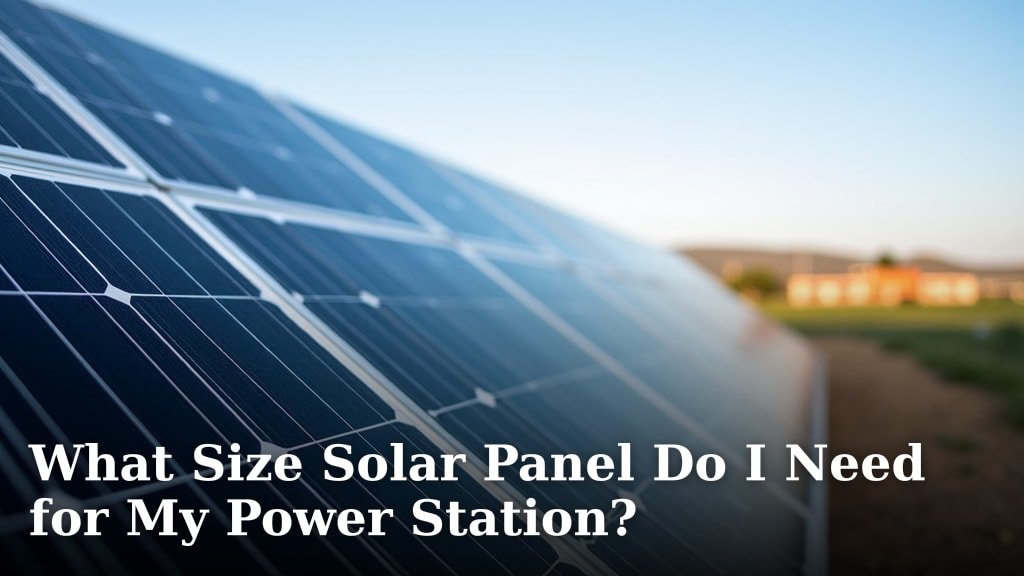
Determining what size solar panel you need for your power station means first figuring out your power needs and daily energy consumption. Most portable power stations pair well with solar panels ranging from 100W to 200W for efficient charging.
Choosing the right size ensures your power station recharges effectively, especially when you’re off-grid. We found that matching panel wattage to your station’s input capacity prevents slow charging or wasted solar potential. Consider factors like sunlight availability and how quickly you need to recharge.
TL;DR
- Calculate your total power needs first.
- Match solar panel wattage to your power station’s input.
- 100W-200W panels are often ideal for portable stations.
- Factor in sunlight conditions for optimal charging.
- Don’t oversize or undersize your panel significantly.
Let’s walk through exactly how to calculate your power needs and choose the perfect solar panel for your setup.
Choosing the Right Solar Panel for Your Power Station
Matching a solar panel to your power station doesn’t have to be complicated. We’ll guide you through the process, ensuring you pick the perfect panel for your needs. It all starts with understanding your current energy use.
Understanding Your Power Needs: How Much Energy Do You Use?
Before you can pick a solar panel, you need to know how much power your devices consume. Think about what you plan to charge. Are we talking about a smartphone, a laptop, or perhaps a mini-fridge?
List Your Devices and Their Wattage
Grab a pen and paper, or open a spreadsheet. List every device you want to power with your station. Then, find the wattage (W) for each device. You can usually find this on the device itself, its power adapter, or in the user manual.
- Smartphone: typically 5-10W
- Laptop: 40-75W
- Portable fan: 10-20W
- Mini-fridge: 40-60W (when running)
- LED light string: 5-15W
Don’t forget devices that draw power even when not actively used, like charging a drone battery.
Calculate Daily Watt-Hours (Wh)
Now, estimate how long you’ll use each device per day. Multiply the device’s wattage by the hours of use. This gives you its daily watt-hours (Wh). For example, a 60W laptop used for 3 hours equals 180Wh.
Add up the Wh for all your devices. This total is your estimated daily energy consumption. Let’s say your total is 500Wh. That’s a good target for your power station to provide.
Matching Your Solar Panel to Your Power Station
Your power station has a specific input capacity. This is the maximum power it can accept from a solar panel. You need to know this number to avoid problems.
Check Your Power Station’s Input Specifications
Look at your power station’s user manual or the specifications sticker. You’re looking for “solar input” or “DC input” and the associated wattage (W) or amperage (A) and voltage (V). Most portable power stations have a solar input range, such as 100W to 200W.
We found that connecting a panel with significantly higher wattage than your station’s input capacity won’t necessarily charge it faster (Renogy Solar, for example, explains this in their guides). The power station will only draw what it can handle, effectively wasting the excess solar energy.
The “Sweet Spot” for Panel Wattage
For most portable power stations, a 100W to 200W solar panel is the sweet spot. This range often matches the input limits and provides a good balance between charging speed and portability.
If your power station has a 120W input limit, a 100W panel is a great fit. If it can handle 200W, then a 200W panel will recharge it faster on a sunny day.
Considering Environmental Factors and Efficiency
Solar panel wattage ratings are based on ideal laboratory conditions. In the real world, several factors affect actual output. We call this “real-world efficiency.”
Sunlight Availability and Angle
The amount of direct sunlight your panel receives is crucial. On a cloudy day, a 200W panel might only produce 50W. Similarly, the angle of the panel to the sun makes a huge difference. Facing it directly at the sun maximizes output.
Many experts recommend adding a buffer to your calculations. If you need 100W of actual output, you might need a 150W or even 200W panel, especially if you anticipate less-than-perfect sun conditions (National Renewable Energy Laboratory).
Temperature and Shading
Solar panels are actually less efficient at very high temperatures, though this effect is usually minor for portable setups. More importantly, even partial shading can drastically reduce a panel’s output. A single leaf covering a cell can cut the entire panel’s production significantly.
Always try to position your panel in full, unobstructed sunlight for the best performance.
Calculating Recharging Time
Once you have an idea of your panel’s real-world output, you can estimate how long it will take to recharge your power station. This helps manage expectations, especially when off-grid.
The Simple Recharging Formula
Take your power station’s battery capacity (in Wh) and divide it by the expected actual power output of your solar panel (in W). This gives you the estimated hours to recharge.
For example, a 500Wh power station charged by a panel consistently producing 50W (due to conditions) would take 10 hours (500Wh / 50W = 10 hours).
Real-World Example Table: Charging Times
This table shows approximate charging times for a 500Wh power station under good sun conditions, using different panel sizes. Remember, these are estimates.
| Solar Panel Size (W) | Approx. Actual Output (W, good sun) | Time to Charge 500Wh Station |
|---|---|---|
| 60W | 40W | 12.5 hours |
| 100W | 70W | ~7.1 hours |
| 200W | 140W | ~3.6 hours |
Notice how a larger panel significantly cuts down charging time, which is very helpful when daylight hours are limited.
Why Not Just Get the Biggest Panel?
It’s tempting to think “bigger is always better” with solar panels, but that’s not always the case. There are practical limitations to consider.
Portability and Storage
Larger panels are heavier and take up more space. If you’re hiking or have limited vehicle space, a massive panel might be impractical. Consider foldable or portable designs if space is a concern.
We’ve found that for car camping or RV use, larger rigid panels might work, but for backpacking, smaller, more compact options are usually preferred.
Cost Implications
Generally, higher wattage panels cost more. You want to strike a balance between your needs, your power station’s capabilities, and your budget. There’s no sense in overspending on a panel that your power station can’t fully utilize.
Key Considerations Checklist for Your Solar Panel
To help you decide, here’s a quick checklist to review before making your final purchase.
- Power Station Input: What is the maximum solar input (W) your power station can handle?
- Daily Energy Need: How many Watt-hours (Wh) do your devices consume daily?
- Sunlight Conditions: Will you have consistent, direct sun, or often partial shade?
- Portability: How important is size and weight for your typical use?
- Budget: What’s your comfortable spending limit for a solar panel?
- Connector Type: Does the panel’s connector (e.g., MC4, Anderson, DC7909) match your power station?
By thinking through these points, you’ll be well on your way to selecting a solar panel that perfectly complements your portable power station and keeps your devices charged wherever you go.
Conclusion
Choosing the right solar panel for your power station is all about understanding your needs. By calculating your daily energy consumption and checking your power station’s input limits, you’re already halfway there. Remember to consider real-world factors like sunlight and shade, as these significantly impact performance.
Aim for a panel that balances efficiency, portability, and your budget. Don’t be tempted to drastically oversize; focus on what your power station can actually utilize. With this knowledge, you can confidently select a solar panel that keeps your devices charged and your adventures powered, wherever they take you.
Now, go put these tips into action and enjoy reliable solar power!
Frequently Asked Questions
Can I use any solar panel with any power station?
Not necessarily. You need to ensure the solar panel’s voltage and connector type are compatible with your power station. Most portable power stations use common connectors like MC4, Anderson, or specific DC plugs, but it’s always best to check your station’s manual for exact specifications.
What happens if my solar panel is too big for my power station?
If your solar panel’s wattage significantly exceeds your power station’s maximum input, the power station will only draw the amount of power it can safely handle. The excess power from the panel will simply go unused, meaning you won’t charge any faster and you’ve spent more than necessary on a larger panel.
Do I need a charge controller if my power station has a solar input?
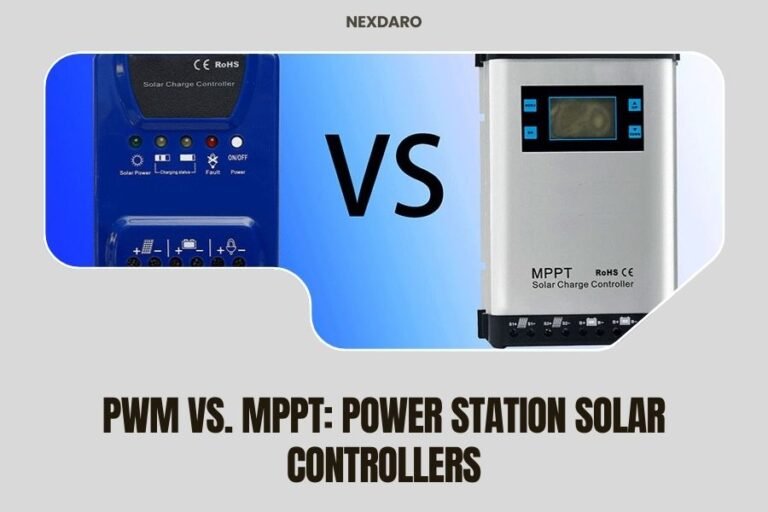
Most modern portable power stations come with a built-in charge controller. This means you can directly plug your solar panel into the station’s designated solar input port. Check your power station’s specifications, but for most models, an external charge controller is not needed.
How much faster does a 200W panel charge compared to a 100W panel?
Under ideal, consistent sunlight conditions, a 200W panel can theoretically charge a power station twice as fast as a 100W panel. However, real-world factors like panel angle, shading, and the power station’s input limits will affect the actual charging speed difference.
Is it better to have one large panel or multiple smaller panels?
This depends on your specific needs. One large panel can be simpler to set up and manage, but multiple smaller panels offer more flexibility for positioning and can be easier to transport. Sometimes, if one small panel gets shaded, the others can still produce power, which isn’t possible with a single large panel.