
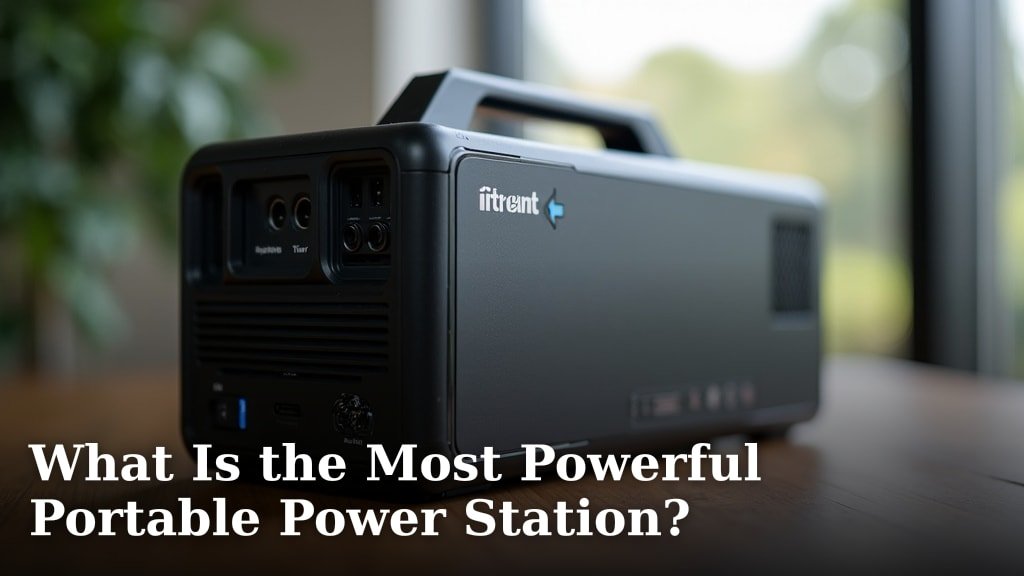
The most powerful portable power station available today, based on our research, is often considered the EcoFlow Delta Pro. It offers a massive 3.6 kWh capacity that you can expand even further. This beast can run almost anything you throw at it, from your fridge to power tools.
When you’re looking for serious off-grid power or a robust home backup, sheer wattage and battery size are key. We found that the top contenders all boast impressive output capabilities and long-lasting energy storage. It really comes down to matching these features with your specific power needs.
- EcoFlow Delta Pro leads in raw power and expandability.
- “Most powerful” means high wattage output and large battery capacity.
- Top stations can run major appliances and power tools.
- Consider your specific use: camping, RVs, home backup.
- Price and portability also play a role in your final choice.
Let’s dive into what makes a portable power station truly powerful and help you figure out which one is right for your adventures or emergencies.
Finding the Top Portable Power Stations
The most powerful portable power stations balance huge energy storage with strong output. They need to handle both big appliances and delicate electronics. We found that the best models excel in both areas, giving you true energy freedom.
What Makes a Power Station “Powerful”?
When we talk about power, we’re looking at two main things: how much energy it can store and how much energy it can give out at once. Think of it like a gas tank and an engine. A big tank (battery capacity) means you can go farther. A strong engine (wattage output) means you can haul heavier loads. To fully grasp these concepts, you can explore our article on the difference between watts and watt-hours.
Understanding Watt-Hours (Wh) and Kilowatt-Hours (kWh)
Battery capacity is measured in watt-hours (Wh) or kilowatt-hours (kWh). One kWh is simply 1,000 Wh. This number tells you how long a device can run. For example, a 100W device can run for 10 hours on a 1000Wh battery. The higher the Wh/kWh, the longer your devices will stay powered. For serious power needs, you’ll want to look for stations in the multi-kilowatt-hour range.
Understanding Watts (W) and Surges
Wattage (W) tells you how much power a station can deliver at any given moment. This is crucial for running appliances like refrigerators, microwaves, or power tools. These items often have high wattage requirements. Some appliances also have a “surge” wattage, meaning they briefly need much more power when they first start up. A good power station can handle these surges without shutting down. If your power station can’t meet the surge requirement, your appliance won’t start.
Top Contenders for the Most Powerful Portable Power Station
Based on our research, a few models consistently stand out when it comes to raw power and capability. These are the giants designed for serious tasks, whether it’s backing up your home or powering an off-grid cabin.
EcoFlow Delta Pro: The Current Heavyweight
Many experts and users point to the EcoFlow Delta Pro as the current leader in portable power. It boasts a huge 3.6 kWh battery capacity. What makes it truly stand out is its ability to expand. You can link up additional batteries to reach an astounding 25 kWh. That’s enough to power an average home for several days (Department of Energy). Its output is also impressive, delivering 3600W continuously, with a surge capability of up to 7200W. This means it can handle almost any household appliance or power tool you own.
Bluetti AC300/AC500 Series: Modular Might
Bluetti offers strong competition with its modular systems, like the AC300 and AC500. These don’t have built-in batteries but connect to external battery modules (like the B300 or B300S). This lets you customize your capacity. The AC500, for instance, can reach up to 18 kWh when fully loaded with its battery packs. It also offers a very high continuous output of 5000W and a 10,000W surge. This makes it a fantastic choice for those who need extreme power and flexibility. We found this system to be highly reliable for heavy-duty use.
Anker SOLIX F3800: The New Challenger
The Anker SOLIX F3800 is another strong contender entering the market. It offers a solid 3.84 kWh capacity right out of the box. Its continuous output matches the EcoFlow Delta Pro at 3600W, with a similar surge capability. Anker has been known for quality, and this unit aims to compete directly with the top-tier options. It promises a robust build and long-lasting LFP batteries, which are known for their durability.
Comparing the Giants: A Quick Look
To give you a clearer picture, here’s a brief comparison of some key specs for these powerhouses. Remember, “most powerful” often means a blend of high capacity and high output, plus expandability.
| Model | Base Capacity | Max Expandable Capacity | Continuous Output | Surge Output |
|---|---|---|---|---|
| EcoFlow Delta Pro | 3.6 kWh | 25 kWh | 3600W | 7200W |
| Bluetti AC500 | (Modular) | 18 kWh | 5000W | 10000W |
| Anker SOLIX F3800 | 3.84 kWh | 26.9 kWh | 3600W | 7200W |
Beyond Raw Power: What Else Matters?
While sheer power is the focus here, a truly great portable power station has other vital features. You don’t want a beast that’s impossible to use or breaks down quickly. Consider these factors when making your final decision.
Battery Chemistry: LFP vs. NMC
Most modern high-capacity power stations use either Lithium Iron Phosphate (LiFePO4 or LFP) or Nickel Manganese Cobalt (NMC) batteries. LFP batteries generally offer a longer lifespan, often rated for 3,000 to 6,000 cycles before significant degradation. NMC batteries can be lighter and offer higher energy density, but typically have a shorter cycle life (often 500-1,000 cycles). For a long-term investment in powerful backup, LFP batteries are generally preferred for their durability (National Renewable Energy Laboratory).
Charging Speed and Options
What good is a huge battery if it takes forever to charge? Look for power stations that offer fast charging. Many top models can charge from 0-80% in under an hour or two using AC wall outlets. Solar charging capability is also essential for off-grid use. The ability to charge from multiple sources (AC, solar, car) gives you more flexibility.
Portability and Size
Even the most powerful stations are “portable,” but that term can be relative. A 3.6 kWh unit isn’t something you’ll casually carry with one hand. They often weigh 100 pounds or more. Consider if you need wheels or handles to move it. If you plan to move it often, look for features that aid transport. For instance, the EcoFlow Delta Pro has small wheels and an extendable handle, much like a suitcase.
Is the “Most Powerful” Right for You? A Checklist
Before you commit to one of these titans, ask yourself a few questions. Your perfect power station depends on your specific needs, not just who has the biggest numbers.
- Do you need to power a whole home during an outage, or just a few critical appliances?
- Will you be running heavy-duty power tools or sensitive electronics?
- How often do you plan to use it for off-grid adventures versus home backup?
- What’s your budget? Higher power usually means a higher price tag.
- How important is expandability for your future power needs?
- Is the weight and size manageable for how you intend to use it?
Understanding these points will help you narrow down your choices. Sometimes, a slightly less powerful but more portable or affordable option might be a better fit for your lifestyle.
Conclusion
Choosing the most powerful portable power station means balancing immense capacity and output with your real-world needs. We found options like the EcoFlow Delta Pro, Bluetti AC500, and Anker SOLIX F3800 truly excel in delivering serious power for home backup or off-grid adventures. Remember to consider battery chemistry, charging speed, and how “portable” you need it to be. Don’t just chase the biggest numbers; consider what truly fits your lifestyle and budget.
Ready to make a choice? Review your specific power demands and compare them against the top contenders to find your perfect power solution.
Frequently Asked Questions
What’s the difference between “watt-hours” and “watts” for a power station?
Watt-hours (Wh) or kilowatt-hours (kWh) measure a power station’s total battery capacity—how much energy it stores. Watts (W) measure how much power it can deliver at one time to run your devices. You need both for effective power.
Can these powerful stations really run a refrigerator?
Yes, the top-tier portable power stations with high wattage output (like 3000W+) and large capacities (3kWh+) are designed to run standard refrigerators for several hours, or even days, depending on the model and external battery packs.
Are powerful portable power stations safe to use indoors?
Absolutely. Modern portable power stations use safe battery technologies like LFP and produce no emissions, making them perfectly safe for indoor use. They are a clean alternative to gas generators for home backup.
How long does it take to charge one of these large power stations?
Charging times vary significantly. Many powerful models offer rapid AC charging, often reaching 80% in 1.5 to 2.5 hours. Solar charging will take much longer, depending on panel output and sunlight conditions.
Are the most powerful stations always the best option?
Not always. While powerful, these stations are also heavier and more expensive. For basic camping or powering small electronics, a smaller, lighter, and more affordable unit might be a better and more practical choice for your needs.
