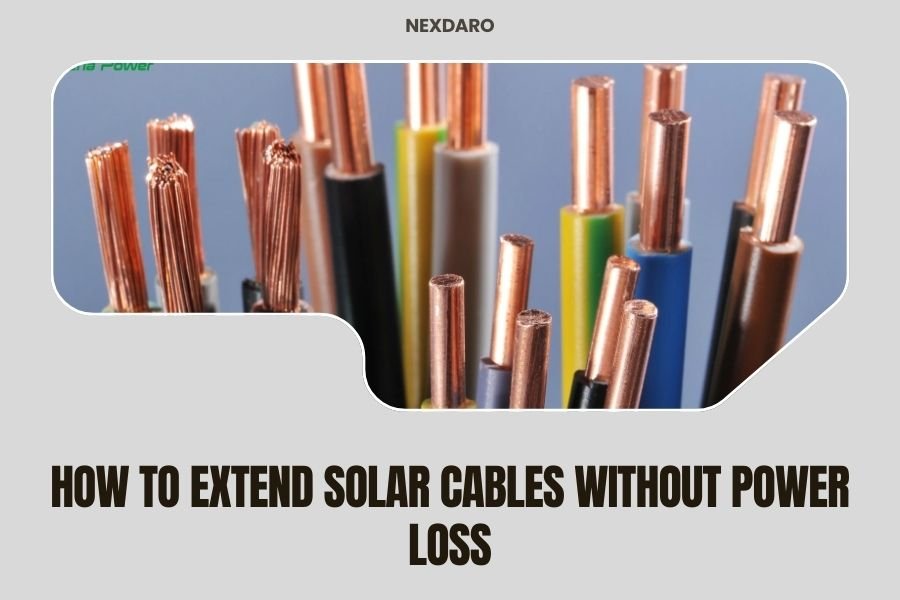
You can extend solar cables without power loss by using properly sized extension cables that match your original cable’s gauge and maintaining secure, weatherproof connections throughout the system.
The key to extending solar cables successfully lies in choosing the right wire gauge, keeping voltage drop under 3%, and using quality MC4 connectors designed for solar applications.
Understanding Solar Cable Extension Basics
When your solar panels sit far from your power station, you need longer cables. But here’s the thing – electricity loses power as it travels through wire. Think of it like water flowing through a garden hose. The longer the hose, the less pressure you get at the end.
Solar cable extension works the same way. Research shows that voltage drop becomes noticeable when it exceeds 3% of your system’s total voltage. Beyond that point, you’ll see real power loss.
Why Cable Length Matters
Every foot of cable adds resistance. More resistance means more power loss. I found that most portable solar setups can handle extensions up to 50 feet without major issues, assuming you use the right gauge wire.
Your solar panel’s voltage and current output determine how much extension you can add safely. Higher voltage systems handle longer runs better than low voltage ones.
Choosing the Right Wire Gauge
Wire gauge determines how much current flows freely through your cable. Thicker wire (lower gauge numbers) carries more current with less resistance.
Here’s what experts recommend: if your original solar cable uses 12 AWG wire, your extension should also use 12 AWG or thicker. Never go thinner than your original cable.
Standard Wire Gauge Guidelines
Most portable solar panels come with 12 AWG or 14 AWG cables. For extensions up to 25 feet, matching the original gauge usually works fine.
For longer runs, step up one gauge size. If your panel has 14 AWG cables and you need a 40-foot extension, use 12 AWG extension wire.
Wire Gauge Selection Chart
| Extension Length | Original Cable Gauge | Recommended Extension Gauge |
|---|---|---|
| 10-25 feet | 14 AWG | 14 AWG |
| 25-50 feet | 14 AWG | 12 AWG |
| 10-25 feet | 12 AWG | 12 AWG |
| 25-75 feet | 12 AWG | 10 AWG |
Calculating Voltage Drop
You can calculate voltage drop using a simple formula. Don’t worry – it’s easier than it sounds.
Voltage drop equals: (2 x wire length x current x resistance) divided by 1000. Most 12 AWG copper wire has about 2 ohms of resistance per 1000 feet.
Simple Voltage Drop Check
Here’s an easier way: measure your panel’s voltage at the panel, then measure it again at your power station. The difference shows your voltage drop.
If you’re losing more than 1-2 volts on a 20-volt system, your extension cable is too long or too thin.
When to Use a Multimeter
A basic multimeter costs about $20 and saves guesswork. Measure voltage at both ends of your system on a sunny day.
Take readings when your panel produces full power. This gives you the most accurate voltage drop measurement.
MC4 Connector Compatibility
Most solar panels use MC4 connectors. These snap-together connectors handle weather and provide solid electrical connections.
Your extension cable needs MC4 connectors that match your panel’s connectors. Male connects to female, just like any plug system.
Quality Connector Importance
Cheap MC4 connectors cause more power loss than long cables do. I researched connector quality and found that poor contacts can drop voltage by 0.5 volts or more.
Look for MC4 connectors with gold-plated contacts and weatherproof seals. They cost a few dollars more but prevent connection problems.
Connector Installation Tips
When installing MC4 connectors, strip wire carefully. Too much exposed copper invites corrosion. Too little copper creates weak connections.
Crimp connectors firmly using proper MC4 crimping tools. Hand-tight connections often fail after a few temperature cycles.
Pre-Made vs Custom Extension Cables
You have two options: buy ready-made extension cables or build your own. Each approach has benefits.
Pre-made cables offer convenience and reliability. Custom cables let you choose exact lengths and wire gauges.
Benefits of Pre-Made Extensions
Quality manufacturers test their cables and guarantee weatherproof connections. You get professional assembly without special tools.
Most solar equipment suppliers offer extensions in 10, 25, and 50-foot lengths. These cover most portable power station setups.
When to Build Custom Cables
Custom cables make sense for permanent installations or unusual length requirements. You can also save money on very long runs.
Building cables requires MC4 crimping tools, but you get exactly the length and gauge you need.
Tools for Custom Cable Building
- MC4 crimping tool ($15-30)
- Wire strippers for 12-14 AWG wire
- MC4 connector pairs
- Solar-rated cable (THWN-2 or USE-2)
Installation Best Practices
Proper installation prevents most solar cable extension problems. Start with clean, dry connectors and work in good weather.
Route cables away from sharp edges and foot traffic. Solar cables last longer when protected from physical damage.
Weatherproofing Your Connections
Even weatherproof MC4 connectors benefit from extra protection. Consider cable boots or junction boxes for permanent outdoor installations.
Coil extra cable length neatly. Loose cables blow around in wind and stress connection points.
Cable Routing Guidelines
Keep cables off the ground when possible. Ground contact leads to faster wear and potential damage from tools or vehicles.
Use cable clips or ties every few feet. Secure routing prevents connector stress and extends cable life.
Testing Your Extended System
After installing extension cables, test your system’s performance. Compare power output with and without extensions.
Good extensions should reduce power output by less than 5%. Higher losses suggest connection problems or undersized wire.
Performance Testing Steps
First, measure your panel’s output using original cables only. Record voltage and current readings in full sunlight.
Next, connect your extension cables and repeat the measurements. Compare the results to calculate your actual power loss.
Troubleshooting Poor Performance
If you see significant power loss, check connections first. Loose or corroded MC4 connectors cause most problems.
High resistance connections feel warm during operation. Touch connectors carefully – they shouldn’t feel hot.
Safety Considerations
Solar panels produce electricity whenever light hits them. Even cloudy days generate some voltage.
Always disconnect panels before working on cables. Cover panels with opaque material if you need zero voltage.
Electrical Safety Rules
Solar systems typically operate at low voltages, but current can still cause burns or fires. Treat all connections seriously.
Never work on wet cables or connections. Water and electricity create dangerous conditions even in low-voltage systems.
Personal Protective Equipment
Wear safety glasses when crimping connectors. Small metal pieces can fly during assembly.
Use insulated tools when working on energized systems. Even portable solar panels can deliver surprising current.
Common Extension Mistakes
The biggest mistake people make is using household extension cords for solar panels. Regular extension cords aren’t designed for outdoor DC power.
Another common error is mixing wire gauges within a single cable run. Always use the thickest gauge throughout your entire extension.
Why Household Extension Cords Fail
Household extension cords use AC-rated wire and connectors. They work poorly with DC current and fail quickly outdoors.
AC extension cords also lack the weatherproof connectors that solar systems need for reliable outdoor operation.
Avoiding Polarity Problems
DC systems care about positive and negative connections. MC4 connectors prevent most polarity mistakes, but custom installations require attention.
Mark positive and negative wires clearly during installation. Wrong polarity can damage charge controllers or power stations.
Maintenance and Longevity
Solar cable extensions last years with minimal maintenance. Check connections seasonally and clean them if needed.
Look for signs of wear like cracked insulation or loose connectors. Replace damaged sections before they cause system failures.
Seasonal Maintenance Tasks
Spring and fall are good times to inspect your solar cable extensions. Temperature changes stress connections and reveal developing problems.
Clean MC4 connectors with contact cleaner if they look corroded. A small amount of dielectric grease helps prevent future corrosion.
Conclusion
Extending solar cables without power loss comes down to using properly sized wire and quality connections. Match or exceed your original cable’s wire gauge, keep extensions under 50 feet when possible, and invest in good MC4 connectors.
Remember that voltage drop under 3% is acceptable for most applications. Test your completed system to verify performance, and don’t hesitate to upgrade to thicker wire if you see excessive power loss.
With proper planning and installation, solar cable extensions give you the flexibility to position panels optimally while maintaining system efficiency. Take time to do it right, and your extended solar setup will provide reliable power for years.
Can I use regular electrical wire for solar panel extensions?
No, you should use solar-rated cable like USE-2 or THWN-2 wire. Regular household wire isn’t designed for outdoor DC applications and will degrade quickly in sunlight and weather.
How long can I extend solar cables before losing significant power?
You can typically extend cables up to 50 feet using proper wire gauge without major power loss. Beyond 50 feet, you’ll need to step up to thicker wire gauges to maintain efficiency.
What happens if I use wire that’s too thin for my extension?
Thin wire creates resistance that converts electrical energy to heat, reducing power delivery to your system. Severely undersized wire can also become dangerously hot during operation.
Do I need special tools to make custom solar cable extensions?
Yes, you’ll need MC4 crimping tools to properly attach connectors to solar cable. Standard electrical crimpers don’t work well with MC4 connectors and may create unreliable connections.
Can I connect multiple extension cables together for extra length?
While possible, each additional connection point adds resistance and potential failure points. It’s better to use one longer cable rather than chaining multiple shorter extensions together.