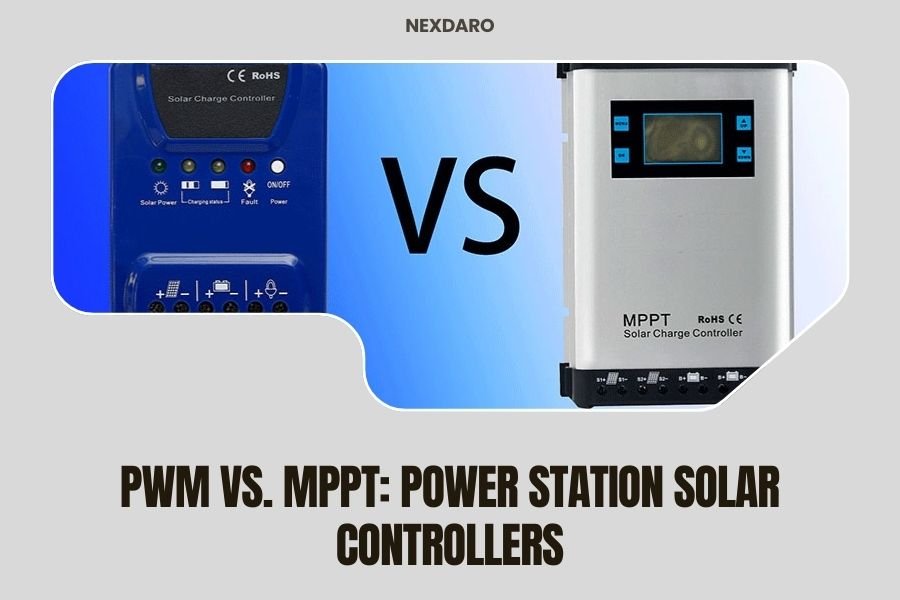
MPPT solar controllers capture 20-30% more energy from your solar panels compared to PWM controllers, making them the better choice for most power stations.
PWM vs MPPT power station solar controllers differ mainly in efficiency and cost, with MPPT being more expensive but significantly more effective at converting solar energy.
What Are Solar Controllers and Why Do You Need Them?
Think of solar controllers as traffic cops for electricity. They manage the flow of power from your solar panels to your power station’s battery. Without them, your battery could get damaged from too much voltage or charge incorrectly.
Your power station needs this protection because solar panels produce varying amounts of electricity throughout the day. As clouds pass by or the sun moves, voltage levels change constantly.
Two Types Rule the Market
You’ll find two main types of solar controllers: PWM and MPPT. Each works differently and affects how much solar energy you actually capture and store.
PWM stands for Pulse Width Modulation. MPPT means Maximum Power Point Tracking. Don’t worry about the technical names – what matters is how they perform for you.
How PWM Controllers Work
PWM controllers work like a simple on-off switch. They pulse electricity from your solar panels to the battery in short bursts. When the battery gets close to full, the pulses get shorter and less frequent.
I found that PWM controllers basically pull down the solar panel voltage to match your battery voltage. If your battery operates at 12 volts, the controller forces your 18-volt solar panel to work at 12 volts too.
The Voltage Matching Problem
Here’s where PWM controllers struggle. They waste the extra voltage your panels produce. It’s like having a car that can go 80 mph but only driving 50 mph on the highway.
Your solar panels might produce 18-22 volts in full sun, but PWM controllers only use whatever matches your battery voltage. The rest gets lost as heat.
When PWM Makes Sense
PWM controllers work fine when your solar panel voltage closely matches your battery voltage. They also cost much less than MPPT units.
Small power stations with basic charging needs can handle PWM controllers without major issues. If you’re on a tight budget, PWM gets the job done.
How MPPT Controllers Work
MPPT controllers act like smart translators between your solar panels and battery. They constantly search for the best combination of voltage and current to maximize power transfer.
Research shows that MPPT controllers can convert high-voltage, low-current input into lower-voltage, higher-current output without losing energy in the process.
The Power Point Magic
Every solar panel has a sweet spot where it produces maximum power. This spot changes throughout the day based on sunlight conditions, temperature, and shading.
MPPT controllers track this sweet spot automatically. They adjust their operation hundreds of times per second to squeeze every bit of available power from your panels.
Voltage Conversion Benefits
Unlike PWM controllers, MPPT units can handle much higher input voltages. You can connect panels in series to create 24V, 36V, or even higher voltage arrays.
The controller then converts this high voltage down to whatever your battery needs, keeping the power output high. It’s like using a gear system on a bicycle – you get more efficiency.
Performance Comparison: Real Numbers
When I researched controller efficiency, I found consistent patterns. MPPT controllers typically capture 20-30% more energy than PWM controllers in most conditions.
The difference becomes even bigger when conditions aren’t perfect. Cold weather, partial shading, or mismatched components favor MPPT controllers heavily.
| Condition | PWM Efficiency | MPPT Efficiency | Difference |
|---|---|---|---|
| Perfect match | 75-80% | 95-99% | +20-24% |
| Cold weather | 70-75% | 95-99% | +25-29% |
| Partial shading | 50-65% | 85-95% | +35-45% |
Temperature Effects
Solar panels actually produce more voltage in cold weather. PWM controllers can’t use this extra voltage, but MPPT controllers convert it into additional charging power.
On a cold sunny day, your MPPT-equipped power station might charge 40% faster than one with PWM control.
Shading Scenarios
Partial shading kills PWM controller performance. Even small shadows can cut charging rates in half.
MPPT controllers handle shading much better. They can work around shaded cells and still extract useful power from the unshaded portions of your panels.
Cost Analysis: Is MPPT Worth the Extra Money?
MPPT controllers typically cost 2-4 times more than equivalent PWM units. A basic PWM controller might run $30-50, while MPPT controllers start around $100-150.
But here’s the math that matters: the extra energy you capture often pays for the price difference within 1-2 years of regular use.
Break-Even Calculations
Let’s say you spend an extra $100 for MPPT over PWM. If you capture 25% more solar energy daily, you’re getting more usable power every time you charge.
For weekend campers, this might mean fewer generator hours or less reliance on shore power. For full-time users, it could mean the difference between staying charged and running out of power.
Long-Term Value
MPPT controllers often last longer than PWM units because they run cooler and more efficiently. Many come with 2-5 year warranties compared to 1-2 years for PWM models.
The reliability factor becomes important when you depend on solar charging in remote locations. Controller failure can ruin a camping trip or leave you stranded.
Compatibility and Installation Differences
PWM controllers need solar panel voltage that closely matches battery voltage. This limits your panel options and expansion possibilities.
MPPT controllers accept a much wider voltage range. You can mix different panels, add panels later, or upgrade to higher-voltage arrays without replacing the controller.
Wiring Flexibility
With MPPT controllers, you can run panels in series for higher voltage. This reduces current in your wiring, which means you can use smaller wire gauges over longer distances.
PWM setups usually require parallel wiring, which means higher current and thicker cables. This adds weight and cost to your installation.
System Monitoring
Most MPPT controllers include digital displays showing voltage, current, power, and daily energy production. This data helps you understand your system’s performance.
Basic PWM controllers often have just LED indicator lights. You won’t know exactly how much energy you’re capturing or missing.
Which Controller Type Fits Your Needs?
Choose PWM if you have a small power station, limited budget, and simple charging needs. They work fine for occasional use and basic applications.
Go with MPPT for larger power stations, frequent use, or when you want maximum efficiency from your solar investment. The extra cost pays off through better performance.
Power Station Size Matters
Small power stations under 500Wh can get by with PWM controllers. The absolute energy difference might only be 20-50Wh per day – not huge in practical terms.
Larger power stations over 1000Wh benefit greatly from MPPT efficiency. An extra 100-200Wh daily can extend your off-grid time significantly.
Usage Patterns
Weekend warriors who use power stations occasionally might find PWM adequate. The cost savings could go toward other camping gear.
Full-time RVers, van lifers, or frequent campers should invest in MPPT. The improved reliability and efficiency become essential for daily life off-grid.
Common Mistakes to Avoid
Don’t assume bigger is always better with controllers. Match the controller capacity to your actual solar panel wattage, not your maximum theoretical needs.
Many people buy MPPT controllers for tiny 100W solar setups. The efficiency gains might only be 5-10W daily – barely noticeable in real use.
Oversizing Problems
Buying a 40A controller for a 200W solar panel wastes money. A 20A controller handles that load perfectly and costs much less.
Controllers work most efficiently when properly sized to your actual power generation, not some future dream setup.
Compatibility Issues
Make sure your controller matches your battery type. Lithium, AGM, and gel batteries need different charging profiles.
Some power stations have built-in charge controllers. Adding an external controller might cause conflicts or damage. Check your manual first.
Future-Proofing Your Investment
Solar technology keeps improving, but charge controller basics remain stable. A good MPPT controller bought today should serve you for 5-10 years easily.
Consider buying slightly more capacity than you need now. Adding solar panels later becomes much easier with extra controller headroom.
Expansion Planning
MPPT controllers make system expansion simple. You can add panels in series or parallel without major rewiring projects.
PWM controllers limit expansion options. Adding panels might require controller replacement and complete wiring changes.
Conclusion
MPPT controllers deliver significantly better performance than PWM controllers for most power station applications. They capture 20-30% more energy, handle varying conditions better, and offer more flexibility for system expansion. While they cost more upfront, the improved efficiency and reliability usually justify the investment within 1-2 years.
Choose PWM only if you have a very small system, tight budget, or minimal power needs. For everything else, MPPT controllers provide better value and performance that will serve you well for years to come. Your power station deserves the efficiency boost that comes with maximum power point tracking technology.
Can I upgrade from PWM to MPPT later?
Yes, but you’ll need to replace the entire controller and possibly rewire your solar connections. MPPT controllers often have different terminal layouts and voltage requirements than PWM units. Plan for a few hours of installation work when upgrading.
Do MPPT controllers work in cloudy weather?
MPPT controllers actually perform better than PWM in cloudy conditions. They can extract more power from low-light situations by optimizing the voltage-current relationship even when solar output is reduced. Cloudy weather showcases MPPT’s tracking advantages.
How do I size a solar controller for my power station?
Divide your total solar panel wattage by your system voltage, then add 25% safety margin. For example, 400W of panels on a 12V system needs at least 42A capacity (400W ÷ 12V = 33A, plus 25% = 42A controller minimum).
What happens if my solar controller fails while camping?
You can still charge your power station from your vehicle or generator, but solar charging stops completely. Some people carry a backup PWM controller as emergency insurance since they’re small and inexpensive compared to being stranded without power.
Are there any disadvantages to MPPT controllers besides cost?
MPPT controllers are more complex, which means slightly higher failure rates and more difficult troubleshooting. They also generate more electromagnetic interference, which might affect sensitive electronics nearby. These issues are minor compared to their efficiency benefits.