
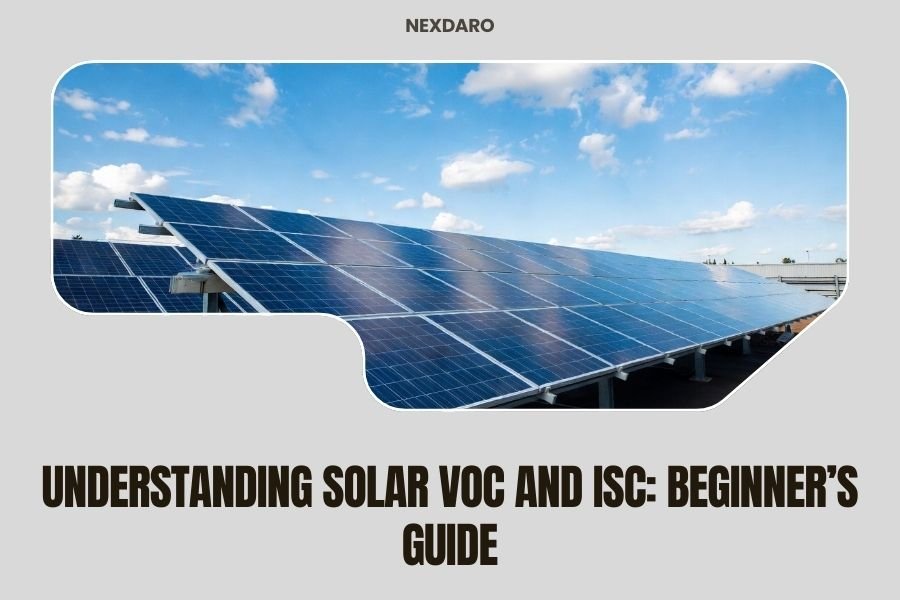
Solar Voc (Voltage at Open Circuit) measures the maximum voltage a solar panel produces when no current flows, while Isc (Current at Short Circuit) measures the maximum current when voltage drops to zero.
These two measurements help you understand your solar panel’s power limits and determine if it matches your portable power station’s charging requirements.
What Solar Voc and Isc Actually Mean
Think of your solar panel like a water hose. Voc is the water pressure when you turn off the nozzle completely. Isc is the maximum water flow when you remove all restrictions.
Neither measurement shows real-world performance. They represent opposite extremes that never happen during normal use.
Why These Numbers Matter for Your Setup
Your portable power station has input limits. If your solar panel’s Voc exceeds these limits, you could damage the charging system.
I found that most power station manufacturers list maximum input voltage clearly in their specs. Always check this before connecting any solar panel.
How Solar Panels Generate Electricity
Solar cells create electricity when sunlight hits them. Each cell produces about 0.6 volts under load.
Manufacturers connect multiple cells in series to reach useful voltages. A typical 100-watt panel has 36 cells, producing around 18 volts during operation.
The Relationship Between Voltage and Current
Voltage and current work opposite each other in solar panels. When voltage goes up, current goes down. When current peaks, voltage drops to nearly zero.
This relationship follows what engineers call the I-V curve. The sweet spot for maximum power sits somewhere in the middle.
Real-World Operating Point
Your panel operates at its Maximum Power Point (MPP) under normal conditions. This typically happens at around 80% of Voc and 90% of Isc.
MPPT charge controllers find this sweet spot automatically. They adjust the load to extract maximum power from your panels.
Understanding Voc in Detail
Voc happens when you disconnect your solar panel completely. No current flows, so voltage reaches its peak.
This voltage changes with temperature and sunlight intensity. Cold weather increases Voc. Hot weather decreases it.
Temperature Effects on Voc
Solar panels lose about 0.3% voltage for every degree Celsius above 25°C. They gain voltage when temperatures drop below 25°C.
In winter conditions, your panel’s Voc might jump 20% higher than rated specs. This matters when choosing compatible equipment.
Calculating Cold Weather Voc
Use this simple formula: Cold Voc = Rated Voc × (1 + 0.003 × (25 – Minimum Temperature))
For a 20V panel in -10°C weather: 20 × (1 + 0.003 × 35) = 22.1V
Light Intensity Effects
Voc changes much less with light intensity compared to current. Even at 25% sunlight, Voc only drops about 10%.
This stability makes Voc useful for sizing electrical components that must handle peak voltages.
Understanding Isc in Detail
Isc occurs when you short-circuit your solar panel’s positive and negative terminals together. Current reaches maximum, but voltage drops to zero.
Current responds directly to sunlight intensity. Double the sunlight, double the current. Half the light, half the current.
How Light Affects Current Output
Unlike voltage, current scales almost perfectly with available sunlight. This makes Isc a good predictor of real-world current output.
On a cloudy day with 30% normal sunlight, expect about 30% of your panel’s Isc rating.
Temperature Effects on Current
Temperature barely affects current output. Most panels see less than 0.1% change per degree Celsius.
This makes current much more predictable than voltage across different weather conditions.
Reading Solar Panel Specifications
Every solar panel includes a specification sheet with key electrical parameters. Look for the electrical characteristics table.
Standard Test Conditions (STC) provide the baseline: 1000 watts per square meter irradiance, 25°C cell temperature, and 1.5 air mass.
| Parameter | Symbol | Typical 100W Panel |
|---|---|---|
| Open Circuit Voltage | Voc | 22.5V |
| Short Circuit Current | Isc | 6.2A |
| Maximum Power Voltage | Vmp | 18.2V |
| Maximum Power Current | Imp | 5.5A |
What These Numbers Tell You
Compare Vmp and Imp to Voc and Isc. Notice how the maximum power point sits well below the extreme values.
This gap explains why you never get the full multiplication of Voc times Isc as actual power output.
Matching Panels to Power Stations
Your power station’s solar input has voltage and current limits. Exceed either limit and you risk damage.
Check your power station manual for maximum input voltage and current ratings. Compare these to your panel’s Voc and Isc.
Voltage Compatibility Rules
Your panel’s cold-weather Voc must stay below your power station’s maximum input voltage. Build in a 10% safety margin.
If your power station accepts 30V maximum, choose panels with cold-weather Voc below 27V.
Series Connection Considerations
Connecting panels in series adds their voltages together. Two 20V panels create 40V combined Voc.
This voltage addition happens regardless of light conditions. Plan for worst-case scenarios.
Current Compatibility Rules
Your power station’s input current limit should exceed your panel array’s combined Isc. Again, build in safety margin.
Parallel connections add currents together while keeping voltage the same.
Testing Your Solar Panels
You can measure Voc with any multimeter. Set to DC voltage and touch the panel’s output terminals in bright sunlight.
For accurate Isc measurement, you need a DC current meter capable of handling your panel’s full output safely.
Safety Precautions
Never short-circuit large solar arrays directly. High currents can create dangerous sparks or heat.
Use appropriate test equipment rated for your panel’s output levels.
Best Testing Conditions
Test around solar noon on clear days for most accurate results. Avoid shadows on any part of the panel.
Clean panels before testing. Dust and debris reduce both voltage and current output.
Common Misconceptions
Many people think higher Voc means better panels. This isn’t always true. Panel efficiency depends on the complete I-V curve, not just extreme points.
Others assume you can multiply Voc by Isc to get maximum power. Real maximum power always falls short of this calculation.
Marketing vs Reality
Some manufacturers emphasize high Voc or Isc numbers in marketing. Focus on actual power ratings and efficiency percentages instead.
Real-world performance matters more than impressive extreme specifications.
Practical Applications
Use Voc to size fuses, circuit breakers, and charge controllers. These components must handle peak voltages safely.
Use Isc to calculate wire sizes and current handling requirements for your system.
System Planning Tips
Plan your solar setup around maximum power ratings, not Voc and Isc. These extreme values help with safety calculations, not performance predictions.
Choose charge controllers and power stations with adequate safety margins above your calculated requirements.
Conclusion
Understanding solar Voc and Isc gives you the foundation for building safe, effective solar charging systems. These measurements represent the extreme limits of your panel’s electrical output, helping you select compatible equipment and avoid damage.
Remember that real-world performance happens between these extremes. Focus on maximum power ratings for performance planning, but use Voc and Isc for safety calculations and equipment compatibility checks.
Start with your power station’s input specifications, then work backward to choose appropriate solar panels. This approach prevents costly mistakes and ensures your system works reliably for years.
What happens if my solar panel’s Voc exceeds my power station’s input limit?
You risk damaging your power station’s charging circuitry. The overvoltage protection might shut down the input, or in worst cases, you could burn out internal components. Always check cold-weather Voc calculations against your power station’s maximum input voltage specification.
Can I use solar panels with higher Isc than my power station can handle?
Generally yes, because your power station will only draw the current it needs. Current gets pulled by the load, not pushed by the panel. However, your charge controller or power station should still be rated to handle the available current safely.
Why don’t I get Voc times Isc as actual power output?
These represent opposite extremes that never occur simultaneously. Voc happens with zero current flow, while Isc happens with zero voltage. Maximum power occurs at a middle point where both voltage and current are present but below their peak values.
How much do Voc and Isc change throughout the day?
Voc stays relatively stable, dropping only 10-15% from peak sun to late afternoon. Isc changes dramatically with light intensity, potentially dropping 70% or more on cloudy days. Temperature affects Voc more than Isc, with cold weather increasing voltage significantly.
Do I need to measure Voc and Isc myself, or trust the manufacturer specs?
Manufacturer specifications are generally accurate for new panels under standard test conditions. Measuring yourself helps verify panel health and understand real-world variations due to temperature and light conditions. It’s good practice but not always necessary for basic system setup.
