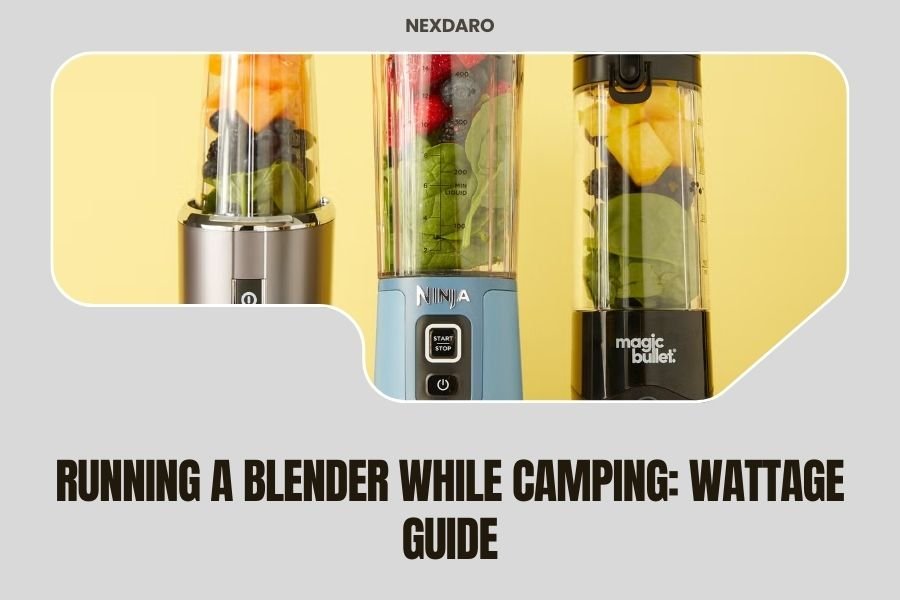
Most camping blenders need 200-1,000 watts to run, with personal blenders requiring 200-400 watts and full-size models needing 600-1,000 watts.
Your portable power station must have 20-30% more capacity than your blender’s wattage rating to handle startup power surges safely.
Quick Wattage Chart for Camping Blenders
Want the numbers straight up? Here’s what I found when researching different blender types and their power needs.
| Blender Type | Watts Needed | Runtime on 500Wh Station |
|---|---|---|
| Personal/Bullet Blenders | 200-400W | 15-30 minutes |
| Mid-size Blenders | 400-600W | 10-15 minutes |
| Full-size Blenders | 600-1,000W | 5-10 minutes |
| High-performance Models | 1,000-1,500W | 3-5 minutes |
Understanding Blender Power Requirements
Think of blender wattage like horsepower in a car. More watts mean more crushing power for ice, frozen fruit, and tough ingredients.
Why Wattage Matters for Your Smoothie Success
Low-wattage blenders struggle with frozen ingredients. You’ll end up with chunky disappointment instead of smooth perfection.
Higher wattage blenders work faster. That means less drain on your power station battery. It’s actually more efficient to use a powerful blender for 30 seconds than a weak one for 3 minutes.
Startup Surge vs Running Watts
Here’s something many campers miss. Blenders need extra power when they first turn on.
I found that most blenders draw 1.5 to 2 times their rated wattage for the first few seconds. A 600-watt blender might need 900-1,200 watts at startup.
Your power station needs to handle this surge. Otherwise, it’ll shut down to protect itself.
Choosing the Right Power Station Size
You can’t just match your power station’s watts to your blender’s rating. That’s a recipe for disappointment.
The 130% Rule
Multiply your blender’s wattage by 1.3. That’s your minimum power station requirement.
Got a 500-watt blender? You need at least a 650-watt power station. This covers the startup surge plus gives you breathing room.
Battery Capacity Considerations
Power stations list two numbers: continuous watts and watt-hours (Wh). You need both.
Continuous watts handle the surge. Watt-hours determine how long you can blend.
Real-World Runtime Calculations
A 1,000Wh power station running a 400-watt blender gives you about 2 hours of blend time. But who blends for 2 hours straight?
Most smoothies take 30-60 seconds. That’s roughly 120-240 smoothies from a 1,000Wh station.
Best Blender Types for Camping
Not all blenders make sense for camping. Some are power hogs that’ll drain your battery faster than a leaky tent in the rain.
Personal Blenders: The Smart Choice
Personal blenders win for camping. They use 200-400 watts and blend directly into travel cups.
Less power consumption means more smoothies per charge. Plus, you’re not washing a giant pitcher at the campsite.
Top Features to Look For
- Under 400 watts power draw
- BPA-free travel cups included
- Compact design for easy packing
- Dishwasher-safe parts
Mid-Size Blenders: The Compromise
Got a bigger family or group? Mid-size blenders handle 32-48 ounce batches with 400-600 watts.
They’re still reasonable for most 1,000+ watt power stations. You can make smoothies for 2-3 people at once.
When Mid-Size Makes Sense
Family camping trips benefit from bigger batches. Making one large smoothie uses less total power than three separate small ones.
Full-Size Blenders: Think Twice
Full-size blenders eat power like hungry teenagers eat pizza. They’re often 800-1,500 watts.
Unless you have a massive power station or generator backup, skip these for camping.
Power Station Recommendations by Blender Type
Matching your gear prevents frustration. Here’s what works together.
For Personal Blenders (200-400W)
A 500-watt power station handles most personal blenders. Look for 300-500Wh capacity for weekend trips.
This setup gives you 15-25 smoothie sessions per charge. Perfect for solo camping or couples.
Budget-Friendly Options
Entry-level power stations around 500Wh cost $300-500. They’re worth it for the convenience of fresh smoothies anywhere.
For Mid-Size Blenders (400-600W)
Step up to 800-1,000 watt power stations. You’ll need 1,000Wh or more for extended trips.
This combination works great for family camping. Everyone gets their smoothie fix without rationing power.
Investment-Grade Stations
Higher-capacity stations cost more but power other camp gear too. Think mini-fridges, coffee makers, and device charging.
For Full-Size Blenders (600W+)
You’ll need serious power stations with 1,500+ watts continuous output and 2,000Wh+ capacity.
These setups cost $1,500-3,000. Only makes sense for base camp situations or RV camping with shore power backup.
Power-Saving Tips for Longer Blending
Smart techniques stretch your battery life. Every watt saved means more smoothie time.
Pre-Cut and Prep Ingredients
Smaller pieces blend faster. Cut fruit into 1-inch chunks before freezing.
This simple step can cut blending time in half. Less time equals less power drain.
Room Temperature Liquids
Cold liquids make your blender work harder. Use room temperature water, juice, or milk when possible.
Layer Ingredients Properly
Liquids go in first, then soft ingredients, then frozen items on top. This creates better flow and faster blending.
Many experts say proper layering reduces blend time by 20-30% (Vitamix technical guides).
Pulse Instead of Constant Blending
Use short pulses to break up ingredients, then blend continuously for the final smooth texture.
This technique prevents overheating and reduces total power consumption.
Safety Considerations
Power stations and blenders need respect. A few safety tips keep your camping trip injury-free.
Ventilation Requirements
Never run power stations inside enclosed spaces. They need airflow to prevent overheating.
Set up your blending station outside or in well-ventilated areas only.
Weather Protection
Power stations hate moisture. Keep them dry and covered during use.
A simple tarp overhead protects against dew and light rain while maintaining airflow.
Ground Fault Protection
Many modern power stations include GFCI protection. This prevents electrical shock in damp conditions.
Check your unit’s specifications. It’s a safety feature worth having around water and outdoor conditions.
Overload Prevention
Don’t run multiple high-watt devices simultaneously. Your power station will shut down or potentially damage itself.
Alternative Solutions
Sometimes a traditional blender isn’t the best camping solution. Consider these alternatives.
12V DC Blenders
Some blenders run directly off 12V car outlets. They’re less powerful but incredibly efficient.
Perfect for car camping where you can run the engine occasionally to recharge the battery.
Hand-Crank Blenders
Zero electricity required. Manual blenders work great for soft fruits and protein shakes.
They’re lightweight, unbreakable, and never need charging. Old school but effective.
Rechargeable Personal Blenders
Built-in batteries eliminate power station needs for quick jobs. Most handle 10-15 smoothies per charge.
Charge them at home before your trip. They’re perfect for short camping adventures.
Conclusion
Running a blender while camping comes down to matching your power needs with the right equipment. Personal blenders using 200-400 watts pair perfectly with mid-range power stations for most camping situations. Remember the 130% rule when sizing your power station, and you’ll have smooth smoothies throughout your outdoor adventures. The key is realistic expectations and smart power management. Your morning smoothie routine doesn’t have to end when you hit the trail.
Can I run a NutriBullet on a 500-watt power station?
Yes, most NutriBullet models use 600-900 watts, but many 500-watt power stations can handle the startup surge for short blending sessions. Check your specific model’s requirements and your power station’s surge capacity.
How long should I wait between blending sessions to preserve battery life?
Wait 2-3 minutes between blending sessions to let your power station cool down and stabilize. This prevents overheating and extends both battery life and equipment lifespan.
Do blenders use more power with ice than without?
Yes, crushing ice requires significantly more power and longer blending times. Frozen ingredients can increase power consumption by 30-50% compared to room temperature ingredients.
What happens if my blender’s wattage exceeds my power station’s capacity?
Your power station will shut down automatically to protect itself from overload. Some units display error codes, while others simply turn off until you reduce the power demand.
Can solar panels recharge my power station fast enough for multiple daily smoothies?
Solar charging is typically slower than power consumption for high-watt blenders. Plan to recharge overnight or during long breaks between uses. A 100-watt solar panel needs 3-4 hours of good sunlight to replace the power from one blending session.