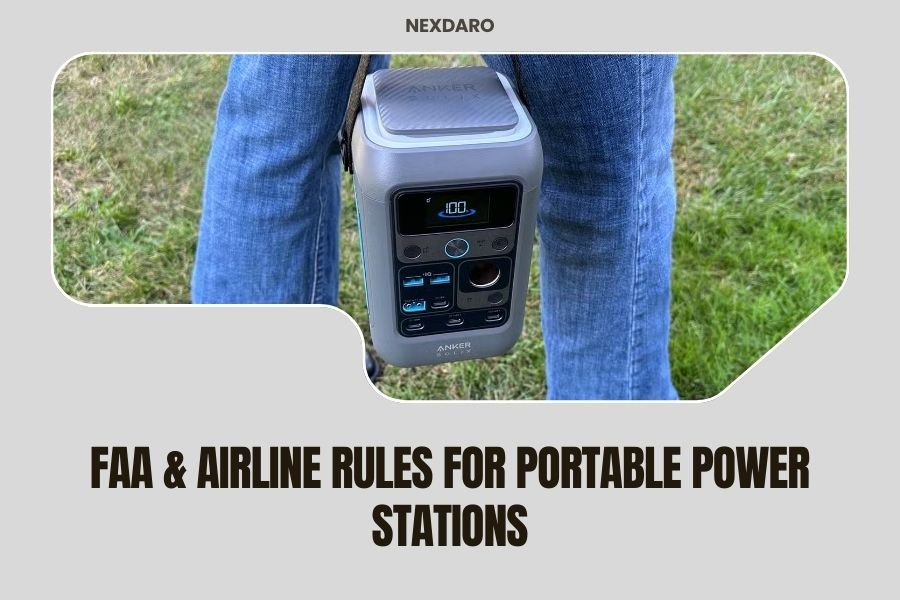
Most portable power stations under 100Wh can go in carry-on bags, while units over 100Wh need airline approval and have strict limits up to 160Wh for passenger flights.
FAA rules for portable power stations focus on lithium battery capacity, with different restrictions for carry-on versus checked baggage to prevent fire hazards during flight.
Quick Answer: Can You Fly With Your Power Station?
Your power station’s battery size determines everything. The magic number? 100 watt-hours (Wh).
Units under 100Wh fly like your laptop or phone. Anything bigger gets complicated fast. Think of it like carrying water through security – small bottles are fine, but bigger containers need special permission.
The 100Wh Rule Explained
Watt-hours measure how much energy your battery stores. Most phone chargers hold 20-50Wh. Larger camping power stations can pack 500-2000Wh.
You’ll find this number printed on your device or in the manual. If you only see amp-hours (Ah), multiply by the voltage. A 27Ah battery at 3.7V equals 99.9Wh.
FAA Categories for Power Stations
The Federal Aviation Administration splits portable batteries into three groups. Each has different rules.
Under 100Wh: Green Light Category
These smaller units travel like regular electronics. You can pack them in carry-on or checked bags without asking permission.
Popular models in this range include most phone chargers and small camping batteries. They’re perfect for weekend trips or emergency backup.
What You Can Bring
- Anker PowerHouse 100 (97Wh)
- Goal Zero Sherpa 100PD (94.7Wh)
- Most portable phone chargers
- Small solar generators under 100Wh
100-160Wh: Yellow Light Category
This middle zone needs airline approval. You can bring up to two units, but only in carry-on bags.
Call your airline at least 48 hours before flying. Some approve these quickly, others want detailed specs sent by email.
Airline Approval Process
Most airlines ask for your battery’s exact watt-hour rating and model number. They’ll give you a reference number for airport security.
Keep approval emails on your phone. TSA agents don’t always know these rules, so documentation helps avoid delays.
Over 160Wh: Red Light Category
Passenger flights ban these entirely. You’d need cargo shipping or ground transport instead.
Large camping power stations like the Goal Zero Yeti 1500 (1516Wh) fall here. They’re amazing for RV trips but terrible for air travel.
Carry-On vs Checked Bag Rules
Location matters as much as size. The FAA treats carry-on and checked bags very differently.
Carry-On Bag Guidelines
Power stations belong in carry-on bags when possible. Flight crews can access them quickly if problems arise.
Keep devices easily accessible during screening. TSA might want to inspect them separately, like laptops.
TSA Screening Tips
Remove large power stations from bags at security. Place them in separate bins like computers.
Arrive 30 minutes earlier than usual. These devices sometimes trigger additional screening.
Checked Bag Restrictions
Only batteries under 100Wh can go in checked luggage. Larger units must stay in the cabin.
This rule prevents cargo fires that crews can’t reach. It’s the same reason spare phone batteries stay in carry-ons.
International Flight Differences
Other countries often copy FAA rules, but some add extra restrictions. Research shows international guidelines vary more than domestic ones (International Air Transport Association).
European Union Rules
EU flights follow similar 100Wh limits but enforcement varies by country. Germany tends to be stricter than Spain or Italy.
Some European airlines want manufacturer documentation, not just watt-hour ratings.
Asian Airline Policies
Japan and South Korea mirror FAA rules closely. China sometimes adds paperwork requirements for batteries over 50Wh.
Singapore Airlines pre-approves most power stations under 160Wh online, making the process smoother.
Common Power Station Models and Their Limits
Here’s how popular models stack up against airline rules:
| Model | Battery Size | Flight Status | Approval Needed |
|---|---|---|---|
| Anker PowerHouse 100 | 97Wh | Allowed | No |
| Goal Zero Sherpa 100PD | 94.7Wh | Allowed | No |
| Jackery Explorer 160 | 167Wh | Banned | N/A |
| EcoFlow River Mini | 210Wh | Banned | N/A |
What Happens If You Break the Rules?
TSA will confiscate banned power stations at security. You can’t ship them home from the airport either.
Some travelers try hiding large batteries in checked bags. This risks serious fines and flight delays when X-ray machines spot them.
Real Consequences
Airlines can deny boarding for battery violations. You might miss your flight and lose money on tickets.
Checked bag fires have forced emergency landings. The FAA takes these rules very seriously for good reason.
Smart Packing Strategies
Planning ahead prevents airport headaches. A few simple steps make flying with power stations much easier.
Before You Leave Home
Check your device’s exact watt-hour rating. Don’t guess – look it up or contact the manufacturer.
Print or save approval emails if needed. Airport Wi-Fi isn’t reliable when you’re stressed at security.
Backup Plans
Consider shipping large power stations to your destination. UPS and FedEx handle lithium batteries with proper packaging.
Many hotels and vacation rentals rent power equipment. This saves weight and eliminates flight restrictions.
At the Airport
Keep power stations charged between 30-70%. Completely dead batteries raise security concerns.
Bring charging cables to prove devices work if agents ask for demonstrations.
Special Situations and Exceptions
Some circumstances change normal battery rules. Medical devices and military travel have different standards.
Medical Equipment
Medically necessary batteries sometimes get exemptions. Contact airlines well ahead of time with doctor documentation.
CPAP machines and mobility device batteries have separate rules under disability accommodation laws.
Business and Freight Options
Large power stations can ship as cargo with proper hazardous material labeling. This costs more but works for expensive equipment.
Some courier services specialize in lithium battery shipping. They handle documentation and safety requirements.
Future Rule Changes
Battery technology evolves faster than regulations. The FAA reviews rules regularly but changes take time.
I found that new lithium iron phosphate batteries might get different treatment. They’re safer than traditional lithium-ion but current rules don’t distinguish between types.
Tips for Choosing Travel-Friendly Models
If you fly often, buy power stations under 100Wh. The convenience outweighs having less capacity.
Multiple smaller units work better than one large battery. You can bring several 99Wh devices without approval.
Best Features for Air Travel
- Clear watt-hour labeling on the device
- Compact size for carry-on bags
- Multiple charging ports to share with fellow passengers
- LED displays that prove the device works
Conclusion
Flying with portable power stations doesn’t have to be complicated. Remember the key number: 100 watt-hours separates simple travel from airline approval headaches.
Check your device’s rating before every trip. Rules rarely change, but enforcement varies between airports and airlines. When in doubt, pack smaller units or ship large batteries separately. Your vacation power needs aren’t worth missing flights or facing confiscation at security.
The safest approach? Choose travel-friendly models under 100Wh and keep approval documentation handy for anything larger. This simple preparation ensures your power station reaches your destination along with you.
Can I bring multiple power stations under 100Wh on the same flight?
Yes, you can bring multiple power stations as long as each individual unit stays under 100Wh. Airlines don’t limit the total number of small batteries, just like you can carry multiple phones and laptops.
What if my power station doesn’t show the watt-hour rating anywhere?
Contact the manufacturer or check the manual for amp-hour and voltage ratings. Multiply these numbers together to get watt-hours. If you can’t find this information, assume it’s over 100Wh and seek airline approval to be safe.
Do power stations need to be turned off during takeoff and landing?
Most airlines treat power stations like other electronic devices. You can use them throughout the flight, but check with your specific airline as policies sometimes vary for battery packs versus phones or tablets.
Can I charge my power station during the flight using seat outlets?
Airlines generally allow this, but some restrict charging large battery devices due to power draw concerns. Ask flight attendants before plugging in anything bigger than a laptop charger to avoid tripping circuit breakers.
What happens if my approved power station gets flagged at security despite having permission?
Show TSA agents your airline approval documentation and the device’s watt-hour rating. If they still have concerns, ask to speak with a supervisor who may be more familiar with battery regulations. Stay calm and polite – most issues resolve quickly with proper paperwork.