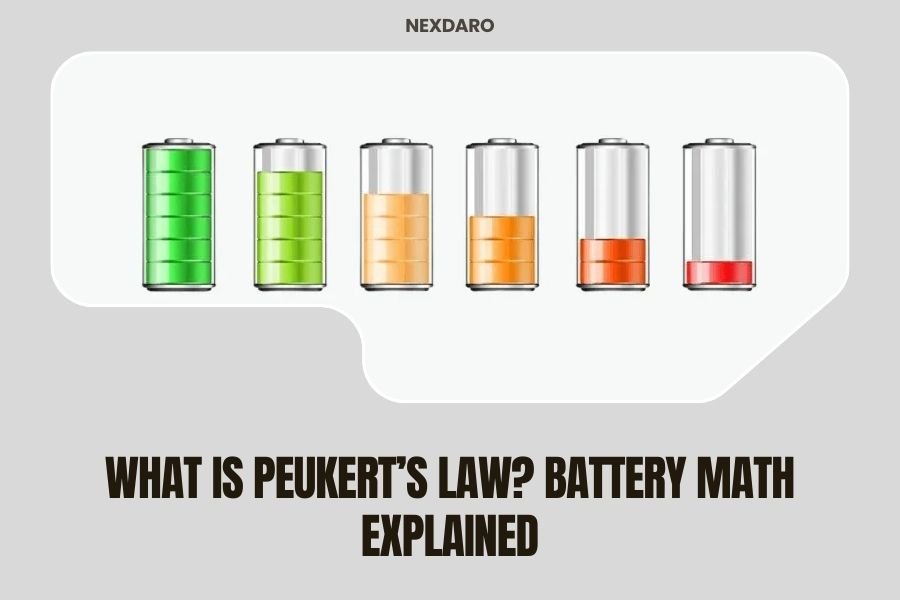
Peukert’s Law describes how batteries deliver less total capacity when discharged at higher rates, meaning your portable power station won’t last as long under heavy loads.
This mathematical principle explains why your battery life varies dramatically between powering a small LED light versus running a high-wattage appliance like a microwave.
Understanding the Basics of Peukert’s Law
German scientist Wilhelm Peukert discovered this battery behavior back in 1897. He found that batteries don’t work like simple math would suggest.
Think of it like this: imagine your battery is a water tank with a flexible hose. When you open the valve just a little, water flows steadily for hours. But crank that valve wide open, and the water rushes out so fast that you get less total water than expected.
That’s exactly what happens with batteries under different discharge rates.
The Mathematical Formula Behind Peukert’s Law
The formula looks intimidating, but it’s pretty straightforward:
Cp = I^n × t
Where:
- Cp = Peukert capacity
- I = discharge current
- n = Peukert exponent
- t = time
Don’t worry about memorizing this. The key point is that the “n” value tells you how much your battery suffers from high discharge rates.
What the Peukert Exponent Means
The Peukert exponent (n) is like a report card for your battery type:
- Perfect battery: n = 1.0 (doesn’t exist in real life)
- Excellent: n = 1.0 to 1.1
- Good: n = 1.1 to 1.25
- Fair: n = 1.25 to 1.4
- Poor: n = 1.4+
How Different Battery Types Handle Peukert’s Law
Not all batteries are created equal when it comes to high-discharge performance. I researched various battery chemistries and found some interesting patterns.
Lithium-Ion Batteries: The Champions
Lithium-ion batteries typically have Peukert exponents between 1.05 and 1.15. This means they’re superstars at maintaining capacity even under heavy loads.
When you’re running that power-hungry coffee maker from your portable power station, lithium-ion batteries keep delivering close to their rated capacity.
Why Lithium Performs So Well
The secret lies in their internal chemistry. Lithium-ion cells have low internal resistance and efficient ion movement. It’s like having a wide, smooth highway for electrical current instead of a bumpy country road.
Lead-Acid Batteries: The Strugglers
Traditional lead-acid batteries have much higher Peukert exponents, often between 1.2 and 1.4. Some cheaper deep-cycle lead-acid batteries can hit 1.6 or higher.
This means a 100Ah lead-acid battery might only deliver 70-80Ah when powering high-draw devices. That’s a massive difference for your camping trip or emergency backup power.
AGM and Gel Batteries: The Middle Ground
AGM (Absorbed Glass Mat) and gel batteries perform better than flooded lead-acid, with Peukert exponents typically around 1.15 to 1.25. They’re a compromise between cost and performance.
Real-World Examples of Peukert’s Law in Action
Let me show you how this plays out with actual portable power station scenarios.
Scenario 1: LED Lights vs Electric Heater
Picture this: you have a 1000Wh lithium power station. You could run:
- LED lights (20W total): Nearly the full 1000Wh of capacity
- Electric space heater (1500W): Maybe 850-900Wh of usable capacity
The heater draws so much current that Peukert’s Law kicks in, reducing your total available energy.
Scenario 2: The Coffee Maker Reality Check
Your power station says it can run a 1200W coffee maker for 50 minutes based on simple math. But Peukert’s Law might cut that to 45 minutes with lithium-ion, or just 35-40 minutes with lead-acid.
Those missing minutes could mean the difference between that second cup of coffee and disappointment.
Calculating Peukert Effects for Your Equipment
You don’t need to become a mathematician, but understanding some basics helps you make smarter power choices.
The C-Rate Connection
Battery experts talk about C-rates, which describe discharge speed relative to capacity. Here’s the breakdown:
| C-Rate | What It Means | Example (100Ah battery) |
|---|---|---|
| 0.1C | 10-hour discharge | 10A for 10 hours |
| 0.5C | 2-hour discharge | 50A for 2 hours |
| 1C | 1-hour discharge | 100A for 1 hour |
| 2C | 30-minute discharge | 200A for 30 minutes |
When Peukert Effects Become Noticeable
Most batteries handle low discharge rates (under 0.2C) without major Peukert losses. But push above 0.5C, and you’ll start seeing real capacity reduction.
For portable power stations, this often happens when running:
- Power tools
- Kitchen appliances
- Space heaters or air conditioners
- Hair dryers
Practical Strategies to Minimize Peukert Losses
You can’t eliminate Peukert effects, but you can definitely reduce their impact on your power needs.
Choose Your Battles Wisely
Instead of running one massive 1500W heater, consider two 750W units if your power station has multiple outlets. Splitting the load reduces the C-rate and improves total capacity.
Timing Your High-Draw Devices
Use power-hungry appliances when your battery is fuller. Peukert effects get worse as battery voltage drops during discharge.
Run that coffee maker first thing in the morning, not after you’ve already drained 50% of your capacity with other devices.
The Power Station Size Sweet Spot
Bigger isn’t always better, but there’s a practical minimum. If you regularly need 1000W of power, get at least a 1500-2000Wh station. This keeps your C-rate reasonable and minimizes Peukert losses.
Why Portable Power Station Manufacturers Don’t Always Tell You
Here’s something I found during my research: many portable power station specs assume ideal conditions that ignore Peukert’s Law.
The Marketing vs Reality Gap
When a manufacturer claims their 1000Wh unit can power a 100W device for 10 hours, they’re using simple division. Real-world performance might be 8-9 hours due to various factors, including Peukert effects.
This isn’t necessarily deceptive – it’s industry standard. But knowing about Peukert’s Law helps you set realistic expectations.
Reading Between the Spec Lines
Look for these clues in power station specifications:
- “Runtime may vary based on load”
- Different efficiency ratings at various wattages
- Battery chemistry details (lithium-ion performs better)
Advanced Tips for Power Station Optimization
Once you understand Peukert’s Law, you can make smarter decisions about your portable power setup.
Temperature Considerations
Cold weather makes Peukert effects worse. Your battery’s internal resistance increases, amplifying capacity loss under high discharge rates.
Keep your power station warm (but not hot) for best performance. Many users don’t realize their winter camping struggles stem from this double whammy of cold and Peukert losses.
Parallel Battery Banks
If you’re building a custom system, connecting batteries in parallel helps reduce Peukert effects. Each battery handles a smaller portion of the total load, keeping C-rates manageable.
Series vs Parallel Trade-offs
Series connections (higher voltage) don’t help with Peukert effects the same way parallel connections do. Current draw per battery stays the same in series, but gets divided in parallel configurations.
Future Battery Technologies and Peukert’s Law
Battery technology keeps improving, and newer chemistries are getting better at handling high discharge rates.
Lithium Iron Phosphate (LiFePO4) Advances
LiFePO4 batteries often have Peukert exponents below 1.1, making them excellent for high-power applications. Many premium portable power stations now use this chemistry.
From what I read in recent battery research, these cells can maintain over 95% of their rated capacity even at 1C discharge rates.
Solid-State Battery Promise
Solid-state batteries in development show even better high-rate performance. Some prototypes achieve Peukert exponents near 1.02, which is almost ideal.
These aren’t commercially available yet for consumer power stations, but they represent the future direction of battery technology.
Conclusion
Peukert’s Law might sound like academic theory, but it directly affects your portable power station’s real-world performance. Understanding this principle helps you choose the right equipment, set realistic expectations, and optimize your power usage strategies.
Remember that lithium-ion batteries handle high discharge rates much better than lead-acid alternatives. When shopping for a portable power station, consider both the total capacity and the battery chemistry’s Peukert characteristics.
The next time your power station doesn’t last as long as expected under heavy loads, you’ll know exactly why – and how to plan better for your energy needs.
Does Peukert’s Law affect all batteries equally?
No, different battery chemistries have varying Peukert exponents. Lithium-ion batteries typically have exponents between 1.05-1.15, while lead-acid batteries range from 1.2-1.6, meaning lead-acid suffers much more capacity loss under high discharge rates.
Can I completely avoid Peukert losses in my portable power station?
You can’t eliminate Peukert effects entirely, but you can minimize them by keeping discharge rates low, using multiple smaller appliances instead of one large one, and choosing power stations with lithium-ion chemistry and adequate capacity for your needs.
How do I know if my power station is experiencing significant Peukert losses?
If your runtime is significantly shorter than expected based on simple math (watts divided by watt-hours), and especially if this happens more with high-power devices, you’re likely seeing Peukert effects in action along with other inefficiencies.
Does temperature affect Peukert’s Law performance?
Yes, cold temperatures increase internal battery resistance, which amplifies Peukert effects. Your power station will experience more capacity loss under high loads when it’s cold compared to room temperature operation.
Should I buy a larger power station to compensate for Peukert losses?
Getting a larger capacity power station can help by reducing the C-rate (discharge rate relative to capacity) of your typical loads, but focus first on choosing quality lithium-ion chemistry, which naturally has lower Peukert losses than cheaper alternatives.