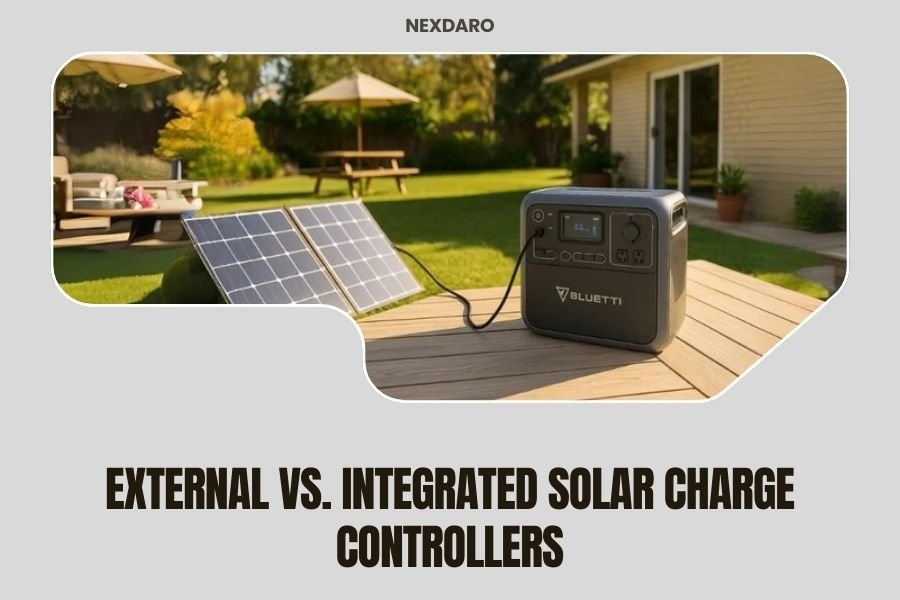
External solar charge controllers connect separately to your portable power station, while integrated controllers are built directly into the unit itself.
The main difference is flexibility: external controllers let you upgrade and customize your solar setup, but integrated ones offer simpler plug-and-play convenience.
When you’re shopping for a portable power station, you’ll face this choice pretty quickly. Should you get one with a built-in solar charge controller, or buy the controller separately?
Both options work well, but they serve different needs. Let me walk you through what I found when researching this topic.
What Are Solar Charge Controllers?
Think of a solar charge controller as a traffic cop for electricity. It manages the power flowing from your solar panels to your battery.
Without one, your panels could send too much voltage and fry your battery. Or they might not send enough power efficiently.
The controller keeps everything running smoothly. It prevents overcharging during sunny days and maximizes power collection when clouds roll in.
Two Main Types You’ll See
PWM controllers are the basic option. They’re cheaper but less efficient.
MPPT controllers cost more but harvest up to 30% more power from your panels. Most modern portable power stations use MPPT technology.
External Solar Charge Controllers Explained
External controllers live outside your power station. You connect them between your solar panels and battery with cables.
Many serious solar users prefer this setup. Why? You get complete control over your charging system.
Key Benefits of External Controllers
You can pick exactly the controller you want. Need something that handles 60 amps? No problem. Want advanced monitoring features? You got it.
Upgrading becomes simple. Your power station might last 10 years, but solar technology keeps improving. With an external controller, you can upgrade without replacing everything.
Troubleshooting gets easier too. If something breaks, you know exactly which component failed.
Flexibility in Solar Panel Choices
External controllers often accept higher voltages. This means you can use bigger panels or wire multiple panels in series.
I found that many integrated controllers limit you to specific panel types or brands. External ones open up your options.
Better Heat Management
Controllers generate heat when working hard. External units can be mounted in shaded, ventilated spots.
This keeps them cooler and extends their lifespan. Heat kills electronics faster than almost anything else.
Integrated Solar Charge Controllers Explained
Integrated controllers come built into your portable power station. Everything you need sits in one box.
This approach appeals to people who want simplicity. Plug in your panels and you’re ready to go.
Main Advantages of Integrated Systems
Setup takes minutes instead of hours. No figuring out wire gauges or fuse ratings. The manufacturer already matched everything perfectly.
You’ll carry fewer pieces when camping or traveling. One less thing to forget at home or lose in the field.
The price often works out better too. Buying everything together usually costs less than piecing it together.
Space and Weight Savings
Integrated units pack everything efficiently. No duplicate cases or mounting hardware.
For backpacking or RV trips where every ounce counts, this matters a lot.
Warranty and Support Benefits
When everything comes from one manufacturer, warranty claims get simpler. No pointing fingers between companies.
Customer support can help with your entire system instead of just one piece.
Performance Comparison
I researched performance data from several manufacturers and found some interesting patterns.
External controllers often charge batteries 10-15% faster in ideal conditions. They can handle more complex solar arrays and optimize better.
But integrated controllers have gotten much better recently. The gap is closing, especially in smaller systems.
Efficiency Differences
High-end external MPPT controllers can reach 99% efficiency. Most integrated controllers hit 95-97%.
That 2-4% difference adds up over time, but it might not matter for casual users.
Charging Speed Factors
External controllers can often accept more solar input. Some handle 1000+ watts while integrated ones max out around 400-600 watts.
If you want to charge quickly with lots of panels, external controllers win.
Cost Analysis
Let’s talk money. Which option costs more upfront and over time?
| Cost Factor | External Controller | Integrated Controller |
|---|---|---|
| Initial Purchase | $200-800+ for controller | Built into power station |
| Installation | DIY or $100-300 labor | Plug and play |
| Cables & Hardware | $50-150 extra | Usually included |
| Future Upgrades | Controller only | Entire unit replacement |
Long-Term Value Considerations
External controllers can outlast multiple power stations. A good one might serve you for 15-20 years.
Integrated controllers die with the power station. When the battery wears out, you lose everything.
Repair and Replacement Costs
External controller breaks? Replace it for $200-500. Integrated controller fails? You might need a whole new power station.
This becomes expensive with larger units that cost $2000+.
Installation and Setup
Installing external controllers requires some electrical knowledge. You’ll wire positive and negative connections, install fuses, and mount the unit.
Integrated controllers need zero installation. Unbox, plug in panels, and start charging.
Tools and Skills Needed
External setups require wire strippers, crimping tools, and a basic understanding of electrical safety.
You don’t need an electrician, but you should feel comfortable following wiring diagrams.
Safety Considerations
Both types are safe when installed correctly. External controllers need proper fusing and grounding.
Integrated units handle safety automatically. The manufacturer already tested everything together.
Maintenance Requirements
External controllers need occasional cleaning and connection checks. Dust and corrosion can cause problems over time.
Integrated controllers need almost no maintenance. They’re sealed and protected inside the power station.
Monitoring and Troubleshooting
Many external controllers offer detailed displays and smartphone apps. You can see exactly what’s happening with your solar system.
Integrated controllers often provide basic information through the power station’s display. Less detailed but usually sufficient.
Which Should You Choose?
Your choice depends on how you plan to use solar power.
Choose external controllers if you want maximum flexibility, plan to expand your system, or use solar heavily.
Pick integrated controllers if you want simplicity, portability, or use solar occasionally.
For Casual Users
Weekend campers and emergency backup users usually prefer integrated controllers. They’re simpler and more reliable for light use.
For Serious Solar Users
Full-time RVers, off-grid homesteaders, and solar enthusiasts often choose external controllers. The extra complexity pays off in performance and flexibility.
Budget Considerations
If you’re buying your first portable power station, integrated controllers make sense. You can always add external controllers later.
If you already own panels and accessories, external controllers might save money by using existing equipment.
Future-Proofing Your Investment
Solar technology keeps improving. New panel types and battery chemistries appear regularly.
External controllers adapt better to these changes. You can upgrade components separately as technology advances.
Integrated systems lock you into current technology. When something better comes along, you need to replace everything.
Compatibility with New Technologies
I found that external controllers typically support more panel types and voltage ranges. This compatibility helps as solar technology evolves.
Some integrated controllers only work with specific panels or voltages. This limits your options down the road.
Conclusion
Both external and integrated solar charge controllers have their place in portable power systems. Your choice comes down to priorities: flexibility versus simplicity.
External controllers offer better performance, upgradeability, and long-term value. But they require more knowledge and setup work.
Integrated controllers provide convenience, portability, and easier warranty support. They work great for most casual users.
Consider your experience level, budget, and how seriously you’ll use solar power. Either choice can serve you well when matched to your needs.
Can I add an external controller to a power station with an integrated one?
Yes, but you’ll bypass the internal controller completely. This wastes the integrated controller but gives you external flexibility. Make sure the power station allows direct battery connections before trying this.
Do external controllers work with all portable power stations?
Not always. Some power stations have sealed batteries that only accept charging through specific ports. Check your manual or contact the manufacturer before buying an external controller.
How much more efficient are external controllers really?
In real-world conditions, external controllers typically harvest 5-15% more power than integrated ones. The difference is biggest when using multiple panels or in partially shaded conditions.
What happens if my integrated controller breaks?
You’ll usually need professional repair or complete unit replacement. Some manufacturers offer repair services, but it often costs 40-60% of a new unit’s price.
Are there any safety differences between the two types?
Both are safe when properly installed. External controllers require correct fusing and grounding, while integrated controllers handle safety automatically. Poor external installation can create fire or shock hazards.
