
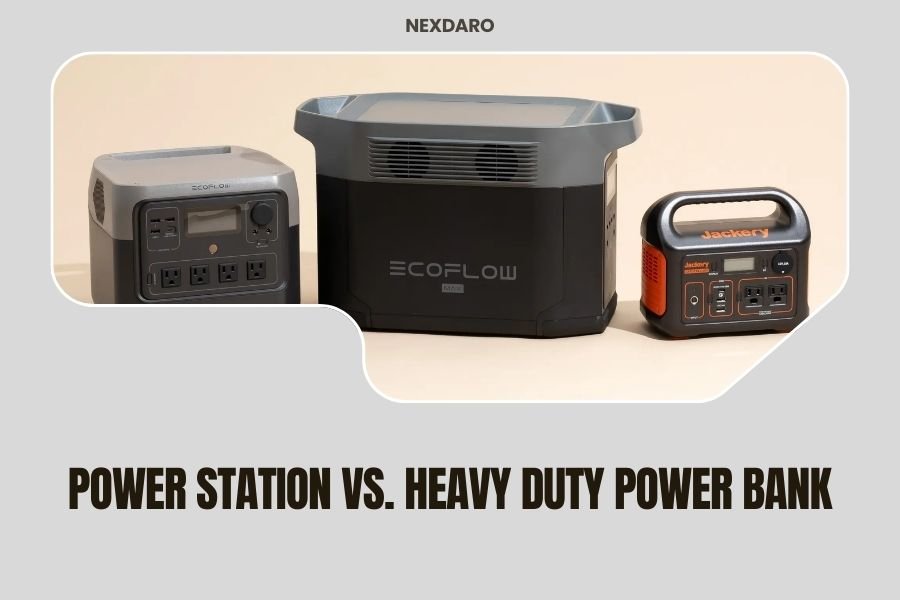
A power station offers more capacity and versatile outlets while a heavy duty power bank focuses on portability and USB charging for smaller devices.
The main difference between power station vs heavy duty power bank comes down to power output, device compatibility, and intended use cases.
What Makes Them Different
Think of a power station as a portable electrical outlet for your home. A heavy duty power bank is more like a supercharged phone charger.
Power stations typically range from 200Wh to 3000Wh capacity. Heavy duty power banks usually max out around 100Wh to 200Wh. That’s a big gap when you need to run multiple devices.
Size and Weight Reality Check
Power stations weigh anywhere from 5 to 80 pounds. You’re not slipping one into your backpack for a day hike.
Heavy duty power banks weigh 1 to 5 pounds. They fit in most bags without much thought. Perfect for air travel since most stay under the 100Wh airline limit.
Power Output Comparison
Here’s where things get interesting. Power stations can output 100W to 4000W of continuous power. Some can run refrigerators, power tools, or medical equipment.
Heavy duty power banks usually cap out at 65W to 100W output. Great for laptops and phones, but forget about running a coffee maker.
AC Power Outlets
Power stations come with standard wall outlets. You can plug in anything you’d use at home. No adapters needed.
Most heavy duty power banks stick to USB ports. Some newer models add a small AC outlet, but the power output stays limited.
USB-C Power Delivery
Both options now offer fast USB-C charging. Power stations often have multiple high-speed ports. Heavy duty power banks focus on optimizing their few ports.
Battery Technology Breakdown
Power stations typically use lithium iron phosphate (LiFePO4) batteries. These last 2000 to 6000 charge cycles. They’re safer and more stable.
Heavy duty power banks often use standard lithium-ion batteries. You’ll get 500 to 1000 charge cycles before capacity drops significantly.
Charging Speed Differences
Power stations take 1 to 8 hours to fully charge from empty. Large units need more time. Some support fast charging from car outlets or solar panels.
Heavy duty power banks charge in 2 to 6 hours. Their smaller batteries fill up faster. Most support fast charging through USB-C.
Best Use Cases for Power Stations
Power stations shine for camping trips, RV living, and emergency backup. You can run lights, fans, small appliances, and charge multiple devices simultaneously.
I found that many RV owners prefer power stations for off-grid adventures. They provide reliable power for 2-3 days without hookups.
Home Emergency Backup
During power outages, a good power station keeps your essentials running. WiFi routers, medical devices, phones, and small appliances stay operational.
Some models connect to your home’s electrical panel. They automatically kick in when the grid goes down.
Construction and Work Sites
Power stations work great for outdoor work. You can run tools, charge equipment, and power lights without finding electrical outlets.
Many contractors choose power stations over gas generators. They’re quieter, need less maintenance, and work indoors safely.
Best Use Cases for Heavy Duty Power Banks
Heavy duty power banks excel for travel, daily commutes, and mobile work. They keep your devices charged without weighing you down.
Business travelers love them for long flights and airport layovers. One power bank can charge a laptop 2-3 times and a phone 10+ times.
Outdoor Activities
For hiking, biking, or day trips, heavy duty power banks make more sense. They provide enough power for GPS devices, cameras, and phones without bulk.
I researched feedback from backpackers who prefer power banks for multi-day hikes. Every ounce matters when you’re carrying everything.
College and Office Use
Students and remote workers appreciate portable charging. Heavy duty power banks charge laptops during long study sessions or meetings.
They’re perfect for coffee shops, libraries, or outdoor workspaces where outlets aren’t available.
Cost Analysis
Power stations range from $200 to $4000 depending on capacity and features. Entry-level units start around $300 for basic needs.
Heavy duty power banks cost $50 to $300. You get solid performance for under $150 in most cases.
Value Per Watt Hour
Power stations often offer better value for raw capacity. You pay less per Wh when buying larger units.
Heavy duty power banks cost more per Wh but offer better portability value. You’re paying for convenience and compact design.
| Feature | Power Station | Heavy Duty Power Bank |
|---|---|---|
| Capacity Range | 200Wh – 3000Wh | 50Wh – 200Wh |
| Weight | 5 – 80 lbs | 1 – 5 lbs |
| AC Outlets | 1 – 6 outlets | 0 – 1 outlet |
| Price Range | $200 – $4000 | $50 – $300 |
Charging Methods
Power stations offer multiple charging options. Wall outlets, car chargers, and solar panels all work. Some units charge from multiple sources simultaneously.
Heavy duty power banks typically charge through USB-C or proprietary adapters. Solar charging exists but isn’t as common or efficient.
Solar Compatibility
Most power stations accept 50W to 400W solar input. You can stay off-grid indefinitely with enough solar panels.
Heavy duty power banks with solar usually max out at 10W to 20W input. It’s more of a backup charging method than a primary option.
Safety Features
Power stations include advanced battery management systems. They protect against overcharging, overheating, and short circuits.
Heavy duty power banks have similar protections but in simpler forms. The lower power output creates fewer safety risks.
Temperature Management
Power stations often have cooling fans and temperature sensors. They shut down automatically if things get too hot.
Power banks rely on passive cooling and thermal protection circuits. They’re less likely to overheat due to lower power draw.
Making Your Choice
Choose a power station if you need to run household appliances, work tools, or multiple devices for extended periods. They’re perfect for base camps, RVs, or emergency preparedness.
Pick a heavy duty power bank if portability matters most. They’re ideal for travel, daily carry, or powering smaller electronics on the go.
Budget Considerations
Start with your actual power needs. Don’t buy more capacity than you’ll use. A smaller power station might cost the same as a large power bank but offer more versatility.
Consider cost per use over several years. Power stations last longer and handle more charge cycles, potentially offering better long-term value.
Conclusion
The choice between a power station and heavy duty power bank depends on your specific needs. Power stations excel when you need serious power output, multiple outlets, and extended runtime. Heavy duty power banks win when portability, travel convenience, and personal device charging matter most.
Think about where and how you’ll actually use your portable power solution. Both have their place, and many people end up owning both for different situations. Start with the option that matches your most common use case, then expand from there if needed.
Can I bring either device on airplanes?
Most heavy duty power banks under 100Wh can fly in carry-on bags. Power stations exceed airline limits and cannot be brought on commercial flights.
How long do these devices hold their charge when not in use?
Power stations typically lose 10-20% charge per month in storage. Heavy duty power banks lose 5-15% monthly, with newer models having better standby performance.
Can I use either device while they’re charging?
Most power stations support pass-through charging, letting you use them while plugged in. Many heavy duty power banks also offer this feature, though it may slow charging speed.
What’s the lifespan difference between these options?
Power stations with LiFePO4 batteries last 2000-6000 cycles, often 8-10 years. Heavy duty power banks typically last 500-1000 cycles, around 3-5 years with regular use.
Are there waterproof or rugged versions available?
Some power stations offer weather-resistant cases but few are truly waterproof. Heavy duty power banks come in more rugged, waterproof options due to their smaller size and simpler construction.
