
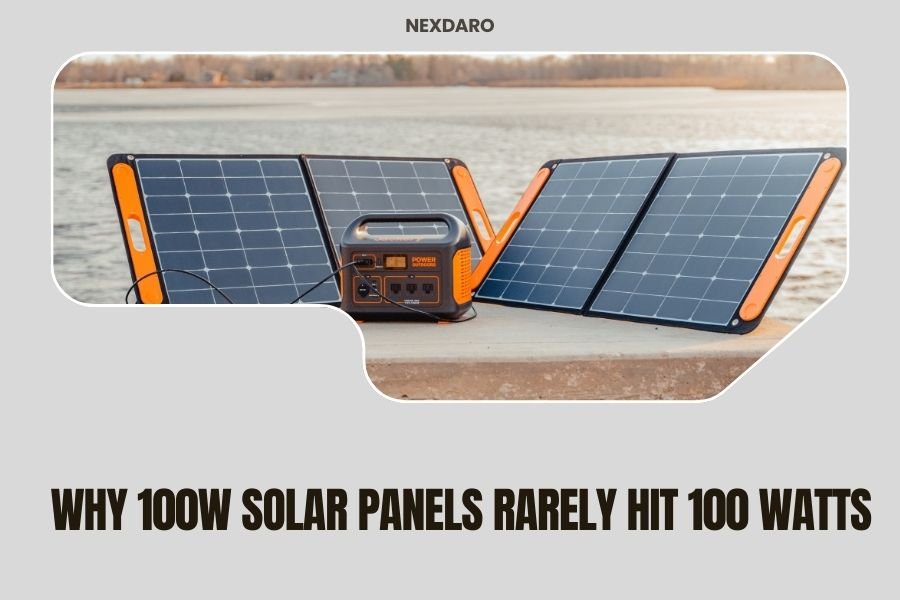
100W solar panels rarely produce their full rated power because real-world conditions never match the perfect laboratory testing standards used for ratings.
Your 100W solar panel will typically generate between 70-85 watts under normal outdoor conditions due to temperature, shading, and angle factors.
The Truth About Solar Panel Power Ratings
You bought a 100W solar panel expecting to get 100 watts of power. But when you test it outside, you’re getting 80 watts on a good day. What gives?
The answer lies in how manufacturers test solar panels. They use something called Standard Test Conditions (STC) in their labs. Think of it like testing a car’s gas mileage on a perfectly flat road with no wind and ideal weather.
Standard Test Conditions Explained
Manufacturers rate solar panels under these perfect lab conditions:
- Solar irradiance of 1,000 watts per square meter
- Cell temperature of exactly 77°F (25°C)
- Air mass of 1.5 (specific atmospheric conditions)
- No shading or obstructions
These conditions almost never happen in real life. It’s like expecting your car to get perfect gas mileage in stop-and-go traffic.
Why Your Solar Panel Underperforms
Temperature Impact on Solar Output
Here’s something that surprises many people: solar panels work worse when they get hot. I found that most solar panels lose about 0.4% of their power for every degree above 77°F.
On a hot summer day when your panel reaches 140°F, you could lose 25% of your power output. That 100W panel might only produce 75 watts because of heat alone.
Why Heat Hurts Solar Performance
Solar panels are like electronic devices. When they heat up, their internal resistance increases. This creates a bottleneck that reduces power flow.
Cold weather actually helps solar panels work better. You might see higher output on crisp winter days with bright sun.
Sun Angle and Intensity Issues
The sun’s position changes throughout the day and seasons. Your panel gets maximum power when the sun hits it at a perfect 90-degree angle.
Research shows that even a 15-degree angle difference can reduce output by 5-10%. As the sun moves across the sky, your panel’s efficiency changes constantly.
Time of Day Affects Power Output
You’ll see peak performance around noon when the sun is highest. Morning and evening hours produce much less power, even on clear days.
I came across data showing that solar panels typically produce their rated power for only 2-3 hours per day under ideal conditions.
Shading Problems You Might Not Notice
Even tiny shadows can hurt your solar panel’s performance. A shadow covering just 10% of your panel can reduce output by 50% or more.
This happens because solar cells are wired in series. When one cell gets shaded, it acts like a clog in a pipe, reducing flow through the entire panel.
Common Shading Culprits
- Tree branches and leaves
- Clouds passing overhead
- Building shadows
- Dirt and bird droppings
- Your own body when checking the panel
Environmental Factors That Reduce Output
Weather Conditions Matter
Cloudy days obviously reduce solar output, but you might still get surprised by how much. Light clouds can cut your power by 20-30%. Heavy clouds might reduce it by 80% or more.
Humidity also plays a role. Water vapor in the air filters sunlight before it reaches your panel.
Dust and Debris Build-Up
Your solar panel collects dust, pollen, and grime over time. This creates a film that blocks sunlight from reaching the solar cells underneath.
Studies suggest that dirty panels can lose 15-25% of their efficiency. In dusty areas, this happens faster.
Cleaning Makes a Real Difference
Regular cleaning can restore much of your lost power. Use water and a soft brush to avoid scratching the surface.
Many people see immediate improvements after cleaning panels that haven’t been maintained for months.
Technical Losses in Your Solar Setup
Wiring and Connection Losses
Every connection in your solar system creates a small power loss. Wires have resistance that converts some electricity into heat instead of useful power.
Long wire runs between your panel and battery can lose 5-10% of your power. Cheap or corroded connections make this worse.
Charge Controller Efficiency
Your charge controller manages power flow from the panel to your battery. Even good controllers aren’t 100% efficient.
PWM controllers typically run at 75-85% efficiency. MPPT controllers do better at 95-98%, but they still create some losses.
Inverter Losses Add Up
If you’re converting DC power to AC power, your inverter adds another 5-15% loss depending on its quality and load.
Realistic Power Expectations
What to Actually Expect
Under typical conditions, your 100W panel will produce:
| Conditions | Expected Output | Percentage of Rating |
|---|---|---|
| Perfect sunny day, clean panel | 85-95 watts | 85-95% |
| Good sunny day, normal conditions | 70-85 watts | 70-85% |
| Partly cloudy day | 40-60 watts | 40-60% |
| Overcast day | 10-25 watts | 10-25% |
Planning Your Power Needs
When sizing a solar system, plan for real-world performance, not rated power. If you need 100 watts of actual power, consider buying a 120-130W panel.
This gives you headroom for all the efficiency losses we’ve discussed.
How to Get Better Performance
Panel Positioning Tips
Point your panel directly at the sun when possible. If you can’t adjust it throughout the day, face it south (in the Northern Hemisphere) at an angle equal to your latitude.
Tilting your panel helps shed dust and rain, keeping it cleaner automatically.
Avoid Hot Mounting Surfaces
Don’t mount panels flat against hot surfaces like metal roofs. Leave air space underneath for cooling.
Better cooling means better performance and longer panel life.
System Optimization Strategies
Use quality wiring and keep runs as short as possible. Invest in an MPPT charge controller instead of PWM for better efficiency.
Check connections regularly for corrosion or looseness. Clean terminals help maintain good power flow.
Consider Multiple Smaller Panels
Sometimes two 50W panels work better than one 100W panel. If one gets shaded, the other keeps producing power.
Seasonal Performance Variations
Summer vs Winter Output
Summer brings longer days but also heat that reduces panel efficiency. Winter days are shorter but panels run cooler and more efficiently.
You might be surprised to find that spring and fall often give the best daily power totals.
Geographic Location Matters
Your location affects both sun intensity and seasonal variations. Areas closer to the equator get more consistent year-round power.
Northern locations see bigger swings between summer and winter production.
Conclusion
Your 100W solar panel isn’t broken or defective when it produces less than 100 watts. It’s working exactly as designed under real-world conditions that differ from laboratory testing standards.
Understanding these limitations helps you set realistic expectations and plan your solar system properly. Focus on maximizing what you can control: panel positioning, cleanliness, and system efficiency. Accept what you can’t control: weather, seasonal changes, and the laws of physics.
Remember that even at 70-80% of rated power, your solar panel is still providing clean, free energy from the sun. That’s pretty amazing when you think about it.
Why don’t solar panels work at night?
Solar panels need photons from sunlight to generate electricity through the photovoltaic effect. Without light, there’s no energy source to convert, so panels produce zero power at night.
Can I damage my solar panel by expecting too much power from it?
No, you can’t damage a solar panel by expecting more power than it can produce. Panels naturally limit their own output based on available sunlight and conditions. They won’t overheat or break from power demands.
Do expensive solar panels perform closer to their ratings?
Higher-quality panels typically have better temperature coefficients and more accurate power ratings, but they still face the same real-world limitations. The difference might be 5-10% better performance, not dramatically higher output.
Should I buy a bigger panel to compensate for efficiency losses?
Yes, buying a panel 20-30% larger than your calculated needs accounts for real-world efficiency losses and provides more consistent power output throughout different conditions and seasons.
How often should I clean my solar panels for best performance?
Clean panels every 2-3 months in normal conditions, or monthly in dusty environments. You’ll notice immediate power improvements after cleaning panels that haven’t been maintained for several months.
