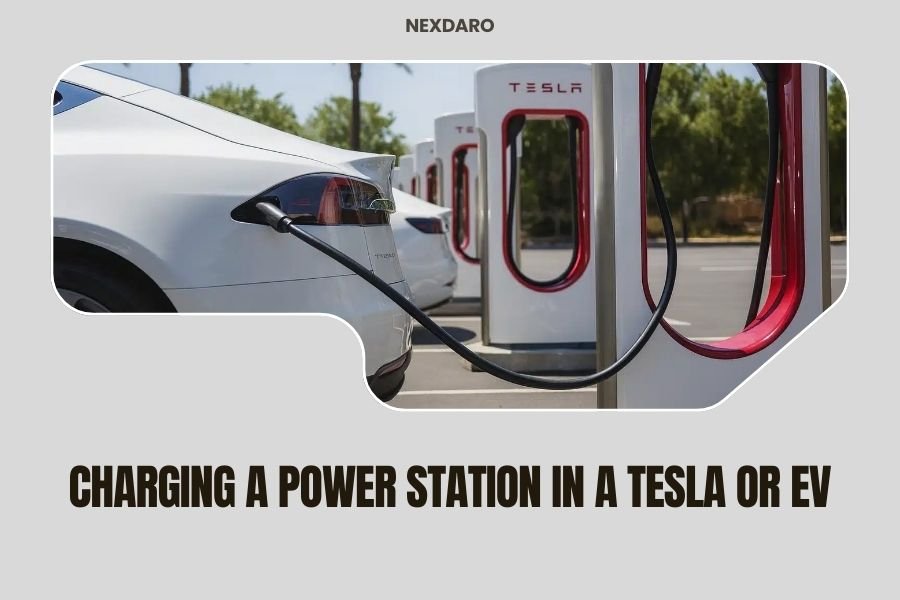
Yes, you can charge a power station in a Tesla or any EV using the 12V DC outlet or by connecting to the vehicle’s main battery system with proper equipment.
Charging a power station in a Tesla works best through the 12V accessory port, though you’ll need to keep the car awake to maintain consistent power flow.
Why Charge Your Power Station in an EV?
Your Tesla or EV carries a massive battery pack. Why not tap into that power for your portable station?
I found that many EV owners use this setup for camping trips. You get extended off-grid power without running a gas generator. Your car becomes a mobile charging hub.
The math works in your favor too. A Tesla Model 3 Long Range holds about 75 kWh of energy. That’s enough to fully charge most power stations 15-20 times over.
Understanding Your Tesla’s Power Options
Your Tesla offers several ways to access its stored energy. Each method has different power limits and quirks.
The 12V Accessory Port
Every Tesla has a 12V outlet in the center console. This port delivers up to 120-150 watts of power.
The catch? Your Tesla might go to sleep after 15-20 minutes of inactivity. When it sleeps, the 12V port stops working.
You’ll need to keep the car awake by turning on Camp Mode or keeping the climate system running.
USB Ports for Smaller Stations
Your Tesla’s USB ports put out 5V at 2.1 amps each. That’s only about 10 watts per port.
This works for tiny power banks, but forget about charging any serious power station this way. You’d be waiting days for a full charge.
Direct DC Connection Methods
Some people connect directly to the 12V battery system under the hood. This requires special adapters and technical knowledge.
I found online that this method can deliver 200-400 watts, but it voids warranties and carries safety risks if done wrong.
Best Power Stations for EV Charging
Not every power station plays nice with EV charging. You need one that accepts 12V DC input efficiently.
Look for These Features
- 12V DC input port (car charger compatible)
- High charging efficiency (85% or better)
- Pass-through charging capability
- Low idle power consumption
Capacity Sweet Spot
I researched charging times and found the sweet spot is 300-800 watt-hour stations. These charge in 3-6 hours through your 12V port.
Bigger stations work too, but you’re looking at 8-12 hour charging times. Plan your stops accordingly.
Step-by-Step Charging Process
Ready to charge your power station? Here’s how to do it right.
Before You Start
Check your Tesla’s battery level. Keep it above 30% to avoid range anxiety. Your power station will use 5-15% of your car’s total battery for a full charge.
Setting Up the Connection
Plug your power station’s car charger into the 12V outlet. Make sure the connection feels solid.
Turn on Camp Mode in your Tesla. This keeps all systems awake and prevents charging interruptions.
Monitoring the Process
Watch both your power station’s display and your Tesla’s energy screen. You should see steady power draw of 120-150 watts.
If the charging stops unexpectedly, your Tesla probably went to sleep. Wake it up by touching the screen or adjusting the climate.
Charging Times and Efficiency
Let’s talk real numbers. How long will this actually take?
Small Stations (200-400 Wh)
- Charging time: 2-4 hours
- Tesla battery used: 2-4%
- Range lost: 5-10 miles
Medium Stations (500-800 Wh)
- Charging time: 4-7 hours
- Tesla battery used: 4-7%
- Range lost: 12-20 miles
Large Stations (1000+ Wh)
- Charging time: 8-12 hours
- Tesla battery used: 8-15%
- Range lost: 25-45 miles
These numbers assume 80% charging efficiency. Real-world results vary based on temperature and your specific equipment.
Other EVs and Power Station Charging
Own a different EV? The same principles apply, with some variations.
Ford Lightning and EV Trucks
The Ford F-150 Lightning has built-in 120V outlets that put out up to 2.4 kW. This charges power stations much faster than Tesla’s 12V port.
You can fully charge even large power stations in 1-3 hours using these outlets.
Rivian and Other Adventure EVs
Rivian trucks come with 120V outlets and a “Camp Mode” similar to Tesla. The charging process works the same way.
I found that most adventure-focused EVs prioritize power export features for exactly this kind of use.
Standard EVs (Leaf, Bolt, etc.)
Most regular EVs only have 12V outlets like Tesla. The charging times and methods match what I described earlier.
Some newer models add 120V outlets as options. Check your owner’s manual for power ratings.
Maximizing Efficiency Tips
Want to squeeze every watt out of your setup? Try these tricks.
Temperature Matters
Charge when it’s cool outside. Hot batteries are less efficient, and your Tesla’s cooling system will eat extra power.
I heard from experts that charging in 60-75°F weather gives the best results.
Use Camp Mode Wisely
Camp Mode keeps everything awake, but it also runs the air conditioning. Turn off climate control if you don’t need it.
You can also try “Theater Mode” as an alternative that uses less background power.
Monitor Phantom Loads
Your Tesla draws power for computers, displays, and other systems even when “sleeping.” This phantom load is usually 1-5 watts.
Long charging sessions can waste 10-50 watt-hours on these background systems.
Safety Considerations
Charging power stations in EVs is generally safe, but follow these guidelines.
Ventilation and Heat
Power stations generate heat while charging. Don’t stuff them in closed compartments.
Keep air flowing around the unit. Your Tesla’s cabin fan helps with this.
Cable Management
Don’t run charging cables where people might trip. Route them along the floor or under seats.
Avoid pinching cables in doors or seat tracks. Damaged wires create fire risks.
Battery Protection
Never let your Tesla’s main battery drop below 10% while charging accessories. You need reserve power for emergencies.
Set charging limits on your power station if possible. Most units stop automatically when full.
Cost Analysis
Is this cheaper than other charging methods? Let’s break down the numbers.
Electricity Costs
If you charged your Tesla at home for $0.13 per kWh, using that power for your portable station costs the same rate.
Charging a 500Wh power station costs about $0.07 in electricity. That’s much cheaper than buying disposable batteries.
Compared to Solar Charging
Solar panels for power stations cost $200-500. Your Tesla method has zero extra equipment costs if you already own the car charger.
Solar wins for extended off-grid stays. EV charging wins for quick overnight stops.
Troubleshooting Common Issues
Running into problems? Here are the most common fixes.
Charging Keeps Stopping
This usually means your Tesla went to sleep. Enable Camp Mode or Sentry Mode to keep it awake.
Some power stations also pause charging when they detect voltage drops. Try a different 12V cable.
Slow Charging Speeds
Your 12V outlet might be current-limited. Tesla limits power to prevent overheating.
Hot weather makes this worse. Try charging when it’s cooler, or run the AC to cool the cabin.
Power Station Won’t Start Charging
Check that Camp Mode is active first. Then verify your charging cable works with other 12V devices.
Some power stations need a minimum voltage to start charging. Your Tesla’s 12V system might be running low.
Alternative Solutions
EV charging isn’t your only option. Consider these alternatives too.
Portable Solar Panels
100-200 watt solar panels charge power stations in 3-8 hours of good sun. They work anywhere, not just near your car.
The downside is weather dependence. Cloudy days mean slow or no charging.
Wall Charging at Destinations
Many campgrounds and RV parks have 120V outlets. These charge power stations faster than 12V car adapters.
Hotels and Airbnbs work too if you’re doing a road trip.
Portable Gas Generators
Small generators put out 1000+ watts and charge power stations quickly. But they’re noisy, need fuel, and produce emissions.
Save generators for emergencies or places where quiet operation doesn’t matter.
Conclusion
Charging your power station in a Tesla or EV opens up new possibilities for off-grid adventures. The 12V method works reliably, though it’s slower than wall charging. Plan for 4-8 hours to fully charge most stations.
Your EV’s massive battery pack makes this practical for weekend trips and emergency backup. Just remember to keep your car awake during charging and maintain enough range for your drive home.
The setup costs nothing extra if you already have a car charger cable. For occasional use, it beats buying solar panels or generators.
Can I damage my Tesla by charging a power station?
No, charging through the 12V port is safe and designed for this kind of use. Tesla builds in current limiting to prevent damage. Just avoid direct battery connections unless you’re an experienced technician.
How much range do I lose charging a 1000Wh power station?
You’ll lose about 25-35 miles of range, depending on your Tesla model. A Model S loses less range than a Model 3 due to its larger battery pack. Plan your charging stops around Supercharger locations.
Will this work while driving?
Yes, the 12V port stays active while driving. This is actually more efficient since you’re not running Camp Mode. Just secure your power station properly so it doesn’t become a projectile during sudden stops.
What’s the fastest way to charge a power station in an EV?
Ford Lightning and similar trucks with 120V outlets are fastest, charging most stations in 1-3 hours. Tesla’s 12V port is slower but still practical. Some people add power inverters, but this adds complexity and potential failure points.
Can I charge multiple power stations at once?
Only if their combined power draw stays under 150 watts. Most car chargers pull 100-120 watts each, so you’ll overload the circuit. Use a power splitter designed for 12V automotive use, and expect slower charging for each unit.