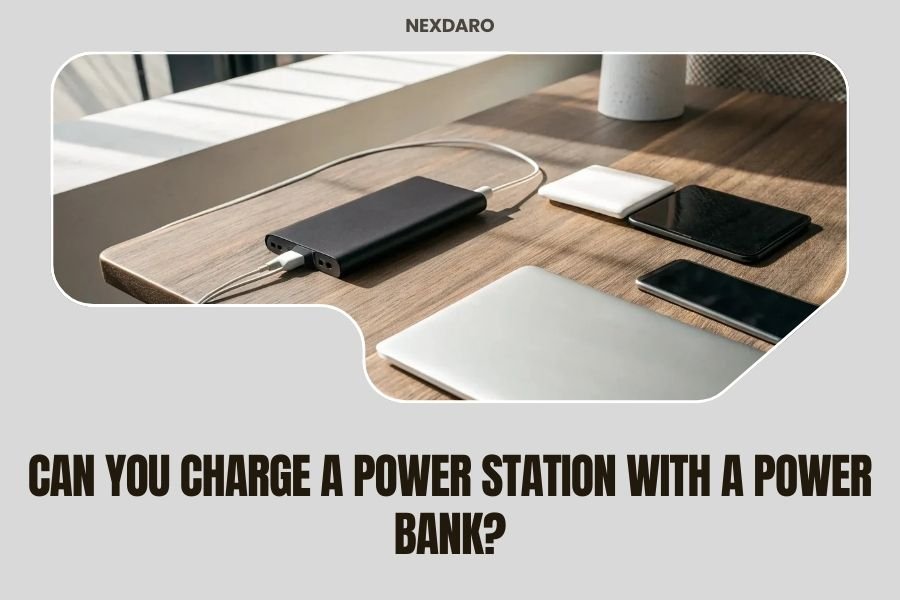
Yes, you can charge a power station with a power bank, but only if both devices support compatible charging methods and the power bank has enough capacity.
The power bank must output sufficient voltage and current that matches your power station’s input requirements, typically through USB-C PD or DC output ports.
What You Need to Know Before Charging
Charging a power station with a power bank sounds simple, but it’s not always straightforward. Think of it like trying to fill a swimming pool with a bucket – it can work, but you need the right setup.
Your power bank needs to deliver enough juice to actually charge your power station. Most power banks output 5V to 20V, while power stations often need higher voltages to charge efficiently.
Power Output Requirements
I researched power station charging specs and found that most units need at least 60W input for meaningful charging. Many power banks only output 18W to 30W through their ports.
Your power bank should support USB-C Power Delivery (PD) or have a DC output port. Regular USB ports won’t cut it for most power stations.
Voltage Matching
Check your power station’s input voltage range. If it accepts 12V to 24V DC input, your power bank needs to output within that range.
Mismatched voltages can damage both devices. When in doubt, check the manual or contact the manufacturer.
Current Capacity
Your power bank’s current output (measured in amps) determines charging speed. Higher current means faster charging, assuming voltage compatibility.
Most portable power banks deliver 2A to 5A maximum. Power stations often prefer 5A or higher for optimal charging.
Compatible Charging Methods
Not all charging connections work the same way. Here’s what actually works in real-world situations.
USB-C Power Delivery
USB-C PD is your best bet for charging compatibility. Many modern power stations accept USB-C PD input up to 100W.
I found that power banks with 65W or 100W USB-C PD output can charge smaller power stations effectively. Look for power banks that specifically mention high-wattage PD support.
PD Protocol Versions
USB-C PD 2.0 supports up to 100W, while PD 3.0 can go higher. Both devices need to support the same protocol for optimal performance.
Most quality power banks and power stations from 2020 onward support at least PD 2.0.
DC Barrel Connections
Some high-capacity power banks include DC output ports. These often provide higher voltage and current than USB ports.
You’ll need the right cable or adapter to connect your power bank’s DC output to your power station’s DC input port.
Cable Considerations
DC cables come in different barrel sizes and polarities. Using the wrong cable can damage your equipment.
Always verify the cable specifications match both devices before connecting.
Power Bank Size Requirements
Size matters when charging power stations. Your power bank needs enough stored energy to make a meaningful difference.
Capacity Calculations
Power banks are rated in mAh (milliamp hours), while power stations use Wh (watt hours). Converting between these helps you plan better.
To convert: (mAh × Voltage) ÷ 1000 = Wh. A 20,000mAh power bank at 3.7V contains about 74Wh of energy.
| Power Bank Capacity | Estimated Wh | Power Station Charge |
|---|---|---|
| 20,000mAh | 74Wh | 15-25% for 300Wh station |
| 30,000mAh | 111Wh | 25-35% for 300Wh station |
| 50,000mAh | 185Wh | 45-60% for 300Wh station |
Efficiency Losses
Energy transfer isn’t 100% efficient. Expect 15-25% loss during charging due to heat and conversion losses.
This means your 20,000mAh power bank might only deliver 60Wh of usable energy to your power station.
Minimum Recommended Sizes
For small power stations (under 200Wh), use power banks with at least 30,000mAh capacity.
Larger power stations (500Wh+) need massive power banks (50,000mAh+) to see meaningful charging.
Real-World Performance
Theory is nice, but how does this work when you’re actually camping or during a power outage?
Charging Speed Reality
I came across user reports showing that charging a 300Wh power station with a 30,000mAh power bank takes 4-6 hours.
That’s assuming both devices support fast charging protocols and you’re using quality cables.
Temperature Effects
Cold weather slows charging significantly. Both power banks and power stations lose efficiency below 50°F.
Hot weather can also trigger thermal protection, reducing charging speeds to prevent overheating.
Practical Use Cases
Charging works best as an emergency backup or for topping off smaller power stations.
Don’t expect to fully charge a large power station from empty. Think of it as extending runtime rather than complete charging.
Best Scenarios
This setup works great for:
- Emergency phone charging when your power station is nearly dead
- Extending camping trips by a day or two
- Keeping essential devices running during short power outages
- Backing up small power stations for critical medical devices
Safety Considerations
Mixing different battery technologies and voltages can create safety risks if done incorrectly.
Overheating Prevention
Both devices generate heat during charging. Keep them in well-ventilated areas and avoid direct sunlight.
If either device feels uncomfortably hot, disconnect immediately and let them cool down.
Charging Surface
Place both devices on hard, non-flammable surfaces during charging. Avoid beds, couches, or other soft materials that trap heat.
I read safety guidelines recommending at least 6 inches of clearance around each device during charging.
Cable Quality Matters
Cheap cables can overheat or fail during high-power charging. Use cables rated for the power levels you’re working with.
Quality USB-C cables should be marked with their power rating (60W, 100W, etc.).
Connection Monitoring
Check connections periodically during charging. Loose connections can arc or overheat.
If you smell burning or see sparks, disconnect everything immediately and inspect for damage.
Alternative Solutions
Sometimes other charging methods work better than using a power bank.
Solar Panel Options
Portable solar panels often charge power stations more effectively than power banks.
A 100W solar panel can deliver more sustained power than most power banks, assuming decent sunlight.
Solar vs Power Bank Comparison
Solar panels work indefinitely with sun, while power banks drain completely after one use.
Power banks work instantly regardless of weather, while solar needs good conditions.
Car Charging
Your vehicle’s 12V outlet or USB ports can charge power stations more efficiently than most power banks.
Car alternators provide much higher sustained power than battery-powered devices.
Vehicle Power Limitations
Most car 12V outlets are fused at 10-15 amps, limiting power to about 120-180W.
This still beats most power banks for sustained charging capability.
Product Compatibility Examples
Some combinations work better than others based on real user experiences I found online.
Small Power Station Charging
Power stations under 300Wh often accept USB-C PD input, making them easier to charge with power banks.
Many experts recommend high-capacity power banks (40,000mAh+) with 100W USB-C PD for these smaller units.
Large Power Station Challenges
Power stations over 500Wh typically need proprietary charging ports or high-voltage DC input.
Most consumer power banks can’t provide the voltage or current these larger units require.
Cost-Effectiveness Analysis
Is buying a massive power bank to charge your power station actually worth it?
Financial Comparison
High-capacity power banks cost $150-400, while equivalent solar panels cost $100-250.
Solar panels provide unlimited charging potential, while power banks need recharging after each use.
Long-term Value
Power banks degrade over time, losing 20-30% capacity after 2-3 years of regular use.
Solar panels can last 10-20 years with minimal performance loss.
Conclusion
You can charge a power station with a power bank, but success depends on compatible ports, sufficient power output, and realistic expectations. This setup works best for emergency situations or extending the runtime of smaller power stations rather than providing complete charging solutions.
Consider your specific needs, device compatibility, and alternative charging methods before investing in high-capacity power banks for this purpose. Solar panels or vehicle charging often provide better long-term value and more reliable performance.
Can I damage my power station by using the wrong power bank?
Yes, using a power bank with incorrect voltage output can damage your power station’s charging circuit. Always verify voltage compatibility and use quality cables rated for the power levels involved.
How long does it take to charge a power station with a power bank?
Charging time varies greatly based on capacities and power output. Expect 4-8 hours to partially charge a 300Wh power station with a 30,000mAh power bank, assuming compatible fast-charging protocols.
What’s the minimum power bank size worth using for power station charging?
For meaningful charging, use power banks with at least 30,000mAh capacity and 60W+ output. Smaller power banks won’t provide enough energy transfer to justify the time and effort involved.
Do power banks work better than solar panels for charging power stations?
Power banks provide instant charging regardless of weather but only work once before needing recharging themselves. Solar panels require good sunlight but provide unlimited charging potential and better long-term value.
Can I leave my power station connected to a power bank overnight?
Most modern devices have built-in charging protection, but it’s safer to monitor the charging process. Disconnect once charging completes to prevent potential overheating or energy waste from standby power consumption.