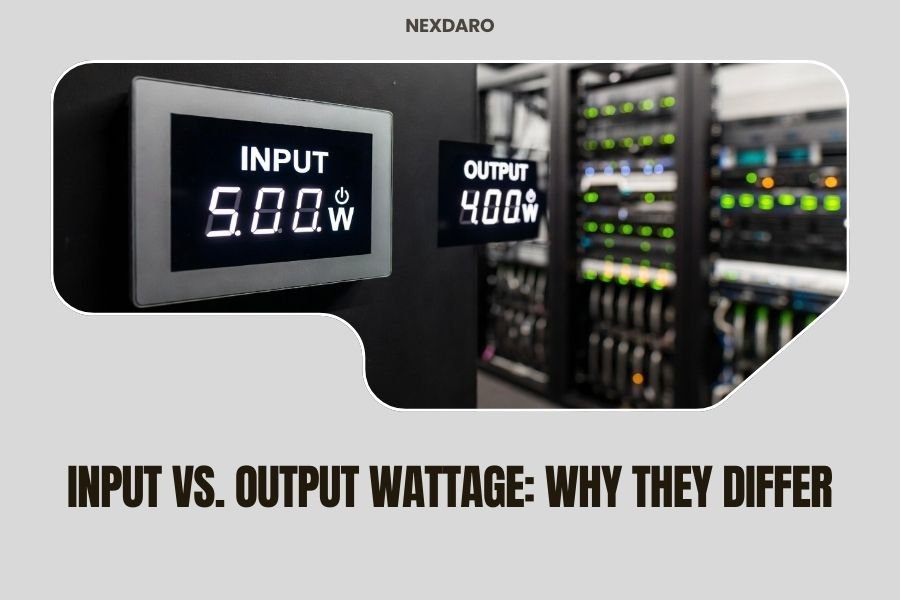
Input wattage refers to the power your portable power station draws from the wall outlet or solar panels to charge its battery, while output wattage is the maximum power it can deliver to your devices.
The difference between input vs. output wattage exists because energy gets lost during conversion processes, battery charging inefficiencies, and heat generation inside the power station.
Understanding the Basic Power Flow
Think of your portable power station like a water tank with pipes. The input pipe fills the tank, and the output pipe drains it. Just like water pressure differs between these pipes, power flows differently too.
When you plug your power station into the wall, electricity flows in at the input wattage rate. This charges the internal battery. Later, when you plug in devices, electricity flows out at the output wattage rate.
What Happens During Charging
Your power station doesn’t just store electricity like a bucket. It transforms AC power from your wall outlet into DC power for the battery. This conversion process wastes some energy as heat.
I found that most power stations lose about 10-15% of energy during this charging process. So if your unit has 500W input, only about 425-450W actually reaches the battery.
What Happens During Discharge
When you use your power station, another conversion happens. The DC power from the battery gets converted back to AC power for your devices. Again, some energy becomes heat instead of useful power.
This explains why your 1000Wh battery might only power a 100W device for 8-9 hours instead of 10 hours. Energy conversion isn’t perfect.
Why Input Wattage Matters for You
Input wattage controls how fast your power station charges. Higher input wattage means shorter charging times. It’s that simple.
A 200W input takes about 5 hours to charge a 1000Wh battery. A 600W input cuts that down to roughly 2 hours. But you’ll pay more for faster charging capability.
Wall Charging vs. Solar Charging
Most power stations accept different input wattages from different sources. Wall charging usually offers the highest input wattage. Solar charging typically provides much lower input wattage.
From what I read, solar input often ranges from 100-400W, while wall input can reach 600-1000W or more. This explains why solar charging takes much longer.
Multiple Input Methods
Many newer power stations let you combine input sources. You can charge from the wall and solar panels at the same time. This adds their wattages together for faster charging.
Some units even accept car charging through the 12V outlet. Each input method has its own wattage rating and speed.
Why Output Wattage Matters More
Output wattage determines what devices you can actually run. This matters more than input wattage for most people.
Can you power a microwave? A hair dryer? Multiple devices at once? Output wattage answers these questions.
Continuous vs. Peak Output
Power stations list two output numbers: continuous and peak (or surge) output. Continuous output runs indefinitely. Peak output lasts only a few seconds.
Many experts say focus on continuous output for planning. Peak output helps with devices that need extra power to start up, like refrigerators or power tools.
AC vs. DC Output
Your power station provides both AC outlets (like wall plugs) and DC outlets (like USB ports and 12V sockets). Each type has different output limits.
AC output usually offers the highest wattage. DC outputs typically handle lower wattage devices like phones, tablets, and LED lights.
The Efficiency Factor
Efficiency explains the gap between input and output wattage. No power station operates at 100% efficiency. Energy always gets lost somewhere.
Research shows most quality portable power stations operate at 85-95% efficiency. Cheaper units might drop to 70-80% efficiency.
What Causes Energy Loss
Several factors steal energy inside your power station:
- Heat generation during power conversion
- Battery charging and discharging losses
- Internal electronics consuming standby power
- Cooling fans using energy
- Display screens and LED indicators
Temperature Effects on Efficiency
Hot weather reduces efficiency. Cold weather also hurts performance, especially for lithium batteries.
I found online that extreme temperatures can drop efficiency by 20% or more. Keep your power station in moderate temperatures when possible.
Real-World Examples
Let me show you how input vs. output wattage works with actual scenarios you might face.
Camping Weekend Scenario
You bring a 1000Wh power station with 600W input and 1000W output. You want to power a 150W mini-fridge continuously.
The output wattage easily handles the fridge. But charging takes about 2 hours from empty using wall power before your trip.
Emergency Backup Scenario
Power goes out. You need to run a 800W space heater. Your power station has 1000W output, so it works.
But you can’t recharge from the wall during the outage. Solar input at 200W would take 6+ hours to fully recharge the battery.
Multiple Device Scenario
You want to power several devices at once:
- Laptop: 65W
- LED lights: 20W
- Phone charging: 15W
- Small fan: 25W
Total: 125W. Any power station with 200W+ output handles this easily. Input wattage only matters when you need to recharge.
Choosing the Right Balance
You don’t always need matching input and output wattages. Your usage pattern determines the right balance.
High Output, Lower Input
This works well if you use high-power devices infrequently. You can wait longer for charging between uses.
Great for weekend camping or emergency backup. You charge slowly at home but get full power when needed.
Balanced Input and Output
This suits daily use or off-grid living. You can recharge as fast as you discharge.
Perfect for work sites, RV living, or frequent outdoor activities. Higher cost but better convenience.
High Input, Lower Output
This combination rarely makes sense. Why pay for fast charging if you can’t use much power?
Only consider this if you run many low-power devices and want quick turnaround times.
Common Misconceptions
Let me clear up some confusion I hear about input vs. output wattage.
Misconception: Higher Input Always Better
Wrong. Higher input costs more and might exceed your needs. Match input wattage to your charging timeline.
Misconception: Output Wattage Equals Battery Size
Nope. A 2000Wh battery might only output 1000W. Battery capacity (Wh) and output power (W) are different measurements.
Misconception: You Can Exceed Rated Output
Never try this. Power stations shut down or get damaged when overloaded. Stay within the output limits.
Maximizing Your Power Station’s Performance
Get the most from your input and output wattage with these tips:
For Better Charging (Input)
- Use the included wall charger for maximum input wattage
- Combine charging methods when supported
- Charge in moderate temperatures
- Keep vents clear for cooling
For Better Performance (Output)
- Don’t max out the output continuously
- Turn off unused DC outlets to save power
- Use DC outputs for DC devices when possible
- Monitor battery levels to prevent deep discharge
Conclusion
Input vs. output wattage differences exist because energy conversion isn’t perfect. Your power station loses some energy as heat during charging and discharging processes. Understanding this helps you choose the right unit for your needs and use it more effectively. Focus on output wattage for device compatibility and input wattage for charging speed. Both matter, but output wattage usually impacts your experience more directly.
Can I use a power station while it’s charging?
Yes, most modern portable power stations support pass-through charging. This lets you power devices while the battery charges simultaneously. Just check that your combined device load doesn’t exceed the output rating.
Why does my 1000W power station trip when I plug in a 900W device?
Many devices draw more power when starting up than during normal operation. A 900W heater might pull 1200W for the first few seconds. This surge power exceeds your power station’s continuous output rating.
Does higher input wattage damage my power station’s battery?
No, using the manufacturer’s specified maximum input wattage won’t harm your battery. The internal charging system regulates power flow to protect the battery. Only use approved chargers and don’t exceed rated input limits.
Can I increase my power station’s output wattage somehow?
Output wattage is fixed by internal components like inverters and circuits. You cannot safely increase it beyond the manufacturer’s rating. Some brands offer parallel connection kits to combine multiple units for higher total output.
Why do solar generators have lower input wattage than wall charging?
Solar panels produce DC power that requires less conversion than AC wall power. But solar panels also produce variable power based on sunlight conditions. Most portable power stations limit solar input to prevent damage from power fluctuations and overheating.