
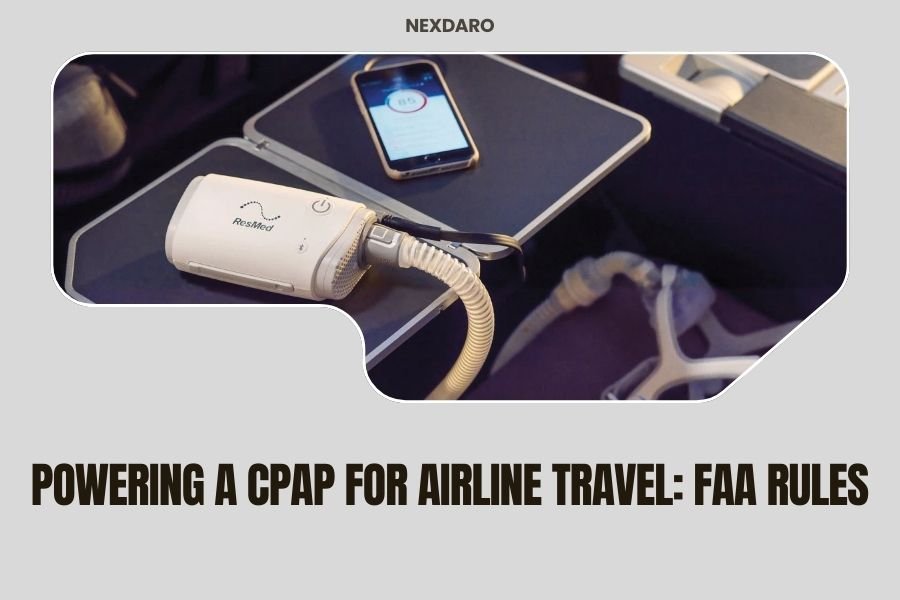
You can travel with a CPAP machine on airlines, but you must notify your airline 48-72 hours before departure and follow FAA battery regulations for portable power stations.
The FAA allows lithium-ion batteries under 100Wh in carry-on luggage, while batteries between 100-160Wh need airline approval for powering CPAP devices during flight.
Understanding FAA Battery Rules for CPAP Travel
Flying with sleep apnea doesn’t mean sacrificing your therapy. The Federal Aviation Administration has clear guidelines that let you bring both your CPAP machine and backup power sources on board.
The key lies in understanding watt-hour (Wh) ratings. This number determines whether you can pack your power station in carry-on luggage or if you need special permission.
What Are Watt-Hours and Why Do They Matter?
Think of watt-hours as your battery’s fuel tank size. Airlines use this measurement to assess fire risk. You can find the Wh rating printed on your power station’s label or calculate it yourself.
The formula is simple: Voltage × Amp-hours = Watt-hours. For example, a 12V battery with 8Ah equals 96Wh.
The Three FAA Battery Categories
The FAA sorts portable batteries into three groups:
- Under 100Wh: Allowed in carry-on without restrictions
- 100-160Wh: Requires airline approval but permitted
- Over 160Wh: Prohibited on passenger aircraft
CPAP-Specific Airline Policies
Most major airlines treat CPAP machines as medical devices, not regular electronics. This gives you extra flexibility that other passengers don’t get.
Your CPAP doesn’t count toward your carry-on limit. You can bring it plus your regular luggage allowance.
Required Documentation
Airlines typically ask for a doctor’s prescription or letter stating your medical need. Keep this handy during check-in and security screening.
Some carriers accept your machine’s medical device labeling instead of additional paperwork. Call ahead to confirm what your specific airline requires.
Advance Notice Requirements
Most airlines want 48-72 hours notice when you’re bringing medical equipment. This helps them prepare and ensures you won’t face delays.
During booking, mention both your CPAP machine and any portable power station you’re bringing. This prevents surprises at the gate.
Choosing the Right Power Station for Air Travel
Not every portable power station works for airline travel. You need one that meets FAA rules while providing enough juice for your CPAP.
Research shows that most CPAP machines use 30-60 watts per hour (Cleveland Clinic). A 100Wh power station gives you roughly 2-3 hours of operation.
Size vs. Capacity Trade-offs
Smaller power stations fit FAA rules easily but run out faster. Larger ones last longer but might need airline approval.
For short flights, a sub-100Wh unit works fine. Cross-country or international trips might justify getting approval for a 100-160Wh model.
Calculating Your Power Needs
Check your CPAP’s power consumption in your manual. Multiply this by your flight duration plus a safety buffer.
Don’t forget taxi time, delays, and potential gate holds. What looks like a 5-hour flight might need 7-8 hours of power in reality.
Features That Matter for Travel
Look for power stations with multiple DC outputs. Your CPAP likely uses 12V or 24V DC power, which is more efficient than converting to AC.
Built-in DC cables save space and reduce connection points that might fail. Some units even include CPAP-specific connectors.
TSA Security Screening Process
Security screening follows predictable steps when you understand what screeners look for. Your CPAP and power station will both get extra attention.
Arrive early. Medical equipment screening takes longer than regular electronics.
What to Expect at Checkpoint
Remove your CPAP from its case and place it in a separate bin. Keep your power station easily accessible for inspection.
Officers might swab both devices for explosive residue. This is routine for electronics, not personal suspicion.
Backup Documentation
Carry your prescription or doctor’s letter even if your airline doesn’t require it. TSA agents appreciate clear medical documentation.
Take photos of your power station’s specifications label. If the physical label is hard to read, you’ll have a clear backup image.
International Travel Considerations
Flying internationally adds layers of complexity. Different countries have varying rules about medical devices and batteries.
European aviation authorities generally follow similar battery limits but may have different documentation requirements.
Customs and Medical Device Rules
Most countries allow personal medical equipment duty-free. Bring your prescription to prove medical necessity.
Some nations require advance declaration of lithium batteries. Check destination country requirements before departure.
Voltage and Plug Compatibility
Your portable power station solves most international power issues. You won’t need voltage converters or plug adapters for CPAP operation.
However, you’ll still need appropriate plugs to recharge your power station at your destination.
Backup Power Strategies
Smart travelers never rely on single power sources. What happens if your main power station fails or gets lost?
Consider bringing two smaller power stations instead of one large unit. Two 90Wh units give you more total capacity than one 160Wh station.
Alternative Power Options
Many airports now offer charging stations near gates. Scope out power outlets during layovers to top off your batteries.
Some airlines provide power outlets at seats on long-haul flights. Check your aircraft type and seat assignment for power availability.
Hotel and Ground Transportation
Don’t forget about power needs before and after your flight. Airport hotels usually have standard outlets, but rental cars might need DC adapters.
Pack a standard AC adapter as backup. While less efficient than DC power, it works with any wall outlet.
Common Airline-Specific Policies
Major carriers have similar but not identical CPAP policies. Here’s what I found when researching current airline rules:
| Airline | Advance Notice | Documentation Required | Battery Approval Process |
|---|---|---|---|
| American Airlines | 48 hours | Prescription recommended | Online form for 100-160Wh |
| Delta | 72 hours | Medical letter required | Phone approval needed |
| United | 48 hours | Prescription or device label | Special assistance desk |
Budget Carrier Differences
Low-cost airlines often have stricter policies. They might charge fees for medical equipment or require more documentation.
Southwest and JetBlue generally follow major carrier practices. Ultra-low-cost carriers like Spirit might have additional restrictions.
Troubleshooting Common Issues
Even with perfect preparation, things can go wrong. Here’s how to handle the most frequent problems.
Gate Agent Doesn’t Recognize Rules
Not every airline employee knows medical device policies perfectly. Stay calm and ask to speak with a supervisor or medical assistance coordinator.
Many airlines have 24/7 special assistance hotlines. Call this number if gate agents seem uncertain about your equipment.
Power Station Gets Flagged
Sometimes security or airline staff question batteries even when they meet regulations. Point out the Wh rating label clearly.
Explain that this is medical equipment, not recreational electronics. The distinction often matters for policy application.
Documentation Problems
If you forgot your prescription, your CPAP’s medical device labeling might suffice. Most machines clearly mark themselves as medical equipment.
Some doctors can email prescriptions to you during travel. Having your doctor’s contact information helps in emergencies.
Conclusion
Traveling with CPAP equipment doesn’t have to stress you out. The FAA and airlines have clear rules that work in your favor when you understand them. Focus on choosing a power station under 160Wh, notify your airline in advance, and carry proper medical documentation. With these steps, you can maintain your sleep therapy anywhere your travels take you. Remember that preparation beats improvisation every time – a little planning ensures you’ll sleep well no matter how far you fly.
Can I use my CPAP power station during takeoff and landing?
No, you must turn off all electronic devices during takeoff and landing, including CPAP machines and their power sources. Flight attendants will announce when you can safely resume use during cruise flight.
What happens if my power station exceeds 160Wh but I need it for medical reasons?
Airlines cannot approve batteries over 160Wh for passenger flights regardless of medical necessity. You’ll need to check alternative options like splitting power across multiple smaller units or using airline seat power where available.
Do I need to remove the battery from my power station during security screening?
Most portable power stations have non-removable internal batteries. TSA agents understand this and will screen the entire unit together. Only remove batteries if specifically requested by security personnel.
Can I charge my power station using airplane seat outlets during flight?
Yes, if your seat has power outlets and your power station includes AC charging capability. However, airplane power outlets typically provide limited wattage, so charging will be slower than wall outlets.
What if I’m traveling with multiple CPAP users in my family?
Each person can bring their own CPAP and power station following the same rules. Notify the airline about multiple medical devices when booking, and ensure each person has their own medical documentation and prescription.