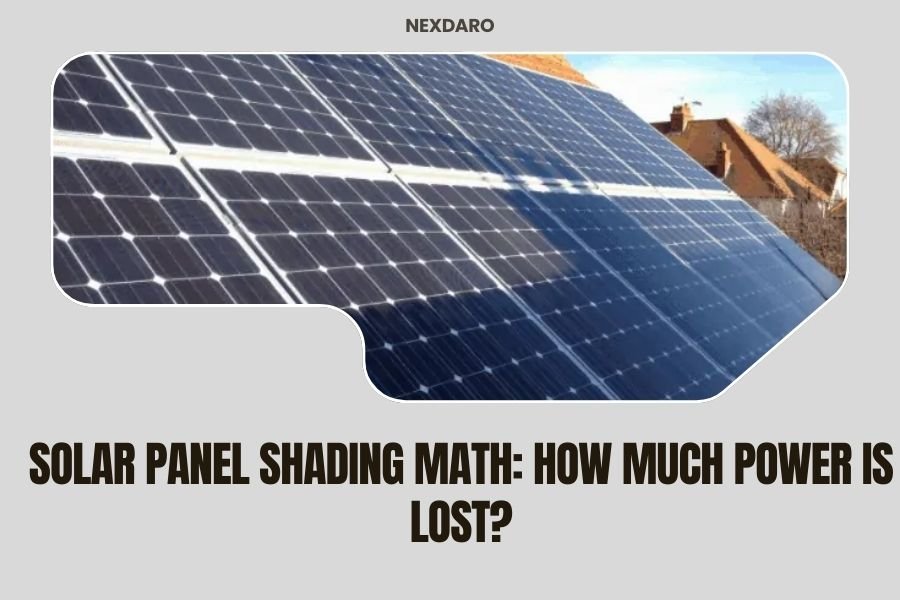
Solar panel shading can reduce your solar power output by 10% to 90% depending on the shading pattern and panel configuration.
Partial shading affects entire panel strings due to bypass diode limitations, making shading math more complex than simple area calculations.
You’re probably wondering exactly how much power you lose when shade hits your solar panels. The answer isn’t as straightforward as you might think.
I’ve researched this topic extensively and found that shading math involves more than just calculating covered area. The way solar panels are wired creates unique power loss patterns that can surprise even experienced users.
Why Solar Panel Shading Math Gets Tricky
Solar panels don’t lose power proportionally to shaded area. A 20% shaded panel doesn’t lose just 20% of its power.
Here’s why: Solar cells connect in series within each panel. When one cell gets shaded, it restricts current flow for the entire string. Think of it like a garden hose with a kink – the whole flow gets reduced, not just the kinked section.
This phenomenon happens because solar cells act like current sources. The weakest cell determines the maximum current for the entire string.
The Real Numbers Behind Shading Losses
Research from the National Renewable Energy Laboratory shows these typical power losses:
- 10% panel area shaded = 50-60% power loss
- 25% panel area shaded = 70-80% power loss
- 50% panel area shaded = 85-95% power loss
These numbers shock most people. But they reflect real-world performance in standard solar panel configurations.
How Bypass Diodes Change the Math
Most solar panels include bypass diodes to reduce shading losses. These diodes split each panel into 2-3 sections.
When shade hits one section, the bypass diode routes current around it. This prevents the shaded section from dragging down the whole panel.
With bypass diodes, your losses look more like this:
- Shading one section = 33% power loss (3-diode panel)
- Shading two sections = 67% power loss
- Shading all sections = 100% power loss
String-Level Shading Effects
Multiple panels connect in strings for your portable power station setup. Shading one panel affects the entire string performance.
Without power optimizers, one shaded panel reduces output for 10-20 connected panels. This multiplies your losses dramatically.
Series vs Parallel String Configurations
Your string wiring method changes shading math significantly.
Series strings (most common): One shaded panel reduces current for all panels in that string. Power loss equals the most shaded panel’s reduction.
Parallel strings: Each panel operates independently. Shading losses stay localized to affected panels only.
Series String Shading Example
You have 4 panels in series producing 100W each normally. One panel gets 50% shaded and drops to 20W output.
Total string output: 20W × 4 panels = 80W (instead of 400W). That’s an 80% loss from shading just one panel.
Parallel String Shading Example
Same 4 panels in parallel. One panel drops to 20W while others maintain 100W.
Total output: 20W + 100W + 100W + 100W = 320W. That’s only a 20% loss.
Types of Shading Patterns
Different shading patterns create different power losses. The shape and location of shade matters more than total area.
Corner Shading
Shade covering panel corners typically causes the least damage. Most bypass diode sections remain unaffected.
Corner shading usually results in 0-33% power loss, depending on which bypass diode section gets hit.
Edge Shading
Shade along panel edges can trigger multiple bypass diodes. This creates moderate to severe losses.
Horizontal edge shading often causes 33-67% power loss. Vertical edge shading might affect all bypass sections for 100% loss.
Scattered Shading
Leaf shadows or partial cloud cover create scattered shading patterns. These often trigger all bypass diodes.
Scattered shading typically results in 67-100% power loss, even when total shaded area stays small.
Moving Shadows
Tree branches or clouds create moving shadows throughout the day. Your power output fluctuates constantly with these patterns.
Moving shadows prevent consistent power planning. Output can swing from 100% to 10% within minutes.
Temperature Effects on Shaded Panels
Shaded solar cells actually perform slightly better in cooler temperatures. But this benefit rarely outweighs the light reduction losses.
Hot spots can form where shaded cells heat up from restricted current flow. These hot spots reduce panel lifespan over time.
Calculating Your Specific Shading Losses
You can estimate shading losses for your setup using this simple method:
Step 1: Identify Shaded Bypass Sections
Most panels have 3 bypass diode sections running horizontally. Determine how many sections have any shading.
Even small shadows affecting a section count as complete section shading for this calculation.
Step 2: Calculate Panel Power Loss
Use this formula: (Shaded sections ÷ Total sections) × 100 = Power loss percentage
Example: 1 shaded section ÷ 3 total sections = 33% power loss for that panel.
Step 3: Apply String Configuration Factor
Series strings: Use the highest individual panel loss for the entire string loss.
Parallel strings: Average the individual panel losses across all panels.
Quick Reference Table
| Shaded Sections | Panel Power Loss | Series String Impact | Parallel String Impact |
|---|---|---|---|
| 1 of 3 | 33% | 33% for whole string | 33% for that panel only |
| 2 of 3 | 67% | 67% for whole string | 67% for that panel only |
| 3 of 3 | 100% | 100% for whole string | 100% for that panel only |
Power Optimizers and Microinverters
Power optimizers and microinverters change shading math completely. These devices perform maximum power point tracking for individual panels.
With optimizers, shading losses stay localized to affected panels. One shaded panel doesn’t drag down others in the string.
Optimizer Shading Performance
Power optimizers typically maintain 60-80% of unshaded power even with significant shading. This compares to 10-40% for standard string configurations.
The trade-off: Optimizers add cost and complexity to your solar setup.
Portable Power Station Considerations
Portable power stations often use charge controllers with multiple power point tracking capabilities. This helps reduce some shading losses.
Many portable units accept parallel panel connections. This naturally reduces shading sensitivity compared to pure series strings.
MPPT vs PWM Controllers
MPPT (Maximum Power Point Tracking) controllers handle shading better than PWM controllers. MPPT units continuously adjust to find optimal power points.
PWM controllers use fixed voltage references. They can’t adapt well to changing panel conditions from shading.
Seasonal Shading Variations
Your shading patterns change throughout the year as sun angles shift. Summer sun sits higher, reducing tree and building shadows.
Winter sun sits lower, creating longer shadows from obstacles. Plan your panel placement considering worst-case winter shading scenarios.
Time-of-Day Shading Patterns
Morning and evening shadows stretch longer than midday shadows. East-facing panels get morning shade relief first. West-facing panels clear shade later.
South-facing panels typically experience the least daily shading variation.
Strategies to Minimize Shading Losses
You can reduce shading impacts through careful planning and positioning.
Panel Placement Optimization
Position panels away from obvious shade sources like trees, buildings, and poles. Even small objects can create significant shadows.
Use sun path tracking apps to predict shading patterns throughout the day and seasons.
Panel Orientation Adjustments
Tilting panels steeper can help them clear ground-level obstacles. Adjusting azimuth angles can avoid building shadows.
Portable panels give you flexibility to move away from developing shade throughout the day.
Multiple Small Arrays
Instead of one large panel array, consider multiple smaller arrays in different locations. This spreads shading risk across your system.
Smaller arrays also give you flexibility to move panels as shading patterns change.
Monitoring Shading Losses
You can track shading impacts using power meters or monitoring apps. Look for power drops that don’t match weather conditions.
Sudden power decreases often indicate new shading from growing vegetation or moved objects.
Daily Power Pattern Analysis
Healthy solar panels show smooth power curves throughout the day. Jagged patterns or early drop-offs suggest shading issues.
Compare your power patterns to clear sunny days to identify shading problems.
When Partial Shading Makes Sense
Sometimes you can’t avoid all shading. In these cases, some power beats no power.
Partial shading might work for maintaining equipment or emergency backup power. Just adjust your expectations for reduced output.
Conclusion
Solar panel shading math shows us that small shadows create big power losses. Understanding bypass diodes, string configurations, and shading patterns helps you predict real-world performance.
The key takeaway: Even minor shading can reduce your power output by 50% or more. Plan panel placement carefully and consider power optimizers if shading can’t be avoided.
Your portable power station performance depends heavily on keeping panels in full sun. When that’s not possible, understanding these shading calculations helps you set realistic expectations and make informed decisions about your solar setup.
Can I use shaded panels to charge my power station?
Yes, but expect significantly reduced charging speeds. Shaded panels often produce 10-50% of their rated power. Your power station will still charge, just much slower than in full sun conditions.
Do some solar panels handle shading better than others?
Panels with more bypass diodes (4-6 vs standard 3) handle shading slightly better. Half-cell panels also show improved shading performance. But the biggest improvement comes from power optimizers or microinverters, not panel selection.
How do I know if my panels are experiencing shading losses?
Monitor your power output throughout the day. Look for sudden drops that don’t match cloud cover or weather changes. Compare current output to previous sunny days at the same time. Apps and power meters help track these patterns.
Will morning dew or frost affect shading calculations?
Dew and frost act like light shading across the entire panel surface. This typically reduces power by 20-40% until the moisture evaporates. Unlike object shadows, this affects panels uniformly and clears naturally with sun exposure.
Should I clean leaves off panels immediately?
Yes, remove leaves and debris quickly. A single leaf can trigger bypass diodes and reduce panel output by 33% or more. Small objects create disproportionate power losses compared to their size, making immediate removal worthwhile.