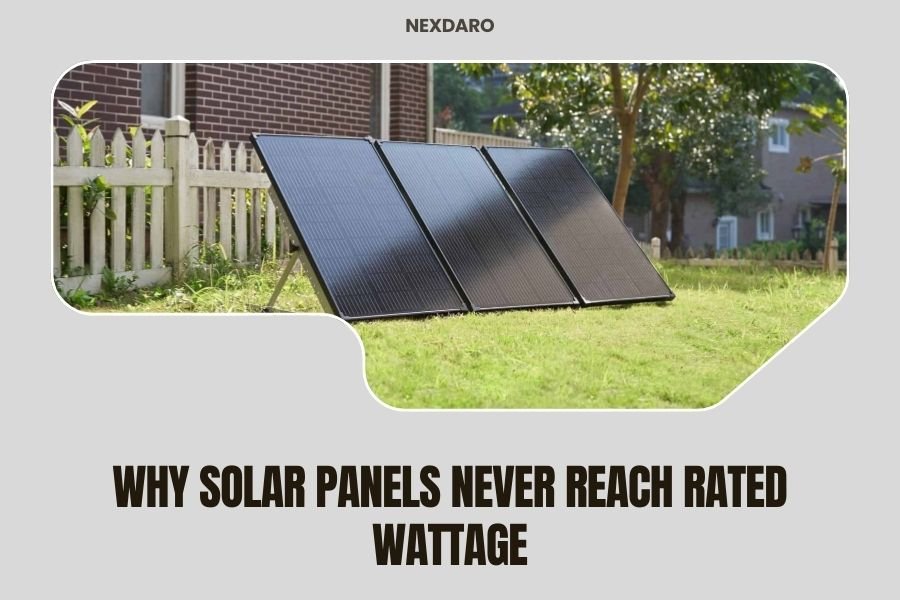
Solar panels never reach their rated wattage because manufacturers test them under perfect lab conditions that don’t exist in real life.
You can expect your solar panels to produce 75-85% of their rated power output under normal outdoor conditions due to temperature, shading, and dust factors.
What Solar Panel Ratings Actually Mean
When you see a 100-watt solar panel, that number comes from Standard Test Conditions (STC). These lab tests use perfect lighting, ideal temperature, and spotless panels.
Think of it like a car’s EPA rating. Your car might get 30 MPG on the sticker, but real driving gives you different results. Solar panels work the same way.
Standard Test Conditions Explained
STC testing uses these exact conditions:
- 1,000 watts per square meter of light intensity
- 77°F (25°C) panel temperature
- 1.5 air mass ratio (sun angle through atmosphere)
- No dust, dirt, or shading
You’ll rarely see these perfect conditions outdoors. That’s why your panels produce less power than advertised.
Temperature Kills Solar Panel Performance
Hot panels produce less electricity. This surprises many people who think more sun equals more power.
Solar panels lose about 0.4% efficiency for every degree above 77°F. On a 100°F day, your panels drop to roughly 90% of rated output from heat alone.
Why Heat Reduces Solar Output
Silicon solar cells work like semiconductors. Heat makes electrons move around more, reducing the voltage your panels can produce.
I found research showing that roof-mounted panels often reach 140°F on hot days. That’s a 25% power loss just from temperature (NREL).
Cold Weather Boosts Solar Performance
Your panels work better in cold weather. Winter days with bright sun and cold air can push panels above their rated wattage.
Many solar owners notice this pattern. December might give you 110% rated power on clear, cold days.
Light Conditions Change Everything
Perfect lab lighting rarely happens outdoors. Clouds, haze, and sun angle all reduce the light hitting your panels.
Cloud Cover Effects
Even thin clouds cut solar output by 20-30%. Thick clouds can drop production to 10-15% of rated power.
Partly cloudy days create the most frustrating results. Your panels constantly switch between high and low output as clouds pass.
Sun Angle and Time of Day
Morning and evening sun hits your panels at sharp angles. This reduces the effective light intensity hitting each cell.
You’ll only see peak performance for 3-4 hours around midday when the sun is directly overhead.
Seasonal Changes in Light Quality
Summer gives you longer days but often hazy conditions. Winter provides clearer air but shorter days and lower sun angles.
From what I read, many locations get their best solar conditions in spring and fall (Department of Energy).
Dirt and Debris Block Solar Cells
Real-world panels collect dust, pollen, bird droppings, and dirt. Even a thin layer cuts your power output.
Research shows that dust alone can reduce solar output by 5-15% depending on your location and weather patterns.
Types of Solar Panel Contamination
- Dust and pollen (gradual buildup)
- Bird droppings (concentrated shading)
- Tree sap and leaves
- Snow and ice in winter
- Salt spray near oceans
Cleaning Frequency Matters
Panels in dusty areas need cleaning every 2-3 months. Areas with regular rain can go 6 months between cleanings.
I came across studies showing that proper cleaning can restore 95% of lost performance from dirt buildup (IEEE).
System Losses Add Up Quickly
Your solar setup includes more than just panels. Wiring, charge controllers, and inverters all steal some power.
Wiring and Connection Losses
Electricity loses power as it travels through wires. Longer wire runs and smaller wire gauges increase these losses.
Most systems lose 2-5% of power in the wiring between panels and your battery or inverter.
Charge Controller Efficiency
MPPT charge controllers are 95-98% efficient. PWM controllers only reach 80-85% efficiency with most solar panels.
Your charge controller choice makes a huge difference in real-world power harvest.
Inverter Losses in AC Systems
Converting DC to AC power costs you another 5-10% in most inverters. High-quality inverters minimize this loss but can’t eliminate it.
Shading Destroys Solar Performance
Even small shadows can cut your solar output dramatically. Solar cells are wired in series, so one shaded cell affects the whole panel.
A shadow covering just 10% of your panel can reduce output by 50% or more. This happens because shaded cells become resistors instead of generators.
Common Shading Sources
- Trees and branches
- Buildings and structures
- Antennas and satellite dishes
- Other solar panels
- Chimneys and roof equipment
Bypass Diodes Help But Don’t Fix Everything
Modern panels include bypass diodes to route power around shaded cells. These help but don’t restore full power output.
Think of bypass diodes like detour routes during road construction. They keep traffic moving but slow everything down.
Age Reduces Solar Panel Output
Solar panels slowly lose efficiency over time. Most manufacturers guarantee 80% output after 20-25 years.
You’ll lose roughly 0.5-0.8% efficiency per year. This means a 5-year-old panel produces about 97% of its original rated power.
What Causes Solar Panel Aging
UV radiation, temperature cycling, and weather slowly break down panel materials. The protective glass and plastic layers yellow and become less transparent.
Metal connections also corrode slightly over decades of outdoor exposure.
Realistic Solar Panel Expectations
Plan for 75-85% of rated wattage in real-world conditions. This accounts for all the factors working against your panels.
| Condition | Power Loss | Typical Output |
|---|---|---|
| Perfect conditions | 0% | 100% |
| Hot weather | 10-15% | 85-90% |
| Dusty panels | 5-15% | 85-95% |
| System losses | 5-10% | 90-95% |
| Real-world total | 15-25% | 75-85% |
Seasonal Performance Patterns
Summer gives you the longest days but often the lowest efficiency per hour. Winter provides better efficiency but fewer daylight hours.
Spring and fall usually deliver the best balance of good conditions and reasonable daylight hours.
Daily Performance Curves
Your best performance happens between 10 AM and 2 PM. Early morning and late afternoon produce much less power per hour.
How to Get Better Solar Performance
You can’t change the weather, but you can optimize your setup for real-world conditions.
Choose Quality Equipment
High-efficiency panels and MPPT charge controllers help you capture more of the available power. The extra cost often pays for itself in better performance.
Keep Panels Clean
Regular cleaning with soap and water restores lost performance from dirt buildup. Clean panels early morning or evening to avoid thermal shock.
Proper Panel Positioning
Face panels true south (in the northern hemisphere) and tilt them at your latitude angle for best year-round performance.
Avoid shading at all costs. Even small shadows cause big power losses.
Understanding MPPT vs Rated Power
Maximum Power Point Tracking (MPPT) helps squeeze more power from your panels under changing conditions.
MPPT charge controllers constantly adjust to find the best voltage and current combination. This helps you get closer to rated wattage more often.
How MPPT Improves Real-World Performance
MPPT can boost power harvest by 20-30% compared to basic PWM controllers. This brings your real-world output closer to panel ratings.
The improvement is biggest in cold weather and partial shading conditions.
Manufacturing Tolerances Matter
Panel manufacturers allow +/- 3% variation from rated wattage. Your 100-watt panel might actually be 97 watts or 103 watts from the factory.
Quality manufacturers often ship panels slightly above rated power to account for this variation.
Testing Your Panel’s Real Rating
You can estimate your panel’s true rating by measuring output on clear, cold days around noon. Compare this to the expected output for current conditions.
Conclusion
Solar panels never reach rated wattage because those ratings come from perfect lab conditions. Temperature, shading, dirt, and system losses all reduce real-world performance to 75-85% of rated power.
This isn’t a flaw in solar technology – it’s just how ratings work. Plan your solar system around realistic expectations, keep your panels clean, and choose quality equipment to get the best performance possible.
Remember that even at 80% of rated power, solar panels provide excellent value and reliable energy for decades. Focus on total energy production over peak wattage numbers.
Why do solar panels work better in cold weather?
Cold temperatures reduce electrical resistance in solar cells, allowing higher voltage output. Silicon semiconductors work more efficiently when cool, often producing 105-110% of rated power on cold, sunny days.
How much does dust reduce solar panel output?
Dust typically reduces solar output by 5-15% depending on location and weather. Desert areas with fine dust see the biggest losses, while areas with regular rain stay cleaner naturally.
Can solar panels ever exceed their rated wattage?
Yes, solar panels can exceed rated wattage in cold, bright conditions with reflective surfaces like snow. Some panels reach 110-115% of rated output when conditions are better than the lab test standards.
What’s the biggest factor reducing solar panel performance?
Temperature is usually the biggest factor, especially in hot climates. Panels lose about 0.4% efficiency per degree above 77°F, which can mean 15-25% power loss on very hot days.
How often should I clean my solar panels?
Clean solar panels every 2-3 months in dusty areas, or every 6 months in areas with regular rainfall. Bird droppings and tree sap should be cleaned immediately since they cause concentrated shading losses.