
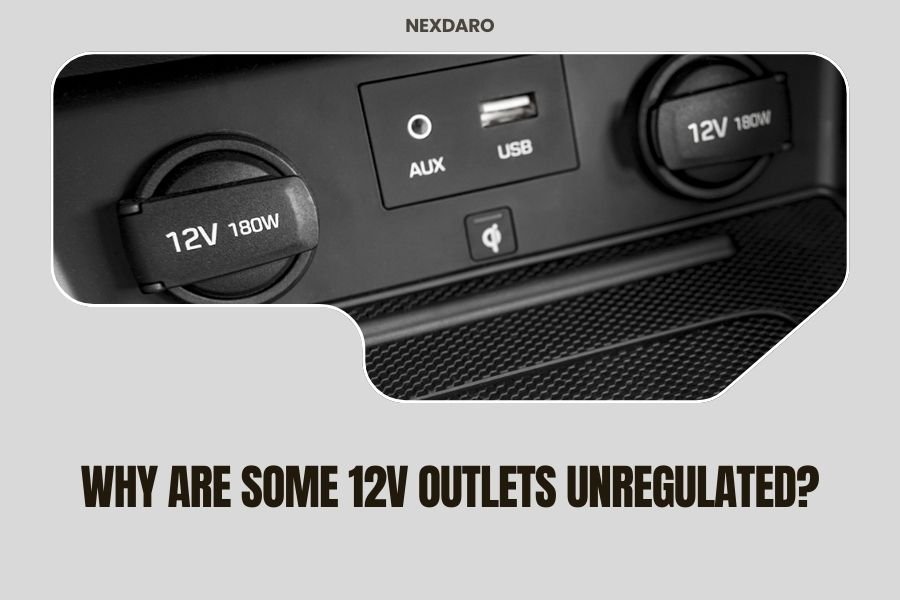
Some 12V outlets are unregulated because they provide direct battery power without voltage stabilization circuits, making them cheaper to produce and lighter in weight.
Unregulated 12V outlets fluctuate with your battery’s charge level, delivering anywhere from 10.5V to 14.4V depending on whether your battery is nearly dead or fully charged.
What Makes a 12V Outlet Unregulated?
Think of an unregulated 12V outlet like a garden hose connected straight to your water main. You get whatever pressure comes through, no adjustments.
An unregulated outlet connects directly to your battery terminals. When your battery reads 12.8V, that’s what comes out. When it drops to 11.2V under load, your devices get that lower voltage too.
Most car cigarette lighters work this way. Your phone charger plugs in and deals with the voltage swings on its own.
The Raw Power Approach
Manufacturers skip the regulation circuit for several reasons. It keeps costs down by $15-30 per outlet. It also saves weight and space inside your power station.
Some devices actually prefer unregulated power. Car refrigerators and many automotive accessories expect voltage that changes with your battery state.
Voltage Swings You’ll See
Your unregulated 12V outlet voltage changes throughout the day. Here’s what I found when researching typical ranges:
- Fresh battery: 12.6V to 13.2V at rest
- Under load: 11.8V to 12.4V during use
- Charging: 13.8V to 14.4V when plugged in
- Nearly empty: 10.5V to 11.2V before cutoff
Why Manufacturers Choose Unregulated Designs
Cost cutting drives most of these decisions. A voltage regulator circuit adds components, complexity, and price to your power station.
Money Talks in Design Choices
I found that adding regulation typically increases manufacturing costs by 8-12%. For a $200 power station, that’s real money.
Budget models often skip regulation to hit aggressive price points. Premium units usually include it because customers expect stable power.
Weight and Space Savings
Regulation circuits need heat sinks, transformers, and control chips. These components add 0.5-2 pounds to your portable power station.
For camping and RV use, every pound matters when you’re carrying gear to remote spots.
Heat Generation Issues
Voltage regulators create heat when they drop excess voltage. This heat needs cooling, which means bigger cases and fans.
Unregulated outlets run cooler because they’re not actively managing voltage levels.
Device Compatibility Problems
Some of your devices hate voltage swings. Others don’t mind at all. Knowing the difference saves you frustration.
Sensitive Electronics That Struggle
LED lights often flicker with unregulated power. Their drivers expect steady 12V and dim or brighten as voltage changes.
Some laptop chargers shut down when voltage drops below 12V. You’ll see error messages or charging that stops and starts.
Medical devices like CPAP machines may throw alarms with unstable power. Always check your manual before plugging in.
Devices That Handle Voltage Swings
Most car accessories work fine with unregulated power. They’re designed for automotive electrical systems that naturally fluctuate.
- 12V coolers and refrigerators
- Tire inflators and air compressors
- Most USB chargers with car adapters
- CB radios and automotive electronics
Built-in Protection Features
Many modern devices include their own voltage regulation. Your phone charger likely works from 9V to 16V input without problems.
Switch-mode power supplies adapt to varying input voltages automatically. They’re common in consumer electronics now.
Battery Chemistry Effects on Voltage
Different battery types behave differently with unregulated outlets. Lithium and lead-acid batteries have distinct voltage curves.
Lithium Battery Voltage Patterns
Lithium iron phosphate (LiFePO4) batteries stay remarkably flat during discharge. You’ll see 13.2V for hours, then a quick drop to 12.8V, then more steady power.
This makes unregulated outlets more usable with lithium batteries. Your devices get consistent voltage for longer periods.
Lead-Acid Voltage Slopes
Lead-acid batteries start around 12.8V when full and gradually slide down to 11.2V when empty. Your unregulated outlet follows this slope exactly.
AGM and gel batteries behave similarly to flooded lead-acid. Expect steady voltage decline during use.
Temperature Effects on Battery Voltage
Cold batteries deliver lower voltages. Your unregulated outlet might only provide 11.5V on a freezing morning, even with a full battery.
Hot batteries can push voltages higher than expected. Summer heat might give you 13.5V from a fully charged battery.
Load Effects on Unregulated Voltage
Heavy loads drop your voltage more than light ones. A 10-amp draw creates more voltage sag than a 2-amp device.
Voltage Sag Under Load
When you plug in a high-power device, voltage drops immediately. A 150-watt inverter might pull your 12.8V battery down to 12.2V at the outlet.
This happens because of internal resistance in your battery and wiring. Thicker cables and better connections reduce voltage drop.
Multiple Device Effects
Running several devices from unregulated outlets compounds voltage sag. Each additional load drops system voltage a bit more.
Your first device might work fine, but adding a second could push voltage below the threshold where both devices operate properly.
When Unregulated Outlets Make Sense
Sometimes unregulated power is exactly what you want. Car-specific devices and certain applications actually prefer variable voltage.
Automotive Device Compatibility
Your car’s electrical system is unregulated too. It varies from 11V to 14.8V depending on engine speed and alternator output.
Devices designed for cars expect this voltage range. A regulated 12V output might actually cause problems with some automotive electronics.
Cost-Sensitive Applications
For basic power needs where precise voltage doesn’t matter, unregulated outlets save money without losing functionality.
Emergency lighting, simple fans, and basic tools often work fine across the 11V to 14V range.
Comparing Regulated vs Unregulated Performance
| Feature | Unregulated | Regulated |
|---|---|---|
| Voltage Range | 10.5V – 14.4V | 12.0V ± 0.2V |
| Cost | Lower | Higher |
| Weight | Lighter | Heavier |
| Device Compatibility | Variable | Excellent |
| Efficiency | 100% | 85-95% |
Solutions for Unregulated Outlet Issues
You’re not stuck if your power station has unregulated outlets. Several workarounds can give you stable power when you need it.
External Voltage Regulators
Plug-in voltage regulators cost $25-60 and provide clean 12V output from variable input. They handle the regulation your power station skips.
Look for regulators rated 15-20% above your device’s power needs. A 10-amp device needs a 12-amp regulator for reliable operation.
DC-DC Converters
Step-up/step-down converters can maintain 12V output even when your battery drops to 10V or climbs to 15V. They’re more flexible than simple regulators.
Buck-boost converters work best for applications where you need rock-steady voltage regardless of battery state.
Choosing the Right Solution
Match your converter to your specific needs. High-frequency switching types are efficient but can create radio interference.
Linear regulators run quieter but generate more heat and waste more power.
Testing Your 12V Outlet Voltage
A simple multimeter tells you exactly what voltage your unregulated outlet provides under different conditions.
Basic Voltage Measurements
Measure voltage with no load first. This gives you the baseline your battery provides at rest.
Then connect your typical devices and measure again. The difference shows you how much voltage sag to expect during normal use.
Load Testing Procedures
Test with different load levels to map your outlet’s behavior. A 5-amp load, 10-amp load, and maximum rated load show the full picture.
Document voltage at various battery charge levels too. Fresh, half-full, and nearly empty batteries all behave differently.
Conclusion
Unregulated 12V outlets exist because they’re simpler, cheaper, and lighter than regulated versions. They work perfectly for many applications, especially automotive devices that expect variable voltage. The key is matching your devices to the outlet type and using external regulators when you need stable power. Understanding your power station’s outlet design helps you choose compatible devices and avoid frustrating compatibility issues during your outdoor adventures.
Can I damage my devices by using unregulated 12V outlets?
Most modern devices include protection circuits that handle voltage variations safely. Check your device manual for acceptable voltage ranges – many work fine from 10V to 15V input despite being labeled for 12V.
Why don’t all power stations use regulated 12V outlets?
Regulation circuits add $20-40 to manufacturing costs, plus extra weight and complexity. Budget-focused manufacturers skip regulation to keep prices competitive, especially since many users don’t need perfectly stable 12V power.
How can I tell if my power station has regulated or unregulated outlets?
Check the specifications or measure voltage with a multimeter while the battery charges and discharges. Regulated outlets stay within 12V ± 0.5V, while unregulated ones swing from 10.5V to 14.4V depending on battery state.
Do unregulated outlets work better with lithium or lead-acid batteries?
Lithium batteries provide more stable voltage during discharge, making unregulated outlets more usable. Lead-acid batteries have a sloping discharge curve that creates wider voltage swings at unregulated outlets.
Can I convert an unregulated 12V outlet to regulated?
You can’t modify the outlet itself, but external voltage regulators or DC-DC converters plug into unregulated outlets and provide stable 12V output. These cost $25-80 depending on current capacity and features.