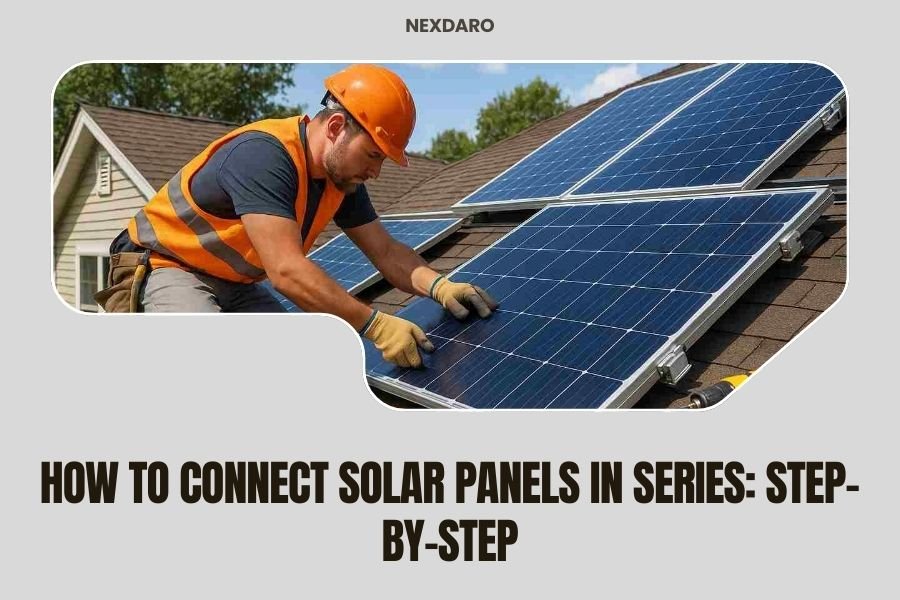
To connect solar panels in series, you join the positive terminal of one panel to the negative terminal of the next panel, creating a chain that increases total voltage while keeping current the same.
Series wiring is perfect when you need higher voltage for your portable power station or charge controller, and it works best when all panels receive similar sunlight.
What Does Connecting Solar Panels in Series Mean?
Think of series wiring like old Christmas lights. When you connect solar panels in series, electricity flows through one panel into the next, then the next, and so on.
The voltage adds up, but the current stays the same as your weakest panel. If you have three 100-watt panels at 18 volts each, series wiring gives you 54 volts total.
Tools and Materials You’ll Need
Before you start, gather these items:
- MC4 connectors (male and female)
- Solar cable (12 AWG or 10 AWG recommended)
- Wire strippers
- MC4 crimping tool
- Multimeter
- Cable ties for organization
I found that having extra MC4 connectors saves time if you make mistakes. Trust me, it happens to everyone.
Step-by-Step Guide to Series Connection
Step 1: Check Your Panel Specifications
Look at the back of each solar panel. You need panels with matching current ratings for best results.
Write down the voltage and current for each panel. Mismatched panels still work, but your system will only produce as much current as your weakest panel allows.
Why Matching Matters
Let’s say you have one 5-amp panel and one 8-amp panel. Your series string will only produce 5 amps, even though the second panel could do more.
Step 2: Position Your Panels
Place your panels where they’ll get similar sunlight throughout the day. Shade on one panel affects the whole series string.
Leave enough space between panels to work comfortably. You’ll need room to reach the junction boxes on the back.
Dealing with Shade Issues
Series wiring has one big weakness: shade. If one panel gets shaded, it drags down the whole string’s performance.
I researched this issue and found that even partial shade on one panel can reduce total output by 50% or more. Pick your location carefully.
Step 3: Identify Positive and Negative Leads
Each solar panel has two wires coming from its junction box. The positive wire usually has a male MC4 connector. The negative wire has a female MC4 connector.
Some panels mark the wires with + and – symbols. Others use red for positive and black for negative.
Step 4: Make the First Connection
Take your first panel’s positive lead and connect it to the second panel’s negative lead. The MC4 connectors should click together firmly.
You’ll hear a satisfying click when they lock properly. If they don’t click, check that you’re using male-to-female connections.
Testing Your Connection
Give the connection a gentle tug. It should hold tight. Loose connections cause power loss and can create dangerous arcing.
Step 5: Continue the Chain
Repeat the same process for additional panels. Connect the positive of panel two to the negative of panel three, and so on.
You’ll end up with two free leads: the negative from your first panel and the positive from your last panel. These become your system’s output wires.
Voltage and Current Calculations
Series wiring follows simple math rules. Voltages add up, but current stays the same as your lowest-performing panel.
| Configuration | Voltage Output | Current Output |
|---|---|---|
| Single 100W Panel (18V, 5.5A) | 18V | 5.5A |
| Two Panels in Series | 36V | 5.5A |
| Three Panels in Series | 54V | 5.5A |
Real-World Example
Let’s say you’re charging a portable power station that needs 24 volts. One 18-volt panel won’t cut it. But two panels in series give you 36 volts, which works perfectly.
Testing Your Series Connection
Using a Multimeter
Set your multimeter to DC voltage. Touch the red probe to your positive lead and the black probe to your negative lead.
You should see voltage close to the sum of all your panels’ ratings. Don’t worry if it’s not exact – real-world conditions affect output.
What Normal Readings Look Like
On a bright, sunny day, expect readings within 10% of your calculated voltage. Cloudy conditions will show lower numbers, and that’s normal.
Current Testing
Testing current requires breaking the circuit, which is trickier. Most people skip this step unless they suspect problems.
If you want to test current, you’ll need to disconnect one MC4 connection and insert your multimeter in series with the circuit.
Common Mistakes to Avoid
Mixing Panel Types
Can you mix different wattage panels in series? Yes, but it’s not ideal. Your system will only produce as much current as your weakest panel.
I found online that mixing a 100-watt and 200-watt panel gives you less than expected. Stick with matching panels when possible.
The Christmas Light Problem
Remember those old Christmas lights where one dead bulb killed the whole string? Solar panels don’t fail that dramatically, but shade works similarly.
Ignoring Voltage Limits
Your charge controller or power station has maximum voltage limits. Exceed these limits and you could damage expensive equipment.
Check your device’s specs before adding more panels to your series string.
Poor Cable Management
Loose cables can get damaged by wind, animals, or foot traffic. Use cable ties to secure everything neatly.
Route cables away from sharp edges and high-traffic areas. A damaged cable can shut down your whole system.
When to Choose Series vs Parallel
Series Works Best When:
- You need higher voltage for your equipment
- All panels get similar sunlight exposure
- You want to minimize current and use thinner wires
- Your charge controller accepts higher voltages
Consider Parallel Instead If:
- Panels will be in different locations or orientations
- Some panels might get shaded
- Your equipment needs lower voltage, higher current
- You want redundancy (one panel failure won’t affect others)
Safety Considerations
Electrical Safety
Solar panels produce electricity whenever light hits them. There’s no “off” switch. Always treat the wires as live.
Series connections create higher voltages than single panels. While still relatively safe, treat the system with respect.
Weather Precautions
Don’t work on connections in wet conditions. Water and electricity don’t mix, even at solar panel voltages.
If you must work in marginal weather, cover the panels with tarps or cardboard to reduce power output.
Equipment Protection
Many experts recommend using fuses or circuit breakers in solar systems. They protect your equipment if something goes wrong.
A simple inline fuse near your charge controller can save expensive repairs later.
Troubleshooting Series Connections
Low Voltage Output
If your voltage reads much lower than expected, check these items:
- Loose MC4 connections
- Partial shading on any panel
- Damaged panels or wiring
- Dirty panel surfaces
The Weak Link Effect
One underperforming panel affects the whole series string. Check each panel individually if you suspect problems.
No Output at All
Complete system failure usually means a broken connection or damaged wire. Check each MC4 connector and look for obvious damage.
Sometimes moisture gets into connectors and causes problems. Disconnect and reconnect each joint to clear minor corrosion.
Maintenance Tips
Regular Inspections
Check your connections every few months, especially after storms or high winds. Look for loose wires, damaged connectors, or animal damage.
Clean panels regularly for best performance. Dust and bird droppings can significantly reduce output.
Seasonal Adjustments
If your panels are portable, you might want to adjust positioning as the sun angle changes with seasons.
Series-connected panels need to move together to maintain similar lighting conditions.
Conclusion
Connecting solar panels in series is straightforward once you understand the basics. You’re essentially creating a chain that adds voltages while maintaining current flow. The key is ensuring all panels receive similar sunlight and using quality connections that won’t fail over time. Series wiring works great for portable power stations and charge controllers that need higher input voltages. Just remember to check your equipment’s voltage limits and always prioritize safety when working with electrical connections.
Can I mix different wattage solar panels in a series connection?
Yes, you can mix different wattage panels, but your system will be limited by the panel with the lowest current output. For example, connecting a 100-watt panel (5.5 amps) with a 200-watt panel (11 amps) in series will only produce 5.5 amps total, even though the larger panel could produce more.
How many solar panels can I connect in series?
The number depends on your charge controller’s maximum voltage rating. Most portable power station controllers handle 60-150 volts maximum. With typical 18-volt panels, you could connect 3-8 panels before hitting voltage limits. Always check your equipment specifications first.
What happens if one panel in my series gets shaded?
Shade on any panel in a series string reduces the entire system’s output dramatically. The shaded panel acts like a bottleneck, limiting current flow through all panels. This is why series connections work best when all panels receive consistent sunlight throughout the day.
Do I need special wire for series solar panel connections?
Use wire rated for outdoor solar applications, typically 12 AWG or 10 AWG depending on your system size. The wire should be UV-resistant and rated for the voltage and current your system produces. Standard household wire isn’t designed for outdoor solar installations.
How do I know if my series connection is working properly?
Use a multimeter to measure voltage across your series string’s output leads. You should see approximately the sum of all individual panel voltages. For three 18-volt panels, expect around 54 volts in good sunlight conditions. Significantly lower readings indicate connection problems or shading issues.