Anker SOLIX F3000 Review: Worth It? (November 2026)
The Anker SOLIX F3000 is a high-capacity power station for home backup, RVs and demanding outdoor use. Its 3,072Wh battery, 3,600W output and solar, generator and AC charging options make it more capable than compact power stations, but its 91.5 lb weight requires planning.
On this page (9 sections)
- Is the Anker SOLIX F3000 worth considering?
- Anker SOLIX F3000 specs at a glance
- What charging options does the F3000 support?
- How long can the F3000 run essential devices?
- Is the F3000 practical for home backup?
- Is the F3000 easy to move?
- How does the F3000 compare with larger Anker models?
- What are the main drawbacks?
- Which Anker SOLIX F3000 version should you choose?
The Anker SOLIX F3000 is a large portable power station for home backup, RVs and demanding outdoor power. It combines a 3,072Wh battery with 3,600W output, solar charging, generator support and optional battery expansion.
This is the kind of unit to consider when a compact power station would run out too quickly. It gives you more stored energy for essential appliances during an outage, and more output for larger loads that smaller models cannot handle well.
The main decision is simple. Choose the standalone unit if you already have compatible solar equipment, or choose the bundle if you want a PS400 bifacial panel included with the power station.
That choice comes down to how you plan to recharge it. If you already own panels, a generator or a fixed AC charging setup, the standalone model keeps things flexible.
If you want solar input without sourcing a panel separately, the bundle is the easier starting point.
It also suits buyers who want room to grow. The starting capacity is already substantial, and expansion to 24kWh gives a path for longer outages.
That added capacity only helps if you have space for extra batteries and a clear plan for placement, connections and daily care.
Is the Anker SOLIX F3000 worth considering?
The Anker SOLIX F3000 is worth considering when you need more capacity and output than a compact camping power station can provide. For a smaller Anker model compared with EcoFlow, see C1000 vs DELTA 2.
Its 91.5 lb weight means you should plan where it will sit before buying. Think about the garage, a utility area, a vehicle load bed or a storage room first.
Then check the route to that spot, including door widths, steps and any tight turns.
We compared the published capacity, charging options, output, dimensions and stated backup uses. The picture that emerges is a station built for planned use rather than casual carrying.
It makes more sense in a fixed backup location or a regular RV setup than as a unit you move from room to room every day.
For a smaller Anker option, read our Anker SOLIX C300 review. It is a better comparison point when portability matters more than whole-home backup capacity.
The trade-off is easy to see. A smaller station is simpler to carry, store and set up for phones, laptops and small appliances.
The F3000 is larger because it is aimed at longer backup runs and more demanding loads.
That distinction matters for set-up and care too. A heavy unit needs a stable surface, good ventilation and a charging routine you will actually follow.
Place it where you can reach the cables, check the charge level and keep it clean without draining or straining yourself.
It is also worth deciding which appliances matter most before you buy. A fridge, lights, a fan, a coffee maker and medical equipment will use stored energy at very different rates.
The F3000 gives you headroom, but it still rewards clear priorities and realistic expectations about runtime.
Anker SOLIX F3000 specs at a glance
The F3000 has a 3,072Wh LiFePO4 battery and 3,600W output. It measures 25.6 x 11.8 x 14.8 in and weighs 91.5 lb.
| Detail | Anker SOLIX F3000 |
|---|---|
| Battery capacity | 3,072Wh |
| Battery type | LiFePO4 |
| Output wattage | 3,600W |
| Solar input | Up to 2,400W |
| Solar ports | 165V and 60V |
| AC output | 120V |
| Higher-voltage setup | 240V when pairing two power stations |
| Weight | 91.5 lb |
| Dimensions | 25.6 x 11.8 x 14.8 in |
| Expansion | Up to 24kWh |
| Charging sources | AC, solar and generator |
| Model | A1782 |
The 3,600W output gives the F3000 room for larger appliances than many compact units. However, the appliance's running and startup demands still need to fit the power station's limits.
Anker SOLIX F3000 review score
Our score weighs specs, features and buyer feedback against what you're shopping for. The solar-panel bundle scores higher because it includes a ready-made solar input option, while the standalone model gives you more freedom to build your own setup.
Anker SOLIX F3000 Portable Power Station: Best for flexible backup charging
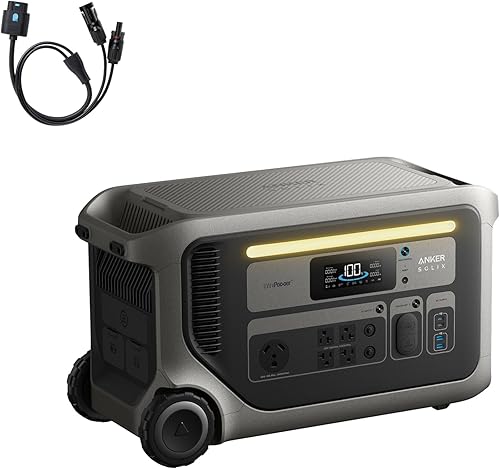
- 3,072Wh LiFePO4 battery
- 3,600W output
- Up to 2,400W solar input
- Expandable to 24kWh
The standalone F3000 suits buyers who already have solar equipment or want to choose their own charging setup. It supports AC, generator and solar charging, with expansion available for longer outages.
Pros
- Large starting capacity
- 120V and 240V output options
- Generator-ready pass-through charging
- Solar input up to 2,400W
Cons
- Heavy at 91.5 lb
- Solar panels are not included
- A 240V setup requires pairing two power stations
The standalone F3000 is the better fit when you want the power station itself and already own compatible panels. Its 165V and 60V solar ports support a range of portable and rigid solar setups, according to Anker's stated specifications.
It also supports 120V output and can provide 240V when two power stations are paired. That makes it more suitable for buyers planning a larger backup system than for someone who only needs phone, laptop or small appliance charging.
What charging options does the F3000 support?
The F3000 supports AC, solar and generator charging, with pass-through charging designed to keep appliances running while the unit recharges from a 120V generator.
Anker states that solar input can reach 2,400W when compatible panels are connected through the 165V or 60V ports. Solar performance depends on panel setup, sunlight and installation conditions.
The unit can also combine fuel-generator and solar input for up to 6,000W of charging input, according to Anker's stated feature claims. That may matter during a long outage when you need to restore battery capacity quickly.
For a package that includes solar equipment, compare the F3000 bundle below.
Anker SOLIX F3000 Portable Power Station: Best for solar-ready emergency kits
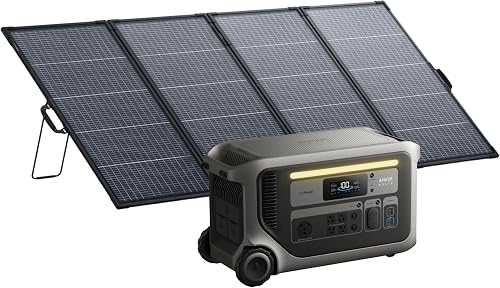
- 3,072Wh LiFePO4 battery
- Includes PS400 bifacial panel
- Up to 2,400W solar input
- Expandable to 24kWh
This bundle adds a PS400 bifacial portable solar panel to the F3000, making it the simpler starting point for buyers building a solar-supported backup kit.
Pros
- Includes a 400W bifacial solar panel
- Panel folds for transport
- Panel has an IP68 rating
- Supports front and rear solar collection
Cons
- The two packages ship separately
- The power station remains heavy
- Solar output depends on sunlight conditions
The bundle includes a PS400 bifacial portable solar panel along with the F3000. The panel weighs 21.9 lb and measures 22.3 x 38.7 x 3.2 in when folded.
The PS400 uses front and rear surfaces to collect sunlight and has an IP68 rating. Anker says it can produce up to 10% more output than a single-sided panel under suitable sunlight conditions, so the real result will depend on the site and weather.
The power station and panel ship separately. If you need a complete solar kit, track both packages before planning an emergency setup.
How long can the F3000 run essential devices?
The F3000's 3,072Wh capacity can support long backup periods, but runtime depends on the wattage and duty cycle of each device.
Anker says the unit can provide 125 hours of AC idle standby time. It also gives a 42-hour example for a 190W refrigerator under stated conditions.
A refrigerator does not draw the same amount of power every minute. Its compressor cycles on and off, and room temperature can change how often it runs.
Use the refrigerator example as a planning reference. For other appliances, estimate runtime by comparing their power draw with the available battery capacity, then allow for conversion losses and changing loads.
The guide How Does a Portable Power Station Work? explains how stored battery energy becomes usable AC or DC power.
Is the F3000 practical for home backup?
The F3000 is practical for planned emergency backup of selected appliances, especially when you can keep it near the equipment and recharge it from solar or a generator.
Its 120V output can support essential devices within the unit's limits. Pairing two stations can provide 240V for more demanding appliances, but that is a larger and more involved setup.
The optional expansion path can increase total storage to 24kWh. That may suit households preparing for longer outages, provided the added equipment, placement and electrical connections are planned correctly.
A portable power station is not automatically a whole-home electrical system. Decide which circuits or appliances matter most, and follow Anker's instructions for any inlet box, smart meter or permanent connection.
For more home-focused options, see our guide to the Top 7 Best Anker Portable Power Station.
Is the F3000 easy to move?
The F3000 is portable in the broad product category, but heavy in daily use. At 91.5 lb, it is better moved with a clear route and suitable help.
Measure doorways, stairs, vehicle access and the final placement area before ordering. Its 25.6 in length and 14.8 in height also need to fit beside the appliances or devices you want to support.
The PS400 panel is easier to carry at 21.9 lb and folds to 22.3 x 38.7 x 3.2 in. That makes the bundle more flexible outdoors, although the main power station still needs a planned location.
For older adults or anyone who prefers lighter equipment, compare the larger F3000 with our Best Portable Power Station For Seniors guide.
How does the F3000 compare with larger Anker models?
The F3000 sits between compact portable units and larger expandable backup systems. Its 3,072Wh starting capacity is substantial, while its 91.5 lb weight limits casual carrying.
The Anker SOLIX F3800 Plus reviews are the next comparison to make if you need a larger system and expect to build around home backup capacity.
The F3000 may be the better fit when you want a single substantial station that can also work for an RV, workshop or outdoor setup. A larger model may make more sense when your main goal is a fixed home energy system.
Also compare the Anker SOLIX vs EcoFlow DELTA Pro guide if you are deciding between brands rather than choosing among Anker models.
What are the main drawbacks?
The biggest drawback is the 91.5 lb weight, followed by the planning needed for high-power charging and 240V use.
The standalone unit does not include the PS400 panel, so solar buyers need to choose compatible panels separately. The bundle solves that issue, but the two packages ship separately.
The 240V feature also requires pairing two power stations. That is useful for compatible demanding appliances, but it is not the same as plugging one unit into every household circuit.
Finally, runtime examples depend on conditions. A 190W refrigerator, for example, may run for a different period depending on compressor cycling, temperature and other loads connected at the same time.
Which Anker SOLIX F3000 version should you choose?
Choose the standalone F3000 if you already have compatible solar panels, want to select your own charging equipment or plan to use generator and AC charging most often.
That version gives you control over the whole set-up. You can match panels to your space, reuse equipment you already own and add expansion batteries later if your backup needs grow.
It also suits buyers who prefer AC or generator charging as the main route and want solar as a secondary option.
Choose the F3000 with PS400 panel if you want a solar-ready starting package. The included bifacial panel adds useful outdoor charging flexibility, but you still need to plan transport and placement for the 91.5 lb power station.
The bundle makes more sense for RV use, camping bases and emergency kits where you want a panel that can fold, travel and set up quickly. The panel is much lighter than the power station at 21.9 lb.
Even so, you will still need help or a trolley for the main unit in many cases.
The F3000 is a strong fit for buyers who need high capacity, 3,600W output and several charging paths in one system. For light camping or small electronics, a smaller unit will be easier to carry and may be a better match.
Before you decide, list the loads you need to run and the hours you need to cover. If your priorities fit the 3,072Wh starting capacity, the F3000 may be enough on its own.
If your outages are longer, factor in expansion batteries, solar input and safe placement from the start.
Also think about daily care and storage. Keep the unit in a dry, ventilated spot where you can check its charge and connect cables without moving it often.
That simple routine will matter more than small spec differences if the power station is meant to be ready when you need it.
Frequently asked questions
What is the capacity of the Anker SOLIX F3000?
The Anker SOLIX F3000 has a 3,072Wh starting capacity and uses a LiFePO4 battery. Anker says the system can expand to 24kWh with additional batteries, which may suit longer outages.
Actual runtime depends on the devices connected, their power draw and conversion losses.
How much does the Anker SOLIX F3000 weigh?
The Anker SOLIX F3000 weighs 91.5 lb and measures 25.6 x 11.8 x 14.8 in. That makes it better suited to planned placement, garage backup or vehicle loading with help than frequent one-person carrying over long distances.
Can the Anker SOLIX F3000 charge from solar?
Yes. The F3000 accepts solar input through its 165V or 60V ports and supports up to 2,400W of solar recharging.
The bundle version includes a PS400 bifacial panel, while the standalone version lets you choose compatible portable or rigid panels separately.
Can the Anker SOLIX F3000 run a refrigerator?
Anker says the F3000 can run a 190W refrigerator for up to 42 hours under its stated conditions. Treat that figure as a planning reference rather than a guarantee, because refrigerator cycling, ambient temperature and other connected loads change runtime.


