9 Best DJI Portable Power Station (October 2026)
The best DJI portable power stations include the Jackery Explorer 300 Portable Power Station for a light drone kit, the Anker SOLIX C2000 Gen 2 Portable Power for longer appliance backup, and the Jackery Explorer 1000 v2 Portable Power Station for a middle-size AC kit.
On this page (7 sections)
- Which DJI portable power station fits your needs?
- How should you compare capacity and drone charging support?
- Which connections matter for a DJI drone setup?
- How much capacity should you bring on a trip?
- Which station makes sense for backup at home?
- What should you check before buying a DJI power station?
- Which DJI portable power station should you choose?
The DJI Power 2000 is the direct choice for buyers who want a DJI portable power station, with 2,048Wh capacity, 15 ports and dual full SDC ports. It is a large unit for multi-device charging and backup, while smaller options here may be easier to carry for a drone kit.
DJI describes the Power 2000 as able to run 99% of appliances, but that broad claim does not tell you whether a particular drone charger is compatible. Match the charger’s input, cable and adapter to the station’s connections, then consider how often you need to recharge batteries.
Our picks at a glance
-
1
 Best for a light drone kit
Jackery Explorer 300 Portable Power Station
9.7/10 our score
See it on Amazon -
2
 Best for longer appliance backup
Anker SOLIX C2000 Gen 2 Portable Power
9.7/10 our score
See it on Amazon -
3
 Best for a middle-size AC kit
Jackery Explorer 1000 v2 Portable Power Station
9.6/10 our score
See it on Amazon
- 4
 Check it
Anker SOLIX C300 DC Portable Power Station
Best for USB-C drone charging - 5
 Check it
BLUETTI Elite 100 V2 Portable Power Station
Best for a compact AC and UPS mix - 6
 Check it
Anker SOLIX S2000 Portable Power Station
Best for 2kWh capacity in a smaller case - 7
 Check it
BLUETTI Elite 30 V2 Portable Power Station
Best for light AC backup - 8
 Check it
OUPES Mega 1 Portable Power Station 1024Wh
Best for capacity expansion - 9
 Check it
DJI Power 2000 Portable Power Station
Best for DJI ecosystem and high capacity
Which DJI portable power station fits your needs?
The DJI Power 2000 is the only DJI station in this roundup, so the other picks are alternatives for different capacities, port types and loads. For a compact option from another brand, read our EcoFlow RIVER 3 Plus review.
Compare what your charging equipment actually needs before choosing by battery size alone.
Jackery Explorer 300 Portable Power Station: Best for a light drone kit
- 292Wh capacity
- 7.5 lb listed weight
- 300W rated output
- Two AC outlets and USB ports
A compact option for a small kit when you want AC and USB charging in one unit. Check your drone charger’s wattage and the total load before choosing it.
Pros
- Portable 7.5 lb design
- Two AC outlets
- 100W USB-C PD port
Cons
- 300W rated output
- Solar panel sold separately
The Jackery Explorer 300 is the lightest option here at 7.5 lb, with 292Wh capacity and a 300W rated output. Its two AC outlets, 100W USB-C PD port and two USB-A ports give you several ways to connect a drone charger or small devices.
This makes sense for a compact travel kit when your charging gear draws less than the station’s rated output. The capacity is much lower than the 1,000Wh and 2,000Wh models below, so it is better suited to modest charging needs than long backup periods.
Jackery says the Explorer 300 can recharge while powering devices. For solar charging, it pairs with Jackery panels, which are sold separately.
Choose it for a lighter kit with modest charging needs. Check the charger’s wattage and connector before relying on the AC or USB outputs.
Anker SOLIX C2000 Gen 2 Portable Power: Best for longer appliance backup
- 2,048Wh capacity
- 2,400W rated output
- 4,000W peak output
- Expandable to 4kWh
Its large battery and expandable capacity suit longer backup needs. Compare its charging ports with your drone charger before treating it as a drone-focused choice.
Pros
- Expandable to 4kWh
- Six recharge methods
- 2,400W rated output
Cons
- 41.7 lb
- Expansion battery is separate
The Anker SOLIX C2000 Gen 2 combines 2,048Wh of capacity with 2,400W rated output and 4,000W peak output. An expansion battery can raise its capacity to 4kWh, according to Anker.
Its six recharge methods may suit a setup that changes between home, vehicle and outdoor use. Anker also states that it can recharge fully in 58 minutes using AC and solar, though the setup depends on compatible inputs.
At 41.7 lb, this is not a lightweight option for a hike or frequent carrying. Its capacity and output make it more appropriate for a vehicle, campsite or backup role where you can plan where it sits.
Choose it when extended runtime matters more than carry weight. Confirm your drone charger’s connection type and leave room for other devices in the power budget.
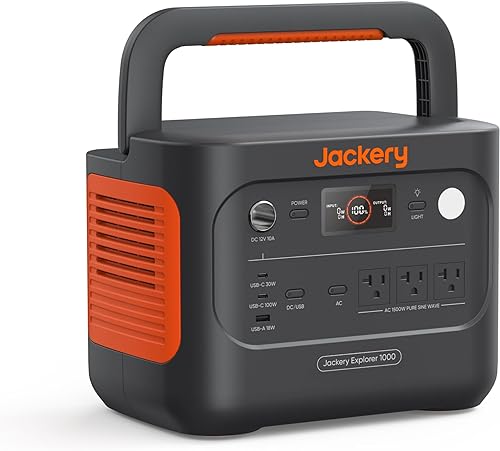
Jackery Explorer 1000 v2 Portable Power Station: Best for a middle-size AC kit
- 1,070Wh capacity
- 1,500W AC output
- Three AC ports
- Two USB-C ports
This balances a 1,070Wh battery with multiple AC and USB ports for charging a mixed kit. It works with Jackery solar panels for solar charging.
Pros
- Three pure sine wave AC ports
- Two USB-C ports
- 23.8 lb
Cons
- Solar charging is compatible only with Jackery panels
- Solar panel sold separately
Jackery’s Explorer 1000 v2 has 1,070Wh capacity and 1,500W AC output, with three AC outlets and two USB-C ports. At 23.8 lb, it sits between the compact 300Wh models and the larger 2kWh stations.
The combination of AC and USB connections can help when your kit includes a standard wall charger alongside phones or other USB devices. Jackery says emergency charging through its app can bring the station from empty to full in one hour; its default full-charge mode takes 1.7 hours.
For solar recharging, this model is compatible only with Jackery panels. The solar panel is sold separately, so include that in your plan if you expect to recharge away from an outlet.
Choose it for a mid-size kit that needs AC output and more capacity than a small unit. Check the charger’s wattage and plan around the solar compatibility limit.
Anker SOLIX C300 DC Portable Power Station: Best for USB-C drone charging
- 288Wh capacity
- 300W output
- Two 140W two-way USB-C ports
- Seven charging ports
The C300 DC has several USB-C ports, including two rated at 140W, for compatible drone batteries or devices. It has no AC outlet, so confirm your charging gear can use USB-C or DC.
Pros
- Two 140W two-way USB-C ports
- Seven charging ports
- Solar and car recharge options
Cons
- No AC outlet
- Solar panel compatibility is limited
The Anker SOLIX C300 DC has 288Wh capacity, 300W output and seven charging ports, including two 140W two-way USB-C ports. It is a DC-only station, so there are no AC outlets for a standard wall charger.
That connection mix is useful if your drone charging setup accepts USB-C or DC input. Anker says the unit can recharge to 80% in an hour using its dual PD 3.1 USB-C ports, and it also supports solar and car charging.
This model needs an 18W or higher USB-C wall charger for its first activation, using only the USB-C2 or USB-C3 ports. Solar panel compatibility also has limits, so check those details if you plan to recharge outdoors.
Choose it for compatible USB-C charging gear. If your drone charger uses a regular AC plug, select a station with AC output instead.
BLUETTI Elite 100 V2 Portable Power Station: Best for a compact AC and UPS mix
- 1,024Wh capacity
- 1,800W rated AC output
- 11 ports
- 10ms UPS switchover
A 1,024Wh battery and 11 ports give this unit room for an AC charger and other gear. Its UPS feature may also suit home office backup.
Pros
- 11 ports
- 10ms UPS switchover
- 25 lb
Cons
- Solar input and connectors need compatibility checks
- AC output is less than the large 2kWh picks
The BLUETTI Elite 100 V2 offers 1,024Wh capacity, 1,800W rated AC output and 11 ports. Its 25 lb weight is moderate for a station with this capacity, and the listed 10ms UPS switchover may help protect connected equipment during an outage.
For drone trips, the practical benefit is the mix of capacity and AC power for a standard charger, with additional ports for smaller devices. BLUETTI says it reaches 80% charge in about 45 minutes through AC fast charging.
The maker also states that it can run quietly in silent mode at 30 dB. Keep the unit upright during storage and transport, as BLUETTI warns that laying it on its side may damage internal components.
Choose it for a mid-size station that can serve both charging and home backup roles. Check the exact solar connector and panel limits if solar charging is part of your setup.
Anker SOLIX S2000 Portable Power Station: Best for 2kWh capacity in a smaller case
- 2,010Wh capacity
- 1,500W continuous output
- 3,000W peak output
- Eight outlets
The 2,010Wh capacity suits extended use, while the 1,500W continuous output sets a limit for combined loads. It has no 12V DC port.
Pros
- 2,010Wh capacity
- 35.7 lb
- Supports up to 400W solar input
Cons
- No 12V DC port
- 1,500W continuous output
Anker’s SOLIX S2000 has 2,010Wh capacity, 1,500W continuous output and eight outlets. The 35.7 lb body is lighter than some 2kWh units, but it still suits a vehicle or fixed backup spot better than a long carry.
Anker says it can power a refrigerator for up to 35 hours under specified lab conditions. For a drone kit, the more useful point is the large capacity, provided the charger’s draw stays within the 1,500W continuous output.
There is no 12V DC port, so check whether your accessories need that connection. The S2000 supports up to 400W solar input and can recharge through several methods, including AC, generator, solar panels, alternator charger or car outlet.
Choose it for a larger reserve and a 1,500W continuous load limit. Compare its outlet layout with your charger and other devices before packing.
BLUETTI Elite 30 V2 Portable Power Station: Best for light AC backup
- 288Wh capacity
- 600W continuous output
- 1,500W power lifting mode
- 10ms UPS switchover
The 9.5 lb Elite 30 V2 offers AC power as well as a 10ms UPS feature. Check your charger’s draw against its 600W continuous output.
Pros
- AC outlets for compatible chargers
- 9.5 lb
- 45-minute charge to 80%
Cons
- 288Wh capacity
- 600W continuous output
The BLUETTI Elite 30 V2 is a 288Wh station with 600W continuous output and AC outlets, weighing 9.5 lb. Its 1,500W power lifting mode is a separate feature, so use the stated continuous output when checking a drone charger or other steady load.
The 10ms UPS switchover may also be useful for a router or computer at home. BLUETTI says the unit can reach 80% in 45 minutes through AC charging, and it supports car and solar charging as well.
This is a small-capacity option rather than a substitute for the DJI Power 2000’s 2,048Wh reserve. It can suit shorter outings when you need AC output but want a lighter station.
Choose it for light AC charging and compact backup. Check continuous wattage, especially if you plan to run more than one device at once.
OUPES Mega 1 Portable Power Station 1024Wh: Best for capacity expansion
- 1,024Wh capacity
- 2,000W continuous output
- Expandable to 5,120Wh
- Dual 100W USB-C PD ports
The Mega 1 can connect with up to two extra batteries for a stated maximum capacity of 5,120Wh. Its mix of AC and USB-C connections may fit a varied kit.
Pros
- Expandable with up to two B2 batteries
- Dual 100W USB-C PD ports
- 2,000W continuous output
Cons
- Extra batteries are separate
- Solar and AC charging setup needs planning
The OUPES Mega 1 pairs 1,024Wh capacity with 2,000W continuous output and dual 100W USB-C PD ports. It weighs 27.8 lb and can expand to a stated 5,120Wh with up to two B2 extra batteries.
That combination offers a useful middle ground for buyers who want AC output and higher-capacity expansion. OUPES says the station can reach 80% charge in 36 minutes through AC, or 26 minutes with AC and solar combined.
For drone charging, check whether your charger uses AC or can connect to USB-C PD. The two 100W USB-C ports may not match every charging hub, so confirm its input requirements first.
Choose it if you want the option to add capacity later. Include the extra battery cost and charging setup in your planning, and verify compatibility before buying accessories.
DJI Power 2000 Portable Power Station: Best for DJI ecosystem and high capacity
- 2,048Wh capacity
- 15 ports
- Dual full SDC ports
- Expandable up to 22.5kWh
The DJI Power 2000 is the only DJI model in this group, with dual full SDC ports and 15 total ports. Solar and car battery charging need separate compatible adapters.
Pros
- Dual full SDC ports
- 15 ports
- 10ms UPS switchover
Cons
- Solar and car charging modules are not built in
- Expansion batteries are sold separately
The DJI Power 2000 is the only DJI model in this guide, with 2,048Wh capacity, 15 ports and dual full SDC ports. DJI lists stable output at 3,000W, and the unit weighs 21.72 kg.
For DJI drone owners, the SDC ports are the most relevant distinction, but the station alone does not confirm which batteries or charging hubs will connect. Check the exact accessory and adapter requirements for your drone model before buying, especially if you expect fast charging.
DJI says the Power 2000 can recharge to 80% in 55 minutes and supports expansion up to 22.5kWh with expansion batteries sold separately. It also has a 10ms UPS switchover and wireless control through the DJI Home app.
The main planning limitation is solar and car charging: the MPPT and car charging modules are not built in. Those inputs require separate compatible adapters, so account for them when setting up an off-grid kit.
Choose it if you want a high-capacity station with DJI-specific ports. For help with the initial steps, see our DJI Power 2000 setup guide.
How should you compare capacity and drone charging support?
Compare the watt-hours your batteries need with the station’s usable capacity, then check charger compatibility and output limits. A larger battery can support more charging, but connector type and charger draw still determine whether the setup works.
For an estimate, find the watt-hours for one full drone battery charge and multiply by the number of charges you need. Leave extra capacity for conversion losses and other devices such as a phone, controller or laptop.
A small station such as the Explorer 300 or C300 DC can suit a compact kit, but their 288–292Wh capacities leave less room for repeated charging. A 1,024Wh or 2,048Wh model gives more reserve, with more weight and space to carry.
To understand how capacity, output and conversion affect runtime, read how a portable power station works. Then compare your charger’s maximum input with the station’s continuous output, not only its peak rating.
Which connections matter for a DJI drone setup?
The best connection depends on your drone charger: AC suits a standard wall plug, while USB-C or DJI SDC ports may fit compatible charging accessories. Confirm the exact charger and cable requirements for your drone model before choosing a station.
The DJI Power 2000 has dual full SDC ports, while several alternatives offer USB-C connections. The Anker SOLIX C300 DC stands out for USB-C charging but has no AC outlet, so it cannot power a standard AC-only charger directly.
Count the devices you expect to charge at once, including phones, controllers and laptops. Check that the total load stays within the station’s output limit and that each device has a matching port.
How much capacity should you bring on a trip?
Choose capacity by the number of full battery charges you need and the extra devices you plan to run. For a short outing, a compact station may be easier to carry; for repeated charging or group use, a larger station gives more reserve.
The Explorer 300 and Elite 30 V2 are under 300Wh, while the mid-size choices offer around 1,000Wh. The DJI Power 2000 and Anker C2000 Gen 2 are around 2,000Wh, which can help with longer trips or broader backup needs.
Capacity is only part of the decision. A high-capacity station can still be a poor fit if it is too heavy for your transport plan or lacks the connector your charging gear needs.
Which station makes sense for backup at home?
For home backup, compare battery capacity, output, UPS switchover and the devices you need to keep running. The DJI Power 2000, Anker SOLIX S2000 and BLUETTI Elite 100 V2 include UPS features, with different capacities and output limits.
A UPS feature can keep supported equipment powered during a brief interruption, but it does not replace planning for long outages. Calculate how much power your essential devices draw and how long you need them to run.
If carrying ease matters more than capacity, our guide to portable power stations for seniors covers factors such as weight and handling. Consider how often you will move the unit and whether you can store it near the devices it must support.
What should you check before buying a DJI power station?
Check whether your drone’s battery hub or charger connects to the station, whether the station can supply its required wattage, and which accessories are needed for solar or car charging. These checks help prevent a high-capacity unit from being a poor match for your kit.
The DJI Power 2000 includes the station and AC power cable. DJI says solar and car battery charging require separate compatible adapters, and expansion batteries are also sold separately.
For any model, compare the listed continuous output with the charger’s input draw. Also check the unit’s weight, capacity and outlet count against your transport plan and the number of devices you need to charge.
Which DJI portable power station should you choose?
Choose the DJI Power 2000 if you want DJI’s 2,048Wh station with dual full SDC ports and can plan for its separate solar or car charging adapters. Choose a smaller alternative if portability matters more, or another 1,000Wh-class option if AC output and price tier matter more than DJI-specific connections.
Before you buy, confirm your drone charger’s connection and wattage, estimate the number of charges you need, and decide how you will transport the station. The DJI Power 2000 setup guide can help you plan its first use.
Our top 3 picks at a glance
-
1
Best for a light drone kit
Jackery Explorer 300 Portable Power Station
9.7/10 our score
See it on Amazon -
2
Best for longer appliance backup
Anker SOLIX C2000 Gen 2 Portable Power
9.7/10 our score
See it on Amazon -
3
Best for a middle-size AC kit
Jackery Explorer 1000 v2 Portable Power Station
9.6/10 our score
See it on Amazon
Frequently asked questions
Which DJI power station is best for drone charging?
The DJI Power 2000 is the DJI option in this guide, and its dual full SDC ports may suit compatible DJI charging accessories. Check the exact drone, battery hub, cable and adapter requirements before buying, because the station’s port count alone does not confirm compatibility.
For a smaller kit, compare the charger’s input needs with the station’s available outputs.
Can I charge a drone from a portable power station?
Yes, if the station has an output that matches your drone charger and enough capacity for the charging you need. Check connector type, voltage, wattage and any brand-specific adapter requirements.
Allow for other devices drawing power at the same time, since the combined load affects runtime.
Does the DJI Power 2000 include solar charging?
The DJI Power 2000 does not have a built-in MPPT module. Connecting a solar panel requires a separate compatible adapter, so include that extra connection step when planning an off-grid setup.
Confirm the panel and adapter match DJI’s current requirements before use.
How much capacity do I need for a drone trip?
Start with the watt-hours needed for your batteries and other gear, then leave capacity for conversion losses and unexpected charging. A 288Wh unit can suit a compact kit, while 1,000Wh or more gives more room for repeated charging or additional devices.
Your actual needs depend on the battery and charger.


