9 Best Dual Fuel Inverter Generators for RVs (November 2026)
The best dual fuel inverter generators for RVs include the Westinghouse 5000 Peak Watt Super Quiet Dual for long RV weekends, the Champion 4000-Watt Dual Fuel RV Ready Portable for lighter portable power, and the WEN Quiet and Lightweight 3600-Watt Dual Fuel for quiet campsites.
On this page (10 sections)
- The best dual fuel inverter generators for RVs, ranked
- How the best dual fuel inverter generator for RVs compares
- How we compared these RV dual fuel generators
- How many running watts does your RV actually need?
- Gasoline vs propane: which fuel should you carry?
- TT-30R vs L5-30R: which RV outlet do you need?
- Weight, noise and storage: what daily use feels like
- How do you size a dual fuel generator for a 30 amp RV?
- Can a solar generator replace a dual fuel generator for RV use?
- Verdict: which dual fuel inverter generator for RVs should you buy?
The best dual fuel inverter generator for RV use is the Westinghouse 5000 Peak Watt Super Quiet Dual for most 30 amp travel trailers. It gives 3900 running watts, a TT-30R 30 amp outlet, remote electric start and up to 18 hours on a 3.4 gallon gas tank.
This guide compares fuel flexibility and electrical capacity for RV camping loads. Gasoline gives more running watts on most models here, while propane gives longer run time on a 20 lb tank.
That trade off matters more than the peak watt number on the box.
You will see TT-30R outlets, L5-30R twist lock outlets, 12 volt DC ports and USB ports across this group. Match the outlet to your RV plug first, then match running watts to your loads.
A generator with the wrong outlet can need an adaptor, and a generator with too few running watts will trip or stall.
Our score weighs specs, features and buyer feedback against what you're shopping for. We checked the specs for running watts, fuel type, outlet type, weight, noise, run time and CO shutoff.
If you want a broader view of RV inverter power before dual fuel, read our guide to the best inverter generator for rv. If your RV service is 30 amp, our best inverter generator for rv 30 amp guide narrows the field by outlet and load.
Our picks at a glance
-
1
 Best for long RV weekends
Westinghouse 5000 Peak Watt Super Quiet Dual
9.6/10 our score
See it on Amazon -
2
 Best for lighter portable power
Champion 4000-Watt Dual Fuel RV Ready Portable
9.5/10 our score
See it on Amazon -
3
 Best for quiet campsites
WEN Quiet and Lightweight 3600-Watt Dual Fuel
9.2/10 our score
See it on Amazon
- 4
 Check it
WEN 6800-Watt Dual Fuel RV-Ready Electric Start
Best for 240 volt and EV backup - 5
 Check it
BILT HARD 5500W Dual Fuel Inverter Generator
Best for mid size RV loads - 6
 Check it
A-iPower 2300W Dual Fuel Inverter Generator
Best for small RVs and pop ups - 7
 Check it
PowerSmart 3800 Watt Dual Fuel Inverter Generator
Best for long propane runs - 8
 Check it
AIVOLT 8000W Dual Fuel Inverter Generator 50A
Best for large RVs and 50 amp needs - 9
 Check it
PowerSmart 4400 Watt Dual Fuel Portable Generator
Best for budget RV backup
The best dual fuel inverter generators for RVs, ranked
The Westinghouse leads for power, run time and RV outlet fit. The Champion follows for light weight and propane run time.
The rest fill clear jobs, from quiet campsites to 50 amp RVs.
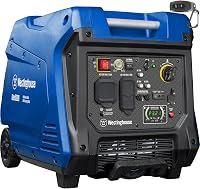
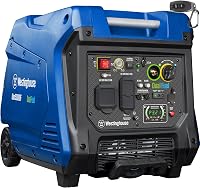
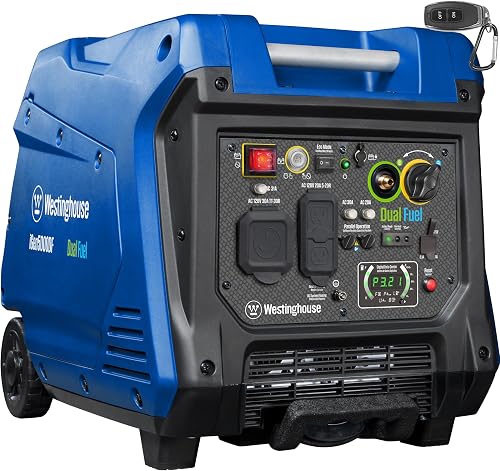
Westinghouse 5000 Peak Watt Super Quiet Dual: Best for long RV weekends
- 5000 peak watts and 3900 rated watts
- RV Ready TT-30R 30 amp outlet
- Remote electric start with key fob
- Up to 18 hour run time on 3.4 gallon gas tank
- About 52 dBA noise output
Strong 30 amp RV power, remote start and long gas run time make this the top pick for travel trailers that run air conditioning, fridges and chargers.
Pros
- 3900 running watts
- TT-30R 30 amp RV outlet
- Remote and electric start
- LED data center display
- Parallel capable
Cons
- 104.7 lb is heavy to lift
- Needs space for a 3.4 gallon tank run plan
Westinghouse suits travel trailer owners who run a fridge, water pump, lights, chargers and air conditioning from one generator. Its 3900 running watts sit near the top of this group, and the TT-30R 30 amp outlet plugs straight into many RV shore cords.
The 3.4 gallon gas tank gives up to 18 hours of run time, and Westinghouse lists noise as low as 52 dBA. Economy mode lowers engine speed under light loads, which helps at night and saves fuel when you only need lights and chargers.
Remote electric start with an included key fob helps when the generator sits outside and the RV door is closed. The LED data center shows fuel level, output, remaining run time, voltage and lifetime hours, so you can plan refills before the tank runs dry.
The trade off is weight at 104.7 lb. It has wheels and a telescoping handle, but it is not a one hand carry.
If you move it between a truck bed, campsite and storage bay often, plan for two people or a ramp.
Champion 4000-Watt Dual Fuel RV Ready Portable: Best for lighter portable power
- 4000 starting watts and 3000 running watts on gas
- 2700 running watts on propane
- Up to 25 hours on 20 lb propane tank
- 51.8 lb weight
- CO Shield auto shutoff
- TT-30R 25 amp outlet
At 51.8 lb with 3000 running watts on gas and long propane run time, this Champion suits smaller RVs, pop ups and weekend base camps.
Pros
- Light at 51.8 lb
- 3000 running watts on gas
- Up to 25 hours on propane
- CO Shield shutoff
- Parallel ready
Cons
- TT-30R rated 25 amp, not 30 amp
- Recoil start only
Champion suits campgrounds, pop ups and smaller travel trailers where weight matters. At 51.8 lb, it is about half the weight of the Westinghouse, and that gap shows up every time you load it into a hatch or truck bed.
It delivers 3000 running watts on gas and 2700 running watts on propane. On a 20 lb propane tank, Champion lists up to 25 hours at 25 percent load.
That makes propane the smart choice for quiet overnight loads like fans, lights and phone chargers.
The outlet set includes a 120V 25A TT-30R outlet, a 120V 20A household duplex and a 12V automotive style outlet. Note the 25 amp rating on the RV outlet, so check your RV load before you assume full 30 amp service.
CO Shield adds auto shutoff for carbon monoxide, and cold start technology helps in cold weather. The trade off is recoil start only, plus less running power than the top pick for air conditioning.
WEN Quiet and Lightweight 3600-Watt Dual Fuel: Best for quiet campsites
- 3600 surge watts and 2900 rated watts on gas
- 3500 surge watts and 2600 rated watts on propane
- 49 lb weight
- CO Watchdog shutdown sensor
- Fuel shut off
- TT-30R RV receptacle
A 49 lb WEN with TT-30R power, CO Watchdog shutoff and fuel shut off suits quiet campsites and lighter RV loads.
Pros
- Light at 49 lb
- TT-30R RV receptacle
- CO Watchdog sensor
- Fuel shut off
- Tool-free LPG connector
Cons
- 2900 rated watts on gas
- 2600 rated watts on propane
- 1.5 gallon tank limits gas run time
WEN suits quiet campsites and buyers who want light weight with RV ready outlets. At 49 lb, it is one of the lightest models here, and the TT-30R RV receptacle fits standard RV shore cords.
Power is 2900 rated watts on gas and 2600 rated watts on propane. That covers a fridge, lights, water pump, chargers and fans, but it leaves less headroom for air conditioning or a second high draw appliance.
The WEN Watchdog CO shutdown sensor adds safety, and fuel shut off lets the carburetor use up remaining fuel before shutdown. WEN says that helps limit maintenance from stale fuel.
You also get two 120V three prong receptacles, one 12V DC receptacle, two 5V USB ports and a tool free LPG quick connector. The trade off is the 1.5 gallon gas tank, so propane planning matters for long weekends.
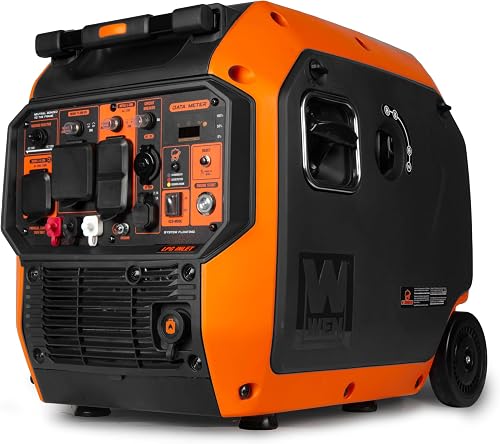
WEN 6800-Watt Dual Fuel RV-Ready Electric Start: Best for 240 volt and EV backup
- 6800 surge watts and 5100 rated watts on gas
- 6000 surge watts and 4500 rated watts on propane
- Bonded-neutral 240 volt L14-30R outlet
- TT-30R RV receptacle
- Electric start
- CO Watchdog sensor
- 99.2 lb weight
This WEN adds 5100 running watts on gas, a 240 volt L14-30R outlet and TT-30R RV power for larger RVs and EV backup.
Pros
- 5100 running watts on gas
- 120V and 240V L14-30R outlet
- TT-30R RV receptacle
- Electric start
- CO Watchdog sensor
Cons
- 99.2 lb weight
- 4500 running watts on propane
- Larger footprint for small RVs
WEN 6800 suits larger RVs, fifth wheels and buyers who need 240 volt power. It delivers 5100 rated watts on gas and 4500 rated watts on propane, the highest gas running watts in this group after the AIVOLT.
The bonded neutral 240V setup includes an L14-30R 120V/240V receptacle, plus a TT-30R RV receptacle, two 120V receptacles, a 12V DC receptacle and two USB ports. WEN says the 240V outlet can provide low power Level 2 charging for battery and hybrid electric vehicles.
Electric start with recoil backup makes cold starts easier, and the CO Watchdog sensor adds shutoff protection. Fuel shut off helps clear fuel from the carburetor before shutdown.
At 99.2 lb, it is heavy and large, at 22.8 x 16.6 x 19.7 inches. Pick it for power and outlet range, not for light packing.
Small RVs will get more use from the lighter WEN 3600.
BILT HARD 5500W Dual Fuel Inverter Generator: Best for mid size RV loads
- 5500 starting watts and 4000 running watts on gas
- 5000 starting watts and 3600 running watts on LPG
- 120V 30A RV TT-30R outlet
- 160cc OHV engine
- 1.14 gallon fuel tank
- CO auto shutoff
- 61.7 lb weight
With 4000 running watts on gas, a 30A TT-30R outlet and 61.7 lb weight, this BILT HARD fits mid size RV loads without Westinghouse weight.
Pros
- 4000 running watts on gas
- 30A TT-30R outlet
- 61.7 lb weight
- CO auto shutoff
- Parallel connectors
Cons
- 1.14 gallon tank
- 3600 running watts on LPG
- Recoil start
BILT HARD suits mid size RV loads where 4000 running watts matter, but Westinghouse weight does not fit your storage plan. It lists 4000 running watts on gas and 3600 running watts on LPG, with a 120V 30A RV TT-30R outlet.
At 61.7 lb, it sits between the light models and the heavy top picks. That makes it easier to move into a truck bed or basement compartment than the 104.7 lb Westinghouse.
The 160cc OHV engine, Economy mode and digital display help you track volts, frequency, amps, watts, runtime and fuel level. CO auto shutoff, overload indicators, breakers and low oil protection add safety layers.
The 1.14 gallon fuel tank is the main limit, so gas run time will be shorter than the Westinghouse. Propane helps for long light loads.
Recoil start is also less convenient than electric start on the top models.
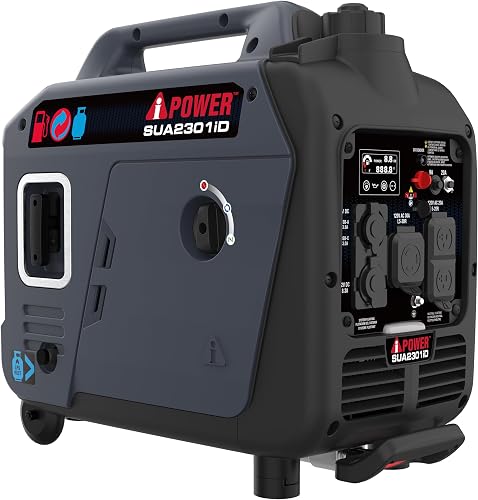
A-iPower 2300W Dual Fuel Inverter Generator: Best for small RVs and pop ups
- 2300 starting watts and 1800 running watts on gas
- 2000 starting watts and 1600 running watts on propane
- 40.3 lb weight
- CO sensor
- 30A RV adaptor included
- Parallel ready
- 61 dB sound level
At 40.3 lb with 1800 running watts on gas and a 30A RV adaptor, this A-iPower suits small RVs, pop ups and light backup loads.
Pros
- Light at 40.3 lb
- 30A RV adaptor included
- CO sensor
- Parallel ready
- Telescoping handle
Cons
- 1800 running watts on gas
- 1600 running watts on propane
- Limited for air conditioning loads
A-iPower suits small RVs, pop ups, teardrops and buyers who carry power in a car hatch. At 40.3 lb, it is the lightest model in this guide, with a telescoping handle and flat free wheels.
It gives 1800 running watts on gas and 1600 running watts on propane. That covers lights, fans, phone chargers, a small fridge and a water pump, but it will struggle with air conditioning or electric heaters.
The control panel includes a CO sensor, LED light, data center display, two USB ports, one 12V DC outlet, one L5-30R 30A 120V outlet and one duplex 5-20R outlet. A 30A RV adaptor is included, which helps bridge outlet types.
Parallel ready design lets you pair two units later if your loads grow. The trade off is clear: buy this for portability and light loads, not for full size RV power.
PowerSmart 3800 Watt Dual Fuel Inverter Generator: Best for long propane runs
- 3800 starting watts and 3300 running watts on gas
- 3500 starting watts and 3100 running watts on propane
- Up to 24 hours on 20 lb propane tank
- 59 dBA at 25 percent load
- 50.7 lb weight
- CO sensor
- Parallel ready
This PowerSmart gives 3300 running watts on gas, 3100 on propane and up to 24 hours on a 20 lb propane tank at 50.7 lb.
Pros
- 3300 running watts on gas
- 3100 running watts on propane
- Up to 24 hours on propane
- 59 dBA at 25 percent load
- CO sensor
Cons
- L5-30R twist-lock, not TT-30R
- 1.3 gallon gas tank
- 8 hours on gas at 25 percent load
PowerSmart 3800 suits RV owners who want long propane run time without heavy weight. It lists 3300 running watts on gas and 3100 running watts on propane, with up to 24 hours on a standard 20 lb propane tank.
At 50.7 lb, it is easy to move compared with the top picks. PowerSmart lists 59 dBA at 25 percent load in Eco mode, which helps at quiet campsites.
The panel includes a 120V 30A L5-30R twist lock outlet, a 120V 20A duplex, a 12V 8A DC port and dual USB ports. Note the L5-30R outlet, not a TT-30R, so check your cord or adaptor plan before you buy.
CO sensor, overload protection, short circuit protection and low oil shutdown add safety. The 1.3 gallon gas tank gives 8 hours at 25 percent load, so propane is the better choice for overnight runs.
AIVOLT 8000W Dual Fuel Inverter Generator 50A: Best for large RVs and 50 amp needs
- 8000 surge watts and 6100 running watts on gas
- 7200 starting watts and 5500 running watts on LPG
- 322cc 4-stroke OHV engine
- 62 dBA noise level from 23 feet
- 130.7 lb weight
- CO Alert shutoff
- Electric start
The AIVOLT delivers 6100 running watts on gas and 5500 on LPG for large RVs, with electric start and CO Alert shutoff at 130.7 lb.
Pros
- 6100 running watts on gas
- 5500 running watts on LPG
- Electric start
- CO Alert shutoff
- 62 dBA from 23 feet
Cons
- 130.7 lb weight
- Largest footprint in this group
- Overkill for small RV loads
AIVOLT suits large RVs, motorhomes and 50 amp setups where power demand is high. It delivers 6100 running watts on gas and 5500 running watts on LPG, with 8000 surge watts on gas.
The 322cc 4-stroke OHV engine, electric start and 62 dBA noise level from 23 feet fit RV and home backup use. AIVOLT lists over 10 hours of runtime at 25 percent load in Eco mode.
The 5-in-1 LCD display shows fuel use, voltage, runtime and more. You get four outlets, a 12V DC cigarette outlet and a dual USB adapter.
CO Alert technology shuts the unit down if CO levels rise.
At 130.7 lb, it is the heaviest model here, with a telescopic handle and two 7 inch wheels. Buy it for large loads and 50A RV power needs.
Small RVs will find it too large and too heavy for daily packing.
PowerSmart 4400 Watt Dual Fuel Portable Generator: Best for budget RV backup
- 4400 starting watts and 3600 running watts on gasoline
- 4000 starting watts and 3300 running watts on LPG
- 1.6 gallon fuel tank
- Up to 24 hours on 20 lb propane tank
- 68 lb weight
- CO Protect shutoff
- Parallel ready
This PowerSmart offers 3600 running watts on gasoline, 3300 on LPG and up to 24 hours on propane for budget RV backup at 68 lb.
Pros
- 3600 running watts on gasoline
- 3300 running watts on LPG
- Up to 24 hours on propane
- CO Protect shutoff
- Parallel ready
Cons
- 68 lb weight
- L5-30R twist-lock, not TT-30R
- 76 dB at full load
PowerSmart 4400 suits budget RV backup and mid size camping loads. It lists 3600 running watts on gasoline and 3300 running watts on LPG, with a 1.6 gallon fuel tank.
On a 20 lb propane tank, PowerSmart lists up to 24 hours at 25 percent load. That makes propane the practical choice for overnight RV loads, while gasoline gives more watts for daytime use.
The panel includes a 120V 30A L5-30R twist lock outlet, a 120V 20A duplex, a 12V 8A DC port and Eco mode. Like the smaller PowerSmart, this uses L5-30R instead of TT-30R, so confirm your RV cord fit.
At 68 lb, it is manageable but not light. CO Protect shutoff, low oil shutdown and overload protection add safety.
The trade off is 76 dB at full load, so quiet campsites may favor a lower decibel model.
How the best dual fuel inverter generator for RVs compares
Our score weighs specs, features and buyer feedback against what you're shopping for. We compared running watts first, because surge watts do not run a fridge or air conditioner all night.
Gasoline wins on watts, propane wins on run time. The Westinghouse gives 3900 running watts on gas with up to 18 hours on a 3.4 gallon tank.
The Champion gives 3000 running watts on gas, but up to 25 hours on a 20 lb propane tank.
Outlet type splits the group. The Westinghouse, WEN 3600, WEN 6800 and BILT HARD list TT-30R RV outlets.
The PowerSmart models and A-iPower use L5-30R or adaptors. Check your shore cord plug before you order.
Weight ranges from 40.3 lb for the A-iPower to 130.7 lb for the AIVOLT. That range is bigger than the watt gap between some mid models, and it affects storage, loading and how often you will actually use the generator.
Noise matters at campgrounds. Westinghouse lists as low as 52 dBA, PowerSmart 3800 lists 59 dBA at 25 percent load, and AIVOLT lists 62 dBA from 23 feet.
If you camp close to other RVers, read our best quiet rv generator guide before you choose.
How we compared these RV dual fuel generators
We looked at running watts on gas and propane, outlet type, weight, tank size, run time, noise, CO shutoff and start type. Peak watts alone did not decide the rank.
We also checked what each model includes, such as propane hoses, adaptors, key fobs and parallel connectors. Those items can save money and packing space on your first trip.
We did not test these generators hands on. We compared specs and features from the product data, then matched each model to RV loads like fridges, water pumps, lights, chargers and air conditioning.
How many running watts does your RV actually need?
Add up the running watts for loads you run at the same time. A fridge, water pump, lights, fans and phone chargers often land near 1500 to 2500 watts.
Air conditioning changes the math fast. A roof air conditioner can add a large starting load, so many owners choose 3500 to 5000 running watts for a 30 amp travel trailer.
For a 30 amp travel trailer
Choose 3500 to 4000 running watts if you plan to run air conditioning. The Westinghouse at 3900 running watts and the BILT HARD at 4000 running watts fit this range.
For a pop up or small RV
Choose 1800 to 2900 running watts for lights, fans, chargers and a small fridge. The A-iPower at 1800 running watts and the WEN 3600 at 2900 rated watts fit light loads.
For a 50 amp or large RV
Choose 5500 to 6100 running watts if you run two air conditioners or heavy loads. The AIVOLT at 6100 running watts on gas fits this higher range.
Gasoline vs propane: which fuel should you carry?
Gasoline gives more running watts on every model here. The WEN 6800 drops from 5100 rated watts on gas to 4500 on propane, and the Champion drops from 3000 to 2700.
Propane gives longer run time on a 20 lb tank for several models. Champion lists up to 25 hours at 25 percent load, and both PowerSmart models list up to 24 hours.
Pick gasoline if you need peak power
Gasoline is the better choice for air conditioning, electric heaters and multiple appliances. It also avoids carrying a large propane tank if fuel space is tight.
Pick propane if you need quiet overnight run time
Propane is the better choice for fans, lights and chargers through the night. It also stores well and avoids fuel smell in storage compartments.
Carry both when your trip allows it
Dual fuel lets you switch based on fuel access. Many RVers carry a propane tank for night loads and use gasoline for daytime high draw loads.
TT-30R vs L5-30R: which RV outlet do you need?
TT-30R is the standard RV plug shape for many 30 amp shore cords. The Westinghouse, WEN models and BILT HARD list TT-30R outlets, so they plug in with less fuss.
L5-30R is a twist lock outlet used by the PowerSmart models and A-iPower. It can work with an adaptor or a different cord, but you need to plan that step before a trip.
Match the outlet to your RV cord first. An adaptor solves fit, but it adds a part to pack and a point of failure at the campsite.
Weight, noise and storage: what daily use feels like
A 40 lb generator is easy to lift into a hatch. A 100 lb generator is a two person lift, even with wheels and a handle.
Noise follows load more than brand. Eco mode and inverter design help at light loads, but air conditioning will raise engine speed and sound on any model.
For truck bed storage
Choose models under 70 lb if you load alone. The Champion at 51.8 lb, WEN 3600 at 49 lb and BILT HARD at 61.7 lb fit this limit.
For campsite neighbors
Choose models with low listed noise at light load. Westinghouse lists as low as 52 dBA, and PowerSmart 3800 lists 59 dBA at 25 percent load.
For basement compartments
Measure height and width before you buy. The AIVOLT at 25.1 x 19.6 x 21.3 inches needs far more space than the A-iPower at 19.7 x 10.7 x 18.5 inches.
How do you size a dual fuel generator for a 30 amp RV?
Start with running watts, not peak watts. List every appliance you will run together, then add starting watts for motors like air conditioning and water pumps.
If you run air conditioning plus a fridge and chargers, aim for 3500 to 4000 running watts. If you skip air conditioning, 2500 to 3300 running watts often covers the rest.
Also check the outlet. A 30 amp RV needs a TT-30R outlet or an L5-30R outlet with the right cord or adaptor.
Can a solar generator replace a dual fuel generator for RV use?
A solar generator can run lights, fans and chargers without fuel, but it depends on sun, battery size and charge time. A dual fuel generator refuels and runs for hours at high load.
Many RVers use both. Solar covers daytime light loads, and a dual fuel generator covers air conditioning, cloudy days and battery charging.
If you want a battery based option for comparison, read our guide to the Best Solar Generator For RV. If you are choosing between battery systems and a generator, our [Power Station vs.
Dual Battery System for Vans](/power-station-vs-dual-battery-system-vans/) guide explains the trade off.
Verdict: which dual fuel inverter generator for RVs should you buy?
The best dual fuel inverter generator for RV use is the Westinghouse 5000 Peak Watt Super Quiet Dual for 30 amp travel trailers. It gives 3900 running watts, TT-30R power, remote start and long gas run time.
Pick the Champion 4000-Watt Dual Fuel RV Ready Portable if weight and propane run time matter more than max watts. Pick the WEN 6800-Watt Dual Fuel RV-Ready Electric Start if you need 240 volt power or EV backup.
For small RVs and pop ups, pick the A-iPower 2300W Dual Fuel Inverter Generator for light weight. For quiet campsites, compare the WEN 3600 and PowerSmart 3800 by noise and outlet fit.
Next, confirm your RV plug and your peak loads, then choose the model that covers both without extra adaptors.
Our top 3 picks at a glance
-
1
Best for long RV weekends
Westinghouse 5000 Peak Watt Super Quiet Dual
9.6/10 our score
See it on Amazon -
2
Best for lighter portable power
Champion 4000-Watt Dual Fuel RV Ready Portable
9.5/10 our score
See it on Amazon -
3
Best for quiet campsites
WEN Quiet and Lightweight 3600-Watt Dual Fuel
9.2/10 our score
See it on Amazon
Frequently asked questions
How many watts does an RV need from a dual fuel inverter generator?
Most RVs need 3000 to 4000 running watts for a fridge, lights, water pump, chargers and fans. Air conditioning pushes that need higher.
Add up running watts for the loads you use together, then add starting watts for motors.
A 3900-watt generator fits many 30 amp RVs.
Is propane better than gasoline for RV camping?
Propane burns clean and stores well, and a 20 lb tank can run some models for up to 25 hours at light load. Gasoline is easier to find in remote areas.
Dual fuel gives you both choices.
You can switch based on fuel access, run time and storage space on your trip.
Can a dual fuel inverter generator run a 30 amp RV?
Yes, if it has a TT-30R 30 amp outlet and enough running watts for your loads. The Westinghouse and BILT HARD in this guide list 30 amp RV outlets.
Check your RV plug and your peak loads before you choose, since outlet shape and watts both matter.
What should I check for CO safety on an RV generator?
Use a model with a CO sensor or CO Shield shutoff, run it outside the RV, and keep exhaust away from windows and vents. Champion, WEN, BILT HARD, A-iPower and PowerSmart list CO shutoff features here.
Never run a generator in an enclosed space, and keep CO alarms inside the RV.