Can You Use BLUETTI for an Oxygen Concentrator?
Yes, you can use a BLUETTI power station with an oxygen concentrator if its output supports the concentrator's running and startup needs. Check runtime, connection type, and your medical backup plan before relying on it.
On this page (8 sections)
- Can you use BLUETTI for an oxygen concentrator?
- How do you match BLUETTI output to the concentrator?
- How do you estimate oxygen concentrator runtime?
- Which portable power options fit this type of backup?
- What should you check before connecting an oxygen concentrator?
- Can solar charging keep an oxygen concentrator running?
- Is a BLUETTI a good medical backup by itself?
- What is the final decision rule?
Yes, you can use a BLUETTI power station for an oxygen concentrator when the unit's output matches the concentrator's running and startup demand. You also need enough battery capacity for the time you expect to be without wall power.
An oxygen concentrator is medical equipment, so a portable battery should support your backup plan rather than replace advice from your clinician or equipment provider. Review our guide to Home Backup Power for Essential Medical Equipment for a wider emergency setup.
Can you use BLUETTI for an oxygen concentrator?
You can use BLUETTI for an oxygen concentrator if the power station supplies the correct AC output and enough wattage. Start by checking the concentrator's label or manual for voltage, running watts, and any startup requirement.
A BLUETTI model with an AC inverter can be more useful for a mains-powered concentrator than a USB-only battery. Match the concentrator's plug to the power station's outlet, and don't use an adapter that changes the electrical requirements.
The power station should also have enough capacity for the planned outage. A unit may run the concentrator for a short period but still be unsuitable for overnight use if its watt-hours are too low.
How do you match BLUETTI output to the concentrator?
Compare the concentrator's wattage with the power station's continuous output first. The continuous rating is the key number for equipment that runs for a long time.
Startup demand can be higher than normal operating demand. If the concentrator needs a surge when its motor starts, the power station must handle that surge without shutting down.
Pure sine wave AC output is another useful detail to check. The Jackery Explorer 300 is described with a 110V/300W pure sine wave AC outlet, but you still need to compare those figures with your concentrator's requirements.
Don't assume a larger battery automatically has the right output. Capacity and inverter power are different measurements, and both matter for this use.
How do you estimate oxygen concentrator runtime?
Estimate runtime by dividing usable watt-hours by the concentrator's operating watts. A practical planning formula is:
Estimated runtime = battery capacity in Wh × 0.85 ÷ concentrator power in W
The 0.85 factor allows for conversion loss, but it is only an estimate. Oxygen settings, power draw, battery condition, temperature, and the power station's operating limits can change the result.
For example, a 60W device connected to a 292Wh battery would have an estimated runtime of about 4.1 hours using that formula. The concentrator's real draw must be used for your own calculation.
Plan around less time than the estimate when oxygen access is essential. A second power source, charged spare battery, or approved oxygen cylinder may provide a safer margin than running a battery until it shuts down.
Which portable power options fit this type of backup?
The right choice depends on the concentrator's wattage, the required backup time, and whether you need a full AC power station. These products show the difference between a battery generator, a small battery station, and a wall-powered charging accessory.
Jackery Explorer 300 Portable Power Station
The Jackery Explorer 300 Portable Power Station has a 292Wh capacity, 300W rated output, and 600W peak surge. It includes 2 AC outlets, a 100W USB-C PD port, 2 USB-A ports, and a 120W car port.
At 7.5 lb, the Explorer 300 is easier to move than a larger home backup unit. Its title and data identify it as a 292Wh model, so use that capacity in your runtime estimate rather than treating it as an all-night guarantee.
Jackery gives a working-time example based on 300Wh multiplied by 0.85 and divided by device power. The same method can help you compare your concentrator's demand, but actual use may vary.
The Explorer 300 can recharge from an AC adapter, a car port, or a Jackery SolarSaga 100W solar panel sold separately. It can also charge devices while it is being recharged.
Check your concentrator's power needs before choosing this size.
HOWEASY Portable Power Station
The HOWEASY Portable Power Station has 88Wh of capacity, 120W running output, and 240W peak output. It has 2 AC sockets, a USB-C port, 2 QC 3.0 USB ports, 1 USB port, 2 DC ports, and an LED display.
HOWEASY states that the H120 supports devices up to 120W and that multiple devices should stay within 150W total. Its own guidance says 88.8Wh may not sustain CPAP use all night, which is a useful warning that this capacity may be too small for long medical backup periods.
The H120 weighs 2.3 lb and measures 6.6 x 3 x 4 in. It can recharge from an AC outlet, a 15V to 24V solar panel, or a 12V/24V car socket.
The solar panel is not included.
This model suits a concentrator with a low measured draw and a short backup window, not a setup that needs many hours without checking runtime. It includes an AC power adapter, car charger, and user manual.
Anker 525 Charging Station
The Anker 525 Charging Station is a 7-in-1 USB C power strip with 65W maximum output. It has 3 AC outlets, 2 USB-C ports, and 2 USB-A ports, but it does not provide stored battery capacity.
Anker places the AC outlets at the back and the USB ports at the front. Its USB-C ports share a total of 65W, and the unit uses a Type B 3-pin North American plug.
This charging station can help organize a powered setup when wall electricity is available. It cannot keep an oxygen concentrator running after an outage because the power strip has no battery capacity.
Don't substitute it for a portable power station. If your goal is outage protection, compare battery watt-hours and AC output instead of the number of outlets.
What should you check before connecting an oxygen concentrator?
Check the concentrator label, the power station output, the cable, and the expected runtime before use. Write down the concentrator's running watts and compare them with the battery unit's continuous AC rating.
Follow these checks:
- Confirm the concentrator's voltage and plug type.
- Record its running wattage and any startup demand.
- Choose a power station with enough continuous output.
- Estimate runtime from watt-hours and actual power draw.
- Charge the power station fully before an expected outage.
- Test the connection while wall power is available.
- Keep the concentrator's normal power source available when possible.
A power station that shuts off from overload is not a dependable match. Disconnect the equipment and check the ratings instead of repeatedly restarting the system.
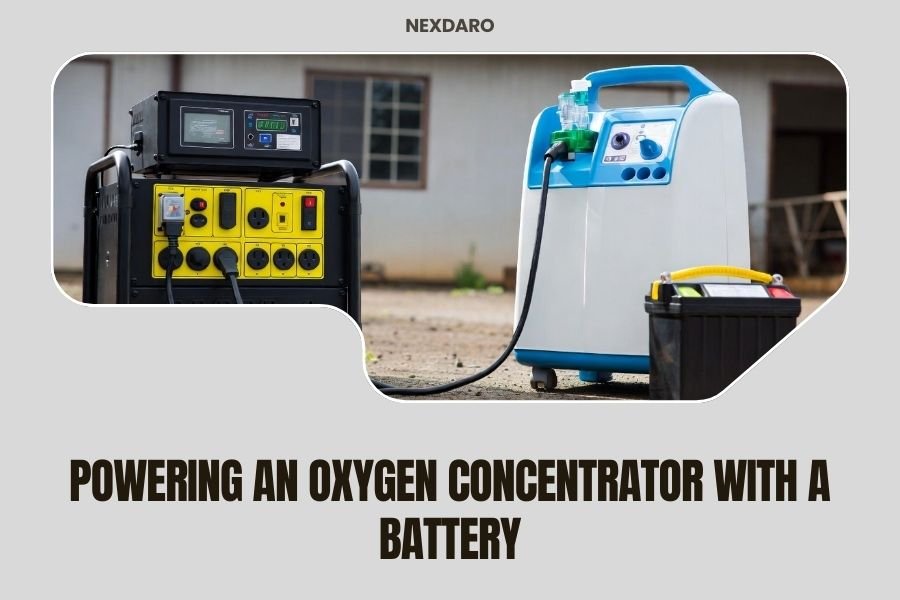
For a deeper comparison of battery capacity and device demand, read Powering an Oxygen Concentrator with a Battery. You can also compare models in Best Portable Power Station For Oxygen Concentrator.
Can solar charging keep an oxygen concentrator running?
Solar charging can refill a compatible power station, but it depends on sunlight, panel size, input limits, and the concentrator's ongoing demand. Solar input may extend a battery plan, but it is not the same as continuous grid power.
The Jackery Explorer 300 can charge with a Jackery SolarSaga 100W solar panel, which is sold separately. Jackery gives an estimate of about 3.5 hours through that panel, while the product data also describes other charging times and methods.
The HOWEASY H120 accepts a 15V to 24V solar panel, with a recommended panel range of 20W to 60W. Its solar panel is not included.
Keep the concentrator connected only when the power station and solar conditions support stable output. Clouds, shade, panel position, and the battery's remaining charge can reduce the energy available.
Is a BLUETTI a good medical backup by itself?
A BLUETTI power station should be one part of an oxygen backup plan, not the only plan. Battery runtime can change with device settings and conditions, and a failure at the wrong time can leave you without needed equipment.
Ask your oxygen supplier or clinician what backup method fits your prescription. Keep emergency contact details, a charged backup battery, and any approved alternate oxygen source ready according to your care plan.
If you also use a nebulizer, Do Nebulizers Have Battery Backups? explains why a wall charger, USB battery, and true power station are different types of backup.
What is the final decision rule?
Pick a BLUETTI only after its continuous AC output, startup handling, and estimated runtime match your oxygen concentrator. Pick a larger-capacity model when the calculated runtime is too close to the planned outage, and don't mistake a power strip for a battery.
The Jackery Explorer 300 is the strongest match of these 3 products for a concentrator that fits its 300W output and needs 292Wh of capacity. The HOWEASY H120 is lighter but has only 88Wh and 120W running output, while the Anker 525 is for wall-powered cable organization.
For more brand context, see Best Bluetti Portable Power Station and Is Bluetti a Good Brand?. Always confirm the final setup with the concentrator's manual and your medical equipment provider.
Frequently asked questions
Can a BLUETTI power station run an oxygen concentrator?
Yes, if the BLUETTI model can supply the concentrator's required voltage and wattage, including any startup demand. Check the concentrator label or manual, use the correct AC output, and confirm the expected runtime before an outage.
Keep another oxygen supply or backup plan available if prescribed.
How long will an oxygen concentrator run on a power station?
Runtime depends on battery watt-hours, the concentrator's actual power draw, conversion loss, and the selected oxygen setting. A simple estimate is battery capacity multiplied by about 0.85, divided by device watts.
Actual runtime can be shorter, so leave a safety margin.
Is a power strip the same as a battery backup for an oxygen concentrator?
No. A power strip distributes electricity from a wall outlet but does not store energy during an outage.
An oxygen concentrator needs a battery power station or another backup source that matches its output needs.
Check the backup device's instructions before connecting medical equipment.
What should you do if the power station overloads?
Turn off the concentrator and disconnect it if the power station reports an overload, shuts down, or becomes unusually hot. Check the total wattage, cable, outlet, and manual.
Do not keep restarting the system without finding the cause, and use your emergency oxygen plan.