9 Best RV Refrigerator Fans (November 2026)
The best RV refrigerator fans include the Beech Lane RV Fridge Fan for simple interior circulation, the Beech Lane 12V RV Refrigerator Evaporator Fin for wired fin cooling, and the Camco Camper/RV Fridge Deodorizer & Airator for odor control in small fridges.
On this page (8 sections)
- Our top RV refrigerator fan picks, from interior to exterior cooling
- How does the best RV refrigerator fan compare across types?
- Which type of RV fridge fan do you need?
- Battery, 12V wired, or vent power: which power source fits your rig?
- How many fans, and how much speed, do you actually need?
- What size and placement work in your fridge?
- How do you install and care for an RV refrigerator fan?
- Which fan should you buy in the end?
The best RV refrigerator fan for most rigs is the Beech Lane RV Fridge Fan, because its 3,000 RPM motor gives strong interior circulation without any wiring. If your fins frost up, the Beech Lane 12V Evaporator Fin Fan is a better fit, since three wired fans sit on the fins.
If the fridge runs warm in desert heat, the Quick Products vent fan moves heat out the back.
RV absorption fridges cool by moving heat out through vents. When air inside sits still, cold air drops and warm spots form.
When air behind sits still, heat builds up and the fridge works harder. That is why this guide splits picks into interior circulation fans, fin fans, and one exterior vent fan.
Our score weighs specs, features and buyer feedback against what you are shopping for. We compared motor speed, fan count, power draw, noise, wiring, size and controls.
We did not test them by hand.
Our picks at a glance
-
1

-
2
 Best for wired fin cooling
Beech Lane 12V RV Refrigerator Evaporator Fin
9.6/10 our score
See it on Amazon -
3
 Best for odor control in small fridges
Camco Camper/RV Fridge Deodorizer & Airator
9.4/10 our score
See it on Amazon
- 4
 Check it
DutchAire RV Refrigerator Fin Fan with Fridge
Best for fridge temperature readout - 5
 Check it
Quick Products QP-CRRF Clip-On RV Refrigerator Fan
Best for two-speed clip-on control - 6
 Check it
Makevivi 12V RV Refrigerator Fan
Best for high RPM triple fans - 7
 Check it
Frost Guard 15" Triple Fan Deluxe RV
Best for low amp draw and lighting - 8
 Check it
uueeGo 12V RV Refrigerator Evaporator Fan,with Three
Best for two-speed fin fan value - 9
 Check it
Quick Products QP-RFVCF90 RV Refrigerator Vent Cooling
Best for exterior vent cooling
Our top RV refrigerator fan picks, from interior to exterior cooling
The Beech Lane RV Fridge Fan leads for simple, no wiring circulation. The Beech Lane fin fan leads for wired prep.
The Camco Airator adds odor control for small fridges. The rest trade speed, controls, lighting, or exterior heat removal.
Beech Lane RV Fridge Fan: Best for simple interior circulation
- 3,000 RPM motor
- Patented spiderweb top
- Easy on and off switch
- Multiple side vents
- Beech Lane lifetime warranty
A compact battery powered fan with a high speed motor and spiderweb top for moving cold air around the fridge.
Pros
- High 3,000 RPM motor
- Simple on and off switch
- Beech Lane lifetime warranty
Cons
- Battery powered, not wired to 12V
- Improves circulation, not exterior ventilation
This fan suits owners who want better air movement without touching wiring. Its 3,000 RPM motor is the highest speed rating in this group for a battery powered interior fan.
That matters in daily use, because a small fridge fan has to mix cold air that sinks to the bottom with warmer air at the top.
The patented spiderweb top and multiple side vents let more air pass through the fan body. Beech Lane says competitor versions use motors around 700 RPM, and the brand backs this fan with a lifetime warranty and USA based customer service.
The trade off is power. It runs on battery, not on your 12V supply, so you need to turn it off to save battery life.
It also does nothing for heat trapped behind the fridge. Choose it for the fridge interior.
Beech Lane 12V RV Refrigerator Evaporator Fin: Best for wired fin cooling
- Three 2.5 in 12V fans
- 1,800 rpm
- 20 db
- Alligator clips for evaporator fins
- Wire nuts included
- Beech Lane lifetime warranty
Three small wired fans clip to the evaporator fins to push air across them and help prevent ice buildup.
Pros
- Three fans for wider fin coverage
- Constant 12V power
- Low 1 watt draw
Cons
- Wiring is required
- Needs access to evaporator fins
This fan suits owners whose main problem is frost on the evaporator fins. It uses three 2.5 inch 12V fans clipped to the fins, where cold air is made.
Moving air across the fins helps prevent ice buildup and spreads cold air more evenly.
At 1,800 rpm, 1 watt and 20 db, it is made to run quietly on constant power. You connect it to wires inside the fridge or through the back to a 12V supply, and wire nuts are included.
Four alligator clips hold it in place, and the design keeps wires hidden.
The trade off is the install. You need fin access and basic wiring, and clips will not suit every fin layout.
It also does not blow air into the main food area as a freestanding fan does. Choose it when frost is the issue.
Camco Camper/RV Fridge Deodorizer & Airator: Best for odor control in small fridges
- Charcoal odor absorber
- Replaceable charcoal pack
- Runs on two D batteries, not included
- On and off switch
- 1-year limited warranty
A battery fan that circulates air and absorbs odors, made for mini and small camper fridges.
Pros
- Absorbs odors with charcoal
- No wiring needed
- Suits small fridges
Cons
- Needs two D batteries
- Lower airflow than wired fin fans
This fan suits mini fridges and small camper fridges where odor is as much a problem as warm spots. It combines a high volume air circulator with a replaceable activated charcoal pack.
Air moves and smells are absorbed at the same time, so food stays fresher longer.
It runs on two D batteries that are not included, with an on and off switch to save battery life. The white unit measures 3.6 x 3.25 x 4.38 inches and weighs 4.8 ounces, so it fits small spaces better than a long fin fan.
Camco gives a 1-year limited warranty.
The trade off is airflow and power. Two D batteries will run down, and a charcoal fan will not match three wired fans on the fins.
Choose it for small fridges and odor control, not for heavy frost.
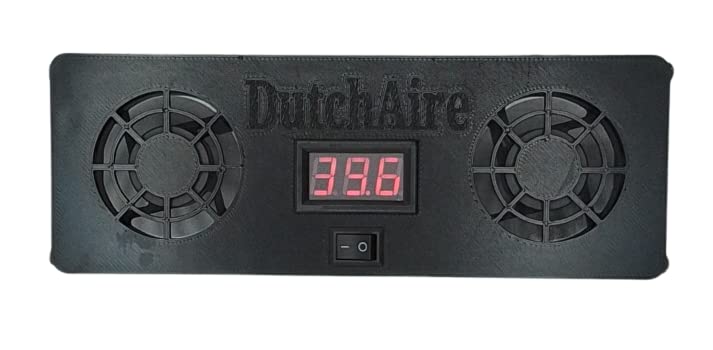
DutchAire RV Refrigerator Fin Fan with Fridge: Best for fridge temperature readout
- Fridge temperature readout
- 1,800 rpm
- 12 volts
- 2.76 watts
- Stainless steel fastener clips
- 1-year warranty
A wired fin fan with an instant temperature readout, so you can see fridge temperature inside the fridge.
Pros
- Shows fridge temperature
- Wired 12V power
- Stainless steel fastener clips
Cons
- Temperature display is the main plus, not extra airflow
- Wiring is required
This fan suits owners who want to watch fridge temperature without opening the door to check a thermometer. Its instant temperature readout is the clear point of difference in this group.
That helps you spot warm drift early, especially in hot weather.
It runs at 1,800 rpm on 12 volts and 2.76 watts, with stainless steel fastener clips and a 1-year warranty. At 31.2 db, it sits in the middle for noise in this group.
The fin mount puts airflow at the fins, where frost forms.
The trade off is that the readout adds a feature, not more fans. You still need wiring, and the display does not cool the food area by itself.
Choose this if knowing the temperature will change how you set the thermostat.
Quick Products QP-CRRF Clip-On RV Refrigerator Fan: Best for two-speed clip-on control
- Two-speed toggle switch
- Clips to interior cooling fins
- Wires to RV 12 Volt power
- 3 blades
- 2.5 inch blades
A clip-on fin fan with two speeds, wired to 12V power, to keep air moving over the cooling fins.
Pros
- Two speed control
- Clips directly to fins
- Constant 12V power
Cons
- Wiring is required
- Larger 11 inch size may crowd small fridges
This fan suits owners who want speed choice on a clip-on fin fan. Its two-speed toggle on the front lets you run low for quiet overnight use and high for hot afternoons.
That control is simple to reach with the fridge door open.
It clips to the interior cooling fins and wires to your RV 12 Volt power, so it runs on constant power with no batteries to change. Three plastic blades at 2.5 inches move air to reduce frost buildup.
Quick Products includes instructions and mounting hardware.
The trade off is size. At 11 x 5 x 2 inches, it is one of the larger fin fans here, so measure your fin area and shelf clearance.
Noise is not rated here, and wiring is required.
Makevivi 12V RV Refrigerator Fan: Best for high RPM triple fans
- Three 12V fans
- 4,200 RPM
- 20 db
- Connects to fridge light wiring or 12V supply
- Space-saving design
A triple fan unit rated at 4,200 RPM, made to circulate cold air and help prevent fin frosting.
Pros
- High 4,200 RPM rating
- Three fans
- Quiet 20 db rating
Cons
- Wiring is required
- High RPM does not guarantee even cooling on its own
This fan suits owners who want a high RPM rating in a compact triple fan. It is rated at 4,200 RPM and 20 db, with three 12V fans made to push air through the evaporator fins.
That speed rating suggests strong air movement for its size.
Makevivi says the fan helps lower internal temperature, keep food fresh longer, and prevent fin frosting. You can connect it to the fridge light wiring or to a 12V supply through the back, with step by step details in the manual.
The space saving design leaves more room for food.
The trade off is that RPM alone does not prove even cooling. Fin coverage and placement still matter.
Wiring is required, and the description also mentions 1,800 RPM, so check the exact rating before you order.
Frost Guard 15" Triple Fan Deluxe RV: Best for low amp draw and lighting
- Three ball bearing fans
- 0.07A per fan
- Built-in LED white lights
- Powder coated finish
- One year warranty
- 15 3/4 x 4 3/16 inch frame, 1/2 inch thick
A slim triple fan frame that clips to fins, draws low power, and adds LED light inside the fridge.
Pros
- Very low 0.07A per fan
- LED light included
- Slim 1/2 inch profile
Cons
- Wiring and ground connection required
- Long frame needs fin space
This fan suits owners who want low power draw and light inside the fridge. It draws 0.07A per fan across three ball bearing fans, which keeps the load on your RV electrical system low.
The slim frame is 15 3/4 x 4 3/16 inches and only 1/2 inch thick.
Built in LED white lights with a toggle switch give you on demand light inside the fridge. The powder coated finish is made for durability, and the brand gives a one year warranty.
Installation uses one DC connection and one ground connection, with the lead sliding through the drain tube.
The trade off is fit and wiring. A 15 3/4 inch frame needs a wide fin area, and you need to make connections at the back.
It also has no speed choices like the two-speed models.
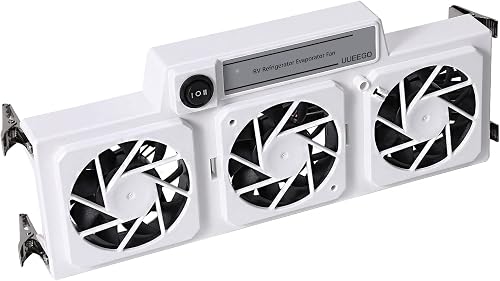
uueeGo 12V RV Refrigerator Evaporator Fan,with Three: Best for two-speed fin fan value
- Three 2.5 in 12V fans
- Two-speed on/off toggle
- Four built-in clips
- 4,200 rpm
- 33 db
- 1 year warranty
A three fan fin unit with two speeds and four clips, made to create cold air and prevent ice buildup.
Pros
- Two speed control
- Four clips for fins
- Compact profile
Cons
- Wiring is required
- More fan noise than the 20 db models
This fan suits owners who want two-speed control on a three fan fin unit. It has three 2.5 inch 12V fans rated at 4,200 rpm, with a two-speed on/off toggle on the face.
Press one setting for faster air and the other for slower, quieter running.
Four included built-in clips attach it to the evaporator fins. You can install it to the fridge light wiring or through the back to a 12V supply.
The profile design keeps wires hidden, and the brand says the waterproof ball bearing fans are rated to last 50,000 hours. It draws 2.7 watts at 33 db.
The trade off is noise and wiring. At 33 db, it is louder than the 20 db models, and you still need to wire it.
Place it near the right side where cooling begins, or close to frost buildup.
Quick Products QP-RFVCF90 RV Refrigerator Vent Cooling: Best for exterior vent cooling
- 90mm vent fan
- Auto and manual functions
- Selectable fan speeds
- 12 volt systems
- 5,500 rpm
- 47 db
- 55.2 watts
An exterior vent fan that pulls cooler air in and pushes warm air out at the back of the fridge.
Pros
- Attacks heat at the vent
- Auto and manual modes
- Speed control box
Cons
- Higher 55.2 watt draw
- Louder 47 db rating
- Does not circulate air inside the fridge
This fan suits owners whose fridge struggles because heat builds up behind it. It is an exterior vent cooling fan that attaches at the back ventilation, bringing cooler air in and pushing warmer air out.
That is a different job from a fin fan, and it can help in hot weather.
It has auto and manual functions, selectable fan speeds, and a control box with LED indicator lights. It works with all 12-volt systems and comes in 90mm and 120mm sizes, with this pick in 90mm.
Quick Products says the design is waterproof.
The trade off is power and noise. At 55.2 watts, 5,500 rpm and 47 db, it draws far more power and makes more noise than any interior fan here.
It also does not circulate air inside the fridge or stop fin frost directly.
How does the best RV refrigerator fan compare across types?
Interior fans move cold air inside the fridge. Battery fans like the Beech Lane RV Fridge Fan and the Camco Airator need no wiring.
Wired fin fans like the Beech Lane 12V, DutchAire, Quick Products QP-CRRF, Makevivi, Frost Guard and uueeGo sit on the fins and help with frost.
Exterior vent fans move heat out the back. The Quick Products QP-RFVCF90 is the only vent fan here.
It helps when the fridge runs warm on hot afternoons and the vent area is hot.
It does not replace an interior fan if air inside is still.
| Product | Best for | Motor | Material | Weight | Our score |
|---|---|---|---|---|---|
| Beech Lane RV Fridge Fan | simple interior circulation | 3,000 RPM | Plastic | 6.4 ounces | 9.7 |
| Beech Lane 12V RV Refrigerator Evaporator Fin | wired fin cooling | 9.6 | |||
| Camco Camper/RV Fridge Deodorizer & Airator | odor control in small fridges | 4.8 ounces | 9.4 | ||
| DutchAire RV Refrigerator Fin Fan with Fridge | fridge temperature readout | 9.1 | |||
| Quick Products QP-CRRF Clip-On RV Refrigerator Fan | two-speed clip-on control | Plastic | 8.9 | ||
| Makevivi 12V RV Refrigerator Fan | high RPM triple fans | 8.7 | |||
| Frost Guard 15" Triple Fan Deluxe RV | low amp draw and lighting | Metal | 8.4 | ||
| uueeGo 12V RV Refrigerator Evaporator Fan,with Three | two-speed fin fan value | 8.2 | |||
| Quick Products QP-RFVCF90 RV Refrigerator Vent Cooling | exterior vent cooling | 7.9 |
For a quick check, match the fan to the symptom. Frost on fins points to a fin fan.
Warm food at the top points to an interior circulation fan. Strong heat at the outside vent points to a vent fan and vent checks.
Which type of RV fridge fan do you need?
You need a fin fan if frost builds on the evaporator fins. Those fins make the cold air.
Still air on the fins lets frost grow, and frost blocks airflow.
A wired fan on the fins keeps air moving there.
Interior circulation fans
Choose a freestanding interior fan if the bottom is cold and the top is warm. The Beech Lane RV Fridge Fan uses a 3,000 RPM motor to mix that air.
The Camco Airator does the same job in small fridges and adds charcoal odor control.
Fin fans
Choose a fin fan if you see ice on the fins or uneven temperatures. Triple fans cover more fin area than a single fan.
The Frost Guard frame is 15 3/4 inches wide, while the Beech Lane and uueeGo models use three 2.5 inch fans.
Exterior vent fans
Choose a vent fan if heat at the back is the limit. The Quick Products QP-RFVCF90 pulls cooler air in and pushes warm air out.
It comes in 90mm and 120mm, so measure first.
If you are deciding between cooling the fridge and cooling the rig itself, our guide on how to properly vent a power station in a van shows the same principle. Heat needs a path out.
Battery, 12V wired, or vent power: which power source fits your rig?
Battery power is simplest, and wired 12V power is most constant. Battery fans need no wiring.
Wired fans run all the time with no batteries to change, but they need a connection and fin access.
Battery fans
Battery fans suit renters, small fridges and owners who do not want to wire anything. The Beech Lane RV Fridge Fan and the Camco Airator both use an on and off switch, so you can save battery life when not needed.
The Camco runs on two D batteries that are not included. Keep spares in the rig.
Battery fans also tend to run at lower total airflow than a triple wired fan.
Wired 12V fin fans
Wired fans suit full time use, hot weather and frost problems. The Beech Lane 12V draws only 1 watt.
The Frost Guard draws 0.07A per fan. The Quick Products vent fan draws 55.2 watts, so it is in a different class.
Most fin fans connect to fridge light wiring or to a 12V supply through the back. If that sounds like too much work, a battery fan is the safer first step.
Vent fan power
A vent fan in auto mode can cut in when heat builds up. The Quick Products QP-RFVCF90 has auto and manual modes with selectable speeds.
Its 55.2 watt draw still needs a plan on battery power.
If you boondock on battery, check your battery bank before adding a high draw vent fan. A low draw fin fan is easier to fit into a tight power budget.
How many fans, and how much speed, do you actually need?
More fans help when they cover more fin area, and speed helps only when air reaches the fins. A single freestanding fan can mix air in a small fridge.
Triple fans spread air across a wider fin area and usually help more with frost.
Fan count
One fan suits small fridges and simple warm spots. Three fans suit larger fin areas and frost.
The Beech Lane 12V, Makevivi, Frost Guard and uueeGo all use three fans, while the Quick Products QP-CRRF uses a single clip-on unit.
Check fin width before you buy. The Frost Guard frame is 15 3/4 inches wide.
The DutchAire is 10 inches long. A fan that is too long will not clip on cleanly.
Motor speed
Speed ratings range from 1,800 rpm on the Beech Lane 12V and DutchAire to 3,000 RPM on the Beech Lane battery fan, 4,200 rpm on the Makevivi and uueeGo, and 5,500 rpm on the Quick Products vent fan. Higher speed can move more air, but blade size and placement also shape the result.
Do not shop by RPM alone. A 4,200 rpm fan that misses the frost area may help less than a slower fan placed right on the fins.
Noise and power draw
Noise ratings run from 20 db on the Beech Lane 12V and Makevivi to 31.2 db on the DutchAire, 33 db on the uueeGo and 47 db on the vent fan. Lower is better if the fridge is near your bed.
Power draw matters on battery. The Beech Lane 12V is 1 watt, the uueeGo is 2.7 watts and the DutchAire is 2.76 watts.
The vent fan at 55.2 watts is far higher.
For air movement through the whole rig, our best camping fan to run on power station guide gives a useful comparison point.
What size and placement work in your fridge?
Placement matters as much as the fan itself. A fin fan must clip to the fins without blocking shelves.
A battery fan must sit where it can pull warm air from the top and push it down.
Fin space
Measure the fin area and space in front of it before you order. The Quick Products QP-CRRF is 11 x 5 x 2 inches.
The uueeGo is 10.09 x 3.8 x 1.4 inches. The Camco is 3.6 x 3.25 x 4.38 inches.
If shelves are small, a slim fin fan that uses 1/2 inch of depth, like the Frost Guard, may fit better than a deeper freestanding fan. Keep food from touching the blades.
Controls and access
A front toggle, like on the Quick Products QP-CRRF and uueeGo, is easy to reach. A control box, like on the Quick Products vent fan, can be mounted within reach.
The DutchAire temperature readout helps you place the fan and set the thermostat with facts. If you can see the temperature inside, you can tell whether the fan is helping.
Vent fit
For exterior fans, fit is the whole job. The Quick Products QP-RFVCF90 is 90mm, and a 120mm size is also available.
Measure the vent opening and check clearance at the back.
Pair the fan with a sound best RV refrigerator vent cover so weather stays out while air still moves. Also check our best RV refrigerator vent screen for pests, and our best RV refrigerator roof vent cover if your setup vents upward.
How do you install and care for an RV refrigerator fan?
Install the fan where air is stuck, not where it is easy to reach. Fin fans go on the fins.
Interior fans go in the food area with space around them.
Vent fans go at the back vent.
Set up
For fin fans, clip the fan to the fins and connect wiring to the fridge light or to a 12V supply through the back. Keep wires hidden where food will not rub them.
For battery fans, place the fan on a shelf, turn it on, and check that food does not block the vents. The Beech Lane fan has multiple side vents, so keep those clear.
For a vent fan, mount it at the back, set auto or manual mode, and place the control box where you can see it. Test it on a hot afternoon.
Daily care
Wipe fan blades and vents with a dry cloth when dust builds up. Dust slows air movement.
Check clips after travel, since vibration can loosen them.
Replace batteries before they run flat. Keep spare D batteries for the Camco, and check charge for other battery models.
Frost care
If frost is already thick, let the fridge defrost by the maker's method before you rely on a fan to prevent new frost. A fan helps prevent buildup, but it is not a defrost tool.
If frost returns quickly even with a fin fan, check vent airflow and thermostat settings. The heat at the back may be the real limit.
Which fan should you buy in the end?
Pick the Beech Lane RV Fridge Fan for simple interior circulation, the Beech Lane 12V Evaporator Fin Fan for wired fin cooling, and the Quick Products vent fan for heat at the back. That rule covers most rigs.
If odor is your main issue in a small fridge, pick the Camco Airator. If you want a temperature readout, pick the DutchAire.
If you want two speeds on a clip-on fan, pick the Quick Products QP-CRRF. If you want low amp draw and LED light, pick the Frost Guard.
Before you order, measure your fin area, check your vent size, and decide on battery or wired power. Then check our best RV refrigerator accessories guide for next upgrades.
If you are comparing a standalone fridge as well, our best 12v portable fridge guide covers the other cold storage option.
Our top 3 picks at a glance
-
1
-
2
Best for wired fin cooling
Beech Lane 12V RV Refrigerator Evaporator Fin
9.6/10 our score
See it on Amazon -
3
Best for odor control in small fridges
Camco Camper/RV Fridge Deodorizer & Airator
9.4/10 our score
See it on Amazon
Frequently asked questions
What is the best RV refrigerator fan for frost on the fins?
A wired fan that clips to the evaporator fins is usually the best choice, because it pushes air directly across the fins where frost forms. The Beech Lane 12V Evaporator Fin Fan and the Frost Guard triple fan both target that spot.
Run the fan before frost builds thick, and check the fins during hot weather.
Do I need an interior fan or an exterior vent fan?
Choose an interior fan if cold air sits at the bottom and food spoils at the top. Choose an exterior vent fan if the fridge struggles on hot afternoons and warm air builds up behind it.
Many owners use only one type, so match the fan to the pattern you see.
Can a battery fan replace a wired 12V fin fan?
A battery fan is easier to use and needs no wiring, but it depends on fresh batteries and usually moves less air than a wired triple fan. It suits small fridges and occasional use.
For constant cooling and frost prevention, wired 12V power is more reliable.
How do I choose between these RV fridge fans?
Start with placement, then power, then controls. Fin fans suit frost and uneven temperatures.
Vent fans suit heat at the back.
Battery fans suit small fridges and no wiring.
Check size against your fin space and shelves before you order.


