Can You Use a Power Station to Charge an Electric Bike?
On this page (8 sections)
- Charging Your Electric Bike with a Portable Power Station: A Practical Guide
- Understanding the Power Station’s Role
- Types of Power Stations Suitable for E-Bikes
- How to Connect and Charge Your E-Bike
- When Is a Power Station the Best Choice?
- Alternatives and Complementary Solutions
- Conclusion
- Frequently Asked Questions
Yes, you absolutely can use a power station to charge your electric bike, and it’s a surprisingly practical solution for staying charged on the go. See Much Power Does Electric Kettle for more details. Think of it as a portable battery that can give your e-bike a much-needed boost when you’re far from a wall outlet.
Many people wonder about this possibility, especially for longer rides or camping trips. We found that power stations offer a flexible way to keep your e-bike’s battery topped up, making them a great companion for adventurers. It’s like having your own personal charging station, anywhere you roam.
- Yes, you can charge your e-bike with a power station.
- It’s like a portable power outlet for your bike.
- Great for camping, long rides, or areas without outlets.
- Check your power station’s output and your e-bike’s charger needs.
Let’s dive into the details and figure out exactly how you can make this happen and what you need to consider for a smooth charging experience.
Charging Your Electric Bike with a Portable Power Station: A Practical Guide
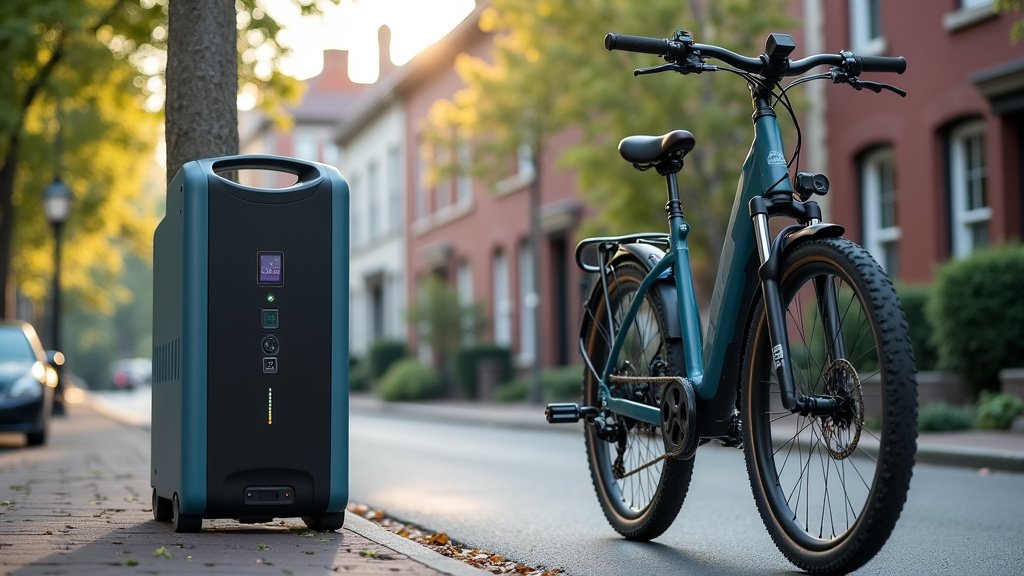
Yes, you can absolutely use a power station to charge your electric bike. It’s a clever solution for keeping your ride powered up when you’re away from a standard electrical outlet. Think of it as a big portable battery that can deliver power to your e-bike’s charger.
We’ve found this to be a growing trend, especially for e-bike riders who love to explore. Whether you’re on a long cycling adventure or camping, a power station offers freedom. It means you aren’t always tethered to finding a plug. Let’s look at how it works and what you need to know.
Understanding the Power Station’s Role
A power station is essentially a large rechargeable battery with multiple outlets. These outlets can provide AC (standard wall plug) or DC power. Your e-bike charger needs a specific type of power to charge your bike’s battery.
Most e-bike chargers plug into a standard wall outlet, meaning they require AC power. For more detail, see our guide to charging e-bike batteries with a power station. A good power station will have AC outlets that can supply this. The key is matching the power station’s capabilities to your e-bike charger’s needs. It’s like making sure you have the right adapter for your electronics when traveling.
Matching Wattage: The Most Important Factor
The biggest consideration is wattage. Your power station needs to provide enough wattage to run your e-bike charger. Your e-bike charger will also have a wattage rating. You need to find the continuous output wattage of your power station.
This is the amount of power the station can supply consistently. Then, check the wattage requirements of your e-bike charger. You can usually find this on a label on the charger itself or in your e-bike’s manual. We found that most e-bike chargers consume between 50 to 300 watts.
If your power station’s continuous output is lower than what your charger needs, it won’t work. The power station might shut off to protect itself, or it might not even start charging. It’s always better to have a power station with a higher wattage capacity than your charger requires.
Finding Your Charger’s Wattage
Look for a label on your e-bike charger. It often lists “Input” power requirements. This might be in amps (A) and volts (V). To find watts, you multiply amps by volts (W = A x V). For example, if your charger says 2A at 120V, it needs 240 watts.
Sometimes, the wattage is listed directly. Your e-bike manual is another great resource. If you’re unsure, contacting the e-bike manufacturer is a good step. We found that many users overlook this simple check, leading to frustration.
Power Station Output Specifications
Power stations list their output in watts. You’ll often see two numbers: “peak” or “surge” wattage and “continuous” wattage. Continuous wattage is what matters for charging. It’s the sustained power the station can deliver. A power station rated for 500W continuous output should easily handle most e-bike chargers.
Battery Capacity: How Much Charging Can You Get?
Beyond just delivering power, the battery capacity of the power station determines how much charging you can do. This is measured in watt-hours (Wh). A higher Wh number means more total energy is stored.
To estimate how many charges you can get, you need to know your e-bike battery’s capacity in Wh. This is often listed on the battery itself or in your e-bike’s specifications. You also need to factor in the power station’s capacity and the efficiency of the charging process.
Charging isn’t 100% efficient. Some energy is lost as heat during the transfer. We found that a general estimate is to divide the power station’s Wh by your e-bike battery’s Wh. Then, multiply that by an efficiency factor, often around 0.85 (for 85% efficiency).
For instance, if you have a 1000Wh power station and a 500Wh e-bike battery: 1000Wh / 500Wh = 2. This means you could potentially get 2 full charges. Applying the efficiency: 2 x 0.85 = 1.7 charges. So, you’d get about one and a half charges, maybe a bit more.
Types of Power Stations Suitable for E-Bikes
Not all power stations are created equal. For charging an electric bike, you’ll want one with a decent capacity and robust output. We generally recommend looking at mid-range to high-capacity power stations.
Key Features to Look For
When shopping, keep these points in mind:
- AC Outlets: Make sure it has standard household AC outlets (like the ones in your home).
- Continuous Wattage: As discussed, this needs to be higher than your charger’s requirement. Aim for at least 300W continuous output, but more is better.
- Battery Capacity (Wh): For a decent charge or two, look for something in the 500Wh to 1500Wh range or higher.
- Portability: Consider the weight and size if you plan to carry it around. Some are quite heavy.
- Rechargeability: How fast does the power station itself recharge? Can it be recharged via solar panels for true off-grid capability?
Example Power Station Categories
You’ll find power stations fall into general categories. Smaller ones might be under 300Wh, suitable for phones but not e-bikes. Mid-range units are often 300Wh to 800Wh and might offer 300-500W continuous output. These are often a good starting point for e-bikes.
High-capacity stations go from 800Wh up to 2000Wh or more. They typically offer higher continuous wattage (1000W+), which is great if you have multiple devices or a faster-charging e-bike. We found that many serious campers and van-lifers opt for these larger units.
How to Connect and Charge Your E-Bike
Connecting your e-bike to a power station is straightforward, much like plugging into a wall. You just need to make sure everything is set up correctly.
Step-by-Step Charging Process
Here’s a simple guide:
- Prepare Your Power Station: Ensure it’s charged to a sufficient level. Check its battery indicator.
- Turn On the Power Station: Most stations have an on/off button for their AC outlets. Make sure the AC output is activated.
- Plug in Your E-Bike Charger: Connect your e-bike’s AC charger into one of the power station’s AC outlets.
- Connect Charger to E-Bike: Plug the other end of the charger into your e-bike’s battery port.
- Monitor Charging: Watch both the power station and your e-bike for any indicators. Ensure the charger light turns on, showing it’s receiving power.
- Turn Off When Done: Once your bike is charged or you need to move, unplug everything. Turn off the power station’s AC output to conserve its battery.
Important Safety Considerations
While generally safe, a few points are worth noting. Always operate the power station in a well-ventilated area. Some chargers can get warm. Avoid charging in direct sunlight or extremely hot environments.
We also found that it’s wise to avoid using the power station’s AC outlet for anything else while charging your e-bike, especially if it’s close to the wattage limit. This prevents overloading. Always read the manuals for both your power station and your e-bike charger.
When Is a Power Station the Best Choice?
Using a power station for your e-bike shines in specific situations. It’s not always the primary charging method, but it’s an excellent backup or travel solution.
Ideal Scenarios for Power Station Charging
Consider it for:
- Camping Trips: Keep your e-bike ready for exploring new trails without needing hookups.
- Long-Distance Rides: A mid-ride top-up can extend your range significantly.
- Remote Locations: Accessing power where there are no outlets available.
- Power Outages: Having a backup for essential charging needs.
- Van Life/RVing: A convenient way to charge your bike while on the move.
When It Might Not Be Practical
However, if you only ride short distances and always return home to charge, a power station might be overkill. They can be an investment. Also, if your e-bike battery is exceptionally large and your power station is small, you might only get a partial charge, which may not be enough for your needs.
The weight of larger power stations can also be a factor if you’re backpacking or need to carry it long distances. We found that careful planning around your typical ride length and charging habits is key.
Alternatives and Complementary Solutions
While power stations are fantastic, other options exist. Some e-bikes have regenerative braking, which captures energy while you slow down. This can add a small amount of range back to your battery.
For serious off-grid enthusiasts, portable solar panels that can recharge the power station itself are a great complement. This allows for virtually unlimited charging power as long as you have sunlight.
We found that using a power station is a reliable way to ensure your e-bike is ready when you are. It offers flexibility and freedom for any cyclist looking to go further and explore more.
Conclusion
You’ve learned that charging your electric bike with a power station is not just possible, it’s a fantastic way to extend your adventures. We’ve seen how matching the wattage output of your power station to your e-bike charger is key. Understanding the battery capacity helps you estimate how many charges you can get, ensuring you’re prepared for longer rides or remote locations.
When choosing a power station, prioritize AC outlets, sufficient continuous wattage, and ample battery capacity. It’s a flexible solution for campers, long-distance riders, and anyone seeking power independence. Now, go ahead and plan your next off-grid e-bike excursion!
Frequently Asked Questions
What’s the minimum continuous wattage I need from a power station for my e-bike?
We generally recommend a power station with at least 300W of continuous output for most e-bike chargers. Check your charger’s label for its specific wattage requirement (often found by multiplying amps and volts). Having a bit more wattage capacity than your charger needs is always a safe bet.
Can I charge my power station while it’s charging my e-bike?
Some high-end power stations support “pass-through charging,” meaning they can be plugged into a wall outlet or solar panels and charge other devices (like your e-bike) simultaneously. However, many standard units cannot do this, and attempting it could damage the station or lead to insufficient power for either device.
How many times can a typical power station charge an e-bike battery?
This depends heavily on the size of your power station’s battery (in Wh) and your e-bike battery’s capacity. A common scenario might be a 1000Wh power station providing about 1 to 2 full charges for a typical 500Wh e-bike battery, accounting for charging inefficiencies.
Will charging my e-bike drain my power station very quickly?
Charging an e-bike does consume a significant amount of power. If your power station has a lower capacity, you might only get a partial charge. For multiple charges or longer trips, you’ll want a power station with a higher Wh rating to ensure you have enough power over time.
Are there any specific safety precautions I should take when charging an e-bike with a power station?
Always ensure the power station is in a well-ventilated area, as chargers can generate heat. Avoid charging in extreme temperatures, direct sunlight, or damp conditions. We also advise against overloading the power station by plugging in too many high-draw devices at once.