How to Charge a Jackery Power Station from a Car
To charge a Jackery power station from a car, connect its DC input to the vehicle’s 12V outlet with a compatible car charging cable, then follow the station’s manual. Charging is usually slower than a dedicated alternator charger, and the exact rate depends on the vehicle and station.
On this page (8 sections)
- What do you need to charge a Jackery from a car?
- How do you charge a Jackery from a car safely?
- How fast will a car charge a Jackery?
- Should you use a cigarette-lighter cable or an alternator charger?
- Can a car charge a Jackery with the engine off?
- Which car charging cable fits a Jackery?
- What should you check if the Jackery does not charge?
- Which setup makes sense for your trip?
To charge a Jackery power station from a car, connect its DC input to the vehicle’s 12V outlet with a compatible car charging cable, then follow the station’s manual. Charging is usually slower than a dedicated alternator charger, and the rate depends on the vehicle, cable, and Jackery model.
Start by checking the exact input port on your power station. A cable that fits one Jackery may not fit another, so match the connector and confirm the allowed input voltage before plugging it in.
What do you need to charge a Jackery from a car?
You need a vehicle outlet, a compatible cable, and a Jackery with car charging supported. Check the station manual for the DC input type and limits before connecting anything.
Many car charging cables use a cigarette-lighter plug on one end and a DC barrel connector on the other. The connector size and polarity must match your station.
Don’t force a plug that feels loose or doesn’t seat fully.
For a broader walkthrough of vehicle outlet connections, see how to charge a portable power station from a car. If you’re choosing a cable, our guide to the best car adapter for power station charging covers connector and fit checks.
Which Jackery input should you use?
Use the car charging input named in your Jackery manual, not a port chosen by appearance alone. Some models use different DC connectors, and certain cables include adapters for specific sizes.
Check the charging label near the port or the manual’s input section. Confirm the cable’s vehicle-side plug, station-side plug, voltage range, and current rating are suitable for both the car outlet and the power station.
How do you charge a Jackery from a car safely?
Park securely, connect the cable to the vehicle outlet and Jackery input, then check that the station shows charging. Follow the vehicle and Jackery manuals, especially for engine-on use and outlet limits.
- Park in a safe, well-ventilated place.
- Confirm that the cable matches the Jackery’s DC input.
- Plug the cable into the vehicle outlet and then the station, following both manuals.
- Start the vehicle if the manuals require it or if the outlet only works with the ignition on.
- Check the Jackery display to confirm charging has begun.
- Keep the cable away from hot surfaces, moving parts, and places where it could be pinched.
Stop if the plug, cable, or outlet becomes unusually hot, or if charging repeatedly starts and stops. A loose connection can interrupt charging and may overheat a connector.
Is it safe to charge while driving?
Charging while driving may work if the vehicle outlet, cable, and Jackery manuals allow it. For RV use, compare Jackery power stations for RVs before choosing a station.
Secure the cable so it cannot interfere with driving, pedals, or passengers, and avoid using a loose connection on rough roads.
The Tonton cable’s instructions warn against using it on bumpy roads because a poor connection can cause burning. They also advise letting hot metal connectors cool before unplugging.
Confirm the connector your station uses before choosing this cable. The cable’s compatibility notes also say the E300 Plus and E240 v2 require a DC8020 to USB-C adapter, which is not included.
How fast will a car charge a Jackery?
A car outlet usually charges a power station more slowly than a dedicated alternator charger. The actual rate depends on the outlet, the station’s input limit, the cable, and whether other vehicle loads are drawing power.
A regular 12V or 24V vehicle outlet may provide about 100W to 200W, according to BLUETTI’s Charger 1 product information. That is a general comparison, not a promise for every vehicle or Jackery.
You can estimate charging time by dividing the energy the station needs by the power it receives, then allowing extra time for charging losses and a slower final stage. The Jackery display is the practical way to monitor progress.
Will the car outlet charge at its full rated power?
Not always. The outlet’s fuse, wiring, vehicle settings, and the station’s own input limit can each reduce the power available.
A cable’s maximum rating does not mean the car will provide that much power. For example, the Tonton cable lists a built-in 15A fuse and a 180W maximum at 12V, with a 360W maximum at 24V.
Those figures describe the cable’s stated limits, not a guaranteed charging rate from a particular vehicle.
Should you use a cigarette-lighter cable or an alternator charger?
Use a cigarette-lighter cable for a simple, lower-power connection when it matches your Jackery. Consider an alternator charger only if your power station supports it and you want a faster setup that follows the charger’s installation requirements.
The BLUETTI Charger 1 is a DC-DC alternator charger rated at 560W. BLUETTI says it can charge compatible power stations faster than a regular car outlet, but its stated compatibility does not mean it works with a Jackery.
Before buying an alternator charger, check connector type, voltage range, installation steps, and vehicle compatibility. Learn more about charging a portable power station with a car alternator and faster charging via a car alternator.
Can a car charge a Jackery with the engine off?
It depends on the vehicle outlet and charging setup. Some outlets turn off with the ignition, while others may remain powered and draw from the starter battery.
Check your vehicle manual to learn how the outlet behaves when the engine is off. For a basic cigarette-lighter cable, avoid leaving the Jackery connected unattended with the engine off unless the vehicle and station instructions clearly allow it.
A DC-DC alternator charger may include battery monitoring, but follow its installation and shutdown instructions. BLUETTI says Charger 1 monitors the vehicle battery and stops drawing power after the engine is off; its guidance also recommends checking that this behavior works on the first use.
Which car charging cable fits a Jackery?
Choose a cable by matching both ends and checking the supported Jackery models. Length, fuse, and current rating matter after connector fit is confirmed.
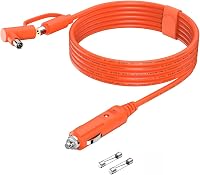
The MOOKEERF cable is 10 ft long, uses a 14AWG wire, and includes DC7909 and DC8020 connectors for its stated Jackery compatibility range. It also has a built-in 15A fuse and red LED indicator.
Its longer reach can help when the vehicle outlet and power station are farther apart. Keep extra cable clear of doors, seats, tires, and hot components, and verify your specific Jackery model before use.
What should you check if the Jackery does not charge?
Check the outlet, both cable connections, and the Jackery input setting first. Then consult the manuals for outlet limits, fuse checks, and troubleshooting steps.
- Confirm the vehicle outlet has power.
- Make sure each connector is fully seated and fits without force.
- Check that the cable and station support the same connector and voltage.
- Inspect the cable and plug for damage or unusual heat.
- Check the vehicle outlet fuse only as directed by the vehicle manual.
If the station charges intermittently, stop and inspect the connection rather than holding the plug in place. A damaged outlet or cable needs attention before another attempt.
Which setup makes sense for your trip?
Choose a cigarette-lighter cable when you need a simple, compatible connection and can accept the outlet’s limits. Choose an alternator charger when your station supports it, the vehicle is compatible, and the installation suits your needs.
For product selection, compare portable power stations with car charging. If your goal is to recharge the vehicle’s starter battery from a power station, read whether a portable power station can charge a car battery, since that is a different connection and charging task.
Match the connector first, check the manual’s input limits, and monitor charging at the station. Those checks help you choose a practical setup without assuming that every car outlet or Jackery charges at the same rate.
Frequently asked questions
Can I charge a Jackery from a car cigarette lighter?
Yes, if your Jackery model supports car charging and the cable has the correct vehicle plug and station connector. Check the station manual for its input requirements, connect the cable securely, and monitor charging.
The vehicle outlet’s fuse and power limit can restrict the charging rate.
How long does it take to charge a Jackery from a car?
Charging time varies by Jackery model, remaining battery level, vehicle outlet, cable, and whether the engine is running. A 12V outlet generally charges more slowly than a dedicated alternator charger.
Use the station’s display and manual for the expected rate and charge estimate.
Can charging a power station drain my car battery?
It can if the outlet stays powered while the engine is off, or if a charging system continues drawing from the starter battery. Check the vehicle and charger manuals, and confirm whether the outlet shuts off with the ignition.
Avoid leaving a basic car cable connected unattended with the engine off.
Can I use an alternator charger with a Jackery?
Possibly, but only if the charger’s output connector and voltage range match your Jackery’s DC input and the charger supports that model. Alternator chargers use a separate installation and may draw much more power than a cigarette-lighter cable, so check both manuals before connecting.