Portable Power Station vs Inverter: Which Should You Choose? (November 2026)
Choose a portable power station when you need stored power away from a vehicle, and choose an inverter when your car will supply the power. In this portable power station vs inverter comparison, the main split is where the energy comes from and how long it must last.
On this page (11 sections)
- Portable power station vs inverter: the two side by side
- Where does the power come from?
- How long will your devices run?
- What can each one actually power?
- Size, weight and how you carry it
- Charging and recharging options
- Inverter vs power station at camp and on the road
- Home backup, outages and emergency use
- Solar generator vs inverter: what changes with panels?
- Which one should you buy in this portable power station vs inverter choice?
- About this guide
Choose a portable power station when you need stored power away from a vehicle, and choose an inverter when your car will supply the power.
A portable power station carries a battery inside. A car inverter only changes DC power from your vehicle into AC power for your devices.
For a fixed home system, see how to choose a 48V low frequency inverter.
That one difference shapes how long you can run a device and whether you can use power at a tent or during an outage.
We compared 2 Jackery power stations with 2 car inverters. We checked capacity, output, weight, ports and charging options, and weighed who each setup suits in daily use.
This guide is for travelers who need practical power and households who want backup for short outages. Some people camp near a car every night, while others hike beyond reach of a vehicle or lose power at home.
A power station stores energy before you leave home. You can charge it from a wall outlet, a vehicle or solar panels, then carry that stored energy to a tent, trail or dark room.
An inverter stores no energy. It depends on a vehicle supply each time, which makes it small and simple for road use but useless when the vehicle is not present.
Size follows the same split. Inverters here weigh under a pound, while power stations weigh 7.5 to 23.8 pounds.
The lighter option stashes easily in a car, and the stored option is safer away from a car.
Output matters for the devices you own. Small inverters suit phones, tablets and many laptops, while larger power stations can support fridges and heavier appliances.
Capacity decides how long they keep running, and only a power station has stored capacity here.
Think about where you sleep and charge first. If your car stays close, an inverter may be enough.
If your car stays behind, stored power is the safer choice.


Portable power station vs inverter: the two side by side
A power station wins on independence, and an inverter wins on price and size for car use.
The table below shows the core split between stored power and converted vehicle power.
| Product | Best for | Capacity | Output | Weight | Our score |
|---|---|---|---|---|---|
| Jackery Explorer 300 Portable Power Station | light camping | 292Wh | 300W | 7.5 lb | 9.7 |
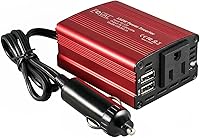
| BESTEK Power Inverter DC 12-17V to AC | car road trips | 300W | 14.4 oz | 9.7 | |
| Jackery Explorer 1000 v2 Portable Power Station | home backup | 1070Wh | 1500W | 23.8 lb | 9.6 |
| PiSFAU 200W Car Power Inverter | budget car charging | 200W | 8.8 oz | 9.3 |
| Feature | Portable power station | Car inverter |
|---|---|---|
| Stores power | Yes, in a built-in battery | No |
| Power source | Its own battery, wall, car or solar charging | Vehicle DC supply |
| Typical output here | 300W to 1500W | 200W to 300W |
| Typical capacity here | 292Wh to 1070Wh | None |
| Weight here | 7.5 lb to 23.8 lb | 8.8 oz to 14.4 oz |
| Use away from car | Yes | No |
| Use during an outage | Yes, if charged | No |
Read the table from your trip first.
If your power should work at a tent, on a hike or at home, stored capacity matters most.
If your power should work in a parked car, an inverter is simpler and lighter.
Start with your usual trip, not with the biggest spec.
Ask where devices will be used after sunset.
Ask also how far you walk from the vehicle.
A tent site a short distance from a car still favors stored power.
There is no cable to run from a vehicle to a sleeping area.
A hike makes the case even clearer for a battery.
An inverter cannot follow you onto the trail.
For home use, the same logic applies at night.
A charged power station can run when a vehicle is elsewhere.
An inverter needs that vehicle to be present and supplying power.
Weight tells a similar story for packing.
An inverter fits in a glove box or side pocket.
A power station needs space in a bag or boot.
Plan that space before you buy either option.
Where does the power come from?
A power station brings its own energy, while an inverter borrows energy from your vehicle.
This is the main reason to pick one over the other.
The Jackery Explorer 300 stores 292Wh and outputs 300W, with a 600W peak surge.
You can charge it at home, from a car port in about 4 hours, or with a compatible solar panel.
The Jackery Explorer 1000 v2 stores 1070Wh and outputs 1500W, with a 3000W surge peak.
That larger store runs heavier appliances for longer.
It can be recharged in 1 hour with emergency charging through the Jackery app.
By contrast, the BESTEK inverter gives 300W continuous and 700W instant power from a 12-17V vehicle supply.
The PiSFAU gives 200W from a DC 12V supply.
Neither one can power anything once the vehicle supply stops.
How long will your devices run?
Runtime is where stored capacity separates the two options.
An inverter runs as long as your vehicle can supply power.
A power station runs until its battery is empty.
Jackery gives a clear way to estimate runtime for the Explorer 300.
Use this formula: working time equals 300Wh times 0.85, divided by the device power in watts.
A 60W device would run for about 4.3 hours.
Apply the same idea to any station.
A 100W device would use about 100W each hour.
A 292Wh store would last roughly 2.5 hours after losses.
A 1070Wh store would last roughly 9 hours.
With an inverter, runtime depends on your car battery and whether the engine is running.
That can work well on a road trip.
It is not a plan for a tent away from the car or for home use during an outage.
What can each one actually power?
Check watts first, because output limits decide what works.
The 4 products here range from 200W to 1500W.
That gap changes your device list.
The PiSFAU 200W inverter suits phones, tablets, laptops and small devices.
Its maker warns against high power devices such as hair dryers, electric heaters, curling irons and vacuums.
The BESTEK 300W inverter suits laptops and tablets through its 2 AC outlets, plus USB devices through its 2 USB ports.
Its 700W instant power helps with short starting surges.
Continuous loads should stay within 300W.
The Jackery Explorer 300 handles laptops, drones and cameras, with 2 AC outlets, a 100W USB-C PD port, 2 USB-A ports and a 120W car port.
Jackery says to keep total loads under 300W and to check device specs before you buy.
The Jackery Explorer 1000 v2 can power multiple appliances, including AC units, fridges and electric pots, up to its 1500W output.
That makes it the only option here for heavier home backup loads.
Size, weight and how you carry it
An inverter fits in a glove box, while a power station is luggage you plan around.
Weight and size should match how you travel.
The PiSFAU weighs 8.8 oz and measures 2.7 x 1.4 x 5 inches.
The BESTEK weighs 14.4 oz and measures 4.8 x 3.1 x 1.9 inches, with a 32 inch cigarette lighter plug.
The Jackery Explorer 300 weighs 7.5 lb and has an integrated handle.
Jackery calls it ultra-lightweight, and it is 17% lighter than the industry average for its class.
It fits a hiking or camping load more easily than the larger model.
The Jackery Explorer 1000 v2 weighs 23.8 lb and measures 12.87 x 8.82 x 9.72 inches.
Its foldable handle helps.
This is a carry for car camping, RV use or home backup, not for long hikes.
Charging and recharging options
A power station gives you several ways to refill, while an inverter has no refill at all.
That matters for long trips and for solar use.
The Explorer 300 can be charged in about 3 hours through 100W Type-C, about 4 hours from a car port, or about 3.5 hours from a Jackery SolarSaga 100W panel, which is sold separately.
You can also use it while it charges.
With solar, Jackery says the Explorer 300 reaches 80% capacity in about 2.8 hours with a 100W panel, or about 7.5 hours with a portable 40W panel.
A solar panel is not included in the box.
The Explorer 1000 v2 charges from 0% to 100% in 1 hour with emergency charging activated in the Jackery app.
It defaults to 1.7 hours to protect battery health.
It is compatible only with Jackery solar panels for solar charging.
An inverter simply plugs into your vehicle.
That is fast and simple on the road.
You cannot charge it at home, charge it from solar, or save power for later.
Inverter vs power station at camp and on the road
Car camping favors an inverter, while tent camping and hiking favor a power station.
Where you sleep decides which is easier to use.
For car camping, a power inverter portable setup is hard to beat.
You plug in, charge laptops and tablets while you drive, then unplug and go.
Our guide to a power inverter dc to ac explains how the conversion works before you buy.
For tent camping, the Jackery Explorer 300 carries power with you.
It can charge 6 devices at once.
Jackery describes it as a dependable CPAP battery for camping when paired with suitable use.
Always check the device manual for power needs.
For longer trips, the Explorer 1000 v2 gives more reserve.
Its 1070Wh store and 1500W output suit a fridge, lights and multiple devices at a base camp or in an RV. If you want to power RV loads from an inverter, compare power inverters for RVs.
Home backup, outages and emergency use
Only a power station works as home backup, because only it stores power before the outage. For other backup setups, compare UPS and inverter battery drain.
An inverter has nothing to offer when the vehicle is not there.
The Explorer 1000 v2 is the strongest backup choice here.
Its 1500W output, 3 AC ports and 1070Wh capacity can run a fridge and other key devices.
Its LFP battery keeps over 70% capacity after 4,000 charge cycles, which Jackery rates as more than 10 years of life.
The Explorer 300 can serve as a lighter backup for phones, laptops and small devices.
Its 292Wh store will not run a home for long.
It can keep essential devices charged through a short outage.
If you are weighing backup power against fuel options, our power inverter vs generator comparison helps you sort stored power from engine power.
Also see our Best Portable Power Station Vs Generator guide for outage planning.
Solar generator vs inverter: what changes with panels?
Adding solar panels turns a power station into a solar generator, but it does not change an inverter at all.
A car inverter still needs a vehicle, no matter how sunny the day is.
Both Jackery stations can be charged with solar panels, but panels are not included with either model.
The Explorer 300 works with Jackery panels.
The Explorer 1000 v2 is compatible only with Jackery solar panels.
That is why our Best Portable Power Station Vs Solar Generator guide is useful next.
It helps you decide whether you need panels now or whether wall and car charging are enough.
For car-based solar setups, a best power inverter for camping page can help you choose the right inverter size.
Pair that with a separate battery and panels if you want a do-it-yourself system.
Expect more parts to manage.
Which one should you buy in this portable power station vs inverter choice?
Buy the power station if you need power away from your car, and buy the inverter if your car will always be there.
Use this rule before you look at brands or features.
Choose the Jackery Explorer 300 if you camp on foot, hike or need light backup for phones, laptops, cameras and drones. Its 7.5 lb weight and 292Wh store fit short trips and car camping.
Choose the Jackery Explorer 1000 v2 if you need home backup, RV power or heavier appliances such as a fridge or AC unit. Its 1070Wh store and 1500W output cover loads the smaller station cannot.
Choose the BESTEK inverter if you road trip in a wider range of vehicles, including Tesla, since it works with 11-17V systems. Its 300W output and 2 AC outlets suit laptops and tablets.
Choose the PiSFAU inverter if you want the lightest, smallest car charger for basic devices. Its 200W output and 8.8 oz weight suit simple phone and tablet charging.
In this test, stored power gave the Jackery models an edge for independence. The BESTEK matched on car use and features.
Pick stored power for freedom from your vehicle and an inverter for simple, low cost car power. Your trip, not the spec sheet, should make the call.
About this guide
We compared specs, capacity, output, weight, ports and charging options for 4 products.
We did not test them directly.
Maker claims are labeled as claims, and buyer patterns are noted as patterns.
This guide uses product data supplied for each model.
That includes listed capacity, output, dimensions, and port counts.
It also includes stated charging times and battery life claims.
We treated those figures as maker claims, not as tested results.
No prices, ratings, or buyer reports were used to decide.
Use the specs to match devices you already own.
Check wattage labels before you load any outlet.
Stored capacity and vehicle supply should guide your choice more than brand alone.
Frequently asked questions
Can an inverter run a fridge without a battery?
No. An inverter only converts power, it stores none, so it needs a car battery or another source running while you use it.
A portable power station stores its own charge, so it can run a fridge for a set time, depending on the fridge draw and the station capacity.
Is a solar generator the same as a portable power station?
Often yes, when the station includes a built-in inverter and battery and can be charged by solar panels. The Jackery models here are described that way, but a solar panel is not included, so you must choose suitable panels separately if you want solar charging.
Which is better for camping, a power station or an inverter?
A power station is better when you camp away from your car, since it carries its own stored power. An inverter is better for car camping and road trips, since your vehicle supplies power while you drive or sit parked with the engine on.