Power Inverter vs Generator: Which Should You Choose? (November 2026)
Choose an inverter for quiet, battery powered AC in a car or RV, and choose a fuel generator for whole house backup with high running watts. In a power inverter vs generator comparison, your load size, runtime and fuel access decide the winner more than brand or wattage alone.
On this page (11 sections)
- Power inverter vs generator: the quick verdict
- How an inverter and a generator make AC power
- Power inverter vs generator side by side
- Running watts, starting watts and your load list
- Runtime: battery limit versus fuel tank limit
- Noise, fumes and where you can use each one
- Portability and setup for travel and home
- Cost drivers and what you pay for over time
- Waveform, outlets and device compatibility
- Who should buy which in this comparison
- Power inverter vs generator: final decision rule
Choose an inverter for quiet, battery powered AC in a car or RV, and choose a fuel generator for whole house backup with high running watts. For RV AC loads, compare power inverters for RVs.
In a power inverter vs generator comparison, your load size, runtime and fuel access decide the winner more than brand or wattage alone.
Our score weighs specs, features and buyer feedback against what you're shopping for. We compared car inverters, a dual fuel generator and a portable power station to show where each type fits.
 Best for car charging and laptops
BESTEK Power Inverter DC 12-17V to AC
Power inverter vs generator: the quick verdict
An inverter converts stored DC power to AC, while a generator creates AC power from fuel. That difference shapes noise, runtime, size and cost below.
A car inverter is limited by your vehicle battery. A fuel generator is limited by its tank and safe fuel storage at home.
A portable power station sits between them, with a built in battery and inverter. For an RV setup that also needs shore power charging, compare RV inverter chargers.
It is quiet like an inverter but carries its own stored energy.
Pick a 150 watt or 300 watt car inverter for phones and laptops on the road. Pick the Westinghouse for a fridge and lights in a long outage.
Pick the BLUETTI where fuel is not practical.
How an inverter and a generator make AC power
An inverter changes DC from a battery into AC, and a generator burns fuel to make AC directly. Both give 110 volt AC, but the source differs.
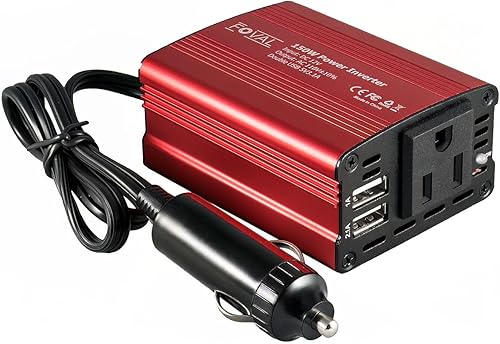
The BESTEK gives 300 watts continuous from 11 to 17 volts DC. The FOVAL gives 150 watts continuous from 12 volts DC.
Neither creates energy, so both drain the connected battery.
The Westinghouse makes 9500 running watts on gasoline and 8500 on propane, for up to 12 hours on 6.6 gallons at a stated load.
The BLUETTI Elite 30 V2 stores 288 watt hours and outputs 600 watts continuous. It is a battery plus inverter, not a fuel generator.
Power inverter vs generator side by side
The table below shows the real gap in this matchup: hundreds of watts from a car battery versus thousands of watts from fuel. Use it to match your loads before you compare anything else.
| Type | Example here | Continuous output | Energy source | Best use |
|---|---|---|---|---|
| Car inverter | FOVAL 150W | 150 watts | Vehicle battery | Phones, tablets, small laptop |
| Car inverter | BESTEK 300W | 300 watts | Vehicle battery, 11-17V | Laptops, cameras, larger car loads |
| Portable power station | BLUETTI Elite 30 V2 | 600 watts | Built in 288Wh battery | Camping, CPAP, laptop, lights |
| Fuel generator | Westinghouse WGen9500DF | 9500 watts on gasoline | Gasoline or propane | Home backup, RV, jobsite |
A note on peak and surge watts
Peak watts are short bursts, not continuous power. The BESTEK lists 700 watts instantaneous, the FOVAL lists 300 watts peak, and the BLUETTI lists 1500 watts in Power Lifting Mode.
Plan your loads around continuous watts. Use peak only for brief motor starts, and keep the total load below the continuous rating for steady use.
Our guide to power inverter dc to ac explains how continuous, peak and outlet ratings work together when you size a system.
Running watts, starting watts and your load list
Add up the running watts of every device you will run at the same time, then check that total against the continuous rating. This one step prevents most wrong purchases in a power inverter vs generator choice.
A laptop, phone and camera fit comfortably within 150 watts if their chargers stay under that total. A 300 watt inverter gives you more headroom for a larger laptop charger plus USB devices at once.
Motors in a fridge, pump or AC unit need extra watts to start. The Westinghouse generator's 12500 peak watts on gasoline exist for that starting surge, while its 9500 running watts carry the steady load.
How to build your load list
Write each device, its running watts from the label, and whether it has a motor. Separate small electronics from motor loads, because they stress an inverter in different ways.
Small electronics are steady and predictable. Motor loads can spike at startup and trip a small inverter even when the running total looks safe.
If your list includes a fridge or AC, a car inverter is the wrong tool. A fuel generator or a much larger battery system is the safer match.
For a larger battery setup, see 48V low frequency inverters.
Learn what a solar generator can run in practice with What Can You Power with a Solar Generator? before you assume a small battery will cover a major appliance.
Runtime: battery limit versus fuel tank limit
An inverter stops when its battery drains, while a generator stops when fuel runs out. Runtime is therefore battery sizing on one side and fuel storage on the other.
The BLUETTI has 288 watt hours. A 100 watt device runs well under 3 hours after losses, while a 20 watt device runs far longer.
The Westinghouse runs up to 12 hours on 6.6 gallons of gasoline at a stated load. Heavier loads use fuel faster.
Car inverters have no tank. They draw from the vehicle battery, so run the engine or recharge regularly and protect starting power.
Runtime questions to ask before you buy
Ask how many hours you need power, at what load, and how you will recharge or refuel. An outage that lasts a weekend needs a different plan from a 2 hour blackout.
For short outages, a portable power station with UPS can bridge the gap for routers and CPAP devices. For a multi day outage, fuel generation with safe storage is usually the practical choice.
Our comparison of Best Portable Power Station Vs Generator helps when you are deciding between stored battery power and fuel power for camping or home use.
Noise, fumes and where you can use each one
An inverter and a portable power station are quiet and fume free, while a fuel generator must run outdoors with exhaust and noise managed. That difference shapes where each one belongs.
The BESTEK and FOVAL inverters have cooling fans that run faster as they warm up. The FOVAL is described as very silent, and both are used inside a vehicle cabin for small electronics.
The BLUETTI station has no engine, so it can run indoors for a CPAP or laptop during a blackout. Its 10 millisecond UPS switchover helps protect critical devices when power cuts out.
The Westinghouse generator is an open frame fuel unit. Run it outdoors, away from windows and doors, with exhaust pointed away from living spaces, and follow the manual for clearances.
Safety basics for both types
Keep vents clear, use the right outlets, and never overload a circuit. Both inverters here include protection against overheating, over and under voltage, short circuits and overloads.
Use the built in fuse protection as a backup, not as a reason to push the rating. If a fuse blows, find the overload cause before you replace it.
For a generator, use GFCI outlets where required, keep fuel away from ignition sources, and let the engine cool before refueling. Never run a fuel generator in a closed garage.
Portability and setup for travel and home
A car inverter fits in a pocket or glove box, a portable power station fits in a carry bag, and a home generator needs a dedicated outdoor spot. Size and weight decide which jobs each one can do.
The FOVAL inverter is 3.2 x 2.5 x 1.5 inches and about 8 ounces. The BESTEK is 4.8 x 3.1 x 1.9 inches and 14.4 ounces, with a 32 inch cigarette lighter plug.
The BLUETTI station weighs 9.5 pounds and measures 9.8 x 7 x 6.6 inches. That is portable for camping and road trips, and it charges from AC, car, solar or a lead acid battery.
The Westinghouse generator measures 27.2 x 26.1 x 26.5 inches. It has heavy duty wheels and a handle, but it is a home and jobsite unit, not a backpacking power source.
Setup in under 5 minutes versus setup for home backup
A car inverter plugs into a cigarette lighter socket and is ready at once. Plug it in, connect your device, and check that the total watts stay within range.
A portable power station charges from a wall outlet in 45 minutes to 80 percent and 70 minutes to full, according to BLUETTI. It also supports solar charging with compatible panels.
A home generator needs fuel, oil checks, grounding and a transfer switch plan for whole house use. The Westinghouse unit is transfer switch ready with a 120 volt L14-30R 30 amp outlet and a 120/240 volt 14-50R 50 amp RV ready outlet.
For a smaller travel setup, our guide on how to choose a power inverter portable helps you match outlet count and plug type to your vehicle.
Cost drivers and what you pay for over time
An inverter costs less upfront because it is just electronics, while a generator adds an engine, fuel system and ongoing fuel and oil care. Total cost depends on how often you use it and how long you run it.
A car inverter has no fuel cost and little upkeep. Its hidden cost is wear on the vehicle battery if you run it with the engine off for long periods.
A portable power station has no fuel cost, but its battery capacity is fixed. Longer runtime means buying a larger station, and battery replacement eventually becomes part of the cost.
A fuel generator has fuel, oil, filters and service over its life. In return, it delivers thousands of watts for as long as you can safely store and supply fuel.
The right spend for your job
Spend on watts and runtime you will actually use, not on peak numbers you will rarely touch. A 150 watt inverter is enough for phones and tablets, and extra watts would sit unused.
A 300 watt inverter makes sense if you charge a laptop and phones together. A 9500 watt generator makes sense only if your home load list needs that scale.
Buy the smallest unit that covers your load list with headroom. That rule saves money and keeps the unit easier to store, carry and maintain.
Waveform, outlets and device compatibility
Check waveform and outlet types before you plug in sensitive electronics. Both car inverters here use modified sine wave output, which suits chargers and many small devices.
The BESTEK has 2 AC outlets and 2 USB ports with 4.8 amp total USB charging. The FOVAL has 1 AC outlet and 2 USB ports with 3.1 amp total USB output.
The BLUETTI station has 9 total outlets and 140 watt PD fast charging. That mix suits laptops, phones and camping devices from one unit.
The Westinghouse generator has two GFCI 120 volt 20 amp household outlets, a transfer switch ready 30 amp outlet and a 50 amp RV ready outlet. Those outlets fit home circuits and RVs, not just small electronics.
When waveform matters most
Use a pure sine wave inverter for sensitive electronics that require clean power. Check your device manual first, especially for CPAP machines, medical devices and some audio equipment.
Modified sine wave power works for many phone and laptop chargers, but it can cause buzz or heat in some devices. If a device manual requires pure sine wave, choose accordingly.
Our guide on is there loss when combining inverter power explains why paralleling inverters needs careful matching and why losses increase.
Who should buy which in this comparison
Buy a car inverter for road trips, a portable power station for quiet camping and short backup, and a fuel generator for whole home backup.
Choose the FOVAL 150 watt inverter for phones, tablets and a small laptop. Its credit card size keeps it easy in the car.
Choose the BESTEK 300 watt inverter for two AC outlets, two USB ports and 11 to 17 volt use. It suits larger laptops and several devices at once.
Choose the BLUETTI Elite 30 V2 for 600 watts of quiet power with UPS for a CPAP, router or laptop. Within 288 watt hours, it also suits camping lights, speakers and a car fridge.
Choose the Westinghouse dual fuel generator for a fridge, AC, sump pump and lights in a long outage. Remote start and transfer switch ready design suits home backup.
For camping picks, see our best power inverter for camping guide, and compare a portable power station vs inverter if unsure between those types.
Power inverter vs generator: final decision rule
Pick an inverter for small loads with a nearby battery, and a generator for large loads lasting hours. Load size is the first filter and runtime is the second.
Total running watts, add headroom for motor starts, then match to a continuous rating. Under 300 watts may suit a car inverter.
In the thousands needs a generator or large battery system.
Location matters too. Quiet indoor or campsite use points to a battery inverter or station.
Outdoor whole house backup points to a fuel generator.
Start with the load list, not a product. That keeps you from buying 9500 watts for a phone or 150 watts for a fridge.
Frequently asked questions
Is a power inverter better than a generator?
An inverter is better when you need quiet AC from a car or battery for small loads like laptops and phones. A generator is better when you need thousands of running watts for home appliances for hours.
Choose based on load size and how long you need power.
Can an inverter run a refrigerator or air conditioner?
Only if the combined running and starting watts stay within the inverter rating. The 300 watt and 150 watt car inverters here suit small electronics, not major appliances.
For a fridge or AC, check the appliance label and choose a generator or larger battery system.
How long will a battery inverter run?
Runtime depends on battery capacity and load. A vehicle battery inverter draws from the car battery, so a running engine or regular charging matters.
A portable power station has a stated watt hour capacity, so divide usable watt hours by device watts for a rough estimate.
Is a portable power station an inverter or a generator?
It combines a battery, inverter and charging circuits in one unit. It gives quiet AC power without fuel, but its stored energy is limited.
A fuel generator makes its own power as long as fuel lasts, so it suits longer and larger loads.
What should I check before I buy either one?
List every device you want to run at once, add their running watts, then allow extra for starting surge. Check outlet types, runtime at that load, fuel or charging access, and where you can safely use and store the unit day to day.


