What Is an MPPT Solar Charge Controller?
On this page (3 sections)
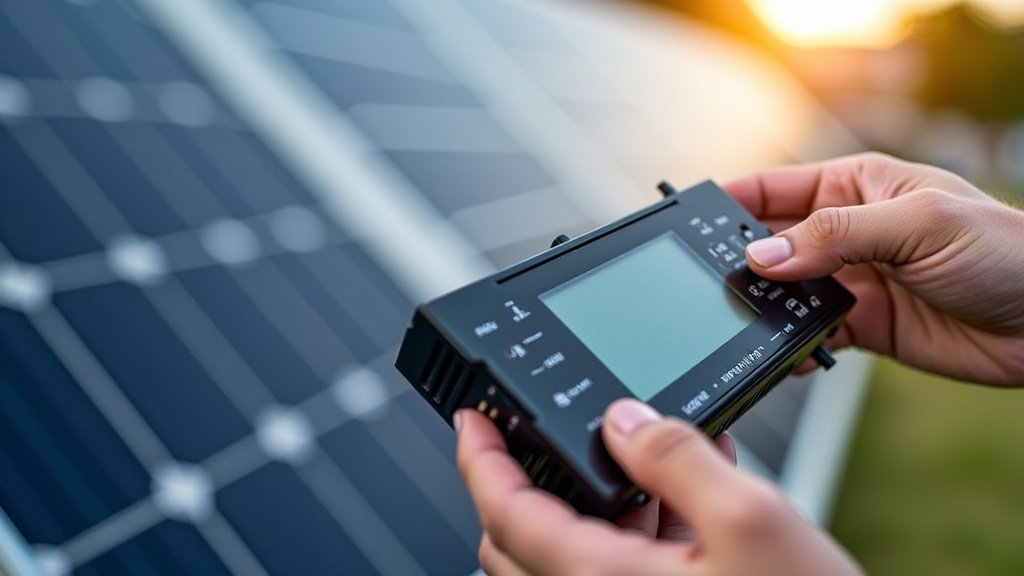
An MPPT solar charge controller is a smart device that optimizes the power output from your solar panels. It does this by converting the voltage from your panels to match your battery’s needs. This process ensures you get the most energy possible from your solar setup.
Think of it as a translator between your solar panels and your battery bank. Without one, you might be leaving energy on the table. This advanced controller helps maximize efficiency, especially when sunlight conditions change. It’s a key component for a well-performing solar system.
- MPPT stands for Maximum Power Point Tracking.
- It makes your solar panels produce more power.
- It works best when panel voltage is higher than battery voltage.
- This leads to faster battery charging and better overall performance.
Ready to understand how this little gadget makes such a big difference? Let’s break down exactly what an MPPT solar charge controller is and how it helps your solar energy system.
Understanding Your MPPT Solar Charge Controller
So, you’ve heard about MPPT solar charge controllers and wonder what makes them so special. You’re in the right place! These devices are like the brain of your MPPT solar charge controllers. They ensure your solar panels are doing their absolute best work. Without one, you might be missing out on precious solar energy. We found that this technology makes a real difference in how efficiently your system charges batteries.
What Exactly Does MPPT Mean?
MPPT is short for Maximum Power Point Tracking. It’s a fancy name for a smart technology. This technology helps your solar panels operate at their peak efficiency. Think of it like finding the sweet spot for your panels. This sweet spot means they produce the most electricity possible at any given moment. We found this is especially important when sunlight conditions are changing.
How Does an MPPT Controller Work?
Your solar panels generate power based on sunlight intensity and temperature. This power comes out as a certain voltage and amperage. Your battery, however, needs a specific voltage to charge properly. Often, the voltage your panels produce isn’t the ideal voltage for your battery. This is where the MPPT controller steps in. It’s designed to adjust the panel’s output. It converts the higher, less efficient voltage from the panels into a lower, more efficient voltage for the battery. This conversion is done while maximizing the total power delivered.
The Voltage Difference is Key
MPPT controllers work best when your solar panel’s voltage is significantly higher than your battery’s voltage. For example, if you have a 12-volt battery system, your solar panels might produce 18 volts or more in full sun. An MPPT controller can take those 18 volts and convert them into the 12 volts needed for charging. It does this without losing much energy in the process. This is a much better situation than simply letting the panels output their raw voltage, which might not be enough or could be too much for some systems. We found that this conversion capability is a major advantage.
MPPT vs. PWM: A Quick Comparison
You might also hear about PWM (Pulse Width Modulation) charge controllers. These are older and simpler. They work by directly connecting the panels to the battery. If the panel voltage is too high, a PWM controller essentially “chops off” the excess voltage. This wastes a lot of potential energy. An MPPT controller, on the other hand, actively converts the voltage. This means you get more power from your panels, especially on cloudy days or when the panels are not at their ideal temperature. Many experts say MPPT can provide 10-30% more power than PWM. This can lead to faster charging times and a more robust system.
| Feature | MPPT Charge Controller | PWM Charge Controller |
|---|---|---|
| Voltage Conversion | Yes, actively converts panel voltage to battery voltage. | No, directly connects panels to battery, discarding excess voltage. |
| Efficiency | Higher, especially in varying light and temperature conditions. | Lower, less efficient when panel voltage is much higher than battery voltage. |
| Best Use Case | Systems where panel voltage is significantly higher than battery voltage; optimal performance desired. | Smaller systems where panel voltage closely matches battery voltage; cost-effectiveness is primary. |
| Cost | Generally more expensive. | Generally less expensive. |
| Performance | Maximizes power harvest from panels. | Can result in wasted energy from panels. |
Why Is Maximizing Power Important?
Imagine your solar panels are like a garden hose. The water pressure is the voltage, and the amount of water flowing is the amperage. You want both to be just right to fill your bucket (battery) as quickly as possible. An MPPT controller helps ensure the pressure and flow are optimized for filling that bucket. If your panels are producing more pressure (voltage) than your battery can handle directly, an MPPT controller adjusts it. This way, you don’t waste any of that precious water. We found that this optimization is key for anyone serious about solar energy.
Faster Charging Times
Because an MPPT controller extracts more power from your panels, your batteries can extracts more power from your panels. This means you can potentially use your solar power sooner. For off-grid living or RVs, this is a huge advantage. You’re less likely to run out of power. Faster charging also means your batteries spend less time in a partially charged state. Some research suggests that regularly charging batteries fully can extend their lifespan (Battery University). So, not only do you get more power, but you might also get more life out of your battery bank.
Better Performance in Non-Ideal Conditions
Solar panels perform best when they are cool and in direct sunlight. But let’s be real, most of us don’t live in a perfectly controlled environment. Cloudy days, partial shading, and hot weather all affect panel output. This is where MPPT shines. Its ability to track the maximum power point means it can still pull a good amount of energy even when conditions aren’t perfect. We found that systems using MPPT controllers consistently outperform PWM systems when the sun isn’t cooperating. This reliability is invaluable for a dependable solar setup.
Who Needs an MPPT Controller?
Generally, if you have a solar system where your panel voltage is significantly higher than your battery voltage, an MPPT controller is a wise investment. This often includes larger systems, systems with higher voltage panels (like those designed for grid-tie systems but used for off-grid), or systems where you want to squeeze every last drop of energy from your panels. If you’re building a new system or upgrading an older one, we recommend considering MPPT. It’s particularly beneficial if you have limited roof space and need to get the most power from the panels you can fit.
Key Benefits to Remember
Let’s recap why an MPPT controller is a smart choice for your solar energy setup. It’s all about getting the most bang for your buck, or rather, the most watt for your sunlight!
- Maximizes Solar Energy Harvest: It ensures your panels are always operating at their peak potential.
- Faster Battery Charging: Get your batteries topped up more quickly, reducing downtime.
- Improved Efficiency in All Conditions: Works better than simpler controllers when sunlight is weak or inconsistent.
- Potential for System Expansion: Allows for higher voltage panels which can sometimes simplify wiring for larger systems.
- Better Battery Health: By ensuring more complete charges, it can contribute to longer battery life.
- Lower Overall Energy Costs: By getting more power from your panels, you rely less on other energy sources.
When you’re investing in solar, you want to make sure you’re getting the best performance possible. An MPPT solar charge controller is a MPPT solar charge controller for achieving that. It’s a smart piece of technology that pays for itself through increased energy production.
Conclusion
You’ve learned that an MPPT solar charge controller is your system’s secret weapon for peak performance. It intelligently converts your solar panel’s power to perfectly match your battery’s needs. This smart technology ensures you harvest the maximum energy possible, even when sunlight conditions aren’t ideal. We found this leads to faster charging and potentially longer battery life. Investing in an MPPT controller means getting more from your solar setup. Your next step is to evaluate your current system and see if an MPPT controller could boost its efficiency and your energy independence.
Frequently Asked Questions
Do I really need an MPPT controller for my small solar setup?
For very small systems where your panel voltage is already close to your battery voltage, a simpler PWM controller might suffice. However, if you’re looking to maximize every bit of energy, especially in less-than-perfect weather, an MPPT controller can still offer advantages. We found that even small gains can add up over time.
How does an MPPT controller handle cloudy days better than PWM?
On cloudy days, solar panels produce lower voltage. A PWM controller is less efficient in these conditions, essentially wasting much of the available power. An MPPT controller, on the other hand, actively seeks out the maximum power point, allowing it to capture more energy from the weaker sunlight.
Can an MPPT controller damage my batteries if I set it up wrong?
MPPT controllers are designed with safety features to prevent overcharging and damage to your batteries. The primary function is to regulate voltage and current, ensuring a safe and efficient charge. Always follow the manufacturer’s installation and settings guidelines to be sure.
Is the extra cost of an MPPT controller worth it?
For many users, the increased energy harvest from an MPPT controller justifies the higher upfront cost. We found that the extra 10-30% of power you can gain often pays for the difference over the lifespan of the system. This is especially true if you have limited space for panels.
What happens if my solar panel voltage is lower than my battery voltage?
An MPPT controller is designed to step down voltage, not step it up. If your solar panel’s maximum power voltage is lower than your battery voltage, an MPPT controller won’t be able to effectively charge the battery. In such cases, a PWM controller is usually a better fit.