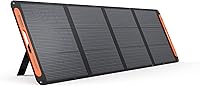
550W Solar Panel Charging Time in Cloudy Weather
A 550W solar panel can take hours to days to charge a battery in cloudy weather, depending on the battery's usable capacity and the panel's measured output. Divide the energy needed in watt-hours by the average power reaching the battery, then allow extra time for charging losses.
On this page (7 sections)
- How do you estimate 550W solar panel charging time in cloudy weather?
- What information do you need from the battery?
- How can you measure the panel's output on a cloudy day?
- Why can the same panel charge at different speeds?
- Which products can help with solar charging?
- How do you make a cloudy-weather estimate more realistic?
- How long should you plan for?
A 550W solar panel can take hours to days to charge a battery in cloudy weather, depending on the battery's usable capacity and the panel's measured output. Divide the energy needed in watt-hours by the average power reaching the battery, then add time for charging losses and periods when clouds cut output.
The 550W rating is a maximum under specified test conditions, not a promise of steady power outdoors. To estimate charging time for your setup, use the battery's energy capacity and check the panel's actual output while the sky is cloudy.
How do you estimate 550W solar panel charging time in cloudy weather?
Divide the watt-hours your battery needs by the average watts reaching it. This gives a rough number of charging hours at that output; real elapsed time is longer if clouds move in and out or the system loses power.
Use this formula:
Charging time in hours ≈ energy needed in watt-hours ÷ average charging power in watts
For example, if a battery needs 600Wh and the panel averages 150W at the charge controller, the simple estimate is 4 hours. That assumes the output stays near 150W and does not include charging losses.
A more useful estimate includes a loss allowance. If you don't know your system's efficiency, treat the result as a starting point and compare it with actual charging progress rather than relying on a precise forecast.
What does the 550W panel rating tell you?
A 550W rating describes the panel's maximum rated power under test conditions. It doesn't mean the panel will supply 550W for every hour of daylight, especially when clouds, shade, dirt, or a poor angle block sunlight.
The energy available depends on both output and time. A panel producing 150W for 3 hours delivers about 450Wh before system losses, while 300W for 1 hour delivers about 300Wh.
If you're comparing panel sizes and technologies, see which solar panel is best for a broader overview. Panel type alone won't determine cloudy-day charging time, but the right setup can make it easier to use the light available.
What information do you need from the battery?
Find the battery's voltage, capacity, chemistry, and current state of charge. Capacity tells you how much energy it can store, while its charge limits and chemistry affect how power should reach it.
If capacity is given in amp-hours, estimate nominal watt-hours by multiplying amp-hours by voltage:
Watt-hours ≈ volts × amp-hours
A 12V, 100Ah battery has about 1,200Wh of nominal capacity. If it is already half charged, it may need roughly 600Wh to reach full, though usable capacity and charging behavior vary by battery.
For an estimate, use the energy the battery actually needs, not its full capacity by default. Check the battery manual for safe charging limits and whether your controller supports its chemistry.
For 12V battery setups, compare MPPT charge controllers.
How can you measure the panel's output on a cloudy day?
Read the solar input watts shown by your charge controller or power station while the panel is connected. Take several readings as cloud cover changes, then use a conservative average for your estimate.
A single reading can be misleading. Note the time, sky conditions, panel angle, and whether any part of the panel is shaded; repeat the check at different times if the weather changes.
Keep the panel connected to compatible equipment and follow its instructions. Avoid handling exposed electrical connections in wet conditions, and keep ports or controllers dry unless they are rated for that exposure.
Solar output depends on the panel design as well as the weather. Our guide to which solar panel type is better explains tradeoffs to consider when choosing a panel for your setup.
Why can the same panel charge at different speeds?
Cloud thickness and coverage can change output throughout the day. Thin cloud may leave useful light, while darker, thicker cloud can cause a much larger drop.
Shade from a branch, roof edge, or nearby object can lower production too. Place the panel where the sun can reach it, adjust its angle as conditions change, and check whether the controller or battery is limiting input.
A battery near full may accept less power than one at a lower charge level. The panel's output and the battery's charging rate are separate limits, so check both when diagnosing a slow charge.
Which products can help with solar charging?
Choose equipment for the battery or device you need to charge, and match its connectors and voltage. The products below have different roles, so none should be treated as a replacement for a 550W panel.
When does the SOLPERK 20W kit fit?
The SOLPERK kit is a 20W panel and controller for maintaining compatible 12V rechargeable batteries. Its adjustable bracket can help you point the panel toward available sunlight.
It is designed for battery maintenance and trickle charging, not for matching the output of a 550W array. Check the battery chemistry and connection instructions before using it.
What is the YCTechCam 5W panel for?
The YCTechCam panel is a 5W solar supply for compatible rechargeable security cameras with a Micro USB or USB-C port. Its 360-degree wall bracket lets you adjust the panel's position to receive sunlight.
It isn't a general battery charger or a way to charge a phone. Confirm that your exact camera supports this panel before connecting it.
When is the ZOUPW 100W panel useful?
The ZOUPW is a foldable 100W panel designed to connect to compatible portable power stations. It includes a five-in-one connector cable, but the station's solar input limit can cap the power it accepts.
ZOUPW says the panel still generates power on cloudy days, with a significant output drop compared with direct sun. Keep its controller and cables dry, even though the panel body is rated IP67.
How do you make a cloudy-weather estimate more realistic?
Use a measured average and plan around the lower end of the output you observe. If readings range from 80W to 200W, calculate with a value near the low end when you need to know whether the battery will charge by a deadline.
For an example of the power available from a smaller panel, see 80W solar panel output.
Check the system's limits before upgrading or connecting more panels. For a series setup, follow this guide to connecting more panels.
The charge controller, power station input, wiring, and battery can each restrict the power that reaches storage.
If you're charging a power station, follow its solar input instructions and connector requirements. An MC4 to DC adapter may help when the compatible panel and station use different connectors.
The guide to charging a power station with solar panels covers the basic connection and setup steps.
For a small maintenance panel on a vehicle, best dashboard solar panels for trickle charging can help you compare that use with a larger battery-charging setup. For vehicle charging needs, read about a portable solar panel for EV charging, since charging an electric car requires equipment designed for that job.
How long should you plan for?
Plan with the battery's energy need and the lowest realistic output you measure. Divide watt-hours needed by that output, then add a buffer for conversion losses, changing clouds, and battery charge limits.
A 550W panel can charge quickly in strong sun when the system accepts its output, but cloudy conditions can stretch the job substantially. If the battery must be ready by a set time, start earlier or use a backup charging source.
For a useful estimate, record the battery's starting charge, check input watts at intervals, and update the calculation as weather shifts. This turns a panel rating into a practical forecast for your location.
Frequently asked questions
How long will a 550W solar panel take to charge a 100Ah battery?
It depends on the battery voltage, its current state of charge, and the panel's measured output. A 12V, 100Ah battery stores about 1,200Wh nominally, but the usable amount may be lower; divide the energy needed by average watts reaching the battery, then allow for charging losses and cloudy interruptions.
Does a 550W solar panel work on cloudy days?
Yes, a solar panel can still make power in cloudy weather, but its output usually falls as clouds reduce sunlight. Measure the watts reaching the charge controller or power station during the conditions you expect, and use that figure for a realistic estimate instead of assuming the panel supplies 550W.
Why is my 550W solar panel charging so slowly?
Cloud cover, shade, panel angle, wiring, controller limits, and the battery's charge level can all reduce charging speed. Check the measured input watts, confirm the controller and battery are compatible, and compare the solar input with the battery's charge limit before changing the setup.
Can I charge a battery with a 550W solar panel without a controller?
Use the correct charge controller for a battery that requires one, and follow the battery and panel instructions. A controller manages the charging connection and must match the battery chemistry and system voltage; never connect a panel directly unless the battery manufacturer specifically permits that setup.