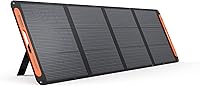
Solar Panels: The Complete Buying Guide
The best solar panel is one that matches your device or battery’s voltage, input limits and daily energy needs. Then choose a panel type and size that fit your space, sun exposure and how often you need to move it.
On this page (16 sections)
- Which solar panel is best for your setup?
- What are the main types of solar panels?
- Is monocrystalline the best solar panel type?
- How much wattage do you need?
- How do voltage and Voc affect compatibility?
- What else affects real-world solar output?
- Which solar panel works for a portable power station?
- Which solar panel works for a 12V battery?
- Can a solar panel run an appliance?
- Which connectors and mounting parts matter?
- Which solar panel is best for common uses?
- How should you choose a solar panel kit?
- How do you compare solar panel brands and styles?
- What should you check before buying?
- Explore solar panels and controllers by topic
- Which solar panel is best for you?
The best solar panel is the one that matches what you want to power, the system’s electrical limits and the place you’ll use it. Start with the device or battery, then compare panel wattage, voltage, mounting, portability and expected sun exposure.
A panel that is too small may not meet your charging needs, while one that exceeds a connected device’s input limits may not deliver its full rated power. The right choice depends on the complete setup, not just the wattage printed on the panel.
This guide covers panel types, sizing, voltage, controllers and mounting so you can narrow your options. If you’re deciding between folding, flexible and rigid designs, compare which solar panel type is better.
Which solar panel is best for your setup?
The best solar panel is one whose electrical output suits the connected device or battery, with enough power for your intended use. Check voltage, current, connector and input limits before comparing brands or cell types.
A solar panel’s rated wattage describes its maximum power under specified conditions. Real output changes with sun, angle, shade, temperature and wiring, so a panel rarely delivers its full rating throughout the day.
For a cloudy-weather charging example, see 550W solar panel charging in cloudy weather.
Start by identifying the load:
| What you want to power | What to check first |
|---|---|
| A 12V battery | Battery chemistry, charge controller, panel voltage and charging needs |
| A portable power station | Solar input voltage range, maximum input power and connector |
| A rechargeable security camera | Camera charging port, voltage and brand or model compatibility |
| A home electrical system | Inverter design, roof space, wiring and local installation requirements |
| A small device directly | Required output voltage, port type and charging limits |
For battery systems, a panel may need a charge controller between it and the battery. For portable power stations, the station usually manages charging, but the panel still must fit its input specifications.
What are the main types of solar panels?
Rigid, portable folding and flexible panels serve different mounting and handling needs. Choose by where the panel will sit and how often you’ll move it, then compare its rated output and electrical limits.
| Panel type | Often suits | Check before choosing |
|---|---|---|
| Rigid framed | Fixed mounts, roofs and long-term outdoor setups | Weight, dimensions, mounting points and wind exposure |
| Folding portable | Camping and temporary charging | Folded size, weight, support legs, cable and connectors |
| Flexible | Curved surfaces or installations with limited clearance | Approved mounting method, heat management and bending limits |
| Small specialty panel | Cameras, maintainers and other low-power devices | Exact device compatibility and charging output |
Rigid panels have a frame and a firm mounting surface. They can be a practical fit for a permanent setup, but they need secure mounting and enough space.
Portable folding panels are easier to pack away and reposition. Before disconnecting one, follow suitcase solar panel disconnection steps.
Their usable output still depends on angle and sunlight, so check whether you can orient them toward the sun during charging.
Flexible panels can suit a curved surface, but the mounting surface and maker’s installation limits matter. For installation steps, see how to mount flexible solar panels.
Don’t assume a panel can bend around any shape or be attached with any adhesive.
For mounted applications, compare best rigid solar panels. A smaller rigid panel can suit low-power charging; see our guide to the best rigid solar panel 100w.
Which solar panel type is best for limited space?
A compact, high-output panel may help when space is limited, but compare dimensions and rated wattage together. A panel that fits the available area still needs a compatible voltage and mounting plan.
Monocrystalline panels are widely used in portable and rigid designs. Look at the specifications for each panel rather than assuming that one cell label alone tells you how much energy you’ll collect.
Bifacial panels can collect light from the rear as well as the front when the setup allows light to reach both sides. Their usefulness depends on the mounting height and the surface below, so a close-fitting roof installation may not provide the same conditions as a raised ground mount.
Is monocrystalline the best solar panel type?
Monocrystalline can be a good choice when you want a common panel type with strong output for its size, but it is not automatically best for every setup. Compare rated power, panel size, voltage and your budget for the specific options.
A panel’s cell material does not determine whether it works with your battery, power station or device. Compatibility comes from the electrical specifications and connection method.
If you’re comparing cell types and models, see best monocrystalline solar panels. Also compare the full system: a panel needs a compatible charge controller or device input to deliver useful power safely.
How much wattage do you need?
Choose panel wattage by estimating the energy you need and how many hours of usable sunlight you expect. Then check the connected system’s maximum input so the panel’s power stays within its limits.
Watts measure power at a moment; watt-hours measure energy over time. A 100W panel does not guarantee 100 watt-hours every hour, because sunlight and operating conditions change.
For a rough planning estimate, multiply panel wattage by expected full-sun hours, then allow for losses from angle, heat, shade and the charging system. For an output example, see power from an 80W solar panel.
Treat that as a planning range, not a promise.
A 100W panel may suit a portable power station or a modest off-grid load, while higher-power systems need larger arrays. For a 12V cooling load, compare portable fridges and coolers.
Small panels can be useful for trickle maintenance or low-power devices, but they are not a substitute for a larger charging setup.
To see how a specific rating may fit common loads, read what a 200 watt solar panel can power. For 12V battery use, compare best 200W solar panel 12V options.
Is a higher-wattage solar panel always better?
A higher-wattage panel is useful only when the system can accept its output and you have enough space and sunlight to use it. Match the panel to the controller or station’s limits, including voltage and current.
If a power station has a 60W solar input limit, it may draw no more than that from a panel rated above 60W. The station manual gives the input range and connector requirements to check.
Larger panels also take more space and may be harder to carry or mount. Compare output with weight, dimensions and how often you’ll set up or move the panel.
How do voltage and Voc affect compatibility?
Voltage limits determine whether a panel can safely connect to a controller, battery system or power station. For a multi-panel series setup, see connecting eight solar panels in series.
Check the panel’s open-circuit voltage (Voc) against the maximum input voltage of the connected equipment.
Voc is the panel voltage measured with no load connected. The panel’s operating voltage is usually lower, but cold conditions can raise Voc, so the system design must account for the panel’s specified limits and local conditions.
For a portable station, compare the panel’s Voc and operating voltage with the station’s solar input range. A connector that fits physically does not prove that the voltage is suitable.
For more detail, see how to choose a 40V Voc solar panel or a solar panel with 25 Voc.
What else affects real-world solar output?
Sunlight, panel angle, shade and temperature all affect how much power a panel produces. Place it in full, unshaded sun when possible, and reposition portable panels as the sun moves.
Shade across even part of a panel can reduce output. Check for nearby trees, roof edges, vents and other obstructions at the hours you plan to charge.
Panels also get hot in direct sun. Use the maker’s temperature range and mounting guidance, and leave any required airflow around the panel.
Learn more about the temperature of a 100W solar panel. For a specific cell type and rating, see how to choose a 200W monocrystalline solar panel.
Which solar panel works for a portable power station?
A compatible portable panel must fit the station’s input voltage, power limit and connector. Check the station manual before buying a panel or adapter, even if the connector appears to match.
Foldable panels can be convenient for camping and temporary backup because you can move them into sunlight and pack them away. For a larger portable option, see the EcoFlow 400W portable solar panel review.
Confirm that the cable reaches the station while the panel sits in a clear, sunlit spot.
For a paired station-and-panel setup, see best portable power station with solar panel. If you already own a station, use the station’s input limits to choose the best solar panel for a portable power station.
What portable solar setup suits camping?
A portable folding panel with a compatible cable can suit camping when you need to recharge a power station during the day. Check the folded dimensions, weight and connectors against your packing space and station.
A 100W portable panel is one option for a small or mid-sized power station, depending on the station’s input limit. Keep the panel pointed toward the sun and protect any controller or connection points that are not rated for rain.
The ZOUPW panel is a foldable 100W option with a five-connector cable for several power station connection types. Its panel body is rated IP67, while its USB hub and cables need to stay dry.
Which solar panel works for a 12V battery?
A panel for a 12V battery usually needs a compatible charge controller and a charging profile suited to the battery chemistry. Check the battery maker’s charging instructions and the controller’s supported battery types.
A small maintenance panel can help offset a battery’s self-discharge when sunlight and setup conditions allow. If charging remains slow, see why a Mighty Mule panel charges slowly.
It will not quickly recharge a deeply discharged battery, and charging needs vary by capacity and chemistry.
The SOLPERK kit is a 20W panel with a controller and mounting bracket. It is designed for 12V rechargeable batteries, including LiFePO₄, lithium-ion, AGM, SLA, GEL, EFB and MF types.
The Topsolar kit is another 20W option for 12V battery charging, with a 10A controller, cable clips and ring terminals. Its framed panel is designed for off-grid battery uses such as RVs, boats and cabins.
For vehicle batteries, see best dashboard solar panel for slow charge. For camera charging, verify the camera’s port and supported panel before choosing solar panels for electric wheelchairs.
Can a solar panel run an appliance?
A solar panel can help power an appliance when the full system can supply the appliance’s energy needs. Check the appliance’s wattage, daily use and startup demand, then size the battery, inverter and panel together.
Many household appliances need more power than a small panel can supply directly. A battery stores energy for use outside sunny hours, while an inverter converts battery power to the AC current many appliances use.
A slow cooker’s draw depends on its model and setting. See whether you can run a slow cooker on solar panels for the system components to consider.
Portable solar panels are not a direct way to charge an electric car unless a compatible charging system and sufficient power source are part of the setup. Read whether portable solar panels can charge an electric car before planning that use.
Which connectors and mounting parts matter?
The panel connection must fit the controller or device electrically and physically. Check connector type, polarity, cable length and weather exposure before you assemble a system.
MC4 connectors are common on many rigid panels, but not every device accepts them directly. A suitable adapter cable may be needed, and every connection should match the equipment’s voltage and current limits.
See best MC4 connectors for solar panels and best MC4 to XT60 adapter cable when comparing compatible connection parts. If you use an XT60 input, confirm the exact polarity and input range in the station manual.
A stable stand helps aim a portable panel at the sun. For fixed installations, mounting brackets need to fit the panel frame and surface, with secure attachment for local wind and weather.
Compare best adjustable solar panel stand for portable setups or best solar panel mounting brackets for roof for roof installations.
Which solar panel is best for common uses?
The best solar panel varies by use because a camera, battery bank and power station have different charging needs. Choose by the connected system first, then narrow by panel style and output.
- For a rechargeable security camera: check the camera’s brand, model, port and charging voltage. The YCTechCam 5W panel supports compatible DC 5V battery cameras with Micro USB or USB-C, but it is not compatible with several named camera brands, including Arlo, Blink, Ring, Eufy, Google Nest and Kasa.
- For a 12V battery: compare a panel and controller rated for the battery chemistry and charging limits.
- For a portable station: match the panel voltage, connector and power to the station’s solar input.
- For an RV: plan the panel layout, controller, battery capacity and cable route as one system.
- For occasional device charging: compare a compact solar charger’s output and device compatibility.
For vehicle and RV installations, compare best Renogy solar panels and best RV solar panel kits. A separate controller may be needed, so review best MPPT charge controller when building a battery system.
How should you choose a solar panel kit?
A solar panel kit can simplify buying because it may include a controller, cables and mounting hardware. Check what is included and whether each part fits your battery or device before choosing a kit.
For a battery system, confirm the controller supports your battery chemistry and voltage. Check whether the cables terminate in clips, ring terminals, MC4 connectors or another plug, and whether the cable length works for your layout.
A kit designed for a particular use can reduce the number of separate parts you need to source. It does not remove the need to confirm compatibility or follow safe installation instructions.
See how to choose the best solar panel kit for a closer look at bundled components and system fit.
How do you compare solar panel brands and styles?
Compare the specific panel’s rated output, voltage, dimensions, connectors and included parts. Brand and cell type can help narrow a search, but neither replaces checking compatibility.
Rigid panels suit fixed mounting, while portable panels suit setups that move between locations. Flexible panels can work where a framed panel does not fit, but use them only within the maker’s mounting and bending guidance.
For different styles, see best flexible solar panels and best bifacial solar panels. If you want a portable panel for direct device charging, compare the best solar panel charger and best portable solar panel kit.
For a panel that works with a specific power station brand, confirm the connector and input range before comparing best Jackery compatible solar panel options. Brand names alone do not guarantee that a panel fits every model.
What should you check before buying?
Check system compatibility, usable power, physical fit and installation needs before you buy. These steps help catch the most common mismatches:
- Identify the exact device, battery or power station model.
- Check its supported solar input voltage, current, wattage and connector.
- Compare the panel’s Voc and operating voltage with those limits.
- Estimate energy use and available sun hours, allowing for lower real-world output.
- Measure the mounting area and confirm the panel’s size and weight will fit.
- Check whether a charge controller, adapter cable or mounting hardware is included.
- Review weather ratings for the panel and for its cables, ports and controller separately.
- Follow the system and battery makers’ installation and safety instructions.
For a roof or permanent installation, consider local building rules and use a qualified installer where the wiring or structure requires one. Keep the panel, cables, controller and battery within their specified operating conditions.
Explore solar panels and controllers by topic
- Best 400W Rigid Solar Panels
Which solar panel is best for you?
The best solar panel depends on what it connects to and where you’ll use it. Choose a small specialty panel for a compatible low-power device, a 12V kit for battery maintenance, or a portable panel for a station that accepts its voltage and connector.
For fixed use, compare panel dimensions, mounting hardware and system design before focusing on wattage alone. For mobile use, balance output with weight, folded size and setup time.
Pick the panel whose electrical limits match your system, then choose the format that suits your space and routine. If you’re still comparing panel styles, start with which solar panel type is better.
Frequently asked questions
Which solar panel is best for a home?
The best panel for a home depends on the roof, energy use, local rules and the system design. Compare the panel’s power and electrical limits with the inverter and mounting plan, and ask a qualified installer to assess roof condition, shade and wiring before you choose.
Is monocrystalline or polycrystalline better?
Monocrystalline panels are a common choice when you want strong output from a limited area, but the right option depends on panel design, space and budget. Compare the rated power, dimensions and electrical specifications for the specific panels you are considering.
How many watts should a solar panel have?
Choose wattage based on the energy you need and the time and sunlight available to collect it. Check the connected device or battery system’s input limit, then allow for weaker output in shade, clouds, poor angle and heat.
Can any solar panel charge a portable power station?
No. The panel’s connector, voltage range and power must fit the station’s solar input limits.
Check the station manual and panel specifications together, and use a compatible adapter only when the manufacturer allows it.
Do solar panels work on cloudy days?
Solar panels can still produce power in cloudy conditions, but output usually falls compared with direct, unshaded sun. The amount depends on cloud cover, panel angle, shade and the specific panel, so plan around lower production if reliable charging matters.