9 Best Flexible Solar Panels (November 2026)
The best flexible solar panels include the Renogy Flexible Solar Panel 100 Watt for most curved installations, the BougeRV Arch Pro 200W Anti-Shading N-Type Fiberglass for partial shade, and the Renogy 200 Watt ShadowFlux Flexible Solar Panel for shaded RV roofs.
On this page (7 sections)
The best flexible solar panels combine low weight, a thin profile and enough bend for the mounting surface. The Renogy Flexible Solar Panel 100 Watt is the best overall pick, while BougeRV and Renogy ShadowFlux are better suited to 200W systems where partial shade is a concern.
Flexible panels work well on curved RV roofs, boat decks, vans and other surfaces where rigid glass panels are hard to place. For brand-specific portable options, compare Anker solar panels.
For ground-deployed RV options, compare foldable solar panels for RVs. They also help when roof weight or a low profile matters more than a framed panel.
If you're still comparing panel types, start with our guide to which solar panel is best. For a controller-based system, our best flexible solar panel with controller guide covers the next decision.
Our picks at a glance
-
1
 Best for most curved installations
Renogy Flexible Solar Panel 100 Watt
9.7/10 our score
See it on Amazon -
2
 Best for partial shade
BougeRV Arch Pro 200W Anti-Shading N-Type Fiberglass
9.6/10 our score
See it on Amazon -
3
 Best for shaded RV roofs
Renogy 200 Watt ShadowFlux Flexible Solar Panel
9.4/10 our score
See it on Amazon
- 4
 Best for a two-panel 260W setupCheck it
- 5
 Check it
Callsun 400W Flexible Solar Panel
Best for a large two-panel array - 6
 Check it
Callsun 400W Flexible Solar Panel System
Best for scalable battery banks - 7
 Check it
Topunive 100W 12V Flexible Solar Panel 9BB
Best for a light 12V system - 8
 Check it
Callsun 200W Flexible Solar Panel
Best for weekend power needs - 9
 Check it
LETSFAB 100W Flexible Solar Panels
Best for portable curved mounting
The best flexible solar panels for curved and portable setups
The Renogy 100W leads this group for general curved-surface use. The other picks increase output, improve shade handling or give you more ways to spread panels across a roof.
Our score weighs specifications, features and buyer feedback against what you're shopping for. We checked bend angle, output, weight, thickness, surface material, panel count and system-fit details.
| Product | Best for | Power | Size | Weight | Our score |
|---|---|---|---|---|---|
| Renogy Flexible Solar Panel 100 Watt | most curved installations | 100W | 48 x 21.5 x 0.08 in | 4 lb | 9.7 |
| BougeRV Arch Pro 200W Anti-Shading N-Type Fiberglass | partial shade | 200W | 52.95 x 30.91 x 0.1 in | 7.9 lb | 9.6 |
| Renogy 200 Watt ShadowFlux Flexible Solar Panel | shaded RV roofs | 200W | 62.2 x 27.4 x 0.1 in | 7.7 lb | 9.4 |
| ECO-WORTHY 2pcs 130 Watt | a two-panel 260W setup | 9.2 | |||
| Callsun 400W Flexible Solar Panel | a large two-panel array | 8.9 | |||
| Callsun 400W Flexible Solar Panel System | scalable battery banks | 8.8 | |||
| Topunive 100W 12V Flexible Solar Panel 9BB | a light 12V system | 100W | 36.22 x 23.22 x 0.12 in | 4.4 lb | 8.7 |
| Callsun 200W Flexible Solar Panel | weekend power needs | 8.2 | |||
| LETSFAB 100W Flexible Solar Panels | portable curved mounting | 100W | 44 x 14.5 x 0.07 in | 4.4 lb | 8.1 |
Renogy Flexible Solar Panel 100 Watt: Best for most curved installations
- 100W maximum power
- 240° flexible bend
- 22% efficiency
- 0.08 in thick
The thin polymer and aluminum alloy panel fits curved roofs, boats, vans and other uneven surfaces. Its 100W output suits smaller off-grid systems.
Pros
- Very thin profile
- 240° bendable design
- IP68 waterproof junction box
Cons
- Only 100W output
- One panel included
The Renogy Flexible Solar Panel 100 Watt is the easiest starting point for a curved roof, van or boat installation. It bends up to 240°, measures 48 x 21.5 x 0.08 in and weighs 4 lb.
That thin profile matters on load sensitive structures. A panel this light is simpler to carry to the roof and easier to position on a surface that cannot take much extra weight.
Its polymer and aluminum alloy construction keeps the profile thin. Renogy gives it a 22% efficiency rating, a 12V output and a maximum power rating of 100W.
The panel uses MC4 connectors and includes one solar panel. Its IP68-rated waterproof junction box and IP67-rated solar connectors suit outdoor installations, while the stated wind and snow load ratings add useful mounting context.
Choose it when you want one light panel for a smaller off-grid system. If you need a smaller footprint, compare our best small flexible solar panel guide.
BougeRV Arch Pro 200W Anti-Shading N-Type Fiberglass: Best for partial shade
- 200W maximum power
- 25% conversion rate
- 270° flexibility
- ETFE coating
Cell-level bypass technology is designed to limit power loss from common partial-shade patterns. Check the 36V open-circuit voltage range against your power station before connecting.
Pros
- Anti-shading diode design
- 270° flexibility
- IP68 water and dust resistance
Cons
- 36V open-circuit range may not suit every power station
- Adhesive and tape are not included
The BougeRV Arch Pro 200W Anti-Shading N-Type Fiberglass Flexible Solar Panel is the best fit when shade is part of the installation problem. Its bypass diode technology is designed to maintain more stable output when trees, leaves or other objects shade part of the panel.
That approach suits real roofs and decks. Vents, rigging and nearby trees rarely shade a whole panel evenly, so limiting loss from a shaded section can matter more than a headline watt number.
The 200W panel uses N-type 16BB cells with a stated 25% conversion rate. It bends up to 270°, weighs 7.9 lb and measures 52.95 x 30.91 x 0.1 in.
Its ETFE coating is described as scratch-resistant, self-cleaning and sand-proof. The 36V open-circuit voltage range may not suit every power station, so check the station's voltage limits before connecting it.
This panel suits RV, camping, boat and marine systems that can accept its electrical range. Adhesive and tape are not included.
Renogy 200 Watt ShadowFlux Flexible Solar Panel: Best for shaded RV roofs
- 200W maximum power
- 25% high efficiency
- 270° vertical bend
- Up to 30 bypass diodes
ShadowFlux cell-level bypass technology targets shade from leaves, branches, vents and other obstructions. The TPO and glass-fiber construction is made for curved outdoor installations.
Pros
- Designed for partial shading
- 25% efficiency
- IP68 outdoor protection
Cons
- Long 62.2 in layout
- Limited horizontal bending
The Renogy 200 Watt ShadowFlux Flexible Solar Panel is designed for curved outdoor surfaces where partial shade is common. Its cell-level bypass technology uses up to 30 bypass diodes to reduce power loss from small spots, lines, patches and moving shadows.
That kind of shading is normal on boats and RVs. Bird droppings, leaves, wires and branches can cover a small area, and the design aims to keep the rest of the panel working.
The panel delivers 200W, has 25% high efficiency and weighs 7.7 lb. It measures 62.2 x 27.4 x 0.1 in, so check the long layout against your roof before choosing it.
The TPO surface and glass-fiber reinforcement are intended to resist aging, vibration and cracking during repeated outdoor movement. It bends up to 270° along the long axis, with limited horizontal bending.
Choose it for an RV, boat, balcony or other curved surface where shade cannot be avoided. It has a maximum voltage of 44.1V, so controller compatibility matters.
ECO-WORTHY 2pcs 130 Watt: Best for a two-panel 260W setup
- 2 panels
- 130W per panel
- 270° bend
- 25% efficiency
Two 130W panels give you a wider 260W system while keeping each panel smaller than many single 200W choices. Pre-drilled holes support several mounting methods.
Pros
- Two-panel layout
- 25% efficiency
- IP68 junction box
Cons
- Heavier combined package
- Each panel is 130W rather than 200W
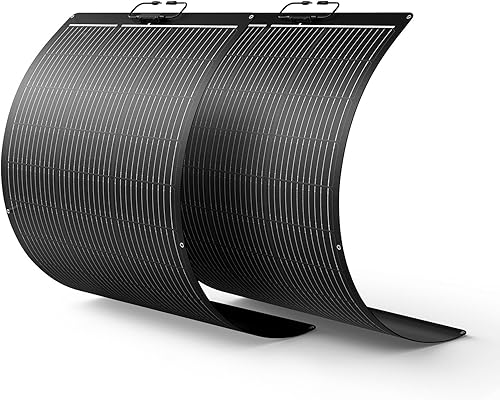
The ECO-WORTHY 2pcs 130 Watt set is a good choice when you want 260W from two smaller flexible panels. Each panel produces 130W, measures 37.8 x 27.1 x 0.1 in and weighs 6.28 lb.
Two smaller panels can fit a roof better than one long module. You can spread them across open sections and work around vents or other fittings.
The pair uses 25% high-efficiency monocrystalline silicon cells and bends up to 270°. Pre-drilled metal-reinforced holes support adhesive, silicone, double-sided tape, cable ties or Velcro for different mounting plans.
An IP68 junction box and built-in diodes support outdoor use. The set includes two panels and cables for series or parallel connections.
Choose it when two-panel placement is easier than one long 200W panel. For adhesive choices, see our guide to flexible solar panel adhesive.
Callsun 400W Flexible Solar Panel: Best for a large two-panel array
- 2 x 200W panels
- 400W total power
- 240° bend
- ETFE coating
This 2 x 200W set is aimed at large power stations, boats and RVs with room for two long panels. The white backsheet is intended to reflect excess heat.
Pros
- 400W combined output
- 23.5% efficiency
- Series and parallel setup options
Cons
- Needs substantial mounting space
- 18.2V maximum voltage per panel
The Callsun 400W Flexible Solar Panel uses two 200W panels for a large curved installation. Each panel bends up to 240°, measures 62.1 x 31.7 x 0.1 in and weighs 9.3 lb.
That size makes it a committed choice. Each panel needs a long, clear area, so measure the roof or deck before you add the second one.
The set uses ETFE and monocrystalline silicon with a stated 23.5% efficiency. Callsun describes the white backsheet as heat-reflective, which may suit white RV roofs and boat decks.
Series or parallel wiring lets you plan for 12V or 24V systems. The two-panel format keeps the module count low, but each panel needs a long and wide mounting area.
Choose this set for a large power station or off-grid system with enough roof space. Compare it with our guide to a flexible solar panel 300w before selecting array size.
Callsun 400W Flexible Solar Panel System: Best for scalable battery banks
- 4 x 100W panels
- 400W total power
- 23% efficiency
- 12V, 24V and 48V battery compatibility
Four 100W panels let you spread the array across several roof sections or connect them for higher-voltage systems. The package includes connection cables and a user manual.
Pros
- Four-panel layout
- Supports 12V, 24V and 48V batteries
- ETFE construction
Cons
- More panels mean more wiring
- 0.98 in stated height is thicker than the other Callsun panels
The Callsun 400W Flexible Solar Panel System spreads 400W across four 100W panels. Each panel measures 43.7 x 24.4 x 0.98 in, and the system is described for 12V, 24V and 48V batteries.
Four smaller panels give you more layout freedom. You can place them on separate roof sections instead of finding one long clear run.
The ETFE and monocrystalline silicon panels have a stated 23% efficiency. The package includes four black 100W panels, connection cables and a user manual.
Four modules can be easier to distribute across separate curved roof sections than two large panels. They also add more wiring and connection points, so plan the cable route before mounting.
Choose this set when a scalable 48V-capable array matters. For larger single-array planning, read about a 400w flexible solar panel.
Topunive 100W 12V Flexible Solar Panel 9BB: Best for a light 12V system
- 100W maximum power
- 12V output
- 9 busbars
- 4.4 lb weight
The compact 100W panel is easy to carry and suits 12V setups on vans, boats, cabins and other uneven surfaces. Its ETFE surface and TPT back panel support outdoor use.
Pros
- Light 4.4 lb design
- Compact footprint
- MC4 connectors
Cons
- 12V output limits system choices
- Efficiency is not stated as a percentage
The Topunive 100W 12V Flexible Solar Panel 9BB suits a light 12V system on a boat, van, cabin, trailer or uneven roof. It weighs 4.4 lb and measures 36.22 x 23.22 x 0.12 in.
That compact size helps on smaller vehicles. It can fit a section of roof that would not take a wider 200W panel.
Its 9BB monocrystalline cells have a stated efficiency of up to 23%. The ETFE surface, TPT back panel and IP67 junction box support outdoor use, while the pre-drilled holes and MC4 connectors make basic mounting easier.
The panel bends to a minimum radius of 17.7 in. It supports series and parallel connections, but its 12V output makes system matching especially important.
Choose it when a compact 100W panel is enough. If you need more output from the same general format, compare our best flexible solar panel 100w guide.
Callsun 200W Flexible Solar Panel: Best for weekend power needs
- 2 x 100W panels
- 200W total power
- 240° bend
- 23% efficiency
Two 100W panels offer a practical middle ground for portable power stations, RVs, vans and boats. The panels support series or parallel connections for 12V and 24V systems.
Pros
- Two-panel flexibility
- 200W combined output
- ETFE coating
Cons
- Needs space for two panels
- 18.61V maximum voltage
The Callsun 200W Flexible Solar Panel gives you two 100W panels instead of one larger module. Each panel measures 43.7 x 24.4 x 0.98 in, and the two-panel set weighs 5.7 lb according to the supplied product data.
That split layout suits roofs with two usable sections. You can place one panel on each side of a fitting instead of forcing a single long panel across it.
The ETFE panels have a stated 23% efficiency and bend up to 240°. Series or parallel connections support 12V and 24V systems.
This format suits weekend RV trips, vans, boats and portable power stations where two smaller mounting areas are easier to use. The 18.61V maximum voltage still needs to match your controller or station.
Choose it for a middle-size setup with a split-panel layout. For a larger 200W panel, see best 200w flexible solar panel.
LETSFAB 100W Flexible Solar Panels: Best for portable curved mounting
- 100W maximum power
- 25.4% efficiency
- 20BB N-type cells
- MC4 connectors
The narrow 100W panel is suited to portable use on RVs, boats, vans and other curved surfaces. Reinforced mounting holes and a waterproof junction box support outdoor installation.
Pros
- Narrow shape
- 25.4% efficiency
- 4.4 lb weight
Cons
- Only 100W output
- The long narrow shape may not suit every roof
The LETSFAB 100W Flexible Solar Panels pick is aimed at portable curved mounting. Its narrow shape measures 44 x 14.5 x 0.07 in and weighs 4.4 lb.
That shape is the main reason to choose it. A narrow panel can follow a strip of roof or deck where a wider panel would overhang or miss the curve.
The panel uses 20BB N-type monocrystalline cells with a stated 25.4% conversion efficiency. An ETFE coating, waterproof junction box, MC4 connectors and reinforced mounting holes support outdoor installations.
Its 100W output suits charging a battery or smaller solar system. The long, narrow shape may fit a roof section that cannot take a wider panel, but measure the mounting area first.
Choose it for a lightweight panel that can spread across a narrow surface. For vehicle-specific options, compare best flexible solar panels for RV and best flexible solar panel for car roof.
How to choose flexible solar panels
The best flexible solar panels depend first on the mounting surface and second on the power system. For a different panel design, compare bifacial solar panels.
Measure the usable length and width, note the curve direction, then check the panel's bend limits. A panel that bends to 270° along one axis may have limited bending the other way.
Start with the surface you actually have. A curved airstream roof, a flat van roof and a boat deck all place different demands on size, bend and cable routing.
A 100W panel suits smaller batteries and compact roofs. A 200W panel offers more output without moving to a large multi-panel array.
Think about what the extra watts will run. A 200W panel may suit a larger battery or a power station, while a 100W panel may be enough for a small 12V setup.
A 400W setup makes sense when you have room for two or four modules and a controller that accepts the combined electrical input. More panels also mean more wiring, so check that side before you commit.
Weight also matters on RVs, vans and boats. The Renogy 100W weighs 4 lb, while the ECO-WORTHY two-panel set weighs 12.6 lb combined.
Compare total array weight rather than the weight of one module. A light single panel can become a heavier system once you add a second or fourth panel.
Thickness matters too. Most of these panels are about 0.1 in thick, so they sit nearly flush and pass under low clearance points.
Shade is the next check. If trees, vents or rigging will shade part of the panel, a bypass or anti-shading design may be worth more than extra watts.
Match voltage before you buy. Panel voltage and wiring choices need to fit your controller, battery bank or power station input limits.
Finally, check how you will mount it. Pre-drilled holes, adhesive and other methods suit different surfaces, and some kits do not include adhesive or tape.
Flexible solar panels for RVs, boats and vehicles
Flexible panels are useful for RVs and boats when a rigid frame would interfere with a curved roof or deck. The Renogy 100W, BougeRV Arch Pro and Renogy ShadowFlux are specifically suited to curved outdoor surfaces.
On an RV, weight and profile matter every day. A thin flexible panel adds less height than a framed rigid panel, which helps with low clearance and roof load.
On a boat, the curve is often the main problem. A bendable panel can follow a cabin top or deck section where a flat panel would need brackets and extra space.
For RV planning, compare our guide to best flexible solar panels for rv. Boat owners can also review best flexible solar panels for boats before deciding between a single panel and a split array.
A single 100W panel suits a smaller system. A split array with two or four panels can spread power across separate sections of a larger roof.
Vans and cars raise similar questions. A narrow panel may fit a strip of roof that a wide panel cannot use, but the cable route to the battery or controller still needs room.
Leave room for cable routing, connectors and any controller enclosure. A panel that fits the roof may still be a poor choice if the cables cannot reach the controller without strain.
Check bend direction before mounting. Some panels bend widely along the long axis but only a little across it, so the curve on your surface needs to match that range.
Marine use adds movement and moisture. Look for sealed junction boxes and connectors rated for outdoor exposure, and keep connections accessible for inspection.
Shade also differs by vehicle. A vent, antenna or mast can shade one corner, so anti-shading cells may help on a roof that cannot be kept fully clear.
Weight should be added up for the whole array. Two or four light panels can weigh more in total than one larger panel, and that total sits on the roof or deck.
Care is simple but regular. Clean the surface, keep leaves and dirt away, and check that adhesive or fixings still hold after vibration and weather.
For a car roof or small van, size is often the limit. Measure the clear area first, then work out whether a 100W panel or a split layout fits without covering walkways or fittings.
Mounting and care
The best mounting method depends on whether you want a permanent or removable installation. Pre-drilled holes support mechanical attachment on several models, while adhesive methods can keep the surface low profile.
Mechanical fixings give you a clear attachment point. Screws or bolts through reinforced holes can hold a panel firm, but you need to seal each penetration well.
Adhesive keeps the profile low and avoids drilling. It works best on a clean, dry surface, and it needs time to cure before the panel carries load.
Read how to mount flexible solar panels before fixing a panel to a roof. Clean the surface, keep the panel supported across its mounting area and allow any adhesive to cure according to its instructions.
Support matters during fitting. A flexible panel can fold or crease if you let it hang, so lay it flat and work from the centre out.
Check the bend before you fix anything. Force a panel past its stated bend limit and you risk damage to cells and layers that will not show on the surface.
Plan the cable route at the same time. Cables should reach the controller or power station without pulling on connectors or stretching across sharp edges.
Avoid sharp bends, standing water and cable strain. Keep the surface free from leaves, dirt and other shade sources, and inspect connectors after severe weather.
Cleaning helps output. A soft cloth and water will remove dust and salt, and you should avoid harsh cleaners that could harm the coating.
Inspect fixings through the seasons. Heat, cold, vibration and UV can loosen adhesive and wear sealant, so check edges and holes a few times a year.
For removable setups, check that the fixing method can be undone without damage. Tape and cable ties suit temporary use, while adhesive is harder to reverse.
Keep vents and walkways clear when you place panels. A panel that covers a fitting or blocks access will be a problem every time you need to service it.
Finally, keep the junction box and connectors dry and accessible. Sealed parts still need an occasional check for cracks, loose connections and signs of water entry.
Can flexible panels charge a portable power station?
Yes, if the panel's voltage, current and connector arrangement fit the power station's solar input. The BougeRV panel's 36V open-circuit range and the Renogy ShadowFlux panel's 44.1V maximum voltage show why the electrical check matters.
Wattage alone does not prove compatibility. A power station may accept a 100W panel but reject a higher voltage panel, or it may need a specific connector type.
Check the open-circuit voltage first. That figure can be well above the voltage while the panel is working, so it needs to stay within the station limit.
Also check the current limit. Two panels wired in parallel can push current higher, while panels in series raise voltage, and either change can cause a mismatch.
Connector fit is a practical step. MC4 leads may need an adapter for a power station input, and that adapter should be part of your plan before you travel.
Shade matters for portable use too. A panel placed on a curved roof or deck may lose output from a small shadow, so an anti-shading design can help.
Orientation also limits output. A panel fixed to a vehicle roof cannot be turned to follow the sun, so expect less than a tiltable ground panel in some conditions.
If you need a full portable setup, compare Best Cheap Portable Power Station and Best Portable Power Station With Solar Panel. A panel's watt rating alone does not guarantee compatibility.
Match the controller as well when you use a battery bank. Controller limits for voltage and current need to cover the panel or array you connect.
Keep the cable run short and supported. Long loose cables can snag, strain connectors and make a portable setup harder to pack away.
More guides on this topic
- Best Flexible Solar Panel Kits
Verdict
The Renogy Flexible Solar Panel 100 Watt is the best flexible solar panel for most curved, lightweight installations. Pick BougeRV or Renogy ShadowFlux when partial shade is a major concern, ECO-WORTHY when two 130W panels fit your layout, and Callsun when you need a 400W array.
Choose a 100W panel for a compact 12V system, 200W for a medium setup, and 400W only after confirming roof space, controller limits and wiring needs.
For curved RV roofs and boat decks, the Renogy 100W remains the simplest starting point. Its 240° bend, 4 lb weight and 0.08 in profile suit a smaller off-grid system without a large framed panel.
If shade is unavoidable, the BougeRV Arch Pro and Renogy ShadowFlux are the stronger picks. Both are designed to limit power loss when part of the panel is covered.
If your roof has two usable sections, a split array may fit better than one long panel. ECO-WORTHY gives two 130W panels, while Callsun offers two 100W panels or four 100W panels.
For a 400W system, check the total footprint before you buy. Two large panels need long clear areas, and four smaller panels need more wiring and connection points.
Only choose 400W when the power station or controller can accept the combined voltage and current. The panel watt rating on its own does not guarantee a match.
Measure your surface, note the curve direction and check bend limits first. Then match the electrical side to your battery, controller or power station.
Our top 3 picks at a glance
-
1
Best for most curved installations
Renogy Flexible Solar Panel 100 Watt
9.7/10 our score
See it on Amazon -
2
Best for partial shade
BougeRV Arch Pro 200W Anti-Shading N-Type Fiberglass
9.6/10 our score
See it on Amazon -
3
Best for shaded RV roofs
Renogy 200 Watt ShadowFlux Flexible Solar Panel
9.4/10 our score
See it on Amazon
Frequently asked questions
What are the best flexible solar panels for curved surfaces?
The Renogy 100W is the strongest general choice because it bends up to 240° and is only 0.08 in thick. For larger curved surfaces, the BougeRV Arch Pro and Renogy ShadowFlux both bend up to 270°.
Measure the curve and available roof area before choosing a panel.
Are flexible solar panels good for RVs?
Yes, flexible solar panels can suit RV roofs where low weight, a thin profile or a curved surface matters. Renogy, BougeRV, ECO-WORTHY and Callsun all have models described for RV or curved outdoor use.
Match the panel voltage and wiring plan to your controller or power station.
What is the best flexible solar panel for partial shade?
The BougeRV Arch Pro and Renogy ShadowFlux are the strongest choices here for partial shade. Both use bypass or cell-level shade technology designed to reduce power loss from obstructions.
Shade still lowers solar output, so keep as much of the panel in direct sunlight as possible.
Are 400W flexible solar panels worth choosing?
A 400W flexible array makes sense when you have enough roof area and a controller or power station that accepts the required voltage and current. Callsun offers either 2 x 200W panels or 4 x 100W panels.
The four-panel design gives you more layout options, while the two-panel design uses fewer modules.