9 Best Inverter Battery Cable Kits (November 2026)
The best inverter battery cables include the A ABIGAIL 2 AWG Battery Cable 2AWG for short inverter hookups, the CARTMAN 4 AWG 18-Inch Battery Inverter Cables for compact 4 AWG pairs, and the Linkstyle 6PCS 2 AWG Battery Cables for battery bank wiring.
On this page (9 sections)
- Best inverter battery cables for different setups
- How to compare best inverter battery cables
- How we compared these cable sets
- How do I choose the right gauge for my inverter?
- What lug size do my battery and inverter terminals need?
- How long should inverter to battery cables be?
- Pure copper or CCA: which is better for inverter cables?
- How do I install and care for battery to inverter cables?
- Verdict: which inverter battery cable set should you buy?
The best inverter battery cables for most people are a short pure copper 2 AWG pair with lugs that match your studs. The A ABIGAIL 2 AWG pair fits that job for close installations.
Pick a 6 piece set for battery banks, and pick a 1/0 gauge bulk kit only if you need a longer custom run.
Short and thick matters more than extras. A cable that is too long or too thin loses voltage as heat.
That loss can make an inverter shut down or run warm under load.
Our score weighs specs, features and buyer feedback against what you are shopping for. We compared gauge, conductor material, length, lug size and what is included in each set.
Start with your inverter manual for the gauge it calls for. Our guide to power inverter dc to ac helps you match inverter size to battery size before you choose cable.
If you are choosing a power source, compare an inverter with a generator.
Our picks at a glance
-
1
 Best for short inverter hookups
A ABIGAIL 2 AWG Battery Cable 2AWG
9.7/10 our score
See it on Amazon -
2
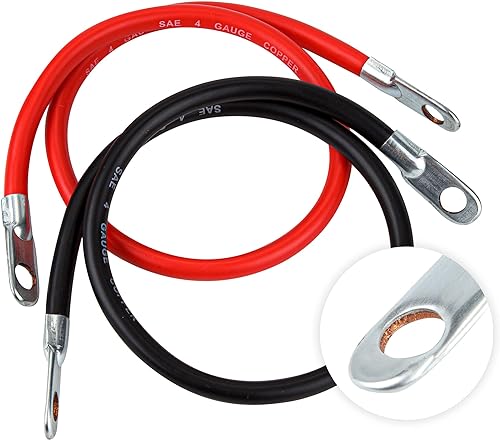 Best for compact 4 AWG pairs
CARTMAN 4 AWG 18-Inch Battery Inverter Cables
9.6/10 our score
See it on Amazon -
3

- 4
 Check it
TOPDC 4 AWG Battery Cable Pair
Best for 24 inch 4 AWG runs - 5
 Check it
ECO-WORTHY 2AWG Battery Cable with 5/16'' Lug
Best for 5/16 inch studs - 6
 Check it
6 AWG Battery Cable 3FT 6 Gauge
Best for 3 ft 6 AWG runs - 7
 Check it
Ruikarhop 40FT 1/0 Battery Cable CCA
Best for cut to length 1/0 runs - 8
 Check it
InstallGear AWG 5 Gauge 10ft Battery Power
Best for 10 ft 5 AWG runs - 9
 Check it
Tuijodaix 1/0 Gauge Battery Cable Kit 40ft
Best for 1/0 kits with lugs
Best inverter battery cables for different setups
The top pick suits a short, direct hookup. The other picks cover longer runs, battery banks and custom cut lengths.
Your stud size and run length decide which group fits you.
A ABIGAIL 2 AWG Battery Cable 2AWG: Best for short inverter hookups
- 2 AWG pure copper
- 1 ft pair, red and black
- 3/8 in lugs both ends
- PVC insulation, heat shrink ends
A short pure copper 2 AWG pair with 3/8 in lugs for direct inverter to battery links.
Pros
- Pure copper conductor
- 3/8 in lugs both ends
- Sealed heat shrink ends
Cons
- Only 1 ft long
- Single pair only
A ABIGAIL suits an inverter placed close to the battery, where 1 ft is enough. It gives you a 2 AWG pure copper pair in red and black with 3/8 in lugs at each end.
Pure copper keeps resistance low for its size. Tinned copper lugs help resist corrosion and keep conductivity steady over time.
Heat shrink at the ends helps seal the joint from moisture.
Flexible PVC insulation resists abrasion and moisture in automotive, solar, marine and RV use. That jacket matters in a battery box or engine bay where cables rub and get warm.
The trade off is length and quantity. You get one pair at 12 inches, so this will not span a long install or wire several batteries.
For that, a multi piece set or bulk kit fits better.
Buy it for a direct 1 ft inverter to battery link with 3/8 in studs. Skip it for long runs or for banks that need several jumpers.
CARTMAN 4 AWG 18-Inch Battery Inverter Cables: Best for compact 4 AWG pairs
- 4 AWG, 18 inch pair
- 3/8 in lugs
- Zinc plated copper lugs
- Heat resistant to 105C
An 18 inch 4 AWG positive and negative set for close battery and inverter placement.
Pros
- 18 inch length suits tight installs
- Flexible multi strand wire
- Corrosion resistant lugs
Cons
- 4 AWG carries less than 2 AWG
- Fixed 18 inch length
CARTMAN suits a compact install where 18 inches gives a little more routing room than 12 inches. It is a 4 AWG positive and negative set with 3/8 in lugs.
Zinc plated copper lugs help resist corrosion and oxidation. The maker says a better stamping process improves current flow and reduces resistance.
Multi strand wire stays flexible in tight spaces.
Heat resistance to 105C is listed for the wire. Flexible PVC insulation helps in boat, RV and solar settings where cable moves and sees temperature changes.
The trade off is gauge. At 4 AWG, it carries less than a 2 AWG pair.
Confirm your inverter manual allows 4 AWG for your size and run length before you use it for a larger unit.
Buy it for a close 18 inch link with 3/8 in studs and a modest inverter. Skip it if your manual calls for 2 AWG or thicker.
Linkstyle 6PCS 2 AWG Battery Cables: Best for battery bank wiring
- 6PCS 2 AWG, 6 inch cables
- 99.9% pure copper
- 3/8 in tin plated lugs
- 12V to 48V systems
Six short 2 AWG cables for parallel battery bank and inverter connections.
Pros
- Six cables in one set
- Pure copper wire
- Suits 12V to 48V banks
Cons
- 6 inch length is very short
- Not for long runs
Linkstyle suits battery banks and parallel wiring more than a single long run. It includes six 2 AWG cables at 6 inches each, three red and three black, with 3/8 in tin plated copper lugs.
99.9% pure copper wire helps keep resistance low. Nickel plated copper terminals and PVC insulation help with corrosion, moisture and wear in harsh settings.
The short 6 inch length is the key feature. Short jumpers reduce voltage loss between batteries in a bank.
The set is aimed at 12V to 48V systems for cars, trucks, RVs, golf carts, marine and solar use. For a 48V solar charging setup, compare 48V solar inverter chargers.
The trade off is that 6 inches is very short. It will not reach from a battery to a distant inverter.
Use it for battery to battery links, and pair it with a longer pair for the inverter itself.
Buy it for multi battery banks and short parallel links. Skip it as your only cable if the inverter sits far from the batteries.
TOPDC 4 AWG Battery Cable Pair: Best for 24 inch 4 AWG runs
- 4 AWG pure copper
- 24 inch pair
- 3/8 in ring lugs
- PVC jacket, heat shrink ends
A 24 inch pure copper 4 AWG pair for slightly longer inverter to battery runs.
Pros
- 24 inch length
- Pure copper conductor
- Heat shrink sealed ends
Cons
- 4 AWG limit for larger inverters
- Pair only, no spares
TOPDC suits a run that needs more than 12 or 18 inches but stays pure copper. It is a 4 AWG pair at 24 inches with 3/8 in ring lugs.
Pure copper helps limit power loss compared with clad conductors at the same gauge. Flexible PVC insulation resists abrasion, water and heat, and heat shrink seals the cable ends.
The 24 inch length gives routing slack without the excess of a 3 ft or 10 ft cable. It is listed for cars, trucks, RVs, marine, ATVs, motorcycles and solar systems.
The trade off is gauge and quantity. Like the CARTMAN set, 4 AWG is lighter duty than 2 AWG.
You also get only one pair, with no spare jumpers for a bank.
Buy it for a 24 inch pure copper link with 3/8 in studs. Skip it if your inverter manual calls for 2 AWG or if you need several cables.
ECO-WORTHY 2AWG Battery Cable with 5/16'' Lug: Best for 5/16 inch studs
- 2 AWG, 1 ft pair
- 5/16 in lugs
- Tinned copper wire
- Maximum current 150 A
A 1 ft 2 AWG pair with smaller 5/16 in lugs for compact terminals.
Pros
- Fits 5/16 in studs
- Tinned copper wire
- Flexible 1 ft length
Cons
- 5/16 in lugs limit fit
- Maximum current 150 A
ECO-WORTHY suits smaller terminals that take 5/16 in lugs. It is a 2 AWG pair at 1 ft in red and black, with nickel plated 5/16 in lugs.
Tinned copper wire helps with power transmission and corrosion resistance. The maker lists a maximum operating current of 150 A and a wide temperature range for the cable.
Flexible construction helps in tight battery compartments. It is listed for boat, vehicle, golf cart and RV use as a battery, ground or inverter cable.
The trade off is lug size. A 5/16 in lug will not fit a 3/8 in stud, and a 3/8 in lug will not fit a 5/16 in stud without a mismatch.
Measure your studs first. The set also gives only one pair at 1 ft.
Buy it for a 1 ft 2 AWG link on 5/16 in studs. Skip it if your terminals use 3/8 in studs.
6 AWG Battery Cable 3FT 6 Gauge: Best for 3 ft 6 AWG runs
- 6 AWG, 3 ft pair
- 5/16 in lugs both ends
- Pure copper, tinned lugs
- Maximum current 75 A
A 3 ft 6 AWG pair for longer runs with smaller inverters and auxiliary loads.
Pros
- 3 ft length
- Pure copper wire
- Heat shrink sealed ends
Cons
- 6 AWG for light loads only
- Maximum current 75 A
A ABIGAIL 6 AWG suits longer runs for smaller loads. It is a 3 ft pair at 6 AWG with 5/16 in lugs at each end, in red and black.
Pure copper wire and tinned copper lugs help resist corrosion and keep conductivity steady. Heat shrink at the ends adds insulation at the joint.
Flexible PVC insulation resists abrasion and moisture.
The 3 ft length helps when the inverter cannot sit right next to the battery. That extra length adds resistance, which is why this set lists a maximum current of 75 A and 12 volts.
The trade off is clear. At 6 AWG, this is for light duty auxiliary loads, not a large inverter.
A larger inverter will need 2 AWG, 4 AWG or 1/0 gauge depending on its manual.
Buy it for a 3 ft run with 5/16 in studs and a small load. Skip it for high wattage inverters.
Ruikarhop 40FT 1/0 Battery Cable CCA: Best for cut to length 1/0 runs
- 1/0 gauge CCA, 40 ft total
- 20 ft red plus 20 ft black
- Lug terminals and heat shrink
- Rated 250 A
A 40 ft 1/0 CCA bulk kit for custom longer inverter and battery runs.
Pros
- 40 ft for custom lengths
- Includes lugs and heat shrink
- Rated 250 A
Cons
- CCA, not pure copper
- Requires crimping tools
Ruikarhop suits custom installs where pre made lengths do not fit. It gives you 40 ft of 1/0 gauge CCA cable, 20 ft red and 20 ft black, plus lug terminals and heat shrink tubes.
The maker rates it at 250 A. Flexible PVC jacketing helps with routing through tight spaces, and red and black colors keep polarity clear.
Alongside the cable, you get matching lugs so you can finish each end.
The trade off is conductor material and work. CCA is copper clad aluminum, not pure copper.
It is lighter and cheaper, but pure copper has lower resistance at the same gauge. You also need a crimper and time to strip, crimp and seal each end.
Buy it for long custom 1/0 runs where you can crimp your own ends. Skip it if you want pre crimped cables or prefer pure copper.
InstallGear AWG 5 Gauge 10ft Battery Power: Best for 10 ft 5 AWG runs
- 5 gauge, 10 ft set
- 99.9% deoxygenated copper
- 3/8 in and 5/16 in ring terminals
- Maximum current 100 A
A 10 ft 5 gauge red and black set with two lug sizes for flexible routing.
Pros
- 10 ft length
- Two lug sizes included
- 99.9% copper wire
Cons
- 5 AWG limit for large inverters
- Long length needs tidy routing
InstallGear suits a 10 ft run where routing needs length. It is a 5 gauge red and black set with 99.9% deoxygenated copper wire for low resistance.
It includes two 3/8 in and two 5/16 in ring terminals, so you can match different stud sizes at each end. Heat shrink at each cable end helps protect against corrosion and wear.
Tough PVC jacketing resists abrasion and environmental damage.
The maker lists a maximum current of 100 A. That puts this set in the mid range for inverter and battery wiring in solar, auto, RV, marine and lawn mower use.
The trade off is gauge and length. At 5 gauge, it is less suited to large inverters than 2 AWG or 1/0 gauge.
Ten feet also needs careful routing to avoid loops, sharp bends and contact with hot or moving parts.
Buy it for a long 10 ft run with mixed lug sizes. Skip it for large inverters or short direct mounts.
Tuijodaix 1/0 Gauge Battery Cable Kit 40ft: Best for 1/0 kits with lugs
- 1/0 gauge CCA, 40 ft total
- 20 ft red plus 20 ft black
- 10x 3/8 in and 10x 5/16 in lugs
- 20x heat shrink tubes, rated 250 A
A 40 ft 1/0 CCA kit with pure copper lugs in two sizes and adhesive heat shrink.
Pros
- Two lug sizes included
- Adhesive lined heat shrink
- Rated 250 A
Cons
- CCA conductor
- Requires crimping and cutting
Tuijodaix suits custom 1/0 gauge installs with a complete lug set. It includes 40 ft of 1/0 CCA wire, 20 ft red and 20 ft black, rated at 250 A.
The kit adds 10x 3/8 in and 10x 5/16 in pure copper lugs plus 20x adhesive lined heat shrink tubes. That mix covers most stud sizes without a separate lug order.
The PVC jacket is soft and flexible for tight engine bays and trunk spaces.
CCA keeps this kit light and affordable compared with pure copper 1/0 wire. The maker notes 1,004 tinned strands for conductivity and heat dissipation in 12V systems.
The trade off is the same as other CCA kits. Pure copper would have lower resistance at this gauge.
You also need to cut, strip and crimp each cable to length, and check each crimp for a tight fit.
Buy it for a 40 ft 1/0 custom run with two lug sizes included. Skip it if you need pre crimped cables or pure copper only.
How to compare best inverter battery cables
We compared gauge, length, conductor material, lug size and what each set includes. Short pre crimped pairs scored higher for most buyers because they are simpler and safer to install.
Longer and thicker is not always better. A 1/0 gauge cable on a small inverter wastes money and is hard to route.
A thin cable on a large inverter risks heat and voltage drop.
CCA kits scored lower than pure copper sets at the same gauge. They still have a place for long custom runs where cost and weight matter.
Pure copper sets led this list for direct inverter links.
Lug size was a filter, not a preference. A 3/8 in stud needs a 3/8 in lug, and a 5/16 in stud needs a 5/16 in lug.
Measure before you order.
| Product | Best for | Gauge | Length | Lug size | Our score |
|---|---|---|---|---|---|
| A ABIGAIL 2 AWG Battery Cable 2AWG | short inverter hookups | 2 AWG | 1 ft | 3/8 in | 9.7 |
| CARTMAN 4 AWG 18-Inch Battery Inverter Cables | compact 4 AWG pairs | 4 AWG | 18 in | 3/8 in | 9.6 |
| Linkstyle 6PCS 2 AWG Battery Cables | battery bank wiring | 2 AWG | 6 in | 3/8 in | 9.5 |
| TOPDC 4 AWG Battery Cable Pair | 24 inch 4 AWG runs | 4 AWG | 24 in | 3/8 in | 9.2 |
| ECO-WORTHY 2AWG Battery Cable with 5/16'' Lug | 5/16 inch studs | 2 AWG | 1 ft | 5/16 in | 9.0 |
| 6 AWG Battery Cable 3FT 6 Gauge | 3 ft 6 AWG runs | 6 AWG | 3 ft | 5/16 in | 8.8 |
| Ruikarhop 40FT 1/0 Battery Cable CCA | cut to length 1/0 runs | 1/0 AWG | 40 ft | 8.5 | |
| InstallGear AWG 5 Gauge 10ft Battery Power | 10 ft 5 AWG runs | 5 AWG | 10 ft | 8.3 | |
| Tuijodaix 1/0 Gauge Battery Cable Kit 40ft | 1/0 kits with lugs | 1/0 AWG | 40 ft | 8.1 |
How we compared these cable sets
We checked the specs for each set, including gauge, length, material, lug size, current rating where stated, and included items. We also looked at how each set fits common inverter tasks, from a single direct link to battery bank wiring.
We did not test these cables hands on. Scores reflect stated specs, included items and fit for the search behind this guide.
That is why a simple pure copper pair can outscore a longer bulk kit.
Buyers often mention lug fit and flexibility in reviews for this type of cable. We weighed those patterns along with corrosion protection, insulation and heat shrink at the ends.
How do I choose the right gauge for my inverter?
Your inverter manual sets the gauge first. Follow that call before you compare brands or lengths.
A gauge that is too thin can run hot and cause voltage drop that trips the inverter.
2 AWG and 1/0 gauge for larger inverters
2 AWG is a common choice for short runs with mid size inverters. 1/0 gauge suits larger inverters and longer runs where low resistance matters.
Check the manual for the exact call.
4 AWG, 5 AWG and 6 AWG for smaller loads
4 AWG, 5 AWG and 6 AWG suit smaller inverters and auxiliary loads. The 6 AWG set here lists 75 A maximum, and the 5 gauge set lists 100 A maximum.
Those limits tell you the intended load range.
Longer runs need thicker cable
Distance adds resistance. If the inverter must sit farther from the battery, you often need a thicker gauge than a short run would need.
Measure the path first, then check the manual again.
What lug size do my battery and inverter terminals need?
Measure the stud on the battery post and the stud on the inverter. The lug hole must match that stud size.
This one check prevents most returns.
3/8 inch lugs for larger studs
Most sets here use 3/8 in lugs. That size fits many batteries, inverters and battery switches.
The A ABIGAIL, CARTMAN, Linkstyle and TOPDC sets all use 3/8 in lugs.
5/16 inch lugs for smaller studs
The ECO-WORTHY and 6 AWG A ABIGAIL sets use 5/16 in lugs. The InstallGear set includes both 3/8 in and 5/16 in terminals.
Mixed sizes help when the battery and inverter studs differ.
Ring lugs, clamps and fused cables
Ring lugs bolt down and resist vibration better than clamps. If you want protection against shorts, compare sets with a fuse holder in our guide to best inverter cables with fuse.
If you need clamp ends for quick links, see best inverter cables with clamps.
How long should inverter to battery cables be?
Shorter is better for voltage and heat. Aim for the direct path with a little slack for routing and service.
Avoid extra loops that add length and places for abrasion.
Short pairs for direct mounts
One foot and 18 inch pairs suit an inverter mounted close to the battery. The top pick at 1 ft and the CARTMAN set at 18 inches fit this layout.
Keep the bend gentle.
Multi piece sets for battery banks
Six inch jumpers suit battery to battery links in a bank. The Linkstyle 6PCS set is built for that job.
You will still need a longer pair from the bank to the inverter, so check our best power inverter extension cables guide for longer runs.
Bulk kits for custom lengths
Forty foot bulk kits let you cut each cable to length. That helps with odd layouts in RVs, boats and sheds.
It also means you must crimp and seal every end yourself.
Pure copper or CCA: which is better for inverter cables?
Pure copper has lower resistance than CCA at the same gauge. That matters most on long runs and high current links.
CCA is lighter and often costs less per foot.
When pure copper is worth it
Choose pure copper for your main inverter to battery link. The top picks here use pure copper wire, including the A ABIGAIL, Linkstyle and TOPDC sets.
Tinned or zinc plated lugs help with corrosion.
When CCA can work
CCA bulk kits can work for long custom runs on a budget. The Ruikarhop and Tuijodaix kits are rated at 250 A.
Use the gauge and rating in your inverter manual, and make solid crimps.
What else affects resistance
Lug quality, crimp quality and corrosion at the joint affect the whole link. Heat shrink helps seal the joint.
A clean, tight bolted ring lug will beat a loose or corroded connection every time.
How do I install and care for battery to inverter cables?
Disconnect power first and keep tools away from battery terminals during the work. Place the inverter where air can flow around it.
Keep cables away from sharp edges, hot surfaces and moving parts.
A safe install order
Connect the negative cable first if your manual says to do so, then the positive cable. Tighten ring lugs on the studs and add a washer if the terminal needs one.
Check that nothing can short across the terminals.
A best power inverter installation kit can add a fuse holder, cable ties and other parts that make the install cleaner. Fused cables also help protect the wire in a short.
Checks after install
Run a light load first and check for heat at the lugs. A warm lug can mean a loose or undersized connection.
Shut down and fix it before you run a large load.
Inspect cables each season for cracked insulation, corrosion and loose nuts. Tighten hardware with the power off.
Replace a cable if the insulation is cut or the lug is badly corroded.
Routing tips for RVs and boats
Route cables with support so they do not hang and pull on the lugs. Add protection where cables pass through panels.
Keep red and black polarity clear at every joint.
If you are powering a vehicle load instead, our guide to the Best Power Inverter For Car Battery Backup covers that different setup. For camping power, How to Set Up a Portable Power Station for Camping? covers a separate station based system.
Verdict: which inverter battery cable set should you buy?
Pick the A ABIGAIL 2 AWG pair if your inverter sits close and your studs are 3/8 in. It is pure copper, pre crimped and simple.
Pick the Linkstyle 6PCS set if you need short jumpers for a battery bank. Pick a 4 AWG pair if your manual allows it and you need 18 or 24 inches.
Pick a 1/0 gauge bulk kit only for long custom runs where you can crimp your own ends. Check gauge, lug size and length against your manual before you order, and your best inverter battery cables will be the ones that fit your layout.
Our top 3 picks at a glance
-
1
Best for short inverter hookups
A ABIGAIL 2 AWG Battery Cable 2AWG
9.7/10 our score
See it on Amazon -
2
Best for compact 4 AWG pairs
CARTMAN 4 AWG 18-Inch Battery Inverter Cables
9.6/10 our score
See it on Amazon -
3
Frequently asked questions
What gauge cable do I need for an inverter?
Match gauge to your inverter manual and run length. Short runs often use 2 AWG or 4 AWG, while longer runs or larger inverters use 1/0 gauge.
Check the manual first, because cable choice affects voltage drop and heat.
Are 3/8 inch lugs better than 5/16 inch lugs?
Neither is better by itself. The lug must match the stud on your battery and inverter.
Measure both studs before you order.
A lug that is too large or too small will not make a safe, tight connection.
Is pure copper better than CCA for battery cables?
Pure copper has lower resistance than copper clad aluminum (CCA) for the same gauge. CCA is lighter and costs less, but pure copper is often preferred for critical inverter links.
Compare gauge, length and lug quality as well.
How long should inverter battery cables be?
As short as practical. Short cables reduce voltage drop and heat.
Measure the direct path between battery and inverter, then add a little slack for routing.
Avoid long loops and sharp bends.
Can I cut bulk battery cable to length?
Yes, if you have the right crimping tools and lugs. Bulk kits save money on long runs.
You must strip, crimp and seal each end well.
Pre crimped pairs are simpler if you lack tools.


