9 Best Portable Power Station for Car Fridges (November 2026)
The best portable power stations for car fridges include the Jackery Explorer 300 Portable Power Station for a compact car-socket setup, the Jackery Explorer 1000 v2 Portable Power Station for longer trips with higher loads, and the Anker SOLIX C300 DC Portable Power Station for DC-only gear.
On this page (7 sections)
- Best portable power stations for car fridges by use
- How do you match a power station to a car fridge?
- What runtime can you expect from a portable station?
- Should you use DC or AC for a car fridge?
- Can you recharge the station while driving?
- How we chose these power stations
- Which portable power station should you choose?
The best portable power station for most car fridges is the BLUETTI Elite 30 V2, because its maker specifies a 5W DC-only standby draw and support for 12V or 24V car charging. For a fridge that needs regulated DC power, the EnginStar states regulated 12V/24V outputs; check your fridge's voltage, connector and draw first.
A station's advertised wattage alone won't tell you how long a fridge will run. Compare its usable battery capacity with the fridge's energy use, and choose an output that matches the fridge's input.
For broader travel planning, see our Overlanding Power Guide: Off-Grid Energy Tips. If your main concern is a longer drive, compare our picks for portable power stations for road trips and overlanding power stations.
Our picks at a glance
-
1
 Best for a compact car-socket setup
Jackery Explorer 300 Portable Power Station
9.7/10 our score
See it on Amazon -
2
 Best for longer trips with higher loads
Jackery Explorer 1000 v2 Portable Power Station
9.6/10 our score
See it on Amazon -
3

- 4
 Check it
BLUETTI Elite 30 V2 Portable Power Station
Best for regulated DC fridge power - 5
 Check it
Anker SOLIX C1000 Gen 2 Portable Power
Best for high capacity in a portable unit - 6
 Check it
BLUETTI Portable Power Station AC180
Best for a fridge plus other AC loads - 7
 Check it
EnginStar Portable Power Station 300W 296Wh Solar
Best for a stated 12V or 24V DC output - 8
 Check it
BLUETTI FridgePower Portable Power Station
Best for a large fridge backup setup - 9
 Check it
DaranEner 300W Portable Power Station with 30W
Best for a light starter kit
Best portable power stations for car fridges by use
The best fit depends on whether your fridge accepts a car socket, needs a regulated DC output or uses an AC adapter. These picks are ordered by score, with capacity and output type called out so you can narrow the choices.
Jackery Explorer 300 Portable Power Station: Best for a compact car-socket setup
- 292Wh capacity
- 120W car port
- 300W rated output
- 7.5 lb weight
A small station with a 120W car port and 292Wh capacity for a compatible fridge. Confirm the fridge's connector and power draw before relying on it.
Pros
- 120W car port
- Compact 7.5 lb build
- 292Wh capacity
Cons
- No regulated DC output is specified
- 300W total rated output
The Explorer 300 is the lightest straightforward pick for a fridge that can use its 120W car port. Its 292Wh capacity gives you a useful baseline for short trips, though the actual runtime depends on the fridge's draw and cycling pattern.
Jackery lists a 300W rated output across the station, but that does not mean its car port can deliver 300W. The car port itself is rated to 120W, so check whether your fridge stays within that limit, including startup needs.
At 7.5 lb, it is easier to move between a vehicle and a campsite than the larger-capacity models here. The Explorer 300 also has two AC outlets, but using AC for a DC fridge requires its adapter and conversion, which can use more energy.
Choose this if your fridge connects directly to a compatible car socket and your trip does not call for a large reserve. For a more detailed vehicle comparison, read our portable power station guide for road trips.
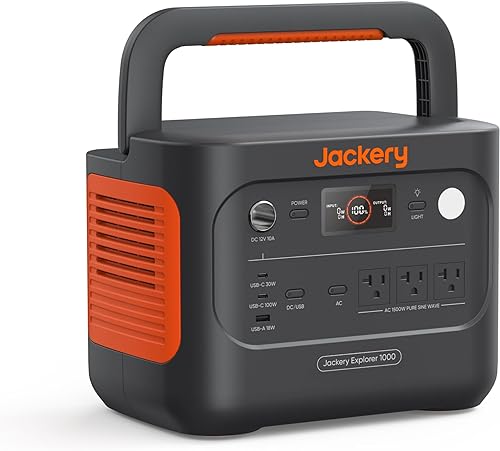
Jackery Explorer 1000 v2 Portable Power Station: Best for longer trips with higher loads
- 1,070Wh capacity
- 1,500W AC output
- One DC car port
- 23.8 lb weight
The larger battery capacity suits longer use between charges, and the station includes a DC car port. Confirm that its output matches your fridge's input requirements.
Pros
- 1,070Wh battery capacity
- One DC car port
- Three pure sine wave AC ports
Cons
- Heavier than the compact picks
- Car port output rating is not specified
The Explorer 1000 v2 is the high-capacity Jackery choice, with 1,070Wh and one DC car port. It suits a longer outing or a fridge with higher energy needs, provided the car port's output fits the fridge.
Its three pure sine wave AC ports and 1,500W AC rating give you room to power other compatible loads. The station weighs 23.8 lb, so consider where it will sit and how you'll secure it while driving.
The DC car port's output rating is not specified here, so don't assume it can handle every fridge that fits a standard socket. Check the station manual for port limits and the fridge manual for its rated and startup draw.
Choose it when stored energy matters more than minimum weight. If you plan to recharge from the vehicle while underway, review how to charge a portable power station from a car and confirm your vehicle socket's limits.
Anker SOLIX C300 DC Portable Power Station: Best for DC-only gear
- 288Wh capacity
- 120W car socket
- 300W output
- Two 140W USB-C ports
This DC-focused station includes a 120W car socket and 288Wh capacity. Check your fridge's connector and rated draw, since an AC outlet isn't specified.
Pros
- 120W car socket
- 288Wh capacity
- Compact DC-oriented design
Cons
- No AC output specified
- First activation requires an 18W or higher USB-C charger
The Anker SOLIX C300 DC is a compact choice for a DC-only setup, with 288Wh and a 120W car socket. It has no AC outlets specified, so it won't suit a fridge that relies on a household-style AC plug.
Its two 140W USB-C ports and other USB outputs can support small electronics alongside the fridge. Keep the fridge's needs first in your capacity estimate, since sharing power reduces the energy left for refrigeration.
Anker says the unit supports car charging and solar charging, and it can recharge to 80% in an hour using its dual USB-C PD ports. For first activation, Anker says to use an 18W or higher USB-C wall charger through USB-C2 or USB-C3.
Choose it if your fridge accepts a compatible car socket and you want a station centered on DC and USB ports. Check the fridge's connector and maximum draw against the 120W socket rating before use.
BLUETTI Elite 30 V2 Portable Power Station: Best for regulated DC fridge power
- 288Wh capacity
- 600W continuous AC output
- 5W DC-only self-consumption
- 12V/24V car charging
Its maker gives a DC-only self-consumption figure and says it supports car charging through 12V or 24V sockets. Check the fridge's own voltage and connector before buying.
Pros
- DC-only self-consumption is specified
- Car charging supports 12V and 24V sockets
- 288Wh capacity
Cons
- The fridge output port's regulation is not specified
- 9.4 lb weight
The Elite 30 V2 is a strong match when DC efficiency matters, because BLUETTI gives a 5W DC-only self-consumption figure. It has 288Wh capacity and supports car charging through 12V or 24V sockets.
That car charging feature describes how to recharge the station from a vehicle. It does not by itself confirm the output voltage or regulation of a fridge port, so check the manual for the exact DC output details before choosing it for direct fridge use.
The station also provides 600W continuous AC output and 1,500W surge power in Power Lifting Mode. For a fridge with an AC adapter, compare its running and startup draw with the station's AC limits.
At 9.4 lb, it remains a manageable size for a vehicle setup. BLUETTI also gives a runtime formula that accounts for battery capacity, conversion efficiency and self-consumption, a useful reminder that rated capacity is not all available to the load.
Anker SOLIX C1000 Gen 2 Portable Power: Best for high capacity in a portable unit
- 1,024Wh capacity
- 2,000W output
- 10 ports
- 11.3 kg weight
A 1,024Wh battery offers more stored energy than the compact choices, with 2,000W output and 10 ports. Check which port can safely power your fridge.
Pros
- 1,024Wh capacity
- 2,000W output
- 10 ports
Cons
- Weight is 11.3 kg
- DC car port details are not specified
The C1000 Gen 2 offers 1,024Wh capacity and 2,000W output for a larger fridge setup with additional devices. Its 10 ports provide more connection options, but the exact DC car output details are not specified here.
An 11.3 kg weight makes it a more substantial unit to move and secure than the compact models. The capacity can help cover longer periods, but runtime still depends on fridge consumption, temperature, ventilation and other connected loads.
Anker says the station can recharge fully in 49 minutes with UltraFast charging enabled in its app. The charging speed depends on battery cell temperature, and the feature must be enabled in the app.
Choose it if you need more stored energy and AC output for more than the fridge alone. Confirm the right port and output limits for your fridge before connecting it.
BLUETTI Portable Power Station AC180: Best for a fridge plus other AC loads
- 1,152Wh capacity
- 1,800W output
- 500W solar input
- Car charging cable included
The AC180 pairs 1,152Wh capacity with high AC output for a fridge that uses an AC adapter. Its car charging cable is for recharging the station, so confirm the fridge's power connection separately.
Pros
- 1,152Wh capacity
- 1,800W output
- Car charging cable included
Cons
- 37.4 lb weight
- No regulated DC fridge output is specified
The AC180 suits a fridge that runs from AC and needs room for other appliances. It has 1,152Wh capacity, 1,800W output and a car charging cable for recharging the station.
That included cable is an input for charging from a vehicle, not evidence of a regulated DC output for powering a fridge. If your fridge has a 12V plug, verify the station's DC output and limits or use a suitable AC adapter if the fridge maker allows it.
The AC180 weighs 37.4 lb, so it is better for a vehicle where you can leave it secured than for frequent carrying. BLUETTI gives a runtime estimate formula of capacity multiplied by 0.85, divided by device power.
Choose it for higher AC loads and a large battery reserve when its weight and connection type suit your setup. The overlanding power station guide covers other vehicle and off-grid considerations.
EnginStar Portable Power Station 300W 296Wh Solar: Best for a stated 12V or 24V DC output
- 296Wh capacity
- Two regulated DC outputs
- 12V/24V DC output
- 65W maximum recharge input
Two regulated 12V/24V DC outputs are a useful match for compatible fridge inputs. Its 296Wh capacity is modest, so plan around the fridge's actual energy use.
Pros
- Regulated 12V/24V DC outputs
- 296Wh capacity
- Car charging cable included
Cons
- 65W maximum charging speed
- Recharge timing depends on the fridge's draw
The EnginStar is the clearest match here for a fridge that requires regulated 12V or 24V DC, with two regulated DC outputs listed. Its 296Wh capacity is close to the other compact stations, so use the fridge's actual consumption to estimate trip length.
It also has two 110V AC outlets rated for a total of 300W. The car input can recharge the station at up to 65W, according to EnginStar, which is a separate limit from the power available to the fridge.
The unit weighs about 6.5 lb in its product details and measures about 9 x 5.5 x 7.5 inches. EnginStar's runtime estimate uses 85% of its 296Wh capacity before dividing by the device's operating power, so treat that as a rough calculation.
Choose this when your fridge's voltage and connector match its regulated DC outputs. Confirm the port's current limit too, since the fridge's startup draw can differ from its average use.
BLUETTI FridgePower Portable Power Station: Best for a large fridge backup setup
- 2,016Wh capacity
- 1,800W output
- 4W standby consumption
- Expansion up to 8,064Wh
Its 2,016Wh capacity and low stated standby draw suit a larger backup setup. The design is aimed at refrigerator backup, so confirm its physical fit and output connection for vehicle use.
Pros
- 2,016Wh capacity
- 4W standby consumption
- Expansion support up to 8,064Wh
Cons
- 41.9 lb weight
- Vehicle mounting and DC fridge output are not specified
The FridgePower has the largest stated capacity here at 2,016Wh, and BLUETTI says its standby use is 4W. It is designed for refrigerator backup, but the details here don't specify a vehicle-ready DC output or mounting method.
At 41.9 lb and a slim 75mm depth, it is a different kind of choice from the compact stations. Its size and installation hardware may suit a fixed backup arrangement better than a unit you regularly take in and out of a car.
BLUETTI says it supports expansion up to 8,064Wh with BlueCell 200 expansion batteries. That capacity is aimed at extending refrigerator backup, so confirm the output type, placement and ventilation before considering it for vehicle use.
Choose it for a high-capacity fridge backup setup when its connection and mounting needs fit your vehicle. For heat and storage precautions, read whether a portable power station can stay in a hot car.
DaranEner 300W Portable Power Station with 30W: Best for a light starter kit
- 192Wh capacity
- 60W car socket
- 30W solar panel included
- 5.8 lb weight
The light 5.8 lb station includes a 60W car socket and a 30W solar panel. Its 192Wh capacity is the smallest here, so it best fits shorter or lower-draw needs.
Pros
- 5.8 lb weight
- 30W solar panel included
- 60W car socket
Cons
- 192Wh capacity
- Confirm the fridge's draw stays within the socket rating
The DaranEner is the lightest pick here at 5.8 lb, but its 192Wh capacity is also the smallest. It includes a 60W car socket and a 30W solar panel, making it more suitable for modest loads and shorter outings.
The station's car socket limit is worth checking carefully against your fridge's draw. A fridge that needs more than 60W at the socket is not a match, and startup power can be higher than average running use.
DaranEner also specifies two 300W AC outlets, 60W USB-C and two DC5521 ports. Those other outputs may help with small accessories, but they don't increase the 60W limit of the car socket.
Choose this for a small compatible fridge with low draw, or as a light station for short trips. If your fridge's energy use is unknown, measure it or check its manual before planning around 192Wh.
How do you match a power station to a car fridge?
Match the station's output voltage, connector and current limit to the fridge, then size capacity from the fridge's energy use over the time between recharges. A larger wattage number alone does not guarantee compatibility or longer runtime.
Start with the fridge label or manual. Note whether it accepts 12V DC, 24V DC or AC, then check its running draw and any startup requirement.
For a rough capacity estimate, multiply average watts by hours. A fridge averaging 35W over 12 hours uses about 420Wh before conversion losses, other devices and reserve capacity.
A station with a regulated DC output can avoid AC conversion when the fridge accepts that output directly. Verify the exact voltage and port limit rather than assuming every car socket supplies regulated power.
What runtime can you expect from a portable station?
Runtime depends on usable battery energy, conversion losses, the fridge's cycling and the surrounding temperature. A simple estimate is battery watt-hours multiplied by an efficiency allowance, divided by average fridge watts.
For example, a 288Wh station at an assumed 85% usable energy provides about 245Wh for the load. At a 35W average draw, that is roughly 7 hours before allowing for extra losses or other devices.
This is only a planning estimate. A compressor fridge may cycle on and off, and warm air, frequent openings and poor ventilation can change its energy use.
Measure consumption over a typical day if you can. That gives a better basis for deciding whether a compact station is enough or whether a 1,000Wh-class model makes sense.
Should you use DC or AC for a car fridge?
Use the fridge's supported DC input when the station provides a matching, suitable output. If the fridge requires AC, use an AC outlet within its running and startup limits.
DC can avoid an inverter conversion step, which may preserve more battery energy. The station's own DC standby draw still matters, so compare models that publish it when estimating longer runtimes.
AC adds flexibility for fridges with household plugs, but inverter use consumes energy. A station's large AC wattage rating does not tell you how long it will run the fridge.
Can you recharge the station while driving?
Yes, if the station supports vehicle charging and the car's socket can supply the required input safely. Recharging speed is often much lower than the station's AC or solar input, so it may not replace the energy a fridge uses during the same drive.
Check the vehicle socket's fuse limit and the station's car charging input rating. Keep the cable and station placed so they don't interfere with driving or become loose.
Some owners may want to charge from a larger vehicle electrical system. Read our guide to charging a portable power station with a car alternator before planning that setup.
How we chose these power stations
We compared capacity, output types, car charging details, portability and any stated self-consumption figures against the needs of a vehicle fridge. A direct match to a fridge's voltage and connector matters more than a high AC rating on its own.
Our score weighs specs and features against what you're shopping for. The order also reflects whether the available details make it possible to assess a car fridge connection and runtime.
Which portable power station should you choose?
Choose the EnginStar if your fridge needs regulated 12V or 24V output and its connector and current needs match. Pick the Explorer 300 or Anker SOLIX C300 DC for a compact car-socket setup, and favor a 1,000Wh-class station when capacity for longer trips matters most.
For travel planning across more than the fridge, use our Overlanding Power Guide: Off-Grid Energy Tips to check charging and vehicle power needs together. Check the fridge and station manuals before connecting them.
Our top 3 picks at a glance
-
1
Best for a compact car-socket setup
Jackery Explorer 300 Portable Power Station
9.7/10 our score
See it on Amazon -
2
Best for longer trips with higher loads
Jackery Explorer 1000 v2 Portable Power Station
9.6/10 our score
See it on Amazon -
3
Frequently asked questions
How many watt-hours do I need for a car fridge?
Choose capacity from the fridge's energy use over your planned time away from charging. If the fridge uses 40W on average for 10 hours, that is 400Wh before conversion losses and other loads.
Use the fridge maker's energy figures when available, then leave extra capacity for warm weather, frequent lid openings and power conversion.
Can I run a 12V car fridge from a portable power station?
Yes, if the station has an output that matches the fridge's voltage, connector and current needs. A regulated 12V DC output can avoid converting battery power to AC and back again.
Check both the fridge's manual and the station's port limits before connecting them.
Is a car port the same as a regulated DC output?
Not always. A car socket describes the connector, while regulation describes how steady the voltage stays as the battery drains or the load changes.
Look for the output voltage and current range in the station's specifications, and confirm that the fridge accepts those values.
Can I recharge a power station while driving?
Many stations can recharge from a vehicle socket, but charging speed and compatibility vary by model and vehicle. Check the station's input limit and the car socket's fuse rating before leaving it connected.
Our guide on charging a portable power station from a car explains the main options.
Can heat affect a power station left in a car?
Yes. A parked car can become much hotter than the outside air, and battery makers set temperature limits for charging, use and storage.
Check the station manual and read our guide to leaving a portable power station in a hot car before storing one in a vehicle.