9 Best Power Inverter Deals (November 2026)
The best best power inverter on sale include the FOVAL 150W Car Power Inverter 12V DC for compact road trips, the BESTEK Pure Sine Wave Power Inverter for sensitive electronics, and the 220W Azocek Power Inverter Compatible with Milwaukee for Milwaukee battery owners.
On this page (8 sections)
- Best power inverter on sale picks by use
- How we compared these power inverter deals
- What continuous watts mean for your devices
- Pure sine wave vs modified sine wave: which should you buy?
- How does it connect: car socket, battery clips or tool battery?
- Which ports and accessories are worth paying for?
- How do safety features and warranties compare?
- Verdict: which discounted power inverter should you buy?
The best power inverter on sale for most drivers is the FOVAL 150W Car Power Inverter 12V DC, because it gives 150W continuous power, two USB ports and one AC outlet in a credit-card-size body. That mix covers the phones, tablets and laptops people actually charge on road trips.
Discounts change the value, but wattage decides whether a deal works for you. A 150W model can be a great deal for small devices and a poor deal for a 300W laptop load.
Use continuous watts as your first filter, then check waveform, ports and how it connects to your vehicle or battery. For larger loads on a 24V battery bank, see 24V split-phase inverter options.
Our score weighs specs, features and buyer feedback against what you are shopping for. We compared the models below by usable output, included accessories and safety protection.
If you are still learning the basics, start with our guide to power inverter dc to ac models before you choose a wattage.
Our picks at a glance
-
1

-
2
 Best for sensitive electronics
BESTEK Pure Sine Wave Power Inverter
9.6/10 our score
See it on Amazon -
3
 Best for Milwaukee battery owners
220W Azocek Power Inverter Compatible with Milwaukee
9.4/10 our score
See it on Amazon
- 4
 Check it
PiSFAU 200W Car Power Inverter
Best for many small devices - 5
 Check it
Pro Chaser 400W Power Inverters for Vehicles
Best for 400W vehicle loads - 6
 Best for battery clip powerCheck it
- 7
 Check it
DrimMek 300W Car Power Inverter
Best for laptop USB-C charging - 8
 Best for EGO battery backupCheck it
- 9
 Check it
BESTEK 400W Car Power Inverter 12V
Best for fast vehicle charging
Best power inverter on sale picks by use
Each pick below solves a different job, from a tiny lighter plug for phones to a 750W clip-on unit for trucks and RVs. For a fixed solar system, compare 48V solar inverter chargers.
Read the badge first, then check the continuous watt rating against your device list.
FOVAL 150W Car Power Inverter 12V DC: Best for compact road trips
- 150W continuous, 300W peak
- 12V DC to 110V AC
- Dual USB ports, 3.1A total
- Modified sine wave
- 3.2 x 2.5 x 1.5 in, 8 oz
A very small cigarette lighter inverter for phones, tablets and laptops. It suits drivers who want one plug for several small devices without a large unit in the console.
Pros
- Very compact and light
- Dual USB plus AC outlet
- Built-in fuse and multi-protection
Cons
- 150W limits larger devices
- Modified sine wave, not pure sine
FOVAL suits drivers who want the smallest useful inverter for a glove box or center console. At 3.2 x 2.5 x 1.5 inches and 8 oz, it stores like a phone charger rather than a piece of cargo.
It gives 150W continuous and 300W peak through one AC outlet, plus dual USB ports with 3.1A total output. That split lets two phones charge while a laptop uses the AC outlet, as long as the combined load stays at or under 150W.
FOVAL uses a modified sine wave, an aluminum shell and a quiet cooling fan. Built-in protection covers overheating, under and over voltage, short circuit, overload and overcharging, with a fuse for extra safety.
The trade-off is clear against 300W and 400W picks here. This model is for laptops, lights and small electronics, not heaters, hair dryers or other high-draw devices.
If your needs stay small, its size is a real advantage.
BESTEK Pure Sine Wave Power Inverter: Best for sensitive electronics
- 300W continuous, 700W peak
- Pure sine wave
- 2 AC outlets, 2 USB ports up to 4.8A
- 11-17V input range
- 40A fuse
A 300W pure sine wave inverter with smart USB charging and wider vehicle voltage support. It is a strong pick for laptops and audio gear that prefer clean power.
Pros
- Pure sine wave output
- 700W peak for startup loads
- Compatible with Tesla and other 11-17V vehicles
Cons
- Larger than 150W and 200W models
- Cigarette lighter plug limits high loads
BESTEK 300W suits buyers who care about clean power for sensitive electronics. It delivers 300W continuous and 700W peak as a pure sine wave inverter, which is a step up from the modified sine wave models in this roundup.
You get 2 AC outlets and 2 USB ports, with smart USB charging up to 2.4A per port and 4.8A total. That helps phones and tablets charge at a faster rate while a laptop or speaker uses AC power.
Its 11-17V input range matters for newer vehicles. BESTEK says it is compatible with Tesla and other new energy vehicles, and the vents plus smart fan help with heat during longer runs.
Compared with the FOVAL, this BESTEK is larger at 8.1 x 5.3 x 2.6 inches and 1.4 lb. You trade portability for pure sine wave output and more peak headroom.
For audio gear, cameras and careful electronics, that trade often makes sense.
220W Azocek Power Inverter Compatible with Milwaukee: Best for Milwaukee battery owners
- 220W continuous, 250W peak
- 18V DC to 110-120V AC
- 1 AC outlet, 2 USB QC, 1 USB-C PD 30W
- 400LM LED work light
- Battery not included
A battery inverter for owners who already use Milwaukee 18V batteries. It adds an AC outlet, fast USB ports and a work light for job sites and outages.
Pros
- Uses existing 18V batteries
- Fast USB and Type-C charging
- LED light for dark work areas
Cons
- Battery and charger not included
- No built-in battery for later use
Azocek suits Milwaukee tool owners who already have 18V batteries at home or on a job site. It converts 18V DC to 110-120V AC and gives 220W continuous with 250W peak, so it is sized for phones, laptops, tablets and other small electronics.
The port mix is strong for its size. You get 1 AC outlet, 2 USB QC ports at 18W and 1 USB-C PD port at 30W, plus a 400LM LED work light with three brightness levels and a strobe function.
Protection covers short circuits, overcurrent, low voltage, overheating, overload and over-discharge. A cooling fan helps during outdoor use, and the light angle adjusts to 90 degrees.
The key limit is that battery and charger are not included. This unit has no built-in battery and cannot charge the attached battery.
If you already own Milwaukee 18V batteries, that is fine. If you do not, a self-contained car inverter may be simpler.
PiSFAU 200W Car Power Inverter: Best for many small devices
- 200W continuous
- 12V DC to 110V AC
- 2 AC outlets, 4 USB ports
- Modified sine wave
- 5 x 2.7 x 1.4 in, 8.8 oz
A compact 200W car inverter with two AC outlets and four USB ports. It fits families who charge several phones and tablets at once during travel.
Pros
- Six total outlets
- Compact and light
- UL listed
Cons
- 200W peak equals continuous rating
- Not for hair dryers or heaters
PiSFAU suits families who need many charging spots in one small unit. It provides 200W continuous through 2 AC outlets and 4 USB ports, which is more total outlets than most picks in this size class.
At 5 x 2.7 x 1.4 inches and 8.8 oz, it is compact enough for a console or door pocket. The ABS shell is fully insulated, and protection covers overheating, undervoltage, overvoltage, overload and short circuit.
PiSFAU uses a modified sine wave and a 12V input for car use only. The maker warns against high-power devices such as hair dryers, electric heaters, curling irons and vacuums.
Against the FOVAL, you gain 50W more continuous power and more ports. Against 300W and 400W models, you give up output for laptops with higher draws.
For a car full of phones and tablets, the port count may matter more than extra watts.
Pro Chaser 400W Power Inverters for Vehicles: Best for 400W vehicle loads
- 400W continuous, 800W peak
- 12V DC to 110V AC
- Dual AC sockets, dual USB ports
- 30-inch cord
- Cooling fan at 113F
A 400W vehicle inverter with a long cord for flexible placement. It handles laptops and similar 300W to 400W devices better than smaller car adapters.
Pros
- Higher continuous output
- Long cord for placement
- 800W peak for startup loads
Cons
- Heavier at 14.08 oz
- Modified sine wave
Pro Chaser suits drivers who need 400W without a large battery clip setup. It gives 400W continuous and 800W peak, with dual 110V AC sockets and dual USB ports for phones, tablets and cameras.
The 30-inch cord is the practical difference here. You can place the inverter where cables reach, rather than forcing every device to sit next to the cigarette lighter socket.
Pro Chaser says the AC outlets handle 300W to 400W devices such as laptops, breast pumps, DVD players and bottle warmers. A smart cooling fan starts at 113F, and protection covers overload, voltage issues and overheating.
At 14.08 oz, it is heavier than the 150W and 200W models but still portable. It uses a modified sine wave, so pure sine wave buyers should look at the BESTEK 300W or EGO POWER+ instead.
Ampeak 750W Power Inverter: Best for battery clip power
- 750W continuous, 1500W peak
- 12V DC to 110V AC
- 2 AC outlets, 2 USB ports
- Battery clip cable and lighter plug
- Two 50A external fuses
The highest-output pick here, with both a battery clip cable for high power and a lighter plug for quick use. It suits trucks, RVs and camping loads beyond small car adapters.
Pros
- 750W continuous output
- Dual connection options
- Replaceable external fuses
Cons
- Largest and heaviest at 2.2 lb
- Modified sine wave
Ampeak suits truck, RV and camping users who need more than a lighter plug can give. For higher output in a pure sine model, see 2000W pure sine wave inverters.
It delivers 750W continuous and 1500W peak, the highest output in this roundup by a wide margin.
You get 2 AC outlets and 2 USB ports at 2.4A each, plus two connection methods. Use the battery clip cable for high-power loads up to the full rating, or the cigarette lighter plug for quick low-power needs.
For cable options, compare inverter battery cable kits.
Safety details matter at this size. Ampeak includes two replaceable 50A external fuses, and the smart fan starts at 50C or during high-power demand.
That helps keep noise down when you are not pushing the unit.
The trade-off is size and weight at 5.2 x 2.56 x 7.91 inches and 2.2 lb. It also uses a modified sine wave.
Choose it for laptops, small appliances and essential devices, not as a tiny console charger.
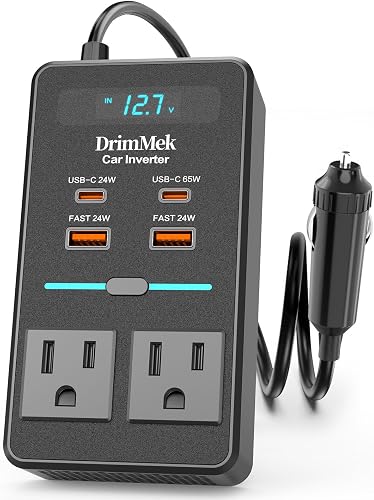
DrimMek 300W Car Power Inverter: Best for laptop USB-C charging
- 300W continuous
- 12V to 110V
- Dual AC outlets
- USB-C 24W and 65W, USB-A 24W
- LCD battery voltage display
A 300W car inverter built around fast laptop charging, including a 65W USB-C port. The LCD display shows car battery voltage while you charge several devices.
Pros
- 65W USB-C for laptops
- LCD voltage display
- Compact glove-box size
Cons
- Not for 16V vehicle systems
- 300W limit for heating devices
DrimMek suits laptop owners who want fast USB-C charging in a car. It gives 300W continuous with dual AC outlets, two USB-C ports at 24W and 65W, and two USB-A ports at 24W.
That 65W USB-C port is the headline feature. It can charge a laptop while the AC outlets run other devices, as long as the total load stays within 300W.
An LCD display shows real-time car battery voltage, which helps you watch the vehicle battery while you charge.
Built-in protection covers overload, short circuit, overheat and low voltage. A quiet fan runs only when needed, and the unit plugs into a 12V car outlet with no installation.
DrimMek warns that it is not compatible with Tesla vehicles with 16V low-voltage systems. It also will not run heating devices with a working peak over 300W.
For standard 12V cars and laptop charging, it is a focused pick.
EGO POWER+ Portable Inverter: Best for EGO battery backup
- 400W continuous, 800W peak
- Pure sine wave
- 120V outlet
- USB-C, USB-C PD and USB-A ports
- 100W USB-C PD in/out
A pure sine wave inverter for EGO 56V ARC Lithium batteries. It powers household items and can charge those batteries through its 100W USB-C PD port.
Pros
- Pure sine wave output
- Pass-through battery charging
- Built-in LED lights
Cons
- Battery and charger not included
- Heavier at 3.3 lb
EGO POWER+ suits owners of EGO 56V ARC Lithium batteries who want home backup or outdoor AC power. It gives 400W continuous and 800W peak as a pure sine wave inverter for sensitive electronics.
You get a 120V outlet plus one USB-C port, one USB-C PD port and one USB-A port. The 100W USB-C PD port can power larger devices or charge EGO batteries, and pass-through charging lets a battery charge while it powers devices.
Built-in LED lights provide ambient lighting during an outage. That helps in a garage, campsite or work area where a work light and AC power are both useful.
At 3.3 lb, it is heavier than car adapters and battery and charger are not included. It works only with compatible EGO 56V ARC Lithium batteries.
If you already own that battery platform, the clean power and charging features are strong. If you do not, car inverters above are simpler.
BESTEK 400W Car Power Inverter 12V: Best for fast vehicle charging
- 400W continuous
- 12V DC to 110V AC
- Dual 110V AC outlets
- USB-C PD 30W and USB-A QC 3.0
- 40-amp fuse
A red 400W car inverter with dual AC outlets and fast USB ports in an iPhone-size body. It is a practical pick for road trips and camping within its 400W limit.
Pros
- 400W continuous output
- Fast USB-C and USB-A ports
- Compact portable design
Cons
- Waveform not stated
- Cigarette lighter plug for vehicle use
BESTEK 400W suits drivers who want 400W in a compact red body. It gives 400W continuous with dual 110V AC outlets and USB-C PD 30W plus USB-A QC 3.0 ports for phones, tablets and cameras.
The maker says AC outlets handle devices from 300W to 400W, such as laptops, breast pumps, DVD players and bottle warmers. A 32-pin cigarette lighter plug fits almost any vehicle for travel and outdoor use.
Safety includes a built-in 40-amp fuse and protection against overheating, overvoltage, undervoltage and short circuits. BESTEK says the unit is ETL certified and offers a 12-month worry-free warranty.
Its size is about an iPhone, which helps in a console. The trade-off is that the data does not state the waveform, while the BESTEK 300W model here states pure sine wave.
If waveform matters to you, compare those two BESTEK picks before you buy.
How we compared these power inverter deals
We compared continuous watts first, because peak watts only cover short startup surges. A model with 400W continuous can run a 350W load for longer than a 200W model with a high peak rating.
We checked waveform next. Pure sine wave picks suit sensitive electronics, while modified sine wave picks cover many basic chargers at a lower size or price.
We did not treat a high peak number as a reason to run a large device all day.
We also checked how each model connects. Cigarette lighter plugs are easy, but battery clip cables and tool batteries change what you can run.
The Ampeak clip cable, Azocek Milwaukee battery design and EGO battery design are not interchangeable.
Ports mattered too. Count AC outlets, USB-A ports and USB-C ports, then check whether fast charging is stated.
A 65W USB-C port, an 18W QC port and a basic USB port do not charge at the same rate.
Finally, we checked protection and included parts. Fuses, cooling fans, voltage displays and warranties vary.
A deal that needs a separate battery is not the same value as a complete car adapter.
What continuous watts mean for your devices
Continuous watts are the amount the inverter can supply without stopping. Peak watts are a short surge for motors or startup loads.
Plan your device list around continuous watts.
Add the watt ratings of every device running at once. Phones and tablets often use USB power, while laptops use AC power.
A 150W inverter can be tight if a laptop and two tablets run together.
Leave headroom for startup surges. A device that starts at a higher wattage may trip protection even if its running draw is lower.
That is why peak ratings exist, but they do not replace continuous capacity.
How to size a 150W to 200W car inverter
A 150W or 200W model fits phones, tablets, lights and many laptops. The FOVAL 150W and PiSFAU 200W are best when your largest AC device stays well under the rating.
Check the laptop charger label before you buy. If your laptop needs more than the inverter can supply with other devices plugged in, move up to 300W or 400W.
How to size a 300W to 400W inverter
A 300W or 400W model gives more room for laptops, DVD players and similar devices. The BESTEK 300W, DrimMek 300W, Pro Chaser 400W and BESTEK 400W sit in this range.
These models still have limits. Heaters, toaster ovens and other heating devices can exceed the rating during a cycle.
Read the device label and keep total load under continuous watts.
When to step up to 750W
The Ampeak 750W suits larger loads through its battery clip cable. That extra output helps with small appliances and essential devices in a truck, RV or campsite.
Higher output also means more current from the battery. Use the correct cable for the load, and do not treat a cigarette lighter plug as the same as a battery clip connection.
Pure sine wave vs modified sine wave: which should you buy?
Pure sine wave output is smoother and closer to household power. It is the safer choice for sensitive electronics, audio equipment and devices whose maker asks for pure sine wave.
Modified sine wave output works for many phone chargers, tablets and basic laptop chargers. Several picks here use it, including the FOVAL, PiSFAU, Pro Chaser and Ampeak.
If you power a nebulizer, CPAP machine or other medical device, check that device maker's guidance first. Do not assume every inverter is suitable because it has an AC outlet.
Best pure sine wave picks here
The BESTEK 300W and EGO POWER+ 400W are the pure sine wave models in this roundup. They suit buyers who want clean power or use sensitive electronics.
Best modified sine wave picks here
The FOVAL 150W, Azocek 220W, PiSFAU 200W, Pro Chaser 400W, Ampeak 750W and DrimMek 300W use modified sine wave. They are practical for basic charging when your device allows it.
How does it connect: car socket, battery clips or tool battery?
Connection type decides where you can use the inverter. A cigarette lighter plug is the easiest for small car loads.
A battery clip cable supports higher loads but needs direct battery access.
A tool battery inverter needs that exact battery platform. The Azocek needs Milwaukee 18V batteries, and the EGO POWER+ needs EGO 56V ARC Lithium batteries.
Neither one includes the battery.
If you want a broader view of vehicle power, compare brands in our best vevor power inverter guide. If you already know a brand you trust, check the best power inverter jupiter roundup for another set of options.
Cigarette lighter plug models
Most car models here plug into a 12V cigarette lighter socket. That is simple for phones, tablets and laptops within the continuous rating.
Watch your vehicle fuse and socket voltage. The DrimMek warns against 16V systems, and the FOVAL warns that overloading the car fuse can blow it.
Battery clip models
The Ampeak includes a battery clip cable for high-power applications. That connection is for loads up to 750W continuous when used correctly.
Keep clips on the correct terminals and cables clear of moving parts. Use the clip cable for high power, not the lighter plug.
Tool battery models
Tool battery inverters travel well because you can swap charged batteries. They also let you move power from a work area to a home outage without a car.
Remember that the battery is a separate purchase. Check which battery models are compatible before you count the inverter as a complete power source.
Which ports and accessories are worth paying for?
Ports decide how many devices you can charge at once. Count AC outlets for laptops and USB ports for phones, tablets and cameras.
Fast charging ports can shorten charge time. Look for stated wattages such as 18W QC, 30W PD, 65W USB-C or 100W USB-C PD.
A port without a stated rate may charge more slowly.
Included cables matter too. A 30-inch cord, a battery clip cable or a lighter plug changes where you can place the unit.
A battery is not included with tool battery models.
If you want stored power instead of vehicle power, compare a Best Portable Power Station On Sale pick. For event timing, our Best Portable Power Station Prime Day Deal guide covers a different buying window.
AC outlets vs USB ports
AC outlets run laptops and household-style plugs. USB ports charge phones and tablets directly, often with less conversion loss.
Many buyers need both. The PiSFAU gives 2 AC outlets and 4 USB ports, while the DrimMek focuses on 65W USB-C laptop charging plus AC outlets.
Fast charging ports
USB-C PD ports at 30W, 65W and 100W suit laptops and large phones. QC USB ports at 18W suit many phones and tablets.
Match the port to the device. A 65W port does not make a small phone charge at 65W, but it can help a laptop that supports that rate.
Cables and included parts
Check whether the box includes a lighter plug, battery clip cable, manual or warranty. The Ampeak includes both a lighter plug cable and battery clip cable.
Tool battery models include the inverter body, not the battery. That distinction affects total cost and readiness on day one.
How do safety features and warranties compare?
Protection features help stop damage when a load is too high or a battery runs low. Look for overload, short circuit, overvoltage, undervoltage and overheating protection.
Fuses add another layer. The FOVAL has a built-in fuse, the BESTEK models have a 40A fuse, and the Ampeak has two replaceable 50A external fuses.
Cooling fans help during long runs. Some fans start at a set temperature, such as 113F for the Pro Chaser or 50C for the Ampeak.
Keep vents clear so the fan can move air.
Warranties vary by brand. BESTEK lists 18 months for the 300W pure sine wave model and 12 months for the 400W model.
Pro Chaser lists 12 months, DrimMek lists 1 year, and Azocek lists 1 year for its battery inverter.
For higher-end systems that charge from shore power or solar, compare the best victron power inverter picks. Those models solve a different problem than small car adapters.
Verdict: which discounted power inverter should you buy?
Buy the FOVAL 150W if you want the best compact car deal for phones, tablets and laptops. Its 150W continuous output and tiny size make it easy to keep in the car.
Buy the BESTEK 300W pure sine wave model if clean power matters more than the smallest size. It gives 300W continuous, 700W peak and wider vehicle voltage support.
Buy the Ampeak 750W if you need battery clip power for larger loads. Its dual connection options and replaceable fuses make it the high-output pick here.
Buy the Azocek 220W if you already own Milwaukee 18V batteries. It adds AC power, fast USB ports and a work light, but the battery is sold separately.
Buy the EGO POWER+ 400W if you already own EGO 56V batteries and want pure sine wave backup. It can also charge those batteries through its 100W USB-C PD port.
Check continuous watts, waveform and connection type before you chase a discount. The best power inverter on sale is the one that runs your actual devices safely, fits your vehicle or battery, and includes the cables you need.
Our top 3 picks at a glance
-
1
-
2
Best for sensitive electronics
BESTEK Pure Sine Wave Power Inverter
9.6/10 our score
See it on Amazon -
3
Best for Milwaukee battery owners
220W Azocek Power Inverter Compatible with Milwaukee
9.4/10 our score
See it on Amazon
Frequently asked questions
What wattage do I need for a car power inverter?
Match continuous watts to your largest device, not peak watts. A 150W to 200W model fits phones, tablets and many laptops.
A 300W to 400W model fits larger laptops and similar devices.
A 750W model with battery clips fits bigger loads.
Add up all devices running at once.
Is pure sine wave or modified sine wave better?
Pure sine wave gives cleaner power for sensitive electronics such as audio gear and some medical devices. Modified sine wave costs less and works for many basic chargers and laptops.
If your device maker asks for pure sine wave, choose that type.
When in doubt, pure sine wave is the safer match.
Can I plug a car inverter into a cigarette lighter socket?
Many models here use a cigarette lighter plug for low-power use. Higher-output models like the Ampeak also include a battery clip cable for high-power use.
Do not exceed the continuous watt rating or your vehicle fuse.
Check your vehicle socket voltage before use, especially 12V versus 16V systems.
Does a battery inverter include a battery?
No. The Azocek model needs a Milwaukee 18V battery, and the EGO POWER+ model needs an EGO 56V ARC Lithium battery.
Neither one stores power on its own.
You need a compatible battery attached for it to power devices.
That keeps the inverter lighter and lets you swap batteries.
How do I compare power inverters on sale?
Compare continuous watts, peak watts, waveform, number of AC and USB ports, input voltage, size and included cables. A lower price means little if the continuous output is too low for your laptop.
Check whether a battery clip cable, lighter plug or battery is included.
Those accessories change usable value.


