Can a Portable Power Station Power a Well Pump?
On this page (7 sections)
Yes, a portable power station can power a well pump, but it depends on the pump’s power draw. You need to match the power station’s output to your well pump’s requirements. We’ll show you how to figure out what you need.
Many homeowners worry about losing water during power outages. Having a generator for a well pump is a smart backup plan. A portable power station offers a convenient, quieter alternative to gas generators.
- Well pump power needs vary greatly.
- Match your power station’s capacity to your well pump.
- Consider starting wattage (surge power) for your pump.
- Portable power stations are battery-powered and quiet.
- They are a great backup for emergencies.
Let’s walk through how to select the right portable power station for your well pump. We’ll help you understand the key factors involved.
Understanding Your Well Pump’s Power Needs
Before you can pick a portable power station, you need to understand your well pump. Not all pumps are created equal. They have different power requirements. Matching these is vital for success.
Your well pump likely has a label. This label shows its electrical information. We found that most well pumps use either 120 volts (V) or 240 volts (V).
You also need to know its amperage (A) or wattage (W). These numbers tell you how much electricity the pump uses to run.
Deciphering Run Watts vs. Starting Watts
This is where things can get a little tricky. Well pumps have two main power ratings: running watts and starting watts.
Running watts are what your pump needs to operate continuously. It’s the power it uses once it’s already on and pumping water.
Starting watts (or surge watts) are different. This is the brief, extra burst of power your pump needs to kick on. It’s like the initial push to get a heavy object moving. It usually lasts only a few seconds.
Many appliances with motors have this surge. For a well pump, the starting watts can be 2-3 times higher than the running watts. You must account for this surge when choosing your power station.
If your power station can’t handle the starting watts, your pump won’t turn on.
Finding Your Pump’s Specifications
Where do you find these numbers? Always check the well pump’s nameplate. It’s a sticker or metal plate on the pump itself. It will list the voltage, amps, and sometimes watts.
If you can’t find the nameplate, check your owner’s manual. Or, you can search online for your pump’s make and model. We found that most manufacturers provide these details on their websites.
As a last resort, contact a local well pump professional. They can help you determine your pump’s exact needs.
Here’s a simple formula if your label only gives volts and amps:
Watts = Volts x Amps
For example, if your pump is 10 amps at 120 volts, it uses 1200 running watts. Remember to estimate the starting watts from there.
Sizing Your Portable Power Station
Once you know your well pump’s power appetites, you can size up a portable power station. You’re looking for two main things: continuous output and surge capacity.
The power station’s continuous output (rated power) must be higher than your well pump’s running watts.
Its surge capacity (peak power) must be higher than your well pump’s starting watts. If it isn’t, your pump will trip the power station’s overload protection.
Comparing Portable Power Stations to Gas Generators
Why consider a portable power station? Many homeowners traditionally use gas generators for backup power. But power stations offer several benefits.
For starters, they are much quieter. No noisy engine rumbling outside your window. They don’t produce any exhaust fumes either, so you can sometimes use them indoors (check manufacturer guidelines).
They are also easier to maintain. No oil changes, no fuel stabilizers, no spark plug checks. Just charge them up and they’re ready to go. We’ve seen many people appreciate this ease of use.
However, gas generators typically offer more raw power for less cost. They can also run for a very long time if you have enough fuel. Portable power stations have a finite battery capacity.
Here’s a quick comparison:
| Feature | Portable Power Station | Gas Generator |
|---|---|---|
| Fuel/Power Source | Battery (rechargeable) | Gasoline/Propane |
| Noise Level | Very quiet | Loud |
| Emissions | None | Exhaust fumes |
| Maintenance | Low | Medium to High |
| Portability | High | Medium |
| Run Time | Limited by battery size | Limited by fuel supply |
| Starting Method | Button press | Pull cord/Electric start |
Battery Capacity and Runtime Considerations
Beyond watts, you also need to think about watt-hours (Wh) or kilowatt-hours (kWh). This measures the total energy stored in the power station’s battery. It tells you how long the power station can run your pump.
Let’s say your well pump uses 1000 running watts. If you have a 2000 Wh portable power station, it could theoretically run your pump for 2 hours (2000 Wh / 1000 W = 2 hours). However, this is an ideal calculation.
Always factor in some efficiency loss. Plus, the power station might be powering other small devices. A good rule of thumb is to assume you’ll get 80-90% of the advertised runtime.
Think about your typical water usage during an outage. How often do you need to run the pump? How long does it need to run each time? This helps you estimate the needed Wh capacity.
Key Features to Look for in a Power Station
When shopping for a portable power station for your well pump, certain features are more important than others. Investing in the right one will save you stress later.
Inverter Type and Outlet Availability
Most portable power stations use a pure sine wave inverter. This is crucial for sensitive electronics and motors like those in well pumps. Modified sine wave inverters can damage these devices over time. Always confirm it’s a pure sine wave output.
Also, check the number and type of outlets. Does it have the right kind of AC (alternating current) outlets for your pump? Many 240V well pumps require a specific NEMA outlet, which not all power stations offer.
We found that smaller power stations often only have 120V outlets. Be sure to check the specifications closely.
Charging Options and Passthrough Power
How will you recharge your power station? Most can charge from a standard wall outlet. Many also support solar panel charging, which is fantastic for extended outages.
Some even charge from your car’s 12V outlet. Multiple charging options give you flexibility, especially during a prolonged event.
Passthrough charging is another valuable feature. This means the power station can charge itself while simultaneously providing power to your devices. This is very handy if you have solar panels hooked up. You can keep your pump running throughout the day and recharge the battery at the same time.
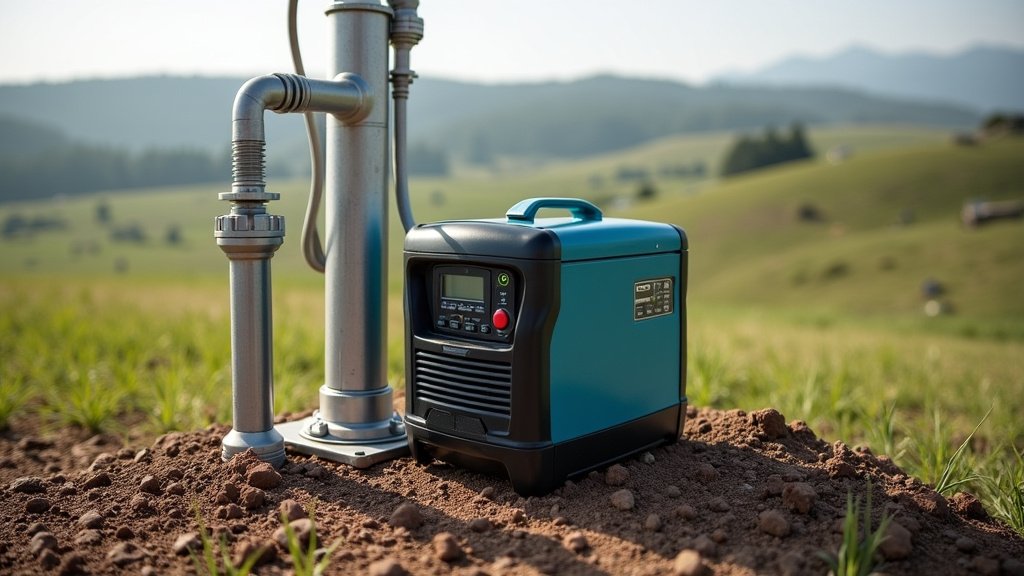
Setting Up Your Well Pump with a Power Station
Connecting your well pump to a portable power station isn’t complicated. But it requires some safety considerations and proper steps.
Safety First: What You Need to Know
Always prioritize safety. When connecting your well pump to a power station, here are some important rules:
- Disconnect your well pump from grid power first. This prevents backfeeding electricity into the utility lines, which can be dangerous for utility workers and damage your pump or power station.
- Ensure the power station is on a stable, dry surface. Keep it away from sources of water or extreme heat.
- Use appropriately rated extension cords. Don’t use thin, flimsy cords that can’t handle the pump’s power draw. This can cause overheating and fire risks.
- Read both your well pump and power station manuals. Each device might have specific instructions or warnings.
A Quick Setup Checklist
Here’s a general checklist to guide you through the process:
- Turn off the circuit breaker to your well pump at your main electrical panel.
- Unplug your well pump from its wall outlet, or disconnect it if hardwired (only if you’re comfortable and know how).
- Plug your well pump’s power cord into the AC outlet on your portable power station.
- Turn on the AC output of your portable power station.
- Listen for your pump to cycle on. If it doesn’t, double-check all connections and review the power station’s error indicators.
- Monitor both the water flow and the power station’s battery level.
Final Thoughts on Choosing and Using
Choosing the right portable power station involves a bit of homework. But the peace of mind during a power outage is truly worth it. Having running water is a basic need.
We’ve guided you through figuring out your pump’s power, understanding different types of power sources, and what features make a difference. Remember, always overestimate your needs a little. It’s better to have too much power than not enough.
Consider your personal circumstances. How often do you lose power? How long do outages typically last? Your answers will help you narrow down your choices. You’ll be ready to face the next outage with confidence.
Conclusion
Successfully powering your well pump with a portable power station grants you independence during outages. We’ve shown you how to identify your pump’s power needs, especially those critical starting watts. Understanding battery capacity and key features like pure sine wave inverters ensures you choose wisely.
You now have the knowledge to make an informed decision, providing peace of mind and access to water when the grid goes down. Take the time to match your pump to the right power station; your future self will thank you for being prepared.
Frequently Asked Questions
Can a portable power station really run a 240V well pump?
Yes, some larger portable power stations are designed with 240V outlets and the necessary power output. You’ll need to confirm the station’s specifications match your 240V pump’s voltage and amperage requirements, including its starting watts.
How long will a portable power station run my well pump?
The runtime depends entirely on the power station’s battery capacity (watt-hours) and your well pump’s running wattage. Divide the power station’s watt-hours by your pump’s running watts to get an approximate run time, but remember to factor in efficiency losses and the pump’s intermittent operation.
Is it safe to connect my well pump directly to a power station?
Yes, but always ensure your well pump is disconnected from your home’s main power supply first to prevent dangerous backfeeding. We found that using appropriately rated extension cords and ensuring the power station is on a stable, dry surface are also critical safety steps.
What’s the main advantage of a portable power station over a gas generator for a well pump?
The primary advantages are quiet operation and zero emissions. You avoid the noise and fumes of a gas generator, and the power station requires minimal maintenance, making it a very user-friendly option for backup power.
Do I need a transfer switch to use a portable power station with my well pump?
Generally, no. If your well pump plugs into a standard outlet, you can usually plug it directly into the power station after disconnecting it from wall power. A transfer switch is typically used for entire home or hardwired generator integrations.