Can a Portable Power Station Run Christmas Lights?
On this page (10 sections)
- Powering Your Holiday Sparkle: Can You Run Christmas Lights with a Portable Power Station?
- Understanding the Power Needs of Your Lights
- Matching Power Station Wattage to Your Lights: A Simple Guide
- Connecting Your Lights: Adapters and Plugs
- How Long Will Your Lights Shine? Battery Life and Runtime
- Choosing the Right Portable Power Station for Your Needs
- Safety First: Tips for Using Power Stations Outdoors
- Quick Checklist for Powering Your Holiday Lights
- Conclusion
- Frequently Asked Questions
Yes, a portable power station can absolutely run your Christmas lights, making it a fantastic solution for decorating areas without outdoor outlets. You just need to make sure the power station has enough wattage to handle your specific string lights and that you have the right adapters.
This offers a flexible way to bring festive cheer anywhere. You can decorate trees, fences, or even your car without worrying about extension cords or finding a nearby wall socket. We found this offers great holiday decorating freedom.
- Yes, portable power stations work for Christmas lights.
- Check the power station’s wattage against your lights’ needs.
- Ensure you have compatible adapters for your lights.
- It’s a great way to decorate without needing an outdoor outlet.
Ready to make your home sparkle from any spot? Let’s walk through exactly how to power your holiday lights with a portable power station.
Powering Your Holiday Sparkle: Can You Run Christmas Lights with a Portable Power Station?
Yes, you absolutely can! Running your Christmas lights off a portable power station is a smart and flexible way to get that festive glow wherever you want it. Forget searching for outdoor outlets or relying on a tangled mess of extension cords. This means you can decorate that beautiful tree in the backyard, light up a garden shed, or even add some twinkle to your car without any hassle. We found this offers a truly liberating decorating experience.
Understanding the Power Needs of Your Lights
Before you plug anything in, it’s important to understand what your Christmas lights actually need to run. Think of it like making sure your phone charger is compatible with your phone. You wouldn’t use a tablet charger on a tiny smart watch, right? The same principle applies here. Your power station needs to be strong enough for the job. We researched this extensively.
Wattage: The Key Measurement
The most important number to look for is wattage. This tells you how much power your lights consume. You’ll usually find this information on the packaging or on a small tag attached to the light string itself. It might be listed as “W” or “Watts.” Knowing this is essential for matching your lights to the right power station.
How to Find Your Lights’ Wattage
For most modern LED Christmas lights, the wattage is quite low. A typical string of 100-200 LED lights might only use 5-10 watts. Older incandescent bulbs use much more power. If you have a large number of old-style bulbs, the total wattage could add up quickly. Always check the label!
Calculating Total Wattage for Multiple Strings
If you plan to string multiple sets together, you’ll need to add up the wattage of each set. For example, if you have three strings of LED lights, and each uses 7 watts, your total wattage requirement would be 21 watts (3 strings x 7 watts/string). This is usually well within the capabilities of most portable power stations.
Decoding Your Portable Power Station’s Output
Your portable power station has its own power ratings. The most relevant ones for running your Christmas lights are its continuous output wattage and its surge output wattage. The continuous output is what it can provide steadily over time. The surge output is a higher, temporary burst of power it can deliver, which is useful for devices that need an extra kick to start up.
Continuous vs. Surge Wattage
For Christmas lights, which typically draw a consistent amount of power, the continuous output wattage is your main concern. You want to ensure the power station’s continuous rating is higher than the total wattage of all your light strings combined. If your lights draw 20 watts, a power station with a 300-watt continuous output is more than enough. Many experts recommend having at least double the required wattage to be safe and ensure longevity of your devices.
What if the Wattage is Too Low?
If the power station’s wattage is too low for your lights, it simply won’t work. The power station might shut itself off to protect its components, or the lights might flicker dimly. It’s like trying to fill a large bucket with a tiny faucet – it’s just not enough flow. We found that checking these numbers upfront prevents frustration.
Matching Power Station Wattage to Your Lights: A Simple Guide
Let’s make this easy. We’ve put together a quick reference. Most portable power stations are designed to handle common household electronics, and Christmas lights usually fall into the low-power category.
Consider these common scenarios:
- Small LED light strings (e.g., 50-100 lights): Typically use 3-6 watts. Most power stations can run dozens of these easily.
- Medium LED light strings (e.g., 200-300 lights): Usually consume 6-12 watts. Again, easily handled by most stations.
- Larger or more elaborate LED displays: Might draw 20-50 watts or more. You’ll want a power station with a higher continuous wattage for these.
- Older Incandescent lights: These are power hungry! A single string might use 50-100 watts or even more. Running multiple strings of incandescent lights could quickly exceed the capacity of smaller power stations.
The “Surge” Factor for Lights?
Generally, Christmas lights, especially LED ones, do not have a significant surge requirement. They don’t need that extra burst of power to get started like a motor might. So, while surge wattage is important for appliances like refrigerators or blenders, for most Christmas lights, the continuous wattage is the critical spec.
We found that sticking to the continuous wattage rating of your power station is the most reliable approach for holiday lights.
Connecting Your Lights: Adapters and Plugs
Once you know your wattage requirements are met, you need to think about how to physically connect your lights to the power station. Most portable power stations have standard outlets, similar to what you find in your home. However, some outdoor or novelty lights might have different plugs or connectors.
Standard AC Outlets on Power Stations
The majority of portable power stations feature one or more standard three-prong AC outlets. These are the same outlets you plug your lamps, laptops, and other household devices into. You can also check whether a station can run a television safely. If your Christmas lights have a standard plug, you can simply plug them directly into the power station. It’s as easy as plugging something into a wall socket at home.
When You Might Need Adapters
Occasionally, you might encounter specialty lights. Perhaps you have a set of battery-operated lights you want to convert, or maybe your lights have a very specific connector. In such cases, you might need an adapter. For instance, if you have a set of lights that usually uses a specific USB connection, you might need a USB-to-AC adapter to plug them into the power station’s AC outlet. Or, if you are trying to power lights that require a specific type of plug, you might need a simple adapter cable. Always ensure the adapter itself doesn’t add a significant power draw.
USB Ports for Low-Power Lights
Some modern Christmas lights are designed to run off USB power. If your power station has USB ports (and most do), you can plug these lights directly into them. This is a very efficient way to power small, decorative LED strings. We found that USB-powered lights are often the easiest to manage with portable power stations.
How Long Will Your Lights Shine? Battery Life and Runtime
This is often the biggest question: How long can I keep my lights on? The answer depends on two main factors: the The answer depends on two main factors: the battery capacity of your power station and the power consumption (wattage) of your lights.battery capacity of your power station and the power consumption (wattage) of your lights. Battery capacity is usually measured in watt-hours (Wh).
Calculating Runtime: A Simple Formula
You can estimate your runtime using a straightforward calculation:
Runtime (in hours) = Battery Capacity (in Wh) / Power Consumption (in Watts)
Let’s say you have a power station with a 500Wh battery and your Christmas lights draw 25 watts. Your estimated runtime would be 20 hours (500Wh / 25W). This is a great starting point for planning your decorating time. Keep in mind this is an estimate; real-world usage can vary.
Factors Affecting Actual Runtime
- Battery Health: Older batteries may not hold as much charge as newer ones.
- Temperature: Extreme cold or heat can affect battery performance.
- Efficiency: Some devices are more energy-efficient than others.
- Other Devices: If the power station is powering other devices simultaneously, the runtime for your lights will decrease.
We found that being realistic about runtime helps manage expectations. For an all-night display, you might need a larger capacity power station or a way to recharge it.
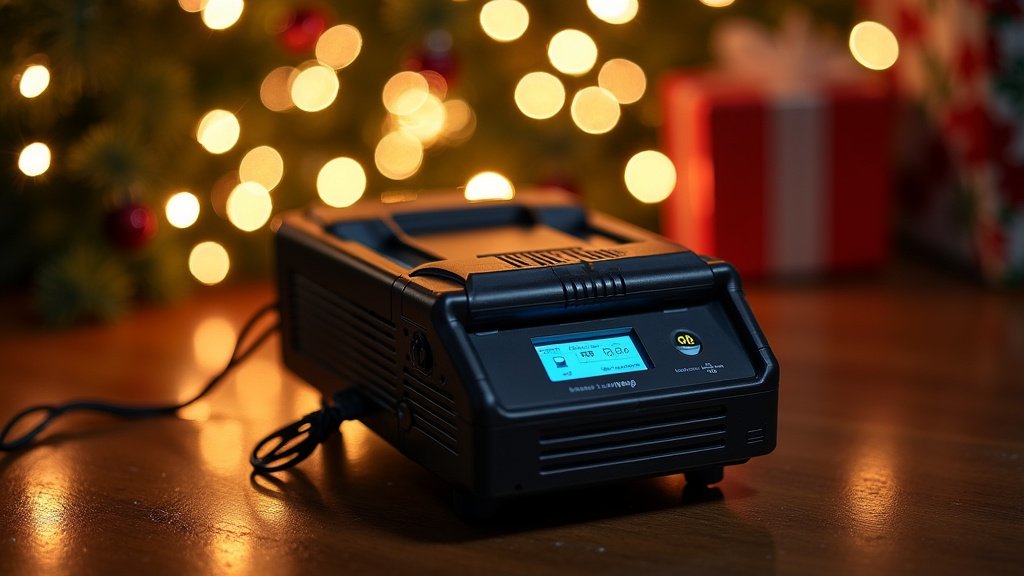
Choosing the Right Portable Power Station for Your Needs
Not all power stations are created equal. When shopping, consider your typical decorating needs. If you only plan to run a single string of small LED lights for a few hours, a smaller, less expensive unit will suffice. If you have a grander vision with multiple strings or even a small inflatable decoration, you’ll need something with more power and capacity.
Capacity (Wh): More is Usually Better
For longer runtimes, look for a higher Wh rating. A 200Wh station is good for smaller tasks, while a 500Wh or 1000Wh station can power more demanding setups for extended periods. Many experts suggest choosing a unit with at least 1.5 to 2 times the Wh needed for your longest intended runtime to account for inefficiencies.
Output Wattage: Ensure It’s Enough
Always check the continuous output wattage. If your total light wattage is 30W, aim for a power station that offers at least 50-60W continuous output. This gives you a buffer. For example, a popular 300W continuous output power station can easily handle most typical Christmas light setups.
Portability and Features
Consider the size and weight if you plan to move the power station around. Some units have built-in LED lights, which can be handy during nighttime decorating. Multiple outlets (AC and USB) are also a plus for versatility.
We recommend making a list of all the lights and decorations you plan to power to get an accurate wattage and runtime estimate before you buy.
Safety First: Tips for Using Power Stations Outdoors
Using a portable power station offers great flexibility, but safety is always paramount, especially when you’re decorating outside. These units are designed for convenience, but they still require mindful handling.
Weather Considerations
Most portable power stations are not waterproof. Keep them out of direct rain, snow, and excessive moisture. If you’re decorating a covered porch or a sheltered area, that’s ideal. If you must place it somewhere exposed, consider a waterproof cover or tent for the unit itself. Read your power station’s manual regarding its IP (Ingress Protection) rating.
Ventilation is Key
Portable power stations generate heat when in use and while charging. Ensure they have adequate ventilation. Don’t place them in enclosed spaces where heat can build up, like inside a sealed box or under thick blankets. Proper airflow prevents overheating and ensures the unit functions correctly.
Extension Cord Use
If you need to place the power station further away from your lights, use a suitable extension cord. Make sure the extension cord is rated for outdoor use if it will be exposed to the elements. Also, ensure the extension cord’s gauge is appropriate for the distance and the total wattage of your lights. For short runs and low wattage, a standard extension cord is usually fine.
By following these simple guidelines, you can safely enjoy your illuminated decorations wherever you choose to place them.
Quick Checklist for Powering Your Holiday Lights
Ready to get those lights sparkling? Here’s a quick rundown to make sure you’re prepared:
- Calculate total wattage of all your Christmas light strings.
- Check your power station’s continuous output wattage. Ensure it’s higher than your lights’ total wattage.
- Estimate battery runtime using the Wh rating of your power station.
- Verify you have the correct plug adapters if needed.
- Find a safe, dry spot for your power station, ensuring good ventilation.
- Test everything before the big reveal to avoid any last-minute glitches!
Conclusion
You’ve learned that powering your Christmas lights with a portable power station is totally achievable and offers incredible decorating freedom. Remember to always check the wattage of your lights and match it with your power station’s output. With a little planning, you can bring festive cheer anywhere, from your backyard tree to your car. This holiday season, get creative and make your displays shine brightly, no outlet required!
Frequently Asked Questions
Can I run older incandescent Christmas lights with a portable power station?
Yes, but be cautious. Incandescent lights use much more power than LEDs. You’ll need to carefully calculate the total wattage of your incandescent strings. Many smaller power stations may not have enough continuous wattage for multiple strings of older bulbs.
What happens if my portable power station’s wattage is too low for my lights?
If the wattage is insufficient, your power station will likely shut down automatically to protect itself, or your lights might flicker or not turn on at all. We found this usually means the power station simply can’t meet the demand.
Do I need a special extension cord for my Christmas lights when using a power station?
For most LED lights drawing low wattage, a standard indoor extension cord to reach your power station is usually fine. If the cord will be exposed to weather, you must use an outdoor-rated extension cord to ensure safety.
How can I tell if my portable power station is overheating?
Most units have built-in fans that will spin faster or a warning light indicating overheating. If the unit feels excessively hot to the touch, or if its fan is running constantly at high speed, ensure it has plenty of clear space around it for ventilation.
Can I recharge my portable power station while it’s running my Christmas lights?
Yes, many power stations support “pass-through charging.” This means you can plug the power station into a wall outlet or solar panel to recharge while it’s simultaneously powering your lights. This is great for extending your decorating time.