Can a Solar Generator Run a Whole House During an Outage?
On this page (8 sections)
- Can a Solar Generator Power Your Entire Home? Let’s Find Out!
- Understanding Solar Generator Power: Wattage is King
- Assessing Your Home’s Power Needs
- Solar Generator vs. Home Electrical Panel: The Connection
- Can a Single Solar Generator Power Everything? The Reality Check
- Checklist: Is Whole-House Solar Backup Right for You?
- Conclusion
- Frequently Asked Questions
Yes, a solar generator can run your whole house during an outage, but with important caveats. It largely depends on the generator’s capacity and the power demands of your home’s appliances. You might need to prioritize essential items like your refrigerator and lights rather than running everything at once. We found that smaller units often aren’t enough for a complete whole-house solution.
Thinking about a solar generator for backup power is smart. It offers a cleaner, quieter alternative to noisy gas generators. We’ve seen many people successfully use them for shorter outages or to power specific circuits. It’s all about understanding the wattage needed and the solar generator’s output capabilities. It’s not a magic bullet for unlimited power, but it can be a lifesaver for essential needs.
- Solar generators can power a whole house, but often require careful management.
- The key is matching the generator’s power output to your home’s needs.
- You may need to prioritize essential appliances like refrigerators and lights.
- Larger, more powerful (and expensive) units are needed for full house backup.
- Consider your longest potential outage duration and highest power demands.
Below, we’ll break down exactly how much power a solar generator can provide and what to consider when choosing one for your whole-house backup needs.
“`htmlCan a Solar Generator Power Your Entire Home? Let’s Find Out!
The question of whether a solar generator can truly run your whole house during an outage is a big one. The short answer is: sometimes, but it really depends. It’s not quite as simple as plugging it in and forgetting about the grid. We’ve seen many people consider this, and the reality often involves some careful planning and understanding of power needs.
Think of it like trying to power a mansion with a single AA battery. It just won’t work. Solar generators, while amazing for portable power and smaller needs, have limitations. We found that for full house backup, you’re usually looking at the larger, more robust models. These are a significant investment, and even then, you might not be running every single appliance you own simultaneously.
Your home’s energy consumption is the key factor. Different appliances draw vastly different amounts of power. Running a refrigerator is one thing; running your air conditioning, electric stove, and washing machine all at once is another entirely. Many experts agree that understanding your home’s peak wattage demand is the first step. This is the highest amount of power your home might draw at any given moment. Without this knowledge, choosing the right solar generator for whole-house backup is like guessing in the dark.
Understanding Solar Generator Power: Wattage is King
At the heart of a solar generator’s capability is its wattage. This is the measure of electrical power it can output. Solar generators have two main wattage ratings to consider. You’ll see a continuous wattage rating and a surge wattage rating.
Continuous vs. Surge Wattage: What’s the Difference?
The continuous wattage is the amount of power the generator can supply consistently over time. This is what keeps your refrigerator running or your lights on for hours. The surge wattage is a higher, temporary burst of power. Many appliances, especially those with motors like refrigerators or power tools, need a surge of electricity to start up. This surge can be two to three times higher than their running wattage. Your solar generator needs enough surge capacity to handle these startup demands.
For example, a microwave might run at 1000 watts continuously, but it could need 1500-2000 watts to start. We found that overlooking the surge capacity is a common mistake. If the generator’s surge wattage isn’t high enough, the appliance simply won’t turn on, or it could even damage the generator. So, when you’re looking at specs, check both numbers carefully.
Battery Capacity: How Long Will It Last?
Beyond the raw power output, the battery capacity is vital. This is usually measured in watt-hours (Wh). It tells you how much energy the battery can store. A higher watt-hour rating means the generator can power your devices for longer periods. Imagine your generator is a fuel tank; watt-hours are how much fuel it holds.
If your goal is whole-house backup, you’ll need a substantial battery capacity. A small unit might have 500Wh, which is great for charging phones or powering a laptop. For a home, we’re talking about units with 5,000Wh or even 10,000Wh and beyond. The longer you anticipate an outage lasting, the more watt-hours you’ll need. It’s a direct relationship: more power needed for longer means a bigger battery.
Assessing Your Home’s Power Needs
This is where you become the detective. You need to figure out exactly what your home uses. Don’t just guess! We found that many homeowners underestimate their usage, especially during peak times. The best way to do this is to look at the power labels on your appliances.
Calculating Your Home’s Wattage
Most appliances have a label indicating their wattage. If it only lists volts and amps, you can calculate the wattage yourself using a simple formula: Watts = Volts x Amps. You’ll want to do this for all the appliances you absolutely need during an outage. Our guide to garage door backup power covers one practical outage need.
For example, a refrigerator might use 150 watts continuously but need 600 watts to start. A laptop uses about 50 watts. A few LED lights might use 10 watts each. Add up the continuous wattage of all essential items you want to run simultaneously. Then, identify the appliance with the highest surge wattage. This will give you a baseline for the generator’s power requirements.
Identifying Essential vs. Non-Essential Appliances
During an extended outage, you likely won’t be able to run everything. Prioritization is key. What are the absolute necessities? We often see lists like:
- Refrigerator/Freezer (to keep food from spoiling)
- Lights (LED are most efficient)
- Medical equipment (CPAP machines, oxygen concentrators)
- Communication devices (charging phones, Wi-Fi router)
- Well pump (if you have one)
- Essential kitchen appliances (microwave, coffee maker)
Things like electric ovens, clothes dryers, hot tubs, and large entertainment systems are usually the first to go. It’s about survival and comfort, not luxury, during an emergency. Thinking about your specific lifestyle and needs is important here.
Solar Generator vs. Home Electrical Panel: The Connection
Connecting a solar generator to your entire home isn’t as simple as plugging it into a wall socket. Most solar generators have standard outlets like you’d find on a power strip. To power your whole house, you need a way to integrate it with your home’s electrical panel.
Transfer Switches: The Bridge to Your Home
This is where a transfer switch comes in. There are two main types: manual and automatic. A manual transfer switch requires you to manually flip a switch to disconnect your home from the grid and connect it to the generator. An automatic transfer switch (ATS) does this automatically when it detects a power outage.
We found that installing a transfer switch is a job for a qualified electrician. It involves working with your home’s main electrical system. Attempting this yourself can be dangerous and could void warranties or even your home insurance. The transfer switch essentially acts as a gatekeeper, ensuring you don’t accidentally feed power back into the grid while it’s being worked on by utility crews. This is a critical safety feature.
Interfacing with Your Panel: What to Expect
Once the transfer switch is installed, it will have a dedicated inlet where you can plug in your solar generator (often using a special cord). The electrician will typically wire the transfer switch to power a specific set of circuits in your home – the ones you’ve identified as essential. This allows the solar generator to act as a backup power source for those circuits.
It’s important to understand that even with a transfer switch, you are still limited by the wattage and capacity of your solar generator. If you try to run too many appliances on those backed-up circuits, you can overload the generator. Your electrician can help you understand which circuits are best to back up and how much load they typically carry.
Can a Single Solar Generator Power Everything? The Reality Check
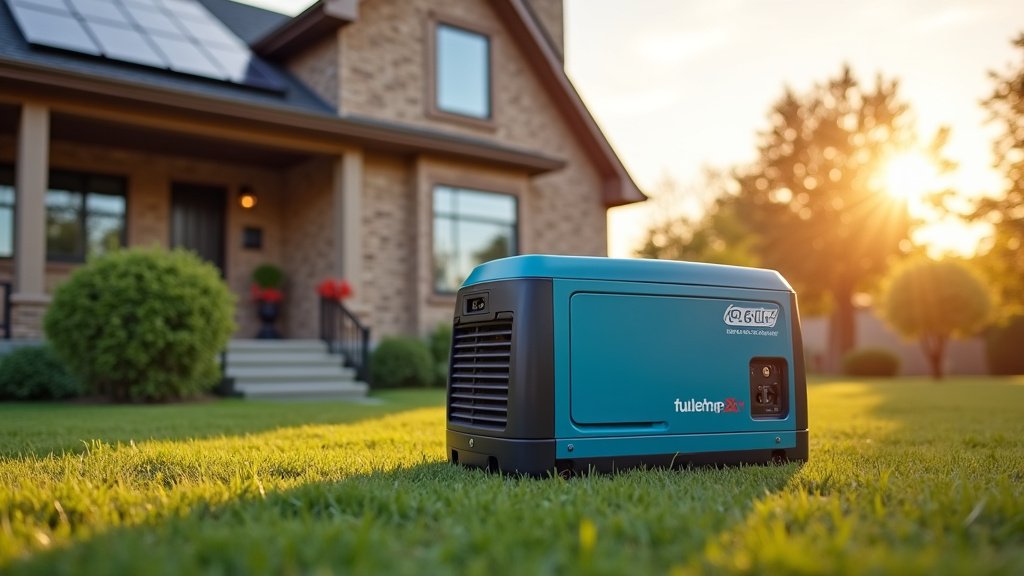
So, can a single unit do it all? For most typical homes, the answer is a resounding probably not, at least not without significant limitations and a very large, very expensive unit. We found that the average home’s peak demand can easily exceed 10,000 watts, and many portable solar generators top out at 3,000 to 5,000 watts continuous power, with perhaps a 6,000 to 10,000-watt surge. Even larger stationary units might reach higher, but they come with a hefty price tag.
When a Solar Generator Can Run Your Whole House
There are specific scenarios where it might be feasible:
- Extremely energy-efficient homes: If your home is exceptionally well-insulated, uses only LED lighting, and has high-efficiency appliances, your total power demand will be lower.
- Very small homes or RVs: These have significantly less power-hungry systems.
- Very short outages: If you only expect outages lasting a few hours, a moderately sized unit might cover essential needs.
- Using multiple units in parallel: Some solar generators can be linked together to increase their total output and storage capacity. This is an option, but it also increases complexity and cost.
We found that combining units offers more flexibility but requires careful planning to ensure they work together effectively.
Common Limitations and Considerations
The biggest hurdles are often:
- Cost: Whole-house capable solar generators are expensive, often costing thousands or even tens of thousands of dollars.
- Charging Time: Recharging a massive battery bank takes time, even with ample solar input. You need enough sunlight to replenish the stored energy.
- Appliance Startup Loads: As mentioned, the surge wattage requirement can be a deal-breaker for many generators.
- Outage Duration: How long will the power be out? If it’s days, even a large battery will eventually drain without sufficient solar replenishment.
It’s crucial to have realistic expectations. A solar generator can be a fantastic backup for essentials, providing peace of mind and comfort. For true whole-house, unlimited power, you’re usually still looking at traditional grid power or a much larger, professionally installed system, as discussed in this guide to whole-house power station capacity, often combining solar with other energy storage solutions.
Checklist: Is Whole-House Solar Backup Right for You?
Before you invest, ask yourself these questions:
- Have I calculated my home’s essential appliance wattage and surge needs?
- Do I understand the difference between continuous and surge wattage?
- What is the typical duration of power outages in my area?
- Am I prepared for the significant cost of a whole-house capable unit?
- Am I willing to manage my energy usage carefully during an outage?
- Do I have a qualified electrician lined up for installation?
Conclusion
So, can a solar generator power your whole house? For most homes, it’s a qualified yes. You’ll need to carefully match a powerful generator with your home’s essential needs, understanding both continuous and surge wattage. Don’t forget about battery capacity for longer outages. While running absolutely everything might be out of reach for many, a solar generator can be a lifesaver for critical appliances and comfort during an outage. Your next step is to tally your home’s essential wattage and start researching larger units that fit your budget and your power requirements.
Frequently Asked Questions
Can I run my air conditioner with a solar generator during an outage?
Running an air conditioner is a challenge. AC units draw a lot of power, especially at startup. You’ll need a very large solar generator with high surge wattage to handle it. Often, you’ll need to prioritize other essentials first.
How many solar generators would I need to power my entire home?
For a typical home, you might need multiple large solar generators linked together. This depends heavily on your home’s total wattage demand and the capacity of individual units. It can become quite expensive.
Will a solar generator automatically turn on when the power goes out?
No, not without an automatic transfer switch (ATS). Standard solar generators have outlets you plug devices into. An ATS is a separate component that detects grid failure and switches your home’s power source.
How much does a solar generator capable of running a whole house typically cost?
Units that can handle whole-house backup are a significant investment. We’ve seen prices range from several thousand dollars to well over $10,000, depending on capacity and features.
What happens if I overload my solar generator during an outage?
Overloading can cause the generator to shut down for safety. It could also potentially damage the generator or the connected appliances. Always check the generator’s wattage limits before plugging in devices.