EcoFlow RIVER 2 Max Review: Worth It? (November 2026)
The EcoFlow RIVER 2 Max 500 suits compact camping, RV and short home backup use because it recharges in 1 hour on AC, weighs 13.3 lb and delivers up to 1000W. Choose a larger DELTA model if you need 2048Wh or more capacity.
On this page (11 sections)
- EcoFlow RIVER 2 Max 500 at a glance
- EcoFlow RIVER 2 Max review: the specs that matter
- What 499Wh means in daily use
- Charging speed: 1 hour on AC, 2.3 hours on solar
- Setup: what is in the box and what to add
- UPS behavior and home backup limits
- Care and battery life in general terms
- Trade-offs: compact size against capacity
- Alternatives in this review
- RIVER 2 Max 500 vs newer and larger EcoFlow options
- Verdict: who should buy the RIVER 2 Max 500
The EcoFlow RIVER 2 Max 500 is a compact 499Wh station that recharges in 1 hour on AC and weighs 13.3 lb. That mix of speed and portability is the core of this ecoflow river 2 max review, because it targets camping, RV and short home backup use rather than whole-home power.
Our score weighs specs, features and buyer feedback against what you are shopping for. We compared the RIVER 2 Max 500 with two larger EcoFlow DELTA models in this post, so you can see where compact size helps and where capacity wins.
EcoFlow RIVER 2 Max 500 at a glance
The RIVER 2 Max 500 gives 499Wh of LiFePO4 storage with up to 1000W output. Its headline numbers are 1 hour AC recharge, 2.3 hour solar recharge at 220W and a 13.3 lb carry weight.
EF ECOFLOW Portable Power Station River: Best for compact camping power
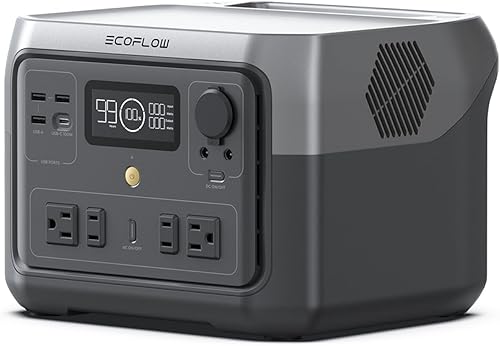
- 499Wh LiFePO4 battery
- Up to 1000W output
- 1 hour AC recharge
- 220W solar input
- 13.3 lb weight
A compact 499Wh station built around 1 hour AC charging, 1000W output and a 13.3 lb carry weight for camping, RV trips and home backup.
Pros
- 1 hour AC recharge
- 1000W output for essentials
- LiFePO4 battery with BMS protection
- Lightweight at 13.3 lb
- 220W solar input
Cons
- 499Wh limits longer backup runs
- Solar panel is optional
- Smaller than the DELTA alternatives here
That size matters for how you use it. At 10.6 x 10.2 x 7.7 inches, it fits in a car trunk, an RV storage bay or a closet shelf far more easily than a 2048Wh DELTA unit.
Portability is not a vague claim here. It comes from the stated weight and dimensions.
The black cabinet uses model number EFR607, and EcoFlow lists the item type as a portable power station for camping and residential use. The 60 hertz frequency and 8 A current rating confirm it is designed for standard North American household outlets.
Who the RIVER 2 Max 500 suits
Buy it if you camp, take RV trips or want a grab-and-go unit for short outages. Its recommended uses are camping and residential use, and its portable design matches those tasks.
It also fits buyers who need a first station for small loads such as lights, phones, laptops and a small fan. Those loads stay well under the 1000W ceiling, so the unit can run several at once without strain.
Skip it if you need to run high-demand appliances for many hours. A 499Wh battery is a compact energy budget, and the math in the next section shows how quickly it drains.
Skip it also if you want expandable capacity or a large outlet count. The DELTA 2 Max in this review expands to 6kWh and offers 15 outlets, which is a different design direction entirely.
EcoFlow RIVER 2 Max review: the specs that matter
The key specs are 499Wh capacity, 1000W output and LiFePO4 chemistry. EcoFlow says the LiFePO4 battery is built for over 10 years of use, with a battery management system that monitors voltage, current and temperature.
Output reaches up to 1000W, and EcoFlow says it can run 11 essential appliances at the same time. X-Boost technology lets it handle devices up to 1000W, though EcoFlow advises testing before use with high-wattage appliances.
Runtime uses a simple formula from EcoFlow: 499Wh x 0.85 divided by your appliance wattage. That 0.85 factor is a useful reality check.
It means the usable energy is lower than the headline 499Wh once conversion losses are included.
Electrical specs help explain that limit. The unit runs on battery power with a maximum of 1000 watts, so any combination of devices must stay below that ceiling.
EcoFlow also lists the running wattage as 1000 watts, which reinforces the need to plan loads rather than assume headroom.
What 499Wh means in daily use
A 499Wh rating does not mean 499 watts for one hour in practice. After the 0.85 factor, you have about 424Wh to work with across whatever you plug in.
That helps you plan. A 100W load would run for roughly 4.2 hours by that formula, while a 400W load would run for just over one hour.
Those are illustrations of the formula, not promises for any specific appliance, because real draw varies.
A 50W load would last about 8.5 hours by the same math, which shows why small devices stretch the battery much further than large ones. Two 100W loads running together would cut that time in half, even though each device alone looks efficient.
The practical lesson is to list your loads before a trip or outage. Add the wattages of the devices you actually plan to run together, then divide.
If the result is short, drop a device or plan a recharge.
Charging speed: 1 hour on AC, 2.3 hours on solar
Charging speed is the strongest point in this RIVER 2 Max review. EcoFlow says X-Stream brings AC charging to 1 hour from a standard outlet.
That speed suits pre-trip top-ups and quick recovery after a short outage.
Solar charging reaches as fast as 2.3 hours with 220W of solar input. That is a peak figure tied to input size and conditions, so treat it as a best-case planning number rather than a guarantee for a cloudy day.
Ports and running 11 appliances at once
EcoFlow describes a range of ports, from 300W AC outlets to USB-C, covering different plug types. Running 11 appliances at the same time is possible within the 1000W limit, but total wattage still decides runtime.
Use the port mix to separate small devices from larger loads. Keep phone and laptop charging on USB-C while reserving AC outlets for appliances that need them.
That simple split helps you stay inside the 1000W ceiling.
Running many small devices at once can feel like an advantage on a campsite table. It works only if their combined draw stays low, so check labels before you plug in a full set of chargers and lights.
Setup: what is in the box and what to add
Setup starts with the power station, AC charging cable and quick start guide. A solar panel is optional, and EcoFlow lists 5-year service with this model.
Charge it fully before your first trip, then test the devices you plan to bring. EcoFlow specifically advises testing high-wattage appliances before relying on them, because X-Boost mode has limits even though it supports devices up to 1000W.
Store it somewhere dry and accessible, and keep the AC cable with the unit. For home backup, plug it in where you can reach it quickly, since EcoFlow says it switches to battery mode within 30 milliseconds when grid power stops.
First setup checks before a trip
Do a short test run at home with your exact load list, and note how fast charge drops under those loads. That test gives you a personal runtime estimate that is more useful than a generic spec sheet.
Also confirm your solar plan if you intend to charge outdoors. The station accepts up to 220W of solar input, so a panel and cable setup must match that limit and connect correctly before you leave.
UPS behavior and home backup limits
EcoFlow says that when plugged into the wall, connected devices get grid power, not battery power. If grid power stops, the unit switches to battery supply mode within 30 milliseconds.
That behavior suits brief outages and sensitive electronics better than a long blackout. It does not turn a 499Wh unit into a whole-home system.
Your runtime still follows the 499Wh x 0.85 formula once the battery takes over.
For readers who want longer backup, our Best Ecoflow Portable Power Station guide puts this compact model in the wider EcoFlow range. That comparison helps you judge whether portability or capacity should win for your home.
Care and battery life in general terms
The LiFePO4 chemistry is built for long service, with EcoFlow citing over 10 years of use. The built-in BMS monitors voltage, current and temperature to protect the battery during charging and discharging.
Keep the unit dry, avoid blocking vents, and recharge it periodically during storage following EcoFlow guidance for your model. Use the included AC cable for wall charging, and keep the quick start guide handy for mode and port details.
Clean the exterior with a dry cloth and store it at a comfortable room temperature. The DELTA 2 Max data in this post also highlights LiFePO4 longevity at 3000 cycles to 80% capacity, which shows how EcoFlow positions this chemistry across its range.
Storage habits that protect the battery
Store the unit at a partial charge for long periods if EcoFlow guidance for your model suggests it, and top it up before a season of use. That habit helps the BMS keep its readings accurate and the battery ready for a trip.
Avoid leaving the unit in a hot car or a damp garage for weeks, since heat and moisture stress batteries and electronics. A cool, dry shelf with the cable stored alongside keeps it ready to grab and go.
Trade-offs: compact size against capacity
The main trade-off is 13.3 lb portability against only 499Wh of storage. You gain a unit you can carry to a campsite or car, and you give up the multi-hour runs a 2048Wh station can offer.
EcoFlow lists 5-year service for the RIVER 2 Max 500, which helps offset that limit for long-term ownership. Still, no service plan changes the energy math.
A fridge, microwave or power tool will drain 499Wh far faster than phone charging will.
Compare that with our Is Jackery Better Than Ecoflow? guide if you are weighing brands. The right choice depends on your loads, your trips and how much weight you are willing to carry.
Alternatives in this review
The two DELTA alternatives below offer 2048Wh, roughly four times the RIVER 2 Max capacity. They suit readers who liked the RIVER 2 Max idea but need longer backup or higher output.
EF ECOFLOW DELTA 3 Max Portable Power
The DELTA 3 Max recharges from 0 to 80% in 1.13 hours and switches with a transfer time under 10 milliseconds. Its ultra-quiet operation and app control suit home backup, while its larger cabinet suits fixed storage more than frequent carrying.
Its dimensions are 9.4 x 12 x 19.44 inches, with an aluminum and plastic build, so it needs more shelf and trunk space than the RIVER 2 Max. The trade is clear, since you gain 2048Wh and 2400W output with 3400W X-Boost for larger appliances.
EF ECOFLOW Portable Power Station DELTA
The DELTA 2 Max charges to 80% in 43 minutes when combining up to 1000W solar input with AC, and it offers 15 outlets. EcoFlow says its volume starts from 30 dB, which helps for overnight use inside a home or RV.
Its weight is listed at 23 kg, and its size is 12.2 x 9.7 x 20 inches, so it is far less portable than the 13.3 lb RIVER 2 Max. Expansion to 6kWh with extra batteries is its main strength, but those batteries are separate purchases.
If you are comparing newer RIVER models, our ecoflow river 3 plus review covers the next step up in that line. It is a useful check before you settle on the 2 Max.
RIVER 2 Max 500 vs newer and larger EcoFlow options
The RIVER 2 Max 500 wins on weight and AC recharge speed, while DELTA models win on capacity. That split should drive your choice more than brand preference alone.
Our ecoflow river 3 plus vs max plus comparison helps if you want to see how EcoFlow positions its Plus models above the RIVER 2 Max. Read it alongside this review to map the full range from compact to large.
Also compare the ecoflow river 3 plus vs river 3 plus wireless if wireless features matter to you. Those models sit in a different tier, so use them to confirm whether you truly need the extra features.
Verdict: who should buy the RIVER 2 Max 500
Pick the RIVER 2 Max 500 if you want a 13.3 lb station with 1 hour AC charging and 1000W output for camping, RV trips and short outages. Its LiFePO4 battery, BMS protection and 5-year service support long-term use in that role.
Pick a 2048Wh DELTA model if you need longer runtime, 2400W output or 3400W X-Boost for larger appliances. Capacity, not charging speed, is the deciding factor once your loads grow.
In this ecoflow river 2 max review, the compact model earns its place for portability and speed. Buy it for what 499Wh can honestly do, plan your loads with the 0.85 formula, and recharge before you need it most.
Frequently asked questions
How long does the EcoFlow RIVER 2 Max 500 recharge?
EcoFlow says the RIVER 2 Max 500 recharges in 1 hour using a standard AC outlet with X-Stream fast charging. It can also recharge in as fast as 2.3 hours with 220W of solar input.
Check your outlet and solar setup before a trip so you know which method you will use.
What can the RIVER 2 Max 500 power?
It delivers up to 1000W and can run 11 essential appliances at the same time, according to EcoFlow. Runtime depends on wattage, and EcoFlow gives the formula 499Wh x 0.85 divided by operating wattage.
Add up your devices first, because a 499Wh battery runs out faster than its wattage rating suggests.
Is the RIVER 2 Max 500 good for home backup?
It suits short home backup for essentials, not whole-home backup. The 499Wh capacity and 1000W output cover small loads, and EcoFlow says it switches to battery mode within 30 milliseconds when plugged into the wall.
For longer outages, compare the 2048Wh DELTA models covered in this review.
What is included with the RIVER 2 Max 500?
The box includes the RIVER 2 Max 500 power station, an AC charging cable and a quick start guide. EcoFlow also lists 5-year service for this model.
A solar panel is optional, so add one only if you plan to charge outdoors or want a solar backup option.


