How Many Watts Does an Electric Cooler Use?
Most compressor electric coolers use about 45 to 60 watts while running. Actual battery drain depends on the cooling cycle, temperature setting, insulation, and power source.
On this page (8 sections)
- How many watts do electric coolers use?
- What changes an electric cooler's watt use?
- How much power does a 12V compressor cooler need?
- How do you estimate electric cooler battery runtime?
- What is the difference between running watts and daily energy?
- How do you choose between 45W, 60W, and larger power needs?
- Can you charge an electric cooler from a vehicle?
- What should you pick for your electric cooler power plan?
Most electric coolers use about 45 to 60 watts while actively cooling, with compressor models cycling on and off instead of drawing that amount every minute. The right power supply depends on the cooler's running watts, expected duty cycle, battery voltage, and how long you need cooling.
Watts measure the rate of electrical use. For a related appliance estimate, see 12V mini fridge wattage.
Watt-hours estimate the energy used over time, so a cooler rated at 45 watts does not automatically consume 45 watt-hours every hour if its compressor rests between cooling cycles.
How many watts do electric coolers use?
Compressor electric coolers commonly use about 45 watts in ECO operation and up to 60 watts in MAX operation. The exact figure varies by model and conditions.
For a simple estimate, multiply watts by hours:
watts × hours = watt-hours
A 45-watt cooler running continuously for 10 hours would use 450 watt-hours. A cooler that cycles on and off may use less than that, but hot weather, warm food, frequent openings, and a low temperature setting can increase the cooling work.
The product's input rating matters when choosing a battery, inverter, or power station. The average energy use matters when estimating how long that supply will last.
What changes an electric cooler's watt use?
Temperature, weather, airflow, contents, and door openings can change how long the compressor runs. The watt rating describes the electrical rate, but not the complete daily energy total.
A cooler works harder when it starts with warm food or drinks. For campsite-ready choices, see portable fridges for camping.
It also needs more cooling in direct sun or a hot vehicle, while shade and good airflow around the cabinet can reduce heat buildup.
Opening the lid or door lets cold air escape. Pack the cooler in a way that keeps common items within reach, and avoid leaving it open while deciding what to take out.
ECO mode usually prioritizes lower energy use, while MAX mode prioritizes faster cooling. Use the setting that matches the job, then allow the cooler to cycle instead of expecting the compressor to run constantly.
How much power does a 12V compressor cooler need?
A 12V compressor cooler using 45 watts draws about 3.75 amps at 12 volts before electrical losses. The calculation is watts divided by volts: 45 ÷ 12 = 3.75 amps.
At 60 watts, the same simple calculation gives 5 amps at 12 volts. Real current can vary with voltage, startup behavior, wiring, and the cooler's control system.
A 12V connection is useful in a vehicle, but battery capacity still controls runtime. A vehicle battery can start an engine, yet that does not mean it is suitable for extended accessory use without protection or recharging.
For a wider look at sizes, cooling methods, and features, see this best 12V portable fridge buying guide. If you're comparing battery types for a smaller appliance, our guide explains what battery a mini fridge uses.
Which electric cooler uses about 45 watts?
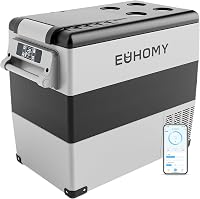
The EUHOMY 59QT 12 Volt Refrigerator lists average power consumption of 45W and offers ECO and MAX modes. Its 59QT format suits readers who need more room for meals, drinks, snacks, and frozen food during longer trips.
It includes 12/24V DC and 110/240V AC adapters, so it can work from a vehicle connection or a household outlet. Compare AC/DC electric coolers for more models with both connection types.
For more vehicle-focused options, compare best 12V fridges for cars.
Its three-level battery protection is relevant when the cooler will run from a vehicle battery during travel or overnight stops.
The 55-liter capacity is larger than the other two products here. Measure your available space before choosing a larger cabinet, especially when the cooler must fit behind seats or in a packed vehicle.
For truck-specific options, compare electric coolers for trucks.
How do you estimate electric cooler battery runtime?
Divide usable battery watt-hours by estimated cooler watt-hours per hour, then allow for losses and changing conditions. This is a planning estimate, not a guaranteed runtime.
For example, a 500Wh power station paired with a cooler averaging 45W would equal about 11.1 hours before conversion losses if the cooler ran at that average continuously. A power station's usable output can be lower than its stated battery capacity.
The same idea works with a battery bank:
estimated hours = usable watt-hours ÷ average watts
Keep the battery away from heat and moisture, use the correct cable, and follow the cooler and power station instructions. Do not treat a battery protection feature as a replacement for a suitable power source.
If you want to use solar charging, read how to choose solar panels for an electric cooler. Solar output changes with sunlight, shade, panel angle, temperature, and the charge controller.
Which 30-quart cooler fits a lower-power setup?
The BougeRV 12v refrigerator 30 Quart lists about 45W in ECO mode and 60W in MAX mode. Its 30-quart size suits readers who want a smaller compressor cooler and need a clear power estimate for vehicle or power-station use.
BougeRV states that the cooler can use less than 1kWh per day in MAX mode because its compressor cycles. That figure is useful for planning, but actual energy use still depends on weather, settings, contents, and openings.
The package includes a removable partition board, a DC power cord, a 6.56 ft AC power cord, and a user manual. Its listed dimensions are 22.68 x 12.60 x 15.53 in, so check the storage space before relying on the 30-quart label alone.
What is the difference between running watts and daily energy?
Running watts tell you the power needed at a moment, while daily energy tells you how much battery capacity you may need. Both numbers matter when choosing a power station.
A power station must handle the cooler's operating demand without overload. Its battery must also hold enough watt-hours for the time between recharges.
A cooler that runs at 45 watts but cycles for half the day would use less than 1,080 watt-hours in 24 hours. That is only a rough illustration because cycling is affected by temperature and use.
If you connect through an AC inverter, allow for inverter losses. Direct DC operation can avoid some conversion work, but the cable and connection still need to match the cooler's requirements.
For setup details, see how to run an electric cooler on a power station. If you're deciding between different battery-equipped models, compare these best portable refrigerators with batteries.
Which mid-size cooler balances capacity and watt planning?
The EUHOMY 37QT 12 Volt Refrigerator lists 148 kWh annual energy consumption and provides ECO and MAX modes. Its 37QT capacity suits readers who want more space than a compact cooler without moving to the largest model here.
It includes 110/240V AC and 12/24V DC adapters. The cooler also has three-level battery protection, which can help manage vehicle-battery use when the correct voltage setting and connection are used.
The cabinet measures 25.98 x 17.5 x 16.9 in and weighs 32.9 lb. Compare electric coolers with wheels if easier movement matters.
Its wheels and pull handle may suit travel where you need to move the cooler, but those dimensions and weight still matter when loading a vehicle.
How do you choose between 45W, 60W, and larger power needs?
Choose the power source from the cooler's highest stated operating demand, then estimate battery capacity from its expected average use. A power station with enough watt-hours but too little output can still be a poor match.
Use these steps:
- Find the cooler's stated watts or input range.
- Use the higher operating figure when checking power-station output.
- Estimate watt-hours for the planned hours away from charging.
- Allow for inverter or conversion losses.
- Add a margin for hot weather, warm contents, and frequent openings.
- Confirm the cable, voltage, and battery-protection settings.
A 45-watt ECO figure should not be treated as a permanent maximum. A 60-watt MAX figure should not be treated as the cooler's all-day energy use.
Can you charge an electric cooler from a vehicle?
Yes, many 12V coolers are designed for 12/24V DC vehicle power, but the vehicle battery and connection must support the load. Use the cooler's battery protection settings and avoid assuming the vehicle can supply power indefinitely while parked.
The EUHOMY 59QT, BougeRV 30 Quart, and EUHOMY 37QT products each include DC power options in the supplied product information. Confirm the correct connection before use, and keep plugs and cables dry.
Read do you charge an electric cooler for the difference between powering a cooler and recharging a separate battery that runs it.
What should you pick for your electric cooler power plan?
For electric cooler watts, start with the stated operating range, then size your power supply around both watts and watt-hours. The 45W figures in these products support lower draw estimates, while MAX operation can reach 60W on the BougeRV model.
Choose the EUHOMY 59QT for the largest capacity here, BougeRV's 30 Quart model for a smaller cooler with stated ECO and MAX watt figures, or the EUHOMY 37QT for a middle capacity with annual energy data. If you need a separate battery system, compare the best electric cooler for a power station before choosing the cooler and power source together.
Frequently asked questions
How many watts does an electric cooler use?
Most compressor electric coolers use about 45 to 60 watts while the compressor is running. The cooler may not draw that amount continuously because the compressor cycles on and off.
Ambient heat, contents, temperature settings, insulation, and door openings all affect total energy use.
Can a 12V battery run an electric cooler?
Yes, a 12V battery can run a compatible electric cooler when its capacity, wiring, and protection settings are suitable. A cooler using 45 watts draws about 3.75 amps at 12 volts before losses.
Use the cooler's battery protection and monitor the battery's state of charge.
How big should a power station be for an electric cooler?
Choose a power station with enough continuous output for the cooler and enough watt-hours for the planned runtime. A 45-watt cooler running for 24 hours would equal 1,080 watt-hours at a constant draw, but cycling can reduce real use while inverter and conversion losses reduce usable capacity.
Do electric coolers use less power than portable refrigerators?
The names overlap, so compare the cooling method and watt draw instead. Compressor portable refrigerators commonly show running power around 45 to 60 watts in the products compared here.
A thermoelectric cooler may show a different draw and may cool differently, so check its electrical specifications before sizing a battery.