What Does the PECRON F3000LFP Cascade Cable Do?
A pecron f3000lfp cascade cable is a model specific link cable meant to join compatible PECRON parts in a cascade setup. It is not a general charging lead, so check the F3000LFP manual and the mating ports before you use it.
On this page (12 sections)
- What is a pecron f3000lfp cascade cable for?
- How does a cascade link differ from a normal power lead?
- Which pecron f3000lfp cascade cable setup does it belong in?
- Can you daisy chain power stations with this kind of cable?
- How is it different from adding an expansion battery?
- What should you check on the cable before first use?
- What are the limits and trade offs of a model specific cable?
- Which related gear helps in a cascade or charging setup?
- What should you do if the cable does not pair or will not fit?
- How should you store and care for the cable?
- Who should buy a spare pecron f3000lfp cascade cable?
- What is the final rule for using this cable?
A pecron f3000lfp cascade cable is the link that lets you join compatible PECRON equipment in a cascade setup. It helps the units communicate or transfer power through the correct ports.
That matters because a cable can fit a socket and still be wrong. Pin layout, voltage, current, and signalling can differ between lookalike leads.
What is a pecron f3000lfp cascade cable for?
It connects two matched parts so they work as one cascade system. It does not create power on its own.
Think of it as a link between parts already built to work together. The port may carry status signals, charge limits, and pairing data as well as power.
A generic lead can miss those signals or make contact in the wrong order. That is why the F3000LFP name matters.
It identifies the pinout and ratings the cable was built for.
How does a cascade link differ from a normal power lead?
A normal lead carries power. A cascade link can carry power plus pairing data.
That data lets units share load, report status, or charge in a set order.
A wall charger sends power in one direction. A cascade link is closer to a data cable with a power role, so both ends and orientation can matter.
Length and connector shape are clues, not proof. Two cables can share a plug shape and differ inside, with different pins wired.
Solar leads are also different. They move power from panels to a charge input, while a cascade link joins equipment designed to act as a set.
Our guide on how to extend solar cables without power loss covers solar runs, not cascade links.
Which pecron f3000lfp cascade cable setup does it belong in?
It belongs only in the setup PECRON names for the F3000LFP. Check the manual for the exact pairing before plugging it in.
If the manual shows the cable in a diagram, use it there. If it does not show it, do not use it there.
Open ports can be inputs, outputs, service ports, or ports for another accessory. The manual is the map for which is which.
Also compare any part number on the cable or tag with the manual. A close name is not a close enough match.
Keep the cable with the unit it came with and label it. That habit avoids a wrong connection months later.
Can you daisy chain power stations with this kind of cable?
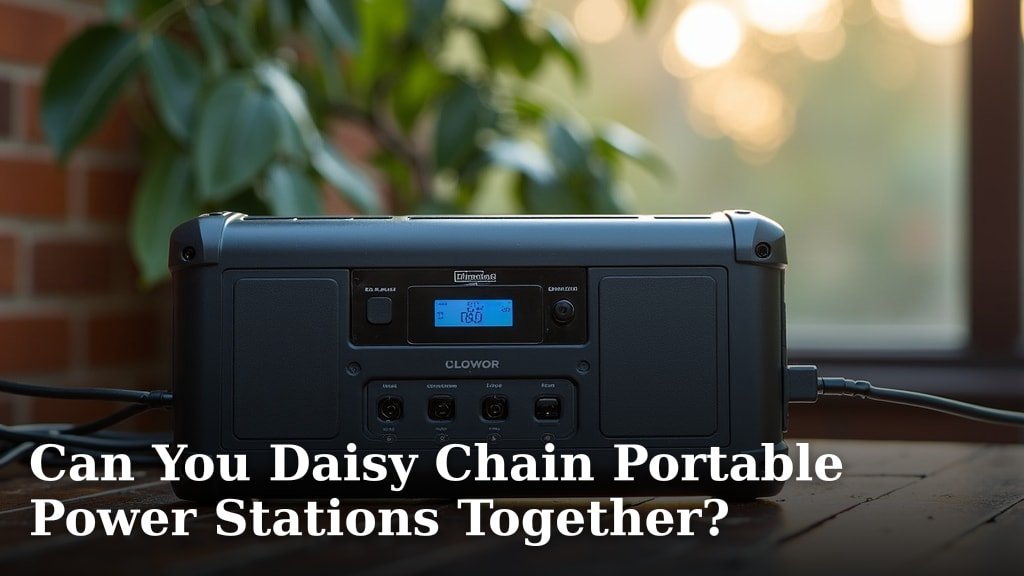
Only if the maker designed that exact pairing for daisy chaining. A cascade link does not make any two power stations safe to chain.
Our post on whether you can daisy chain portable power stations together explains why the maker list matters.
Two units can disagree on voltage, charge rate, or shutdown order. One can also feed back into the other when the first stops.
The designed cable and firmware handle those cases together.
Treat the cable as permission only within its written scope. It does not grant permission to join another brand, a larger model, or an extra unit the manual never names.
How is it different from adding an expansion battery?
An expansion battery adds stored energy. A cascade cable links units in a set order.
Most owners should plan the battery first.
Our guide to what an expandable power station add battery setup means can help you plan extra run time. The cable question comes after that choice.
Do not assume a cascade cable can stand in for a battery cable. The battery cable is rated and wired for that battery, and the cascade link is rated for its named link.
List parts in order when upgrading. Start with the power station, then the battery, then the exact cable for that pair, then any cascade link the manual calls for.
For choosing that battery step, our Best Power Station Expansion Battery guide compares the questions to ask.
What should you check on the cable before first use?
Check the name, both ends, the pins, and any labels before connecting it. A short check can prevent a hard fault.
Look for the F3000LFP name or part number on the cable, tag, or packaging. Compare each plug for key shape, pin count, and any arrow near the port.
Check both unit ports at the same time. One end may be an input and the other an output, and reversing them can stop pairing.
Inspect insulation for cuts, bends, or heat damage. Replace a damaged cable rather than using tape and hoping it holds.
How do you connect a pecron f3000lfp cascade cable safely?
Power both units off, connect each end fully, then switch on in the manual order. That order protects contacts and lets units pair cleanly.
Start off and unplugged from solar, wall power, and loads. Place units on a flat, dry surface with space for airflow, then seat each plug fully.
Do not wiggle or force a plug. If it will not seat, stop and recheck the port and cable name.
After switching on, watch the first few minutes for error codes, fan noise, heat at plugs, or failure to start. Heat or repeated faults are not normal.
What are the limits and trade offs of a model specific cable?
You get a safe, known fit, and you lose freedom to improvise. That is a good trade for data or high current links.
You cannot use a spare lead from another brand, extend it with an adapter, or clone it from a parts bin. Each limit protects the pairing.
Cost is part of the trade off. A named spare can cost more than a plain lead, but a wrong lead can cost far more in a damaged port.
Availability can slow a repair if the cable is lost. Label and store it with the station, not in a shared drawer.
Which related gear helps in a cascade or charging setup?
Related gear helps when it fills a clear gap, like backup power, wall charging, or battery care. None of these parts replace the cascade cable.
For a small 12 volt backup role, the ExpertPower EXP1270 is a 12 volt 7 amp hour sealed lead acid battery with F1 terminals. It suits alarm systems, security devices, and UPS units that use that size.
It measures 5.94 by 2.56 by 3.70 inches, with a height of 3.94 inches including terminals.
This battery is for its own 12 volt systems. It is not a PECRON expansion battery and does not connect through a cascade port.
For wall charging a Goal Zero station, the T Power 16 volt charger is an AC adapter with an 8 millimeter jack and a 5 foot cable. It lists compatibility with Goal Zero Yeti and Sherpa models named in its title and specs, including Yeti 150, 400, 1000, and 1250 families.
This charger covers wall charging for those Goal Zero units. It is not a PECRON cascade link and should not be used on a PECRON port.
For powersports battery care, the Battery Tender Junior 12 volt is an 800 milliamp charger and maintainer. It switches between lead acid and lithium types, including AGM, flooded, gel, and LiFePO4, and uses alligator clips and fused ring terminals.
This maintainer suits motorcycles, ATVs, and similar 12 volt batteries. It does not charge a power station or link two stations.
What should you do if the cable does not pair or will not fit?
Stop, power down, and recheck the model name and port labels. Most failures come from a wrong cable, wrong port, or a plug not fully seated.
Confirm the cable matches the exact part number the manual names. Then confirm each end is in the port shown in the diagram, as a cascade port and solar input can sit close together.
Next, check charge state. Some systems will not pair if one unit is empty, in storage mode, or locked by a fault.
Charge or reset each unit as directed.
If plugs seat but units do not pair, inspect pins for bends or dirt. Clean ports with dry air only and do not insert a tool to straighten pins.
If faults repeat, disconnect the link and run each unit alone. Note the error code and steps tried so support can help faster.
How should you store and care for the cable?
Store it flat or loosely coiled, dry, and labeled with its model name. That keeps pins straight and the cable easy to find.
Avoid tight bends near plugs. Heat and tight bends can break fine wires inside insulation while the outside still looks fine.
Keep it out of wet storage. Moisture and dust in a plug can cause contact faults, and a pouch stops tangling with solar leads and wall chargers.
Replace the cable if insulation cracks, a plug feels loose, or faults occur only when the cable moves. Those signs point to internal damage.
Who should buy a spare pecron f3000lfp cascade cable?
Buy a spare if you run the cascade setup often, travel with it, or would lose run time without it. A single home setup may not need one.
A spare makes sense for camping, RV trips, and backup plans where a lost cable stops the whole set. It also helps if the cable is packed and unpacked often.
Label the spare, store it with the station, and test it once at home. An untested spare is only half a spare.
Do not buy a spare as a substitute for the right battery or charger. For more run time, plan the battery step first with our guide on how to connect two power stations together.
What is the final rule for using this cable?
Use the pecron f3000lfp cascade cable only where the F3000LFP manual names it, in the direction and order shown. That rule covers almost every safe use.
If the manual shows the link, connect it with both units off and watch the first run closely. If it does not show it, leave the port alone.
That choice keeps expansion batteries, solar leads, and wall chargers in their own roles. When cable name, ports, and order are unclear, pause and check the manual again.
Frequently asked questions
What does a PECRON F3000LFP cascade cable do?
It links compatible equipment in a PECRON cascade arrangement for the F3000LFP. Its job is connection between matched ports, not charging by itself.
Confirm the exact cable name, connector shape, and direction in the manual before connecting anything.
Can a cascade cable replace an expansion battery cable?
Not unless PECRON lists that cable for that expansion battery and model. Expansion cables and cascade links can look similar but carry different roles.
Use the cable named for the battery pairing, and keep the original cable if the manual calls for it.
What should I check before using the cable?
Check the model name, both connector ends, any arrows or labels, and the charge state of both units. Power everything off, connect the cable fully, and watch the first few minutes for heat, errors, or loose contact.
Stop if anything feels wrong.