How to Run a Koolatron Cooler from a Power Station
To run a Koolatron cooler from a power station, match the cooler’s DC plug and voltage to a compatible output, then estimate runtime from usable battery capacity and the cooler’s draw. Check the cooler’s manual for its exact requirements.
On this page (7 sections)
- What power does a Koolatron cooler need?
- How do you connect the cooler to a power station’s DC outlet?
- Can you power the cooler through an AC outlet?
- How long will the power station run the cooler?
- How much battery capacity should you plan for?
- What should you check before a trip?
- Which power station setup makes sense for your cooler?
To run a Koolatron cooler from a power station, match the cooler’s DC plug and voltage to a compatible output, then estimate runtime from usable battery capacity and the cooler’s draw. Check the cooler’s manual for its exact requirements.
Koolatron makes different cooler models, so there is no single power requirement for all of them. Find the model number and input details on the cooler label or in its manual before choosing an outlet, cable, or power station.
What power does a Koolatron cooler need?
A Koolatron cooler needs a power source that matches its input voltage, connector, and current requirement. The exact figures depend on the model, so use the cooler’s own label or manual rather than assuming every model uses the same DC connection.
Look for a voltage marking and any current or wattage figure near the power cord or input port. If only voltage and current are shown, multiply volts by amps to estimate watts; for example, 12 volts at 5 amps equals 60 watts.
The watt figure helps you judge whether a station can supply enough power, while watt-hours help estimate how long its battery may last. These are different limits: a station can have enough total energy but still lack a suitable outlet or enough output capacity.
For a higher-draw appliance example, see whether a 2000W power station can run a hair dryer.
How do you connect the cooler to a power station’s DC outlet?
Connect the cooler’s DC plug directly only when the outlet matches the cooler’s electrical requirements. Many power stations include a car-style DC outlet, but the connector shape alone does not confirm voltage or current compatibility.
Before connecting, check both manuals for the outlet voltage and maximum current. Use the cable recommended for the cooler, and don’t force a plug or use an adapter just because it fits.
Keep the power station and cooler dry, and leave airflow around both devices. If either manual gives placement or temperature instructions, follow those directions.
Can a Koolatron cooler use a car-style 12 V socket?
A car-style socket may be suitable if your specific cooler is designed for that voltage and the station’s socket can supply the required current. Confirm the details in both manuals before plugging in.
The Jackery Explorer 300 includes a 120 W car port and has a 300 W rated output. Its 292 Wh capacity is one factor in runtime, not a guarantee of a fixed number of hours.
Can you power the cooler through an AC outlet?
Use an AC outlet only if the cooler’s manual allows AC input or you have a suitable power adapter specified for that model. A power station’s AC outlet does not make an incompatible cooler safe to connect.
AC power passes through an inverter, which consumes energy. If the cooler can use a compatible DC supply, that route may avoid inverter losses and leave more battery energy for the cooler.
The BLUETTI Elite 30 V2 offers 600 W of continuous AC output and a 288 Wh battery. Its output rating alone does not tell you how long it can run a particular cooler; check the cooler’s draw and account for station overhead.
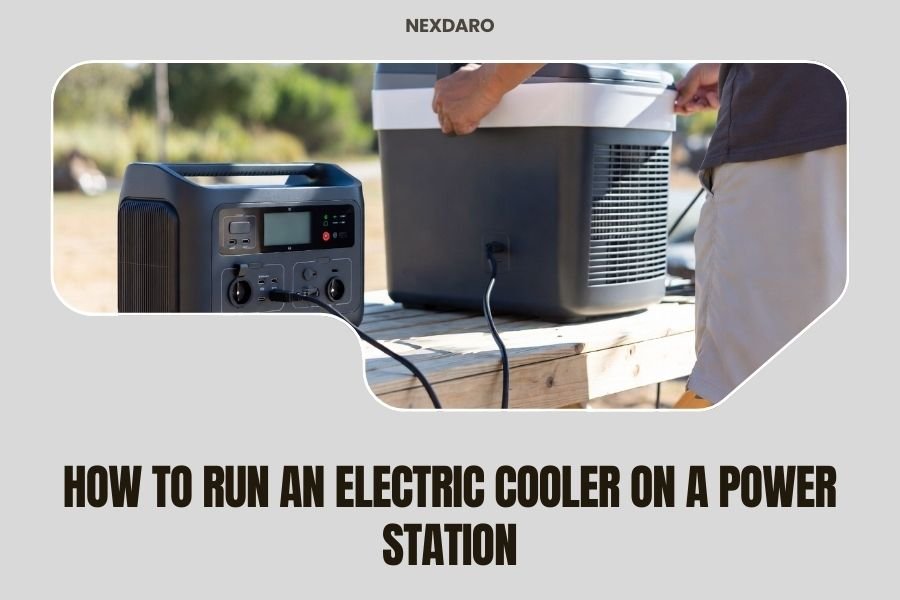
For general connection steps and power estimates, see how to run an electric cooler on a power station. If you’re comparing cooler types, best electric cooler for power station can help frame the choice.
How long will the power station run the cooler?
Estimate runtime by dividing usable battery watt-hours by the cooler’s average watt draw. For a rough first estimate, use the station’s stated capacity, then expect actual runtime to be lower because of conversion losses, temperature, and other conditions.
For example, a cooler drawing an average of 40 W from a 300 Wh station gives a simple estimate of 7.5 hours before losses: 300 Wh ÷ 40 W. This is only a planning calculation, not a runtime promise; the cooler may draw more or less as conditions change.
If the cooler’s wattage is unknown, check its label or manual. A plug-in watt meter can help measure AC draw when the cooler is designed for AC use, but use equipment that is rated for the connection and follow its instructions.
What changes the runtime estimate?
The cooler’s average draw and the station’s usable energy have the biggest effect. Warmer surroundings, frequent lid openings, poor airflow, and a warm cooler load can increase energy use.
A 1,000 Wh station does not necessarily deliver 1,000 Wh to a device. Inverter losses reduce the energy available on AC, and the station may have its own low-battery cutoff or other operating limits.
For a broader sense of battery capacity, read what a 1000 Wh power station can run. For trips that also need lights and a camping fridge, compare power stations for a camping fridge and lights.
How much battery capacity should you plan for?
Choose capacity based on how many hours you need the cooler to run and its average draw. Multiply the cooler’s watt draw by planned hours to estimate energy use, then add a margin for losses and changing conditions.
A 292 Wh station suits a different energy budget than a 3,584 Wh station. The Jackery HomePower 3600 Plus provides 3,584 Wh of capacity and 3,600 W AC output, so it may fit a larger backup plan when the cooler’s connection and requirements are compatible.
A larger station is heavier and may be more than you need for a short trip. Estimate the cooler’s energy use first, then account for any lights, phones, or other devices you plan to run at the same time.
If a TV is also on your device list, compare portable power stations for TVs.
For satellite internet on the trip, compare power stations for Starlink Mini.
What should you check before a trip?
Confirm the cooler’s model requirements, the station’s matching output, and your expected runtime before leaving. Bring the correct cable and check that it is in good condition.
Test the setup at home while you can consult both manuals. Watch for warning lights, unexpected shutdowns, loose connections, or a cable that becomes unusually warm; stop using the setup if you notice a problem.
Keep the cooler shaded and ventilated, and limit lid openings to help control its power use. If the cooler will run overnight, plan a backup way to keep food or drinks cold if the station runs low.
Which power station setup makes sense for your cooler?
For a Koolatron cooler, start with the cooler’s input label, then choose a station with a matching connection and enough capacity for your planned hours. A small station may be enough for brief use, while longer outings or multiple devices call for a larger energy budget.
Consider the Explorer 300 when its 120 W car port and 292 Wh capacity match your cooler and trip. Consider the Elite 30 V2 if you need its 288 Wh capacity and your cooler can use the station’s AC output; consider the HomePower 3600 Plus when your plan calls for its larger 3,584 Wh capacity.
For more options, compare best power stations for electric coolers. If you’re sizing a station for other essential equipment too, see the best power station for running a CPAP for a week.
Frequently asked questions
Can a Koolatron cooler run from a power station?
Yes, if the station has an output that matches the cooler’s required voltage, connector, and current, and its capacity can cover the expected use. Check the cooler manual and power station outputs before connecting them; a plug that fits does not by itself confirm electrical compatibility.
Can I connect a Koolatron cooler to a power station’s car outlet?
You can use a car-style DC outlet only if the cooler’s plug and electrical requirements match that output. Confirm the outlet’s voltage and current limits in both manuals, and avoid adapters that change the connector without confirming the electrical match.
How do I estimate Koolatron cooler runtime?
Divide the power station’s usable watt-hours by the cooler’s average watt draw to get a rough runtime in hours. Use the cooler’s actual draw if its manual or label provides it, and allow for conversion losses, temperature, ventilation, and cycling, which can shorten real runtime.
Is a power station’s AC outlet better for a Koolatron cooler?
Use the cooler’s recommended input when possible. If its manual permits AC power, an AC outlet may work, but an inverter uses extra energy; a compatible DC connection can avoid that conversion.
Check both manuals before choosing a cable or adapter.