Can You Charge an EV with a Portable Power Station?
On this page (7 sections)
Yes, you can charge an Electric Vehicle (EV) with a portable power station, but it’s not always a simple plug-and-play situation. While many portable power stations offer enough juice to give your EV a tiny bit of range, their limited output means it will take a very long time to add meaningful miles. You’ll need to consider the power station’s capacity and output versus your EV’s charging needs. For another electric ride, see how to charge an electric bike with a power station.
This setup is best suited for emergencies or when you need to top off your EV battery in a pinch. It’s unlikely to replace your home charging station or public charging for daily use. We’ve researched how various power stations perform and found that charging speed is the biggest limiting factor for EV owners considering this option. It’s about managing expectations and understanding the practical limitations.
- Yes, you can charge an EV with a portable power station.
- It will add a small amount of range, but slowly.
- Not a replacement for regular home or public charging.
- Check power station output and EV charging input specs.
- Best for emergencies or a tiny top-up.
Let’s walk through exactly how this works and what you need to know to make it happen.
Can You Really Use a Portable Power Station to Charge Your EV?
The short answer is yes, but with some pretty big caveats. Think of it like trying to fill a swimming pool with a garden hose. You’ll eventually get water in it, but it’s going to take a while. A portable power station can provide a charge to your electric vehicle, but it’s generally not going to be a quick or substantial one.
We’ve looked into this, and it’s important to manage your expectations. This isn’t a replacement for your home charger or a fast-charging station at a public spot. It’s more of a lifesaver in a pinch or for a very small top-up when you’re stranded.
Understanding the Basics: Power Station vs. EV Charging Needs
To grasp why this isn’t as simple as plugging in your phone, let’s look at the numbers. Portable power stations are rated by their capacity (Wh or kWh) and their output (W or kW). See Charge Power Station at EV for more details. Your EV is rated by its battery size (kWh) and its charging input capability (kW). To understand if your power station can charge your EV, you need to know its capacity and output.
Think of capacity as the size of the fuel tank and output as how fast you can pump the fuel. A typical portable power station might have a capacity of 1,000Wh (or 1kWh). A medium-sized EV battery might be around 60kWh. Right away, you can see that your power station is a tiny fraction of your car’s total capacity.
Capacity Matters: How Much “Juice” Do You Actually Get?
The capacity of your portable power station is the total amount of energy it can store. This is usually measured in watt-hours (Wh). For example, a 1,000Wh power station can theoretically supply 1,000 watts for one hour. However, you rarely get the full advertised capacity due to energy loss during discharge.
We found that you’ll realistically get about 80-90% of the stated capacity. So, a 1,000Wh station might give you about 800-900Wh of usable energy. To put this into EV terms, 1kWh of energy can add roughly 3-4 miles of range to an average EV (Environmental Protection Agency estimates). So, that 1,000Wh power station might add around 2.5 to 3.5 miles of range to your EV. Not much, is it?
Output is Key: The Speed of Charging
Even more critical than capacity for EV charging is the power station’s output, also known as its inverter rating. This is measured in watts (W) or kilowatts (kW). Most portable power stations have AC outlets that can deliver anywhere from 100W to 2,000W. Some higher-end models might offer more.
Your EV’s charging port (especially if you’re using a Level 1 or Level 2 charger) typically draws power at a much higher rate. A standard Level 1 charger, which uses a regular wall outlet, can deliver about 1.4kW (1400W) to 1.9kW (1900W). If your portable power station’s AC outlet can only output, say, 500W, you’re looking at a very, very slow charge.
| Power Station Output | Estimated Range Added Per Hour |
|---|---|
| 200W | ~0.6 to 0.8 miles |
| 500W | ~1.5 to 2 miles |
| 1000W (1kW) | ~3 to 4 miles |
| 1500W (1.5kW) | ~4.5 to 6 miles |
Note: This table assumes a power station can consistently output this power and that the EV can accept it. Actual results may vary.
How to Connect Your Portable Power Station to Your EV
Connecting your power station to your EV is usually done by simulating a standard wall outlet. You’ll need a few things to make this happen.
What You’ll Need for the Connection
First, you need a portable power station with at least one AC outlet. Most modern ones have these built-in. Then, you’ll need your EV’s Level 1 charging cable. This is the one that looks like a standard three-prong plug on one end and your car’s charging connector on the other.
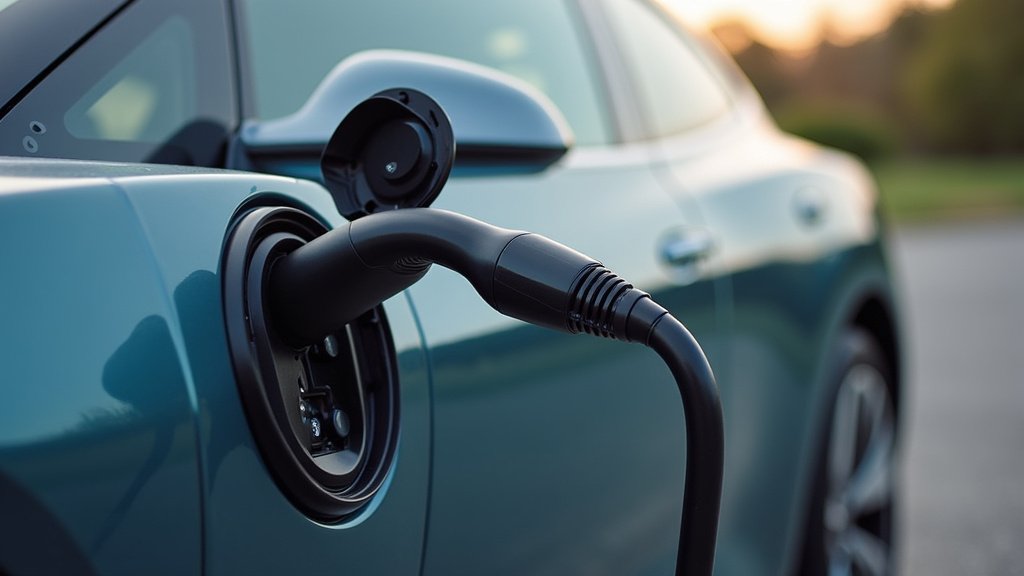
You simply plug the Level 1 charger into the AC outlet of the power station. Then, plug the other end into your EV’s charging port. It’s essentially creating a makeshift charging station wherever you have your power station.
Understanding Charging Speeds: Level 1 vs. Power Station Output
As we touched on, the biggest bottleneck is the power station’s output versus what your EV charger expects. A Level 1 charger is designed to pull power from a typical 120V household outlet. This outlet can usually supply at least 15 amps, meaning around 1.4kW to 1.8kW.
If your power station can only output 500W, it’s like trying to power a microwave with a flashlight. The EV charger will likely detect the low power and charge extremely slowly, if at all. Many experts recommend an output of at least 1,000W (1kW) from the power station to get a somewhat noticeable charge rate, comparable to a very slow Level 1 connection.
When Does This Setup Actually Make Sense?
Given the limitations, when would you actually consider using a portable power station to charge your EV? It’s not for your daily commute, that’s for sure.
Emergency Situations and Range Anxiety
This is where the setup shines brightest. Imagine you’re on a road trip, your battery is critically low, and you’re miles from a charging station. If you have a portable power station with you, you can plug it in and get enough miles to reach the nearest charger. It’s a fantastic backup for those “oh no!” moments.
We’ve seen reports from EV owners who have used their power stations to get an extra 5-10 miles of range. This can be enough to get you to safety or to a proper charging station. It’s all about adding just enough juice to get you out of a bind.
Camping and Off-Grid Use
For EV owners who love to camp or explore off-grid, a large portable power station can be a game-changer. While it won’t fully charge your EV, it can certainly provide a much-needed trickle charge overnight. This can be enough to extend your explorations or ensure you have enough range to get back to civilization.
Some adventurers even use them to power other devices while camping, like refrigerators or lights. It adds a layer of convenience to remote travel that wasn’t previously possible for EV drivers. Just remember to factor in the time it will take to add those miles.
A Tiny Top-Up in a Pinch
Let’s say you’re just a few miles short of home, and you don’t want to run the battery completely dry. You could use a portable power station for a very short charging session. It’s not efficient, but it might be convenient if that’s your only option. It’s about adding those few essential miles.
Factors to Consider Before You Try This
Before you rush out to connect your power station, there are a few things you should absolutely check. Getting this wrong could mean wasted time or even damaging your equipment.
Check Your Power Station’s AC Output
This is the most critical step. Look for the continuous output rating on your power station. Many smaller units only offer 300-500W. As we’ve discussed, this will provide a charge so slow it’s almost negligible. You’ll want a unit that can sustain at least 1,000W, preferably more, for EV charging to be practical.
Understand Your EV’s Charging Input
While most EVs are designed to accept power from standard Level 1 chargers, some might have specific requirements. It’s always a good idea to consult your EV’s owner’s manual. You’re looking for information on its charging port and the typical power draw of a Level 1 charger.
Most modern EVs are built to handle standard 120V AC charging without issue. The power station’s job is simply to provide that 120V AC power. The EV’s onboard charger then converts it to DC power for the battery. If your power station can supply the wattage, your EV should be able to accept it.
Time is of the Essence: Realistic Charging Times
You need to be realistic about how long this will take. Adding even a few miles can take a couple of hours. If you’re hoping to charge a significant portion of your battery, a portable power station just isn’t the tool for the job. We found that charging for an entire day with a powerful station might only add 20-30 miles.
For example, if you need 15 miles of range, and your power station can consistently deliver 1,000W (adding 3-4 miles per hour), you’re looking at 4 to 5 hours of charging time. Plan accordingly!
Battery Health and Temperature
Portable power stations have internal batteries, just like your EV. Constantly discharging them at high rates can impact their lifespan. Likewise, extreme temperatures can affect both the power station’s performance and your EV’s battery.
Most manufacturers recommend avoiding charging your EV from a power station if temperatures are near freezing or excessively hot. Cold weather, in particular, can significantly reduce EV battery efficiency and charging speed. Always check your power station’s operating temperature range (National Renewable Energy Laboratory guidance suggests battery performance is optimal between 20°C and 25°C).
Here’s a quick checklist to help you decide if using your portable power station for your EV is the right move:
- Does your power station have a continuous AC output of at least 1,000W?
- Do you have your EV’s Level 1 charging cable handy?
- Are you in an emergency or a situation where a few extra miles are critical?
- Are you prepared for a very slow charging process that could take hours?
- Is the weather within reasonable limits for both your power station and EV battery?
- Have you checked your EV’s manual for any specific charging limitations?
Conclusion
So, can you charge your EV with a portable power station? Yes, you can, but it’s important to have realistic expectations. Think of it as an emergency tool, not a daily solution. While it can add a few crucial miles in a pinch, its limited output means charging is very slow. Always check your power station’s continuous AC output and your EV’s charging capabilities before relying on this setup. For peace of mind on long trips, a robust power station can be a lifesaver. Plan your charging strategy wisely!
Frequently Asked Questions
How many miles can I actually add to my EV with a portable power station?
You can expect to add a very small amount of range, typically 3-4 miles for every 1,000 watt-hours (Wh) of usable energy from your power station. For example, a 1,000Wh power station might give you around 2.5 to 3.5 miles. This is just enough for emergencies.
What is the minimum power output a portable power station needs for EV charging?
We found that a continuous AC output of at least 1,000 watts (1kW) is recommended for a somewhat noticeable charging rate. Lower outputs will result in extremely slow charging, possibly too slow to be practical for most situations.
Can I use my power station to fully charge my EV?
No, absolutely not. A portable power station’s capacity is a tiny fraction of an EV’s battery size. It’s not designed for full charges and would take an impossibly long time even if it were possible.
Will charging my EV drain my portable power station too quickly?
Yes, charging an EV will drain a portable power station much faster than most other devices. High-wattage devices like an EV charger put a significant strain on the power station’s battery and inverter. Avoid doing this frequently if you want to prolong the life of your power station.
Are there any risks of damage when charging an EV with a portable power station?
The primary risk is that a power station with insufficient output might not charge your EV effectively, leading to wasted time. Also, consistently pushing a power station to its limits can reduce its lifespan. Always ensure your equipment is within its operating temperature range.