How to Connect 420 Watt Solar Panels in Series
Connect 420 watt panels in series by linking one panel’s positive lead to the next panel’s negative lead, then send the two free ends to a compatible controller. Before connecting, add the panels’ actual open-circuit voltage and check that the total stays below the controller’s maximum.
On this page (7 sections)
- How do you connect 420 watt solar panels in series?
- How do you calculate the string voltage?
- How many 420 watt panels can go in one string?
- What should you check before wiring the panels?
- Which connectors and cable parts may help?
- What safety steps matter during connection?
- What is the safest way to plan a 420 watt panel string?
Connect 420 watt solar panels in series by linking positive to negative between neighboring panels, then connect the two remaining leads to a charge controller that can handle the string voltage. A panel’s wattage alone does not show whether the string is safe, so calculate voltage from the actual module ratings first.
A 420 watt panel can have different electrical ratings from another panel with the same wattage. Read the labels or manuals for open-circuit voltage (Voc), maximum-power voltage (Vmp), and current before planning the string.
How do you connect 420 watt solar panels in series?
Connect the positive lead of one panel to the negative lead of the next. Continue the pattern through the string, leaving one free negative lead at one end and one free positive lead at the other.
Those two free leads are the string output. Connect them to the matching solar input on a compatible charge controller, following the controller’s manual and its polarity markings.
Series wiring adds panel voltage, while current stays near the current of one panel under the same conditions. The array’s rated watts add across panels, but real output changes with sunlight, temperature, shade, and orientation.
Before making connections, review a step-by-step guide to connecting solar panels in series. That guide can help you check the wiring order and polarity.
How do you calculate the string voltage?
Add the panels’ open-circuit voltage ratings to estimate the string’s Voc. For example, if each panel label says 49 V Voc, three panels have a nominal combined Voc of 147 V (49 V × 3).
That example is only arithmetic, not a recommendation to connect three panels. Use the actual Voc printed on each module and account for any cold-weather voltage adjustment required by the panel and controller instructions.
The controller’s maximum PV input voltage is a hard limit. Keep the corrected string Voc below that limit, with the safety margin specified by the equipment maker or applicable electrical rules.
Also check Vmp and the controller’s operating voltage range. A string may stay below the maximum Voc but still fall outside the controller’s useful tracking range.
How does 420 watt panel wattage affect the calculation?
Wattage does not determine series voltage by itself. Two 420 watt panels can have different Voc and Vmp ratings, so use the numbers on the exact panel model.
For a rough rated-power total, multiply the panel wattage by the panel count. Two 420 watt panels have 840 W of combined nameplate power, but this does not tell you whether their voltage suits a given controller.
Use the current ratings to check controller limits as well. In a series string, current is generally constrained by the panel with the lowest current capability, so mismatched modules can reduce output.
How many 420 watt panels can go in one string?
The safe number depends on panel voltage, cold-weather conditions, and the controller’s limits. There is no universal series count for 420 watt panels.
Start with the maximum PV input voltage in the controller manual. Divide that voltage by the corrected Voc of one panel to estimate a ceiling, then choose a lower count if required to stay within the maker’s specified margin.
Check the controller’s minimum start-up and MPPT voltage too. A string that is too short may not reach the voltage needed for the controller to operate well.
For a larger array, compare the proposed layout with examples for connecting 3 solar panels in series and connecting 8 solar panels in series. Those examples still need to be recalculated for your own panel and controller ratings.
What should you check before wiring the panels?
Confirm voltage, current, connector compatibility, and polarity before connecting anything. Read the panel and controller manuals, and follow local electrical requirements for the array and installation.
Check that the controller is designed for the panel string’s Voc and power. Confirm the PV input current limit and any maximum array wattage as well.
Inspect cable size, insulation, routing, and connector fit. Follow MC4 connector wiring steps for compatible assembly.
Use connectors that are compatible with the panel leads and intended for the cable type and current; similar-looking connectors are not automatically interchangeable.
If you’re choosing modules, compare the actual voltage and current ratings alongside output when deciding which solar panel is best. A higher wattage label alone is not enough to determine fit.
Do MC4 Y connectors belong in a series string?
Y connectors are for joining branches in parallel, not for the basic panel-to-panel series link. The LiuBaiWuQuStars 4pcs MC4 Y connectors are described for connecting two panels in parallel.
Use the correct connector arrangement for the electrical design. For a series string, join each panel’s positive and negative leads in sequence, and connect the two remaining string ends to the controller.
If you need a parallel branch, first confirm that the controller can accept the resulting current and that the wiring plan allows it. See our guide to how to connect eight solar panels in series for a larger string example.
Which connectors and cable parts may help?
Use connectors that match the panel leads, cable size, and system ratings. Check compatibility and current and voltage limits for the specific installation before buying parts.
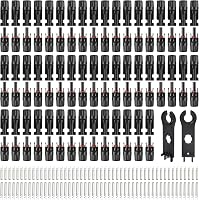
The LEPITERY connector set includes male and female connectors, pins, and spanners, and is rated at 1000 V DC and 30 A. It is described for PV cables from 14 AWG to 10 AWG.
The Usngsny set includes 20 pairs of male and female connectors, connector pins, and spanners. It is rated at 1000 V and 30 A and is described for 10 AWG to 14 AWG PV cables.
Connector ratings do not prove compatibility with every panel connector. Match the connector maker, cable, and equipment instructions, and make sure the finished connection is secure and protected as intended.
For the connection at the controller, see how to connect MC4 solar cables to a charge controller. For portable systems, check whether your unit supports direct solar input and review how to connect solar panels to a portable power station.
What safety steps matter during connection?
Keep panels disconnected from the controller while arranging the string, and follow the manuals’ shutdown and connection sequence. Solar panels can produce electricity whenever they receive light.
Work in dry conditions with the array covered or otherwise made safe as the equipment instructions allow. Do not touch exposed conductors, and avoid letting positive and negative leads contact each other.
Use properly rated tools and connectors, and do not force a connector that does not fit. If the system is roof-mounted, high voltage, or unfamiliar, have a qualified solar installer complete or inspect the work.
After connecting, verify polarity and inspect every joint before powering up. Stop if the controller reports a fault, the connectors heat up, or the measured voltage differs from the expected value.
What is the safest way to plan a 420 watt panel string?
For connecting 420 watt solar panels in series, choose the string count from actual module Voc and the controller’s voltage limits, then check current, operating range, and connector fit. Do not use the 420 W label as a substitute for the panel’s electrical ratings.
Pick a short string when the controller needs a lower input voltage and its manual supports that configuration. Use a longer string only when corrected Voc stays safely within the controller limit and the operating range is suitable.
If your design needs branches, verify the current limits and use the right parallel connectors. Then follow the equipment manuals for installation and startup.
Frequently asked questions
Can 420 watt solar panels be connected in series?
Yes, if the panels and charge controller are compatible and the string’s total open-circuit voltage stays within the controller’s maximum input voltage. Check every panel’s label and the controller manual first.
Wattage alone doesn’t tell you the voltage, current, or safe series count.
Does series wiring add the watts of solar panels?
The panels’ rated power adds in a series string under matching test conditions, but actual output varies with sunlight, temperature, orientation, and shading. Series wiring adds voltage while string current stays near the current of one panel.
Confirm the equipment limits before connecting.
Can I connect solar panels with different wattages in series?
Panels with different current ratings can limit the string to the lower-current panel’s output, so matching electrical ratings is usually simpler. Compare open-circuit voltage, maximum-power voltage, and current, not just wattage.
Follow the panel and controller makers’ instructions before combining modules.
Do I need MC4 Y connectors for panels in series?
No. A basic series string connects one panel’s positive lead to the next panel’s negative lead; Y connectors are generally used to join branches in parallel.
Use compatible connectors and cable, and follow the equipment instructions for the specific array.