Jackery SolarSaga 100W Solar Panel Review: Worth It? (November 2026)
The Jackery SolarSaga 100W Air suits portable charging when a light, foldable panel matters. Check your power station’s input connector and limits first, since model compatibility and real-world output can vary.
On this page (9 sections)
- Jackery SolarSaga 100W Solar Panel Review
- Is the Jackery SolarSaga 100W Air worth considering?
- What do the model number and connector tell you?
- How portable is the folding design?
- What charging output should you expect?
- How does the SolarSaga Air compare with alternatives?
- What should Explorer 1000 owners check?
- Is the SolarSaga 100W Air suitable for outdoor use?
- What is the final buying decision?
Jackery SolarSaga 100W Solar Panel Review
The Jackery SolarSaga 100W Air is a portable 100W panel for people who want a folding setup and a lighter load on camping or off-grid trips. Compare 100W folding solar panels for camping to consider other options.
Its 7.1 lb weight, integrated stand and included adapter are useful, but confirm your power station’s model and solar input before choosing it.
This review focuses on the SolarSaga 100W Air, model JS-100H. Names like “SolarSaga 100,” “SolarSaga 100W” and “JS-100F” can refer to different versions, so match the model number and connector against your own equipment.
Is the Jackery SolarSaga 100W Air worth considering?
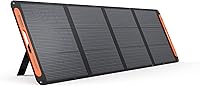
The SolarSaga 100W Air is worth considering if easy carrying and quick setup matter more than broad compatibility. It folds for storage, has an integrated aluminum stand and comes with a DC8020 to DC7909 adapter.
Jackery describes the Air as a bifacial panel with PERC cells and a sun indicator to help with positioning. Those features may help you set the panel toward the sun, but output still depends on sunlight, shade, angle and the power station’s input limit.
One model-specific caution matters: Jackery says the Air is not compatible with the Explorer 300 or Explorer 300 v2 series. It also identifies the Air as model JS-100H, so don’t assume a reference to “JS-100F” means the same panel.
Jackery SolarSaga 100W Air Solar Panel: Best for lighter packing

- 100W maximum power
- 7.1 lb
- W-fold design
- DC8020 to DC7909 adapter included
A compact folding option for Jackery owners who value easier carrying and want a panel with an included DC8020 to DC7909 adapter. Confirm that the JS-100H works with your exact power station before buying.
Pros
- Lightweight folding design
- Storage bag included
- Adapter included for DC7909 connection
- Integrated stand
Cons
- Not compatible with Explorer 300 or 300 v2 series
- The Air name and JS-100H model number differ from older SolarSaga 100 references
Who should choose this SolarSaga 100W panel?
Choose it if you want a foldable panel that is easier to carry than many 100W options and your Jackery station supports its connector and input. The included bag and stand can make transport and positioning simpler.
Look elsewhere if your Explorer is a 300 or 300 v2, or if you need a panel for a fixed roof installation. For more background on which solar panel is best for your setup, compare portability, compatibility and where you’ll place it.
What do the model number and connector tell you?
The Air’s stated model is JS-100H, and the package includes a DC8020 to DC7909 adapter plus a multifunctional solar charging cable. Those details help narrow down compatibility, but they don’t establish that every Jackery station accepts the panel.
Before buying, find your power station’s exact model number and check its manual for the supported connector, voltage range and maximum solar input. A connector that fits physically doesn’t by itself confirm an electrical match.
The included adapter may help with a supported DC7909 connection. For older or other station models, verify whether an adapter is required and whether it is appropriate for that particular panel and station.
Avoid relying on a broad “Jackery compatible” label without checking your specific model.
For a wider set of connection options, compare the best Jackery compatible solar panels. That guide can help if one panel needs to serve more than one power station.
How portable is the folding design?
At 7.1 lb, the SolarSaga 100W Air is designed to be carried and stored between uses. Jackery describes its W-fold design as folding smaller than A2 paper, and a storage bag is included.
The integrated aluminum stand gives you a way to angle the panel without a separate support. The sun indicator is intended to help with positioning, though you’ll still need to move or adjust the panel when the sun’s direction changes.
Portability has a trade-off: a folding panel needs a clear area to open and face the sun. Check the space at your campsite, balcony or vehicle before buying, and make sure the cable can reach the power station without becoming a trip hazard.
If you’re considering a larger folding option, see the Jackery SolarSaga 200W solar panel review. A higher rated panel can suit a different charging plan, but you still need to check the station’s input limit and the panel’s compatibility.
What charging output should you expect?
Treat 100W as the panel’s maximum power rating, not as a guaranteed charging rate. For more on heat exposure, see 100W solar panel temperature.
Sun angle, clouds, shade, temperature and the station’s input limit can all affect what reaches the battery.
Place the panel in direct sun and adjust its angle to face the light. Keep it clear of shadows from trees, tents, roof rails and people.
If you’re charging through a power station, its own solar input limit may cap the amount it can accept.
This is why panel wattage alone doesn’t predict a full charge time. Battery capacity, the station’s input range and changing daylight all matter.
Our guide to why 100W solar panels rarely hit 100 watts explains what can lower output in everyday conditions.
The Air also has dual USB ports for charging devices directly. That can be useful for a phone or small device, but a power station gives you a separate place to store energy when light or panel position changes.
How does the SolarSaga Air compare with alternatives?
The SolarSaga 100W Air stands out for its lighter weight and Jackery-focused accessories. Two alternatives offer different benefits: the ZOUPW includes several connector types, while Jackery’s SolarSaga 100 Prime includes mounting hardware.
ZOUPW 100W Portable Solar Panel for Power: Best for connector flexibility

- 100W maximum power
- 5-in-1 connector cable
- 9.5 lb
- IP67 panel body
A foldable alternative with several connector options for different power stations. Check the input limit and connector required by your model, since the panel's rated power doesn't guarantee that a station will accept 100W.
Pros
- Five connector types included
- Two adjustable kickstands
- USB-C and USB-A ports for direct device charging
Cons
- Heavier than the SolarSaga Air
- USB hub and cables need protection from water
The ZOUPW weighs 9.5 lb and includes a five-in-one cable with DC8020, XT60, Anderson, DC7909 and DC5521 connectors. Its two kickstands can be set at 45 degrees, and built-in USB-C and USB-A ports provide direct device charging.
That connector range can be useful if you own different brands of power station. Confirm the exact connector and input requirements for each station, and keep the USB hub and cables dry: ZOUPW says the panel body is IP67 rated but those parts are not fully waterproof.
Jackery SolarSaga 100 Prime Bifacial DIY Solar: Best for fixed mounting

- 100W maximum power
- Bifacial design
- Z bracket kit included
- IP68 waterproof rating
A bifacial 100W panel with mounting hardware for a more fixed installation. Older Jackery power stations may need a separate DC8020 to DC7909 adapter.
Pros
- Bifacial design
- Z bracket kit included
- 12 mounting holes
Cons
- Different form from a portable folding panel
- Older Jackery models may need an additional adapter
The SolarSaga 100 Prime is a different kind of 100W option, with a bifacial design, 12 mounting holes and an included Z bracket kit. Its model is JS-100E, not JS-100H.
Jackery notes that older models including the E1000, E550, E500, E300, E240 and E160 require a DC8020 to DC7909 adapter for the Prime. Check the exact power station and panel pairing before planning an installation.
If you want to compare more Jackery 100W solar panels, consider how you’ll mount, carry and connect the panel.
What should Explorer 1000 owners check?
Explorer 1000 owners should check the exact Explorer version, its solar input limit and the panel connector before settling on a panel. A 100W rating doesn’t mean every Explorer 1000 accepts the same setup.
The SolarSaga Air includes a DC8020 to DC7909 adapter, while the ZOUPW includes multiple connectors, including Anderson and DC8020. Connector availability is only one part of the match, so use the manual for your exact Explorer model to confirm what it accepts.
For a focused comparison, see the best solar panels for the Jackery Explorer 1000. If you’re also weighing third-party panels, the best 100W solar panel for a power station guide can help you compare cable options and use cases.
Is the SolarSaga 100W Air suitable for outdoor use?
The Air is made for portable outdoor use, with a folding design and integrated stand. Jackery describes it as weather resistant, and its product details give an IP65 waterproof highlight; check the manual for setup and care limits before exposing it to rain.
Set it on stable ground and secure it where wind could move it. Keep the power station and cable connections protected from moisture, and avoid assuming that a weather rating covers every part of a connected charging setup.
For a more fixed installation, the Prime’s included Z bracket kit and mounting holes may fit better. For frequent packing and transport, the Air’s foldable form and carrying bag are the more relevant features.
What is the final buying decision?
Pick the SolarSaga 100W Air if you want a lighter folding panel for a compatible Jackery station. Pick the ZOUPW if its five connector types better suit your equipment, or the SolarSaga 100 Prime if you need the included mounting hardware.
Before ordering, verify the panel’s model number, the station’s connector and its solar input requirements. That check matters especially if you were searching for the SolarSaga 100 JS-100F, since the Air covered here is identified as JS-100H.
Frequently asked questions
Is the Jackery SolarSaga 100W compatible with every Jackery power station?
No. Compatibility depends on the panel model, connector and power station.
The SolarSaga 100W Air is not compatible with the Explorer 300 or 300 v2 series, and its stated model number is JS-100H.
Check your exact station model and its solar input requirements before connecting a panel.
Does a 100W solar panel deliver 100W all day?
No. A 100W rating is a maximum under suitable conditions, not a promise of constant output.
Sun angle, shade, clouds and the power station's input limit affect charging.
Set up the panel in direct sun, adjust its angle as the sun moves and check the station's stated input limit.
What is the difference between SolarSaga 100 Air and 100 Prime?
The SolarSaga 100 Air is a folding panel with an integrated stand and a carrying bag. The SolarSaga 100 Prime is a bifacial DIY panel with mounting holes and a Z bracket kit.
Their model numbers are JS-100H and JS-100E, so check the exact model and connector when comparing them.
Can you charge a phone directly from the SolarSaga 100 Air?
The SolarSaga 100 Air includes dual USB ports for direct device charging, according to Jackery's product details. Solar output can change with light and panel angle, so a power station can provide a steadier charging source when you need to charge devices while the panel is repositioned.