Jackery vs Predator Power Station: Which Is Better? (November 2026)
Choose by capacity, output and the devices you need to run. This Jackery vs Predator power station comparison has detailed specs for Jackery models, but not a specific Predator model, so compare exact models before deciding.
On this page (8 sections)
- Jackery vs Predator power station: what can be compared?
- How do capacity and output affect your choice?
- Which Jackery model fits smaller loads?
- When is the Explorer 1000 v2 a better fit?
- How do EcoFlow and Anker fit this comparison?
- How should you compare charging and portability?
- What should you check before buying?
- Which should you choose, Jackery or Predator?
Choose a Jackery or Predator power station by matching capacity and output to your devices, then comparing charging options, weight and included items.
That approach keeps the choice practical. You start with the gear you own, then find a station that can run it without forcing you to change how you camp, travel or work.
The Jackery models here include the Explorer 300 at 292Wh and 300W rated output. They also include the Explorer 1000 v2 at 1,070Wh and 1,500W AC output.
That range is wide enough to change the decision completely. A 292Wh unit suits small electronics and short outings well.
A 1,070Wh unit suits a broader mix of devices and longer gaps between charges.
A specific Predator model is still needed for a fair head-to-head comparison. Without its capacity, rated output and port list, any verdict would rest on brand preference rather than usable facts.
Start with exact model numbers for both sides. Write down the wattage for each device and note whether you expect to run them together.
Then check weight and recharge methods. A lighter station is easier to carry, while a faster recharge option can matter more if you refill it often.
Also check what is included in the box. Solar panels are not included with the Jackery models described here, so that cost and setup step should be planned in advance.
This method also helps you spot a mismatch early. If your combined load sits close to a station's rated limit, it may be wiser to move up a size.
If your load stays well below that limit, the smaller unit may be the better fit. It will be easier to move, store and charge in a cramped car or tent.
Keep your device list beside the specs as you compare. That simple habit turns a brand debate into a clear check of fit for your own routine.
 Best for light loads and portability
Jackery Explorer 300 Portable Power Station
 Best for a larger Jackery battery
Jackery Explorer 1000 v2 Portable Power Station
Jackery vs Predator power station: what can be compared?
The Jackery models here have specific capacity and output figures; a direct Predator comparison needs the Predator model's matching specifications.
Compare like with like. One unit may be much smaller than another, so sorting by brand alone can hide the real difference in size and power.
The Jackery Explorer 300 has 292Wh of capacity and 300W rated output. It also has a 600W peak surge, which helps with brief startup demands within its limits.
The Explorer 1000 v2 has 1,070Wh and 1,500W AC output. Its surge peak is 3,000W, which gives it more headroom for AC devices.
The EcoFlow DELTA 3 Classic offers 1,024Wh and 1,800W AC output. Its surge rating is 3,600W, so it sits above the Explorer 1000 v2 on rated AC output.
The Anker SOLIX C1000 Gen 2 also offers 1,024Wh, with 2,000W output and a 3,000W peak. That makes it the highest rated output of the four models listed here.
Those differences matter more than brand labels. Capacity shapes how much energy you store, while output limits what you can power at the same time.
A smaller battery can make sense for phones, cameras and a laptop. It weighs less and can be easier to pack for a short trip or a day of field work.
Larger capacity and higher output may suit a broader mix of devices. That can include a fringe of AC appliances, but you still need to check each device's draw.
For a wider overview of brands and buying factors, see our Best Portable Power Station Brand guide. It can help you build a shortlist before comparing exact models.
Use that guide to narrow your options, then return to exact specs. The final choice should come from model numbers, not from general brand impressions.
For a Predator model, find its capacity in Wh and its rated output in W. Also note its surge peak, outlet types, weight and charge time.
Set those figures beside the Jackery model you are considering. If a key figure is missing, ask the seller to confirm it before you decide.
That check protects you from comparing a small station with a larger one. It also shows whether a headline number matches the devices you actually plan to use.
How do capacity and output affect your choice?
Capacity in watt-hours estimates stored energy, while output in watts limits what you can power at once. Check both numbers against your devices rather than using either one alone.
A 292Wh battery stores less energy than a 1,024Wh or 1,070Wh battery. That difference can affect how often you need to recharge, but the actual runtime depends on device draw and how you use the station.
Rated output is a separate limit. The Explorer 300 is rated for 300W, while the Explorer 1000 v2 is rated for 1,500W AC; a device that exceeds a station's limit may not run as intended.
What should you check for a Predator model?
Find the Predator unit's rated output, surge rating and battery capacity. Use those figures beside the Jackery model you are considering, along with port types and recharge methods.
Don't compare a small portable station with a larger one and conclude that the brand with the bigger numbers is always better. First decide which devices matter, whether they run together and how long you need power between charges.
Which Jackery model fits smaller loads?
The Explorer 300 is the lighter, lower-capacity option for modest loads and short trips.
Its 292Wh capacity and 300W rated output suit devices whose combined draw stays within that output limit. That makes it a fit for small electronics rather than larger AC appliances.
It weighs 7.5 lb, which makes it easier to carry between a car and a tent. The integrated handle helps when you move it by hand over short distances.
It has two AC outlets, a 100W USB-C PD port, two USB-A ports and a 120W car port. That mix covers common charging needs without forcing you to carry extra adapters for every device.
The Explorer 300 can be charged from AC, a car port or a separately sold Jackery solar panel. Check which option you will have most often, since that choice shapes your daily routine.
A 100W solar panel can bring it to 80% in about 2.8 hours, according to Jackery's stated charging figures. That figure assumes suitable sun and a correct panel match.
The trade-off is clear. You gain portability and a long list of ports, but you accept a lower output ceiling than the larger models here.
The station's 300W limit rules it out for some higher-draw appliances. If you want a different Jackery capacity, compare the Best Jackery Portable Power Station options against your expected load.
When is the Explorer 1000 v2 a better fit?
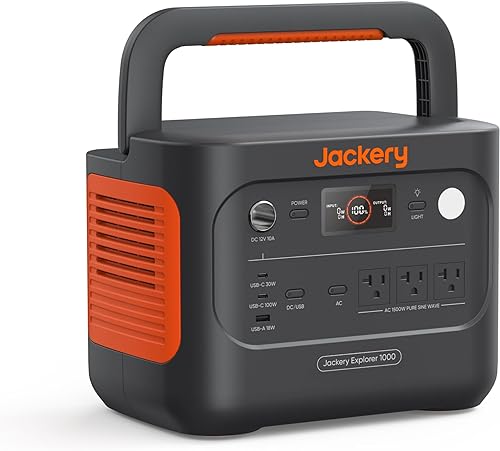
Choose the Explorer 1000 v2 when you need more stored energy and higher AC output than the Explorer 300 offers. Its 1,070Wh capacity and 1,500W AC output fit a different level of demand, with a weight increase to 23.8 lb.
It has three pure sine wave AC ports, two USB-C ports, one USB-A port and a DC car port. Its default full charge time is 1.7 hours, while emergency charging to a full battery in one hour requires enabling that mode in the Jackery App.
The solar panel is not included, and solar charging works only with Jackery solar panels. That compatibility limit is important if you already own a panel from another brand.
Its 23.8 lb weight may be a trade-off if you'll move it often. Compare the Jackery vs Anker power station guide if you are deciding between two larger brand options.
How do EcoFlow and Anker fit this comparison?
The EcoFlow DELTA 3 Classic and Anker SOLIX C1000 Gen 2 both offer about 1,024Wh, with different output and charging details. They provide useful reference points when you want to compare Jackery against another brand as well as Predator.
The EcoFlow DELTA 3 Classic is rated for 1,800W AC output and weighs 26.7 lb. It supports optional solar charging, and EcoFlow says it can recharge from 0% to 80% in 45 minutes with AC charging.
The Anker SOLIX C1000 Gen 2 has 1,024Wh capacity and 2,000W output, with a listed weight of 11.3 kg. Anker says its 49-minute full recharge requires enabling HyperFlash in the app, and its speed depends on battery cell temperature.
The Anker model's expansion feature has been removed, so it may not fit a plan that depends on adding an extra battery later. Read our Paxcess power station vs Jackery and Goal Zero vs Jackery power station comparisons for more brand matchups.
How should you compare charging and portability?
Choose a charging method you'll have access to, and account for the station's weight in your setup.
A fast recharge claim is useful only if the required mode, power source and conditions fit your routine. A mode that needs an app setting may not suit a quick stop on the road.
The Explorer 300 weighs 7.5 lb. That weight makes it simple to move from a car to a campsite, a worksite or a spare room.
The Explorer 1000 v2 weighs 23.8 lb. That extra weight comes with more capacity, but it asks more of you when you lift it in and out of a vehicle.
The DELTA 3 Classic weighs 26.7 lb. It is the heaviest of the three imperial weights listed, so plan where you will store it and how often you will carry it.
The Anker SOLIX C1000 Gen 2 weighs 11.3 kg. Convert that figure to pounds if you want a direct comparison with the Jackery and EcoFlow weights.
Solar panels are optional for these models. Check compatibility as well as panel output, and remember that sunlight and charging conditions affect the time needed.
For the Explorer 1000 v2, the one-hour mode requires activation in the Jackery App. Its default full charge time is 1.7 hours, which is set to support battery health.
Anker's 49-minute claim also depends on using its app setting and suitable battery temperature. Anker says UltraFast Charging activates when the battery cell temperature is above 20 degrees C.
That detail matters in cold weather. Charging at 0 to 20 degrees C will noticeably slow down the charging speed, so the headline time may not apply.
Think about setup as well as speed. A station that charges quickly at home may still be slow to refill if your only option is a small solar panel.
Also consider storage. A heavier unit may stay in one place, while a lighter unit can move with you and be charged where power is available.
Match the charging method to your habits. If you rarely plug in at home, solar compatibility and panel size deserve extra attention.
What should you check before buying?
Write down your device list and compare its power needs with each station's output and capacity. This makes it easier to spot a mismatch before you order.
Check the running wattage of each device, and consider startup power for equipment with a motor. Add the loads you may use at once and leave room below the station's rated output.
Then estimate how long you need those devices to run. A power station's Wh figure is not the same as usable runtime, so account for conversion losses and your actual use.
Finally, check weight, ports, recharge methods, panel compatibility and included items. If a Predator model lacks a clearly stated spec you need, ask the seller or manufacturer to confirm it before deciding.
Our guide to choosing the right portable power station walks through capacity, output and use cases in more detail. Keep the model number beside your notes so you don't accidentally compare different versions.
Which should you choose, Jackery or Predator?
Choose by the exact model's capacity, rated output and charging fit, not by brand alone.
The Jackery Explorer 300 suits lighter loads. Its 292Wh capacity and 300W rated output fit small electronics when the combined draw stays within that limit.
The Explorer 1000 v2 offers a larger battery and higher AC output. Its 1,070Wh capacity and 1,500W AC output suit a broader mix of devices, at a higher weight of 23.8 lb.
A fair Jackery vs Predator power station verdict requires Predator's exact model and matching specifications. Compare its capacity, rated output, surge peak, ports, weight and recharge methods with the Jackery figure you prefer.
Then compare those figures with the device list you have. Add the loads you may run at the same time and leave room below the station's rated output.
Pick the station that meets your needs with a manageable weight and charging setup. That choice will serve your routine better than a brand name alone.
Frequently asked questions
Is Jackery better than Predator for a power station?
There isn't enough information here to name a winner because Predator's exact model and specs aren't specified. Compare capacity in Wh, rated output in W, outlet types, charging options, weight and included items for the particular models you are considering.
What size power station do I need?
Add the wattage of devices you may run at the same time, then check that the station's rated output can handle that total. For runtime, compare the battery's Wh with each device's draw; actual runtime varies with use and conversion losses.
Can a portable power station run a refrigerator?
It depends on the refrigerator's running and startup power and the station's output limits. Check both figures for the exact models, and leave room for other devices you may run at the same time.
Can I use a power station while it is charging?
The Explorer 300 can charge devices while it is being recharged. For any other model, check its instructions for simultaneous charging and output, and follow its limits for the power source and connected devices.
Does a Jackery power station include a solar panel?
The Explorer 300 and Explorer 1000 v2 described here do not include a solar panel. The Explorer 1000 v2 is compatible only with Jackery solar panels for solar charging, so check panel compatibility before buying.


