How to Choose a Solar Panel with 40V Voc
Choose a 40V Voc solar panel only when your charge controller accepts its cold-weather voltage. Compare the panel's Voc and Isc with the controller's maximum input limits before wiring the system.
On this page (7 sections)
- How do you match a 40V Voc solar panel to a controller?
- Why does cold weather matter for a 40V Voc solar panel?
- What is the difference between Voc and working voltage?
- Should you use an MPPT or PWM controller?
- Which panel types fit different solar charging jobs?
- What should you check before wiring a 40V Voc panel?
- Is a 40V Voc solar panel right for your system?
A 40V Voc solar panel needs a charge controller or power station with voltage headroom above 40 volts, plus extra allowance for cold weather. That headroom is the first filter for any system you plan to build around this voltage.
Voc means open-circuit voltage. It is the voltage measured when the panel is not powering a load, so it is not the same as the voltage you should expect during normal charging.
That difference matters because the controller sees the panel at rest before it ever starts charging a battery. If the resting voltage is already too high, the system is unsafe before any real power flows.
Match the panel's open-circuit voltage and short-circuit current to the controller's input limits before you connect anything. Those two numbers tell you more about compatibility than the wattage printed on the label.
Wattage helps you judge how much energy the panel may produce in good sun. Voltage and current decide whether the controller can accept that panel at all, including on the coldest bright morning.
A panel in the 40V Voc range is often chosen for a higher voltage input feeding an MPPT controller. It can also suit some power stations, but only when their solar input range clearly covers the panel's cold adjusted Voc.
This is not a universal charging panel for every battery or device. A low voltage camera or a small 12V maintenance charger may need a very different panel and controller pairing.
Think of the choice as system matching rather than panel shopping. The panel, controller, battery and connectors have to agree with each other on voltage, current and wattage.
Setup also depends on location and season. A system in a mild climate still needs headroom, while a mountain or northern installation needs a wider safety margin.
Care is mostly a matter of keeping connections dry and secure. Loose or damp connections can create faults even when the headline voltage numbers look reasonable.
If you are still comparing basic panel terms, read our Understanding Solar Voc and Isc: Beginner’s Guide first. For broader panel choices, our Solar Panels: The Complete Buying Guide covers wattage, battery systems and use cases.
Those guides help you place Voc alongside Isc, working voltage and battery size. Once those terms feel clear, the 40V decision becomes much easier to judge on its own terms.
How do you match a 40V Voc solar panel to a controller?
Choose a controller whose maximum solar input voltage is higher than the panel's cold-adjusted Voc. The printed 40V figure is only the starting point because voltage can rise when the panel is cold.
Start by writing down the panel Voc and Isc from its data sheet. Then write down the controller maximum PV voltage and maximum PV current from its manual.
Check these numbers before buying:
- Panel Voc
- Panel Isc
- Controller maximum PV voltage
- Controller maximum PV current
- Battery voltage
- Maximum solar wattage
- Connector polarity and type
Battery voltage matters because the controller must be set for the correct system size. A controller that accepts a high panel voltage may still be wrong for your battery chemistry or charging profile.
Maximum solar wattage is another ceiling that is easy to overlook. A panel stack can stay under the voltage limit while still pushing the controller past its wattage rating.
Connector polarity and type decide whether the link between panel and controller is practical. The wrong plug can be adapted in some cases, but the electrical limits still have to be safe first.
A controller rated for exactly 40V is not a comfortable match for a panel marked 40V Voc. The panel can exceed that number in cold conditions, which may damage the controller or trigger a protection shutdown.
That is why a small numerical gap is not real headroom. Cold correction can eat through a narrow margin very quickly, especially after a clear night in winter.
Use the manufacturer's temperature coefficient when it is available. It lets you estimate how far Voc will climb as cell temperature drops below test conditions.
If you do not have that figure, leave a wider margin and ask the controller maker to confirm the combination. Guessing at the coefficient is a poor substitute for a published value.
This suits owners who want a system that works year round without constant adjustment. It also suits anyone adding a second panel later, since spare capacity makes future changes safer.
The trade off is cost and size. A controller with a higher voltage ceiling is often larger than a lightly rated model, even when the charging current is similar.
During setup, connect and disconnect in the order given in the manual. After installation, keep the controller ventilated and its terminals tight, since heat and vibration can loosen connections over time.
Why does cold weather matter for a 40V Voc solar panel?
Cold weather matters because solar panel voltage rises as cell temperature falls. A clear winter morning can push Voc above the panel rating at standard test conditions.
Standard test conditions use a warmer set cell temperature than many real winter mornings. A panel left outside overnight can cool below the forecast air temperature.
The rise depends on the temperature coefficient and the lowest cell temperature at your site. A warm climate install may need less headroom than one where freezing is common.
So two installs with the same panel can need different controllers. The panel is the same, but its coldest service temperature is not.
Do not size the system from air temperature alone. Overnight cooling sets the risk, then bright sun at dawn can drive Voc to its daily peak.
Once the panel warms under load, voltage usually falls toward normal levels. The controller still has to survive that early peak, not just the midday average.
The U.S. Department of Energy's solar panel guide explains how sunlight and photovoltaic cells produce electrical output.
It helps show why temperature changes that output.
For a real install, use both manuals together. The panel manual should list the temperature coefficient, and the controller manual should state its hard maximum input voltage.
If the coefficient is missing, treat any estimate as uncertain. A larger margin is then the safer option, since the cold peak cannot be calculated with confidence.
Placement also affects cell temperature. A panel close to a cold surface may cool more at night than one with airflow underneath.
Shade can cut current and power without removing the Voc limit. Even in warm regions, one cold snap can set the worst case.
More headroom may cost more, but it protects the system on the morning voltage runs highest.
What is the difference between Voc and working voltage?
Voc is the voltage with no load, while working voltage is the voltage while supplying power. Use Voc to protect the controller's upper voltage limit, then use operating voltage and current to estimate charging performance.
Voc asks whether the controller can survive the panel at rest. Working voltage asks how the panel behaves once it is charging.
A panel marked at about 40V Voc may run at a lower voltage through a controller. That does not make Voc unimportant.
New buyers can expect 40V during charging, but operating voltage follows the battery and controller. The controller still must withstand the highest possible open-circuit voltage, often at first light.
Isc means short-circuit current. Use Isc when checking the controller maximum PV current, especially for parallel panels.
Isc is a worst case figure, not everyday output. It is still the right number for checking the current ceiling the controller must tolerate.
In series, voltage adds while current stays close to one panel. That is why series wiring raises voltage risk for a 40V Voc panel so quickly.
Two panels in series can exceed the controller limit. Always add the cold adjusted Voc figures before considering that layout.
In parallel, current adds while voltage stays close to one panel. That keeps voltage steadier but can push the controller past its current limit.
Both layouts need a controller rated for the resulting totals. Wiring is part of the electrical design, not just a way to gain wattage.
Working voltage and operating current estimate charging speed in real sun. Voc and Isc check safety at the extremes.
A sound design checks both sets of numbers. This matters when moving from a plug and play kit to a custom build or comparing panels from different makers.
Should you use an MPPT or PWM controller?
An MPPT controller is usually the better fit for a panel with much higher voltage than the battery. It can convert extra panel voltage into charging current within its rated input and output limits.
A PWM controller connects the panel and battery more directly, so a high-voltage panel may not use its available voltage efficiently. Compatibility still comes first.
Do not assume an MPPT label makes an unsafe voltage combination acceptable.
Check the controller's maximum PV voltage, maximum PV current and supported battery chemistry. A controller can accept a high panel voltage while still having a separate limit for charging current or total solar watts.
If you are charging a 12V battery, the controller must support that battery system. Compare 12V MPPT charge controllers before choosing one.
The panel's 40V Voc does not tell you whether the battery profile is correct.
Which panel types fit different solar charging jobs?
The right panel depends on the input it must serve. A 40V Voc panel is mainly a voltage-matching decision, while a smaller panel may be better when the device has a low-voltage input.
SOLPERK Solar Panel Kit 20W 12V Solar
The SOLPERK Solar Panel Kit 20W 12V Solar is a better fit for maintaining compatible 12V rechargeable batteries than for a 40V solar input. It includes a 10A smart MPPT controller, an adjustable mounting bracket and SAE, alligator clip and O-ring connection options.
Its stated maximum power is 20W and maximum voltage is 12V. That makes it a different kind of choice from a 40V Voc panel.
Do not connect it to a controller selected for a higher-voltage panel without checking the full system design.
YCTechCam 5W Solar Panel for Security Camera
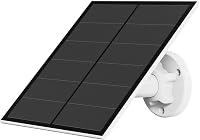
The YCTechCam 5W Solar Panel for Security Camera is designed for compatible rechargeable security cameras with a Micro USB or USB-C port. Its output voltage is 5V, and it includes a 360-degree adjustable wall bracket and a 9.8 ft cable.
This panel is not compatible with Arlo, Blink, Ring, Eufy, Google Nest or Kasa cameras, and it is not for plug-in cameras without a battery. It also is not intended to charge cell phones.
The camera's connector and charging protocol matter as much as the panel's wattage. Confirm the exact camera model before choosing this type of panel.
ZOUPW 100W Portable Solar Panel for Power
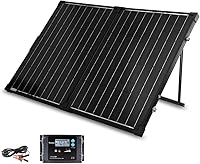
The ZOUPW 100W Portable Solar Panel for Power is the closest match here for portable power station use. It has a stated maximum voltage of 24.3V, output voltage of 20.16V and 100W maximum power, so it is not a 40V Voc panel.
The included cable supports DC8020, XT60, Anderson, DC7909 or 8 mm, and DC5521 connections. The panel also has USB-C and USB-A ports for direct device charging.
Check the power station's maximum solar input before connecting it. A station with a lower wattage limit may draw less than the panel can produce, while a voltage mismatch can prevent safe operation.
What should you check before wiring a 40V Voc panel?
Check voltage first, then current, battery compatibility and connectors. A panel that fits one number but exceeds another is not a safe match.
Voltage comes first because it is the limit most likely to damage a controller. Current comes next, since a controller can be voltage safe yet still be overloaded by too much current.
Use this pre-wiring checklist:
- Find the panel's Voc and Isc.
- Find the controller's maximum PV voltage and current.
- Add cold-weather headroom to the panel Voc.
- Confirm the controller supports your battery voltage and chemistry.
- Check the controller's maximum solar wattage.
- Confirm connector type and polarity.
- Follow the controller's connection order.
- Keep exposed connections protected from water.
Battery chemistry matters during setup because charging profiles differ between battery types. The wrong profile can shorten battery life even when voltage and current limits look acceptable.
Maximum solar wattage should be checked as a total for the whole array. Adding more panels for extra power can breach that total long before the voltage check fails.
Connector type and polarity need a physical check before you tighten anything. A simple polarity mistake can damage electronics, and some connectors seat easily the wrong way round.
Follow the controller's connection order exactly as written in the manual. That order often protects the controller from seeing a live panel before the battery is connected.
Do not rely on the panel's nominal battery label. A panel described as suitable for a 12V system can still have a much higher Voc, depending on its design.
That label usually describes the target system, not the panel's open circuit voltage. The data sheet Voc figure is what the controller actually has to withstand.
Do not wire panels in series until you add their voltage together. Two panels that are individually safe can exceed the controller's input limit when connected in series.
Parallel wiring needs the same care for current. Add the Isc figures together and compare that total with the controller's maximum PV current.
Keep exposed connections protected from water after the system is live. Damp terminals can corrode, overheat or create intermittent faults that are hard to trace later.
A final check in bright, cold conditions is worthwhile where the climate allows it. If the system behaves at its worst case voltage, it is much more likely to behave on an ordinary day.
Is a 40V Voc solar panel right for your system?
Choose a 40V Voc solar panel when your controller or power station accepts its cold-adjusted maximum voltage, current and wattage. For a larger rigid-panel option, compare 400W rigid solar panels.
It can be useful when a higher-voltage panel feeds a compatible MPPT controller, but the panel and controller must be designed as one electrical system.
Choose a lower-voltage panel when your device has a low-voltage input, such as a 5V security camera. For a broader panel comparison, see the best monocrystalline solar panels.
Choose a complete 12V maintenance kit when you need a small battery charger with a matched controller.
If your goal is running a household appliance, check the full battery and inverter design first. Our guide on Can You Run a Slow Cooker on Solar Panels? explains why panel wattage alone does not answer that question.
For a panel with a lower voltage rating, compare How to Choose a Solar Panel with 25V Voc and review the device-specific advice in How to Choose Solar Panels for an Electric Wheelchair.
The decision rule is simple: pick the panel only after its cold-weather Voc stays below the controller's maximum PV voltage. Then confirm current, battery support and connectors before installation.
Frequently asked questions
What does 40V Voc mean on a solar panel?
A 40V Voc solar panel has an open-circuit voltage of about 40 volts under its rated test conditions. Voc is the panel's voltage when it is not connected to a load.
Your controller must accept more than the panel's highest possible cold-weather Voc, not just the printed nominal value.
Can a 40V Voc solar panel charge a 12V battery?
A 40V Voc solar panel can charge a 12V battery only through a compatible charge controller. The controller must reduce the panel's higher voltage to the battery's charging range and must also stay below its maximum solar input voltage in the coldest expected conditions.
Why does cold weather raise solar panel voltage?
Solar panel voltage usually rises as cell temperature falls. That means a panel marked at 40V Voc can produce more than 40 volts on a cold, bright morning.
Leave safety headroom below the controller's maximum input voltage instead of matching the two numbers exactly.
Is a 40V Voc solar panel suitable for a portable power station?
It may be suitable if the power station accepts the panel's operating voltage, maximum Voc and current through the correct connector. Check the power station's solar input limits first.
A panel can have enough wattage but still exceed the station's voltage limit.