9 Best Renogy Solar Panels (November 2026)
The best Renogy solar panels include the Renogy Solar Panels 100W 2PCS for compact fixed installations, the Renogy 400W Portable Solar Panel for high-output portable charging, and the Renogy 200W Portable Solar Panel for Power for lightweight camping power.
On this page (17 sections)
- The best Renogy solar panels for different setups
- How we ranked the best Renogy solar panels
- Renogy solar panel comparison
- 1. Renogy Solar Panels 100W 2PCS: Best for compact fixed installations
- 2. Renogy 400W Portable Solar Panel: Best for high-output portable charging
- 3. Renogy 200W Portable Solar Panel for Power: Best for lightweight camping power
- 4. Renogy Solar Panels 200 Watt N-Type: Best for Class B van roofs
- 5. Renogy 100W 12V Solar Panel Starter Kit: Best for a first 12V system
- 6. Renogy 100 Watt Solar Panel N-Type: Best for a single efficient roof panel
- 7. Renogy ShadowFlux Solar Panel 200 Watt: Best for partial shade
- 8. RENOGY REGO 200W Portable Solar Panel: Best for simple outdoor portability
- 9. Renogy Bifacial Solar Panel 1180W N-Type 16BB: Best for large fixed arrays
- How do you choose between Renogy rigid and portable panels?
- How much Renogy solar power do you need?
- What cables and protection do Renogy panels need?
- Why is a Renogy solar panel producing less power?
- Final verdict on the best Renogy solar panels
The best Renogy solar panels for most buyers are the Renogy Solar Panels 100W 2PCS, because the 2-panel set combines 25% efficiency with a compact size. Choose a portable panel for power stations, ShadowFlux for partial shade, or bifacial panels for large fixed systems.
We compared rigid, foldable, starter-kit and bifacial formats using their stated power, efficiency, dimensions, connection types and system fit. If you're still deciding which solar panel is best, start with your daily energy needs and available mounting space.
The best Renogy solar panels for different setups
The Renogy Solar Panels 100W 2PCS are the strongest general choice for a compact fixed array. Portable buyers should choose the 400W model for maximum input or the 200W portable panel for easier carrying.
Our picks at a glance
-
1

-
2
 Best for high-output portable charging
Renogy 400W Portable Solar Panel
9.6/10 our score
See it on Amazon -
3
 Best for lightweight camping power
Renogy 200W Portable Solar Panel for Power
9.6/10 our score
See it on Amazon
- 4
 Check it
Renogy Solar Panels 200 Watt N-Type
Best for Class B van roofs - 5
 Check it
Renogy 100W 12V Solar Panel Starter Kit
Best for a first 12V system - 6
 Check it
Renogy 100 Watt Solar Panel N-Type
Best for a single efficient roof panel - 7
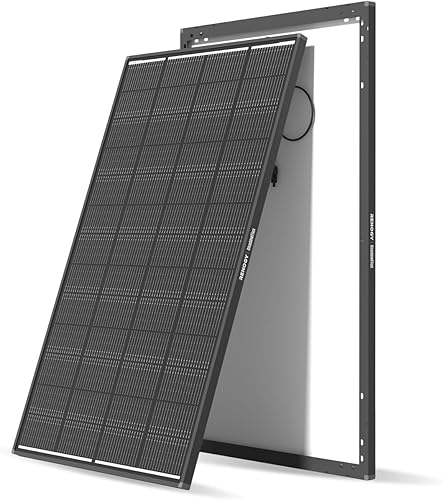 Check it
Renogy ShadowFlux Solar Panel 200 Watt
Best for partial shade - 8
 Check it
RENOGY REGO 200W Portable Solar Panel
Best for simple outdoor portability - 9
 Check it
Renogy Bifacial Solar Panel 1180W N-Type 16BB
Best for large fixed arrays
How we ranked the best Renogy solar panels
Our score weighs specs, features and buyer feedback against what you're shopping for. We gave the highest scores to panels that solve a clear installation need with useful efficiency, output, size or connection options.
A rigid panel makes the most sense for a roof, van, boat or cabin where you can plan a permanent mount. For flexible panels, see how to mount flexible solar panels.
A foldable panel is better when you need to move it between a campsite, vehicle and home backup setup.
The 100W 2PCS set ranks first because it gives you two compact panels, 25% efficiency and IP67 protection. The 400W portable panel follows closely for buyers who want more solar input without a fixed installation.
The starter kit ranks well for beginners because it includes a controller and mounting parts. Its PWM controller makes it less flexible than an MPPT setup, but it reduces the number of separate components you need to select.
Renogy solar panel comparison
| Product | Best for | Power | Dimensions | Output | Our score |
|---|---|---|---|---|---|
| Renogy Solar Panels 100W 2PCS | compact fixed installations | 2 x 100 watts | 34.1 x 22.8 x 1.2 in each | 12V system, 5.31 A | 9.7 |
| Renogy 400W Portable Solar Panel | high-output portable charging | 400 watts | 67.5V maximum, 12.1 A | 9.6 | |
| Renogy 200W Portable Solar Panel for Power | lightweight camping power | 200 watts | 9.6 | ||
| Renogy Solar Panels 200 Watt N-Type | Class B van roofs | 200 watts | 49.7 x 30.1 x 1.2 in | 9.2 | |
| Renogy 100W 12V Solar Panel Starter Kit | a first 12V system | 100 watts | 9.0 | ||
| Renogy 100 Watt Solar Panel N-Type | a single efficient roof panel | 100 watts | 34.1 x 22.8 x 1.2 in | 12V system, 5.31 A | 9.0 |
| Renogy ShadowFlux Solar Panel 200 Watt | partial shade | 200 watts | 49.69 x 30.08 x 1.18 in | 8.9 | |
| RENOGY REGO 200W Portable Solar Panel | simple outdoor portability | 200 watts | 22.99 x 23.84 x 1.77 in | 8.1 | |
| Renogy Bifacial Solar Panel 1180W N-Type 16BB | large fixed arrays | 1180 watts total | 7.9 |
1. Renogy Solar Panels 100W 2PCS: Best for compact fixed installations
Renogy Solar Panels 100W 2PCS: Best for compact fixed installations
- 2 x 100W panels
- 25% conversion efficiency
- 16BB N-Type cells
- IP67 protection
This 2-panel set offers high efficiency in a smaller frame. It suits RV roofs, vans and other fixed installations where you want room to expand.
Pros
- 25% efficiency
- Compact N-Type design
- IP67 protection
Cons
- Rigid panels need a fixed mounting plan
- Controller and battery are separate
The Renogy Solar Panels 100W 2PCS are the best fit for a small fixed array that may grow later. Each panel produces 100 watts, and the pair gives you 200 watts of stated maximum power.
The panels use 16BB N-Type cells with a stated 25% conversion efficiency. Their 34.1 x 22.8 in footprint is smaller than many older 100W designs, which can help when a van roof or RV has vents and roof hardware competing for space.
Renogy gives the panels IP67 protection, low-iron tempered glass and a corrosion-resistant aluminum frame. The panels are rated for a 12V system, with a maximum voltage of 22.79V and an amperage capacity of 5.31 A.
This is a strong choice when you want a fixed array but do not need a complete kit. You will still need a compatible charge controller, battery and properly sized cables.
For a ready-made package, compare the best Renogy solar panel kit.
2. Renogy 400W Portable Solar Panel: Best for high-output portable charging
Renogy 400W Portable Solar Panel: Best for high-output portable charging
- 400W output
- Foldable suitcase design
- 30.2 lb weight
- IP67 protection
The 400W suitcase format gives power-station users more solar input without installing a roof array. It folds into a carry case and includes kickstands.
Pros
- Highest portable output here
- Carry case and kickstands
- IP67 protection
Cons
- Heavier than the 200W portable options
- Adapter cable may be needed
The Renogy 400W Portable Solar Panel is the best portable option when your power station can accept a high solar input. It produces 400 watts and folds to 27.9 x 33.7 x 3.2 in for transport.
At 30.2 lb, it is heavier than the 200W portable models, but the carry case and foldable suitcase design make storage simpler. For more detail, see how to disconnect a suitcase solar panel.
Built-in kickstands help you angle the panel toward the sun without making a permanent mount.
The panel uses fiberglass reinforcement, ETFE coating and Grade A+ monocrystalline cells. It has a stated 23% efficiency, IP67 protection and a maximum voltage of 67.5V.
Compatibility depends on your power station's voltage, current and connector requirements. This panel has MC4 output cables, and a separate adapter may be needed.
Confirm the input limit before connecting it to a power station.
3. Renogy 200W Portable Solar Panel for Power: Best for lightweight camping power
Renogy 200W Portable Solar Panel for Power: Best for lightweight camping power
- 25% efficiency
- 13.89 lb weight
- USB-C PD 45W
- 4 adjustable kickstand angles
This foldable panel is easier to carry than the larger suitcase model and can charge small devices through its built-in USB ports.
Pros
- Lightweight foldable design
- Direct USB charging
- 25% efficiency
Cons
- 4-in-1 adapter sold separately
- Lower output than the 400W model
The Renogy 200W Portable Solar Panel for Power is the better pick when you want useful output without carrying a 30 lb suitcase panel. It weighs 13.89 lb and folds to 23.72 x 22.99 x 1.97 in.
Its 25% efficiency comes from 16BB N-Type cells. Four kickstands give you 40, 50 or 60 degree positioning, while the magnetic closure helps keep the folded panel together during transport.
The built-in USB-C PD port can provide up to 45W, and dual USB-A ports let you charge smaller devices directly. The panel also has MC4 output for compatible power stations.
This format suits camping, RV trips and emergency charging where you may want to charge a phone or laptop without routing power through a separate station. For more detail, see foldable solar panels for RVs.
The 4-in-1 adapter is sold separately for power stations that need one.
If folding panels are your priority, compare this model with our Best Foldable Solar Panel For Camping guide.
4. Renogy Solar Panels 200 Watt N-Type: Best for Class B van roofs
Renogy Solar Panels 200 Watt N-Type: Best for Class B van roofs
- 200W output
- 25% efficiency
- 16BB N-Type cells
- 7.5% smaller than previous models
This rigid 200W panel targets space-limited fixed installations. Its N-Type design and 24V panel designation suit many RV, marine and van systems.
Pros
- 25% efficiency
- 12V and 24V system compatibility
- Compact redesign
Cons
- Requires fixed mounting
- Charge controller must match panel voltage
The Renogy Solar Panels 200 Watt N-Type suit a fixed installation where one larger panel is easier to place than several smaller panels. The panel measures 49.7 x 30.1 x 1.2 in and weighs 23.4 lb.
Renogy states 25% efficiency from 16BB N-Type cells and describes this model as 7.5% smaller and 11.7% lighter than previous models. It is labeled for a 24V system but is compatible with 12V and 24V battery systems when the controller is properly sized.
The panel has a maximum voltage of 37.44V and an amperage capacity of 6.85 A. That voltage matters when choosing a controller, especially if you plan to connect panels in series.
Choose this panel for a Class B van, RV, marine roof or cabin with enough clear mounting area. It is not the best choice when you need a panel you can fold and store after each use.
For a closer look at the 100W format, see Best Renogy 100W Solar Panels.
5. Renogy 100W 12V Solar Panel Starter Kit: Best for a first 12V system
Renogy 100W 12V Solar Panel Starter Kit: Best for a first 12V system
- 100W panel
- 30A PWM controller
- Cables and Z-brackets
- Expandable to 400W
This kit gathers the panel, controller, cables and mounting brackets in one package. It is a practical starting point for a small 12V RV or off-grid setup.
Pros
- Includes controller and mounting parts
- Supports several battery types
- Expandable to 400W
Cons
- PWM controller is less flexible than MPPT
- Starter size may not cover large loads
The Renogy 100W 12V Solar Panel Starter Kit is the easiest starting point for a small 12V battery system because it includes the panel, 30A PWM controller, cables and Z-brackets.
Renogy states that the panel has 22.5% cell efficiency and can support expansion to 400W with additional panels. The kit supports AGM, Gel, Flooded and Lithium batteries, so you have several battery chemistry options.
The included Wanderer controller has an RS232 Bluetooth port. Adding Renogy's BT-1 module enables remote monitoring through the DC Home app, according to the product information.
This kit is useful when you want the main parts in one package. A PWM controller may not offer the same efficiency and voltage flexibility as MPPT, so compare the controller with your planned panel arrangement and battery.
Before buying a battery, read How to Choose a Battery for Renogy Solar Panels. For installation planning, use How to Install a Renogy Solar Panel Kit.
6. Renogy 100 Watt Solar Panel N-Type: Best for a single efficient roof panel
Renogy 100 Watt Solar Panel N-Type: Best for a single efficient roof panel
- 25% efficiency
- 16BB N-Type cells
- IP67 protection
- Low temperature coefficient
This single 100W rigid panel offers the same compact format as the 2-panel set. Choose it when you want to start with one panel and add capacity later.
Pros
- 25% efficiency
- Compact dimensions
- IP67 protection
Cons
- Controller and cables are separate
- One panel gives less output than a 2-panel set
The Renogy 100 Watt Solar Panel N-Type is the right starting point when you want one compact fixed panel instead of a 2-panel set. It measures 34.1 x 22.8 x 1.2 in and weighs 13 lb.
The panel uses 16BB N-Type cells and has a stated 25% conversion efficiency. Its maximum voltage is 22.79V, and its amperage capacity is 5.31 A.
IP67 protection, low-iron tempered glass and a corrosion-resistant aluminum frame support outdoor roof, marine and off-grid use. Renogy also describes a low temperature coefficient for improved output in hot conditions.
Choose this model when your current load is modest or when you plan to add a second panel later. The panel does not include a controller, battery or mounting kit, so budget space and compatibility for those parts.
7. Renogy ShadowFlux Solar Panel 200 Watt: Best for partial shade
Renogy ShadowFlux Solar Panel 200 Watt: Best for partial shade
- ShadowFlux anti-shading technology
- 25% efficiency
- 16BB N-Type cells
- IP67 or higher protection
ShadowFlux is the specialist choice for installations that face leaves, rigging, buildings or other small shaded areas. It works with 12V and 24V battery systems when paired with a suitable controller.
Pros
- Designed for partial shade
- 25% efficiency
- Works with 12V and 24V systems
Cons
- MPPT controller is recommended
- Fixed panel requires mounting space
The Renogy ShadowFlux Solar Panel 200 Watt is the specialist choice for roofs and outdoor sites where leaves, rigging, buildings or other objects create small shaded areas.
Its ShadowFlux technology is designed to reduce power loss in common partial-shading conditions. The panel also uses 16BB N-Type cells with a stated 25% efficiency and a maximum voltage of 36.5V.
Renogy describes the panel as compatible with both 12V and 24V battery systems. For ShadowFlux, an MPPT controller is recommended with at least 50V maximum input voltage and charging current above 10A.
The 49.69 x 30.08 x 1.18 in rigid panel needs a fixed mount. Keep more than half of the panel in direct sunlight for the best result, and remember that no anti-shading design removes the need for sensible panel placement.
Use How to Size a Fuse for Renogy Solar Panels when planning circuit protection.
8. RENOGY REGO 200W Portable Solar Panel: Best for simple outdoor portability
RENOGY REGO 200W Portable Solar Panel: Best for simple outdoor portability
- 200W foldable panel
- 23.5% efficiency
- USB-C PD 45W
- IP65 protection
The REGO gives campers a foldable 200W option with direct USB charging and mounting holes. It is best for outdoor use where portability matters more than maximum weather protection.
Pros
- Foldable and lightweight
- Direct USB charging
- Mounting holes and magnetic closure
Cons
- IP65 is below the IP67 portable model
- Adapter cable may be needed
The RENOGY REGO 200W Portable Solar Panel gives campers a foldable 200W option with USB charging and mounting holes. It uses Grade A solar cells and ETFE material for a stated maximum conversion efficiency of 23.5%.
USB-C PD up to 45W and dual USB-A ports let you charge several smaller devices directly. The panel also has MC4 output for compatible power stations and 12V battery systems paired with a suitable controller.
The REGO folds with magnetic closure, buckles and Velcro straps. Four mounting holes can help you attach it to a vehicle, RV or another outdoor surface, but it is not a substitute for a permanent rigid roof panel.
Its IP65 rating is suitable for splashes and dust, but avoid prolonged soaking or heavy rain. Choose the REGO when easy carrying and direct device charging matter more than the IP67 protection of the other portable models.
9. Renogy Bifacial Solar Panel 1180W N-Type 16BB: Best for large fixed arrays
Renogy Bifacial Solar Panel 1180W N-Type 16BB: Best for large fixed arrays
- 2 x 590W panels
- 1180W combined output
- Bifacial design
- IP68 junction box
This 2-panel set is for large roof, ground or off-grid installations with room for full-size rigid modules. Its transparent backsheet can collect light from both sides.
Pros
- Highest total output here
- Bifacial design
- IP68 junction box
Cons
- Large and heavy panels
- Needs a larger mounting system
The Renogy Bifacial Solar Panel 1180W N-Type 16BB is designed for a large fixed array rather than a small RV or portable setup. The package contains 2 panels rated at 590W each, for 1180W of stated maximum power.
The transparent backsheet allows both sides of each panel to collect light. Renogy says the bifacial design can increase energy production by 5% to 30%, but the result depends on the surface below the panels, light direction and installation spacing.
Each panel measures 44.6 x 89.7 x 1.4 in and weighs 58.4 lb. The black aluminum frame is rated for 2400Pa wind loads and 5400Pa snow loads, while the junction box has IP68 protection.
This set makes sense for a home, farm, cabin or large off-grid array with a suitable racking system. It is too large for most portable applications, and you must size the controller, wiring and battery bank for the array's higher output.
How do you choose between Renogy rigid and portable panels?
Choose rigid Renogy panels for permanent RV, van, boat, cabin or home installations. They offer fixed dimensions and a stable mounting plan, but they need brackets, wiring and a controller that remain installed.
Choose portable Renogy panels when you move between campsites or want temporary home backup charging. The 200W portable panel is easier to carry, while the 400W suitcase provides more input but weighs 30.2 lb.
A flexible solar panel Renogy option may suit a curved surface or a setup where rigid glass panels are difficult to mount. Check the exact construction and installation instructions before using a flexible solar panel on a roof, since mounting and ventilation can affect long-term use.
How much Renogy solar power do you need?
Start with your daily watt-hour use, then account for sunlight, shading, battery capacity and controller limits. A 100W panel is a small starting point, while 200W gives more charging capacity for an RV, van or cabin.
For a portable power station, compare the panel's maximum voltage and current with the station's solar input range. A higher-wattage panel is not automatically better if the station cannot accept its voltage or current.
For a battery system, match panel output to the battery bank and charge controller. Our guide to How to Connect Renogy Solar Panels explains the difference between series and parallel wiring.
What cables and protection do Renogy panels need?
Renogy panels need correctly sized solar cables, connectors, overcurrent protection and a charge controller when connected to batteries. MC4 and solar connector systems must be joined with compatible parts, and adapters should match the equipment's voltage and current limits.
A fuse or breaker protects wiring from excessive current. Use our guide to the best Renogy solar panel wires when choosing cable size, and follow the Renogy solar panel fuse guide for protection planning.
Do not assume every portable panel connects directly to every power station. Check the station input range, connector type and adapter requirements before plugging in the panel.
Why is a Renogy solar panel producing less power?
Lower output can result from cloud, indirect sunlight, heat, shading, dirt, cable length or the connected battery and controller reaching their limits. A panel's watt rating is measured under standard test conditions, so actual output changes throughout the day.
Start by checking the panel surface, cable connections and shade. Confirm that the battery is able to accept charge and that the controller or power station is not limiting the input.
For a step-by-step check, read How to Troubleshoot Renogy Solar Panels. Clean the panel safely and inspect connectors without submerging them or using damaged cables.
Final verdict on the best Renogy solar panels
The Renogy Solar Panels 100W 2PCS are the best overall choice for a compact fixed installation because they combine 200W of total output, 25% efficiency and a space-saving format.
Pick the 400W Portable Solar Panel if your power station accepts its input and you want the most portable output. Pick the 200W Portable Solar Panel for Power for lighter camping gear, the ShadowFlux 200W for partial shade, or the 1180W bifacial set for a large permanent array.
For a first 12V system, choose the starter kit. For a single roof panel, choose the 100W N-Type model.
Recheck your battery, controller, cable and mounting requirements before ordering.
Our top 3 picks at a glance
-
1
-
2
Best for high-output portable charging
Renogy 400W Portable Solar Panel
9.6/10 our score
See it on Amazon -
3
Best for lightweight camping power
Renogy 200W Portable Solar Panel for Power
9.6/10 our score
See it on Amazon
Frequently asked questions
What are the best Renogy solar panels for an RV?
The best Renogy solar panels for an RV depend on roof space and whether you need portability. The 100W 2PCS set suits compact fixed arrays, while the 200W N-Type panel fits buyers who want one larger rigid panel.
A foldable 200W or 400W panel works better when you park in different locations and do not want permanent mounting.
Are Renogy flexible solar panels better than rigid panels?
Renogy flexible solar panels can help when a curved or weight-sensitive surface makes rigid glass panels difficult to mount. Rigid panels are usually easier to compare by frame size, use tempered glass and aluminum construction, and suit permanent roofs.
Check the exact panel construction, mounting method and ventilation needs before choosing a flexible solar panel Renogy model.
What size Renogy solar panel should I buy?
Choose a Renogy solar panel size from your daily watt-hour needs, roof area and battery voltage. A 100W panel suits a small starter setup, 200W adds more charging headroom, and the 400W portable model targets power stations.
For large fixed systems, the 1180W bifacial set needs much more mounting space and compatible equipment.
Can Renogy solar panels charge a portable power station?
Yes, portable Renogy solar panels can charge compatible power stations when voltage, current and connectors match. The 200W and 400W portable models use MC4 output, and some systems need a separate adapter.
Read our guide on Can You Add Solar Panels to Any Portable Power Station? before connecting equipment.
Do Renogy solar panels need a charge controller?
A Renogy panel connected to a battery normally needs a correctly sized charge controller. The 100W starter kit includes a 30A PWM controller, while other panels require a separate controller.
An MPPT controller is recommended for ShadowFlux, and every controller must stay within the panel array's voltage and current limits.


