Can Portable Solar Panels Charge an Electric Car?
A portable solar panel can help charge an electric car, but one panel usually cannot charge an EV directly or quickly. You need suitable solar output, a charge controller or power station, compatible cables, and enough sunlight.
On this page (7 sections)
- Can a portable solar panel charge an EV?
- What equipment does portable solar EV charging require?
- Why is a portable solar panel EV charger so slow?
- Which portable solar panel suits a battery-based setup?
- How should you compare panels for an EV support system?
- How do you set up portable solar EV charging safely?
- Can portable solar charging replace an EV charger?
A portable solar panel can help charge an electric car, but a single panel usually cannot charge an EV directly or at a useful speed. For a vehicle-mounted option, compare flexible solar panels for car roofs.
You need a solar array, charge control, a battery or power station in many setups, compatible cables, and enough clear sunlight.
The main limit is power. A 100W panel produces only a small fraction of the power used by a standard EV charger, and its output changes with sun angle, clouds, shade, temperature, and panel position.
Can a portable solar panel charge an EV?
Yes, but usually as part of a larger system rather than as a panel-to-car connection. The panel produces variable direct-current power, while an EV charging system must manage voltage, current, grounding, and communication with the vehicle.
A practical setup often follows this path:
- Portable solar panels collect sunlight.
- A charge controller manages the solar input.
- A battery or portable power station stores energy.
- An EV charger transfers that stored energy to the car.
A direct connection between a small panel and an EV is not a normal charging method. The panel's output may be too low or unstable, and the car's charging equipment may not accept it.
For a broader look at panel choices, see our guide to which solar panel is best.
What equipment does portable solar EV charging require?
Portable solar EV charging needs more than a panel and a cable. The system must match the panel voltage, controller input, battery voltage, power station limits, and EV charging equipment.
You may need:
- A portable solar panel array
- A compatible solar charge controller
- A battery bank or portable power station
- Correct solar connectors and cable sizes
- An EVSE, if the battery system supplies AC power
- A suitable vehicle charging cable
- Weather-safe placement and dry connections
The battery or power station is often the key middle step. It lets solar energy build over time instead of sending changing panel output straight to the vehicle.
Read the input limit on the battery system before connecting panels. A panel rated at 100W cannot force a power station to accept more than its input limit, and a station with a low output limit cannot deliver normal home-charger power.
Why is a portable solar panel EV charger so slow?
A portable solar panel EV charger is slow because portable panels produce limited power and EV batteries are large. A 100W panel can collect useful energy for small devices, but an EV needs far more for meaningful driving range.
Panel output also drops outside strong direct sunlight. Dust, shade, cloud, poor angle, and heat all reduce collection.
The battery system adds conversion losses, and the charger uses some power while managing the charge.
This makes portable solar more practical for:
- Adding a small amount of energy during an emergency
- Charging a battery system over several hours or days
- Supporting an EV trip when no grid power is available
- Running small accessories near a vehicle
- Learning how much energy your location can collect
It is less practical for quickly filling an EV after a long drive. A home charger, public station, or vehicle generator usually gives more predictable power.
Which portable solar panel suits a battery-based setup?
A portable panel for an EV support system should match the battery or power station's input requirements. Look at maximum solar voltage, accepted connector type, input wattage, and whether the panel is fixed or foldable.
Is a 100W panel useful for portable solar EV charging?
A 100W panel can help collect energy for a compatible power station, but it is still a slow source for an electric car. Its value is portability and flexible placement, not fast EV charging.
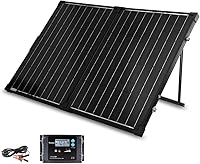
The ZOUPW 100W Portable Solar Panel for Power has 23.5% efficiency, a foldable design, an IP67 waterproof panel body, and a 5-in-1 connector cable. The cable includes DC8020, XT60, Anderson, DC7909, and DC5521 connectors, which can suit compatible power stations from brands and models named in its product information.
It weighs 9.5 lb and folds to 24.13 x 21.06 x 1.77 in. Two adjustable kickstands can help position it toward the sun, while the included 10 ft cable gives more room between the panel and power station.
The panel has a maximum power of 100W and a maximum voltage of 24.3V. Its built-in USB hub includes 1 USB-C port and 2 USB-A ports for direct device charging, but the product information warns that the USB hub and connection cables are not fully waterproof.
Check the power station's solar input limit first. If the station accepts only 60W, this 100W panel will not make it charge at 100W.
Is a 20W panel enough to charge an EV?
A 20W panel is not enough for practical EV charging, but it can suit small 12V battery maintenance. Its lower output makes it a poor match for an EV battery and a better match for a compatible 12V rechargeable battery system.
The SOLPERK Solar Panel Kit 20W 12V Solar includes a 20W monocrystalline panel, a smart 10A MPPT charge controller, an adjustable mounting bracket, an alligator clip, an O-ring, and mounting accessories.
The kit is designed for 12V rechargeable batteries, including LiFePO₄, lithium-ion, AGM, SLA, GEL, EFB, and MF types. Its 10A controller uses a 3-stage charging design and includes protection against overcharging, over-voltage, and short circuits.
The panel has a low-iron tempered glass surface and corrosion-resistant aluminum frame. Its maximum power is 20W, and its connector type is SAE.
The 360° adjustable bracket can help you aim the panel toward the sun.
This kit may help maintain a separate 12V vehicle battery, but that is different from charging an EV's high-voltage traction battery. Use the battery type and controller instructions as the boundary for safe use.
Can a 5W solar panel charge an EV?
No, a 5W panel is far too small for practical EV charging. It is designed for a narrow 5V use case, such as compatible rechargeable security cameras, not electric cars.
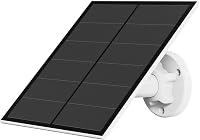
The YCTechCam 5W Solar Panel for Security Camera has a 5W monocrystalline panel, a Micro USB port, a USB-C port, a 360° adjustable wall bracket, a screws bag, a USB-C port adapter, and a manual.
Its maximum voltage and output voltage are 5V. The panel measures 7.28 x 6.5 x 0.6 in and weighs 7.84 oz, with a 9.8 ft cable.
The product is compatible with most DC 5V battery-powered cameras that use Micro USB or USB-C ports. It is not compatible with Arlo, Blink, Ring, Eufy, Google Nest, or Kasa cameras, and it cannot charge cell phones.
This product shows why connector shape alone is not enough. A USB-C port does not make a solar panel suitable for an EV, because voltage, power, charging control, and device compatibility all matter.
How should you compare panels for an EV support system?
Choose the panel by the power station or battery input first, then compare portability and weather handling. For another portable option, compare Anker solar panels.
The highest wattage is not automatically best if the system cannot accept its voltage or connector.
Check these points:
- Solar input range: The panel must stay within the device voltage limits.
- Maximum input wattage: A power station may limit how much output it can use.
- Connectors: Match the connector and polarity before connecting.
- Portability: Foldable panels move easily, while framed panels suit fixed placement.
- Weather protection: A waterproof panel body does not mean every controller, hub, or cable can stay wet.
- Sun access: Clear, unshaded placement matters more than the headline rating.
- Storage capacity: A larger battery stores more, but takes longer to fill.
If you are comparing panel construction, read which solar panel type is better. For small low-power charging, see best dashboard solar panels for trickle charging.
How do you set up portable solar EV charging safely?
Place the panel in clear sun, keep connections protected, and connect only equipment with matching electrical limits. Start with the power station or battery instructions, then confirm panel voltage and connector before plugging it in.
Keep the panel stable and reposition it as the sun moves. Avoid shade from the vehicle, trees, roof racks, and nearby equipment.
Do not leave exposed connections in standing water. The ZOUPW panel body is rated IP67, but its USB hub and cables still need protection from moisture.
Do not connect a small 5V or 12V panel directly to an EV high voltage charging system. For emergency vehicle energy, use a system designed for that vehicle and follow the car and charger instructions.
For another battery approach, see can you charge an EV with a portable power station. You can also learn how solar input works with storage in can you charge a portable power station with solar panels.
Can portable solar charging replace an EV charger?
Portable solar charging usually supplements an EV charger rather than replacing it. It makes the most sense when you want limited off-grid energy and have enough time, sunlight, storage, and compatible equipment.
Choose the ZOUPW 100W panel if you need a portable panel for a compatible power station. Choose the SOLPERK 20W kit for maintaining a compatible 12V battery.
Choose the YCTechCam 5W panel only for its stated 5V rechargeable-camera use.
For vehicle mobility equipment that uses smaller batteries, our guide to solar panels for electric wheelchairs may be a closer match. For an EV, confirm the full charging path before buying any panel.
Portable solar EV charging is possible, but the useful question is not only whether sunlight can reach the car. It is whether the complete system can safely turn that sunlight into compatible, stored charging power.
Frequently asked questions
Can a portable solar panel charge an electric car directly?
Usually, no. An EV needs a controlled charging connection with the correct voltage, current, and safety communication.
A portable panel's changing output is not the same as a dedicated EV charger.
Solar panels normally feed a battery system or power station, which then supplies the car through equipment designed for EV charging.
How many portable solar panels are needed to charge an EV?
The number depends on the car's battery size, charge efficiency, sunlight, and the panels' real output. A 100W panel produces far less than a home EV charger, so one panel is better suited to slow energy collection through a battery system than routine direct charging.
Several panels still need compatible control equipment.
Can a portable power station charge an electric vehicle?
Some large portable power stations can charge an EV slowly if they have enough stored energy, a suitable AC output, and the correct charging connection. The station must support the car's charging equipment, and its battery will drain quickly.
See the station's output limits before connecting an EV.
Is solar EV charging useful during a power outage?
It can provide limited backup energy when paired with a suitable battery system, but it may not replace normal EV charging. Cloud, shade, panel position, battery losses, and the car's charging requirements all reduce usable energy.
Treat portable solar as an emergency or supplemental option unless the system is designed for EV charging.